


I remember staring at my screen in late 2022, watching the GBP/NGN rate climb past 720.

Olumide Adeyemi
West African Trading Pioneer ·  Nigeria
☕ 10 min read
What you'll learn:
- 1What Is Forex, Really? (It's Not Magic)
- 2Brokers, Platforms, and the Nigerian Reality
- 3The Jargon: Pips, Lots, and That Double-Edged Sword Called use
- 4Risk Management: The Only Non-Negotiable Skill
- 5Making Sense of the Charts: Analysis Basics
- 6Common Scams & Pitfalls for Nigerian Beginners
- 7Your First Steps: A 30-Day Action Plan
I remember staring at my screen in late 2022, watching the GBP/NGN rate climb past 720. I had a small position, and the profit was real. But I hesitated, thinking it would go higher. It didn't. It reversed hard, and I watched my profit evaporate before closing for a tiny gain. That moment, more than any win, taught me the first basic thing to know about forex trading: it's not about predicting the future, it's about managing your present risk. Let's break down what you actually need to understand before you put your first Naira on the line.
Forex, or foreign exchange, is simply the global marketplace for trading national currencies against one another. When you trade forex, you're always buying one currency and selling another simultaneously. The price, like EUR/USD = 1.0850, tells you how much of the second currency (USD) you need to buy one unit of the first (EUR).
For us in Nigeria, this has a very practical side. You see it when your auntie needs dollars for school fees abroad and checks the black-market rate. That's a form of currency exchange. Trading it online is just a more formal, leveraged version of speculating on those price movements. The core idea is simple: you profit if the currency you buy increases in value relative to the one you sold.

Warning: A lot of 'gurus' make this sound like a secret money code. It's not. It's a zero-sum game. For you to win, someone else has to lose. Understanding that from day one keeps you humble and careful.
The market is massive and decentralized, trading 24 hours a day during the week. Major sessions in London, New York, and Tokyo create the most activity. For Nigerian traders, the London session (8 AM to 5 PM our time) is often the most volatile and best for opportunities, especially on pairs like GBP/USD or EUR/USD.
I made my first real profit trading USD/JPY. I bought at 113.50 and sold at 114.10. That 60-pip move netted me about $45 on a mini lot. The thrill was real, but so was the lesson: I had no idea why it moved. I just got lucky. Which brings us to the next basic thing you need to know.
“Forex trading isn't about predicting the future, it's about managing your present risk.”
You can't trade forex directly. You need a broker. This is where many Nigerians get tripped up by slick marketing. You'll see ads promising instant withdrawals in Naira and 'no loss' guarantees. Run from those.
A legitimate broker is a regulated intermediary. For us, the key is finding one that accepts Nigerian clients, offers convenient deposit/withdrawal methods (like bank transfers or local payment processors), and has a solid reputation. International brokers like Exness, IC Markets, and XM are popular choices here because they've built that local bridge.
The Deposit & Withdrawal Dance
You'll typically fund your account in USD, EUR, or GBP. Your broker converts your Naira deposit. When you profit and withdraw, they send foreign currency, which your bank converts back to Naira. This process can take a few days and sometimes involves questions from your bank. Always keep records of all transactions.
The Trading Platform
Your battlefield is the trading platform. MetaTrader 4 (MT4) or MetaTrader 5 (MT5) are the global standards. They look complex at first - all those charts and numbers - but you'll get used to them. This is where you'll place orders, set stop losses, and analyze prices. Before you trade live, spend a week just clicking around a demo account. Learn how to place a market order, set a limit order, and most importantly, how to set a stop-loss. A flawed understanding of your platform's order types is a direct path to an avoidable loss.

💡 Winston's Tip
Your first profitable month on a demo account means nothing. Your first profitable month on a live account, trading with real fear and greed, is when the real learning begins.
“You can be wrong about the market direction 60% of the time and still be profitable if your risk management is strict.”
Let's demystify the language.
- A Pip: This is how price movement is measured. For most pairs, it's the fourth decimal place. If EUR/USD moves from 1.0850 to 1.0851, it moved 1 pip. For pairs involving the Japanese Yen, it's the second decimal place.
- A Lot: This is the standard trade size. One standard lot is 100,000 units of currency. That's huge for most of us. Thankfully, you can trade mini lots (10,000 units), micro lots (1,000 units), and even nano lots (100 units). Start with micro lots. Always.
- use: This is borrowed capital from your broker. It's expressed as a ratio like 1:100 or 1:500. If you have $100 and use 1:100 use, you can control a $10,000 position. It magnifies both gains and losses.

Example: You buy 1 micro lot (0.01) of EUR/USD at 1.0850. The price rises to 1.0900, a 50-pip move. With a micro lot, each pip is worth roughly $0.10 (this varies slightly). Your profit would be 50 pips * $0.10 = $5. On a $100 account, that's a 5% gain. Not get-rich-quick, but sustainable.
Here’s my painful use lesson. Early on, I used 1:500 use on a $200 account. I opened a trade that used most of my margin. A small 20-pip move against me triggered a margin call. I lost over 30% of my account in minutes. use isn't your friend when you're learning. It's a dangerous tool. I now rarely use more than 1:30, even on a larger account. Treat high use like a powerful generator: useful if you know exactly what you're doing, but capable of burning your house down.
“You can be wrong about the market direction 60% of the time and still be profitable if your risk management is strict.”
This is the core of all the basic things to know about forex trading. You can be wrong about the market direction 60% of the time and still be profitable if your risk management is strict.
The 1% Rule: Never risk more than 1% of your trading account capital on a single trade. If you have a 100,000 Naira account (about $65), your max risk per trade is 1,000 Naira. This rule alone will keep you in the game long enough to learn.
Always Use a Stop-Loss (SL): This is an order that automatically closes your trade at a predetermined loss level. It's your lifeline. Not using one is like driving without a seatbelt. Decide your stop-loss distance before you enter the trade, based on your chart analysis, not on how much you're willing to lose.
Take Profit (TP): Similarly, have a target. Greed makes you hold winners too long until they turn into losers. A take-profit order locks in your gains.
I use a simple position size calculator for every single trade. I input my account balance, my risk percentage (1%), my entry price, and my stop-loss price. It tells me exactly how many lots to trade. This removes emotion. One of my best trades last year was a short on Gold (XAU/USD) from $1985 with a stop at $1995. The calculator told me to trade 0.15 lots. I took profit at $1950. The risk was $100, the reward was $525. That 5:1 reward-to-risk setup worked because the math was decided upfront.
💡 Winston's Tip
The spread isn't just a cost; it's the house edge. Trading highly volatile, exotic pairs with wide spreads is like playing a rigged game. Stick to majors like EUR/USD where the edge is smallest.
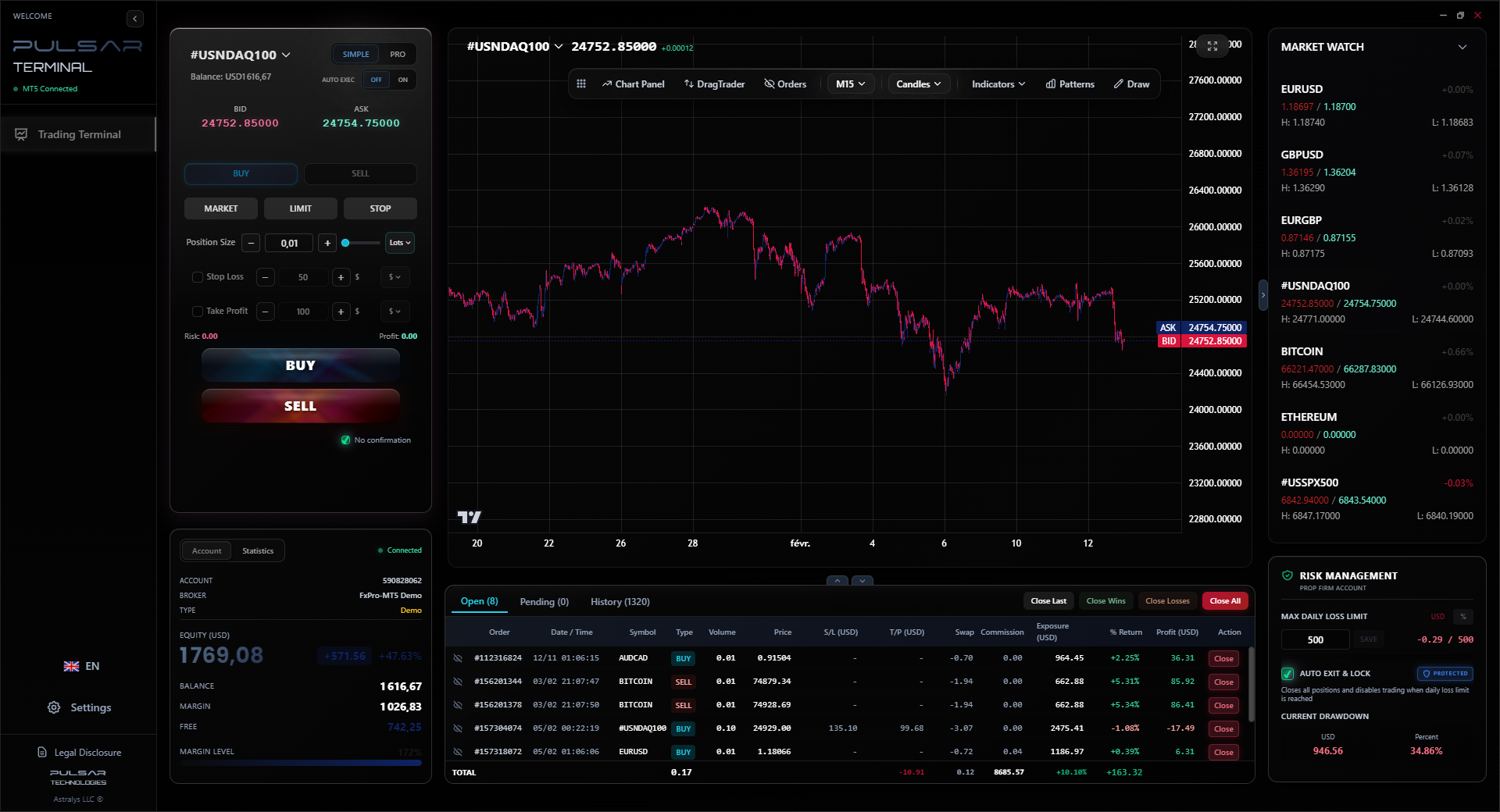
Manually calculating position size for every trade is tedious, but tools like Pulsar Terminal can automate this and your stop-loss placement directly on your MT5 chart.
Pulsar Terminal
The all-in-one MT5 companion: drag-and-drop orders, multi-TP/SL, trailing stop, grid trading, Volume Profile, and prop firm protection. Used by 1,000+ traders daily.
“A flawed understanding of your platform's order types is a direct path to an avoidable loss.”
You need a method to decide when to buy or sell. There are two main schools of thought, and most successful traders blend them.
Technical Analysis: This studies past price action to forecast future movement. You're looking at charts, patterns, and indicators. Start with these three concepts:
- Support & Resistance: Price levels where the market repeatedly reverses. Think of them as floors and ceilings.
- Trend: Is the overall price movement up, down, or sideways? 'The trend is your friend' is a cliché because it's often true.
- Simple Indicators: Tools like the RSI indicator (to spot overbought/oversold conditions) or the MACD indicator (to gauge momentum). Don't overload your chart. Two or three are plenty.
Fundamental Analysis: This looks at economic factors that affect a currency's value: interest rate decisions, inflation reports (like Nigeria's CPI), employment data, and political events. For a Nigerian trading GBP/USD, the Bank of England's interest rate decision is more important than the CBN's for that specific trade.
My approach? I use technicals for timing my entry and exit. But I check the economic calendar to make sure I'm not trading blind into a major news event that could cause a chaotic spike. I lost two weeks' profits in 10 seconds once trading during a US Non-Farm Payroll announcement. Now, I simply don't trade during high-impact news releases for that currency.
“A flawed understanding of your platform's order types is a direct path to an avoidable loss.”
The forex space in Nigeria is, unfortunately, fertile ground for predators. Protect yourself.
- The Signal Seller Guru: The person on Instagram with pictures of luxury cars, claiming to sell 'surefire' signals for a monthly fee. If their system was so surefire, why would they need your 20k Naira subscription? They are salesmen, not traders.
- The Account Manager: Someone who offers to trade your account for you, promising 20-50% monthly returns. This often ends in one of two ways: they blow up your account through reckless trading, or it's a straight-up Ponzi scheme where your 'profits' are just other people's deposits.
- The Unregulated 'Local' Broker: Entities promising instant Naira deposits/withdrawals and crazy bonuses. They are often unregulated and can disappear with client funds. Stick with established, internationally regulated brokers that have a clear track record with Nigerian clients.
- The Get-Rich-Quick Mentality: This is the internal pitfall. Forex is a skill, not a lottery. Expecting to turn 50k Naira into 5 million in a month is a fantasy that will destroy your capital. Aim for consistent, small gains. A 5-10% return per month is exceptional. Compounded over a year, that changes your life.

Pro Tip: The best investment you can make in your first year is not in a signal group, but in a few good books on trading psychology and risk management. That knowledge stays with you forever.
💡 Winston's Tip
When you're tempted to move your stop-loss further away 'to give the trade room,' you're not managing the trade. You're refusing to accept you were wrong. Close it, or stick to the original plan. There is no third option.
“The best investment you can make in your first year is in books on trading psychology, not a signal group.”
Okay, let's get you started without losing money.
Weeks 1-2: Education & Paper Trading
- Open a free demo account with a broker like Pepperstone or IC Markets. Get $10,000 or $50,000 in virtual money.
- Download MT5 and learn the interface. Practice buying and selling.
- Pick ONE major currency pair. I suggest EUR/USD. It's the most liquid and has plenty of free analysis available.
- Watch it every day during the London session. Don't trade yet. Just watch how it moves.
Weeks 3-4: Develop a Simple Rule
- Learn one simple scalping strategy or swing trading method. Just one.
- On your demo account, practice only that method. Your goal is not profit, but consistency in following your rules.
- For every trade, write down: Entry reason, entry price, stop-loss price, take-profit price, position size, and the outcome. Review your journal weekly.
Going Live (Only After 30 Days)
- Fund a live account with money you can afford to lose completely. Start small. 50,000 Naira is a sensible start.
- Trade micro lots (0.01). Your goal for the first three months is to break even or make a small profit while perfecting your discipline.
- Withdraw your first profit. Even if it's just 5,000 Naira. Getting real money back into your bank account is a psychological milestone that proves this is real.
The basic things to know about forex trading boil down to this: it's a business of probabilities and self-control. The market will humble you. Your job is to be humble enough to listen, disciplined enough to follow your rules, and patient enough to let your edge play out over hundreds of trades, not just one.
FAQ
Q1How much money do I need to start forex trading in Nigeria?
You can start with as little as $50 (about 75,000 Naira) with some brokers offering micro and nano accounts. However, I strongly advise starting with at least $200-300 (150k-230k Naira). This gives you enough buffer to trade micro lots comfortably and absorb initial learning losses without a single bad trade wiping you out. Your starting capital should be money you are 100% prepared to lose.
Q2Is forex trading legal in Nigeria?
Trading forex with international, offshore brokers is a legal grey area for individuals. The Central Bank of Nigeria (CBN) has regulations restricting forex trading for banks and BDCs, but individuals trading online with their personal funds are generally not prosecuted. The key risk isn't legality, but security. You have no CBN protection if an unregulated broker scams you. That's why using reputable, internationally regulated brokers is critical.
Q3What is the best time to trade forex in Nigeria?
The most active and volatile times are during the overlap of major market sessions. For Nigeria (WAT), this is: London Session (8:00 AM - 5:00 PM WAT) and the London/New York Overlap (1:00 PM - 5:00 PM WAT). This is when you'll see the most movement on major pairs like EUR/USD and GBP/USD, which is good for opportunities but also higher risk.
Q4Can I make a living from forex trading in Nigeria?
It's possible, but extremely difficult and should not be your initial goal. To even consider it, you need a proven, consistent track record over 1-2 years, a significant trading capital (I'd say at least $10,000 or 15 million Naira to generate meaningful income), and immense psychological discipline. Treat it as a side skill first. Aim for consistent supplemental income before even thinking about replacing your job.
Q5What's the difference between a demo account and a live account?
A demo account uses virtual money. A live account uses your real money. This is the single biggest difference in trading. On a demo, a 50-pip loss is a number. On a live account, it's rent money or school fees. The emotional pressure changes everything. That's why you must master your strategy and emotions on demo first, but understand that live trading will feel completely different. Start with tiny position sizes when you go live.
Q6How do I avoid forex scams in Nigeria?
Follow these rules: 1) Avoid anyone guaranteeing profits or selling 'secret' signals. 2) Never give your money to an 'account manager'. 3) Only use well-known, internationally regulated brokers with a long history (check our broker reviews). 4) Be wary of local platforms offering unbelievable bonuses. 5) If it sounds too good to be true (e.g., 'double your money in a week'), it is a scam.
Prof. Winston's Lesson
Key Takeaways:
- ✓Never risk more than 1% of your capital per trade.
- ✓use above 1:30 is a hazard for new traders.
- ✓Always use a stop-loss. No exceptions.
- ✓Master one currency pair before adding others.
- ✓Journal every trade to learn from mistakes.
How useful was this article?
Click a star to rate
Weekly Trading Insights
Free weekly analysis & strategies. No spam.
About the Author
Olumide Adeyemi
West African Trading Pioneer
One of Nigeria's most active forex trading educators. 8 years of experience trading from Lagos. Specializes in low-capital strategies and prop firm challenges for African traders.
Comments
Risk Disclaimer
Trading financial instruments carries significant risk and may not be suitable for all investors. Past performance does not guarantee future results. This content is for educational purposes only and should not be considered investment advice. Always conduct your own research before trading.
You Might Also Like

Cara Trading Forex Sukses: 7 Prinsip dari Trader Profesional
Cara trading forex sukses dengan 7 prinsip trader pro: manajemen modal, disiplin, journal trading, backtest. Data nyata, bukan janji profit palsu.
Jam Trading Forex Terbaik untuk Trader Indonesia: Panduan Lengkap dengan Tabel Waktu
Panduan jam trading forex untuk trader Indonesia. Tabel 4 sesi dunia, jam emas 20:00-00:00, sesi mana yang harus dihindari. Data akurat + tips dari trader berpengalaman.
Top 5 Sàn Forex Uy Tín Nhất 2026: Review Jujur dari Trader Indonesia
Top 5 sàn forex uy tín 2026 untuk trader Indonesia. Review jujur: spread, deposit, withdraw, dukungan lokal. Exness, XM, IC Markets & lebih.
Get Pulsar Terminal
All these calculators are built into Pulsar Terminal with real-time data from your MT5 account. One-click position sizing, automatic risk management, and instant calculations.
Get Pulsar Terminal