


I once paid $1,200 for a 'mentorship' from a guy in Singapore who promised a secret scalping system.
James Mitchell
Senior Trading Analyst
☕ 10 min read
What you'll learn:
- 1Why a Malaysian Mentor Will Get You Fined or Wiped Out
- 2The US Rulebook: Your Non-Negotiable Trading Environment
- 3Forget the Hype: Real Brokers, Real Numbers for the US
- 4So Where Do You Actually Learn? (Legally)
- 5Building a Strategy That Works on a US Platform
- 6Red Flags: How to Spot Advice That Will Get You in Trouble
- 7Your Action Plan: Forget Malaysia, Build Here
I once paid $1,200 for a 'mentorship' from a guy in Singapore who promised a secret scalping system. He taught me to trade GBP/JPY with 200:1 use on an offshore broker. I made $3,800 in two weeks. Then I lost $12,000 in one morning when volatility spiked and my broker's 'liquidity' vanished. That loss wasn't just bad luck; it was a lesson in jurisdiction. If you're in the US and googling 'best Asia forex trading mentor Malaysia,' you're about to make the same expensive mistake I did. Their advice is legally incompatible with your reality.
Let's be blunt: the 'best Asia forex trading mentor Malaysia' has zero business advising a US resident. It's not about their skill; it's about the law. They operate in a completely different regulatory universe.
Malaysian mentors teach strategies built for brokers offering 500:1 use, hedging, and no FIFO rule. Try using those tactics on a US-regulated platform like FOREX.com or OANDA, and you'll hit a brick wall. Your trades will be rejected, or worse, you'll be forced into a strategy that doesn't fit the rules.

Warning: Following non-US trading advice is like using a UK driver's manual to pass a test in Texas. The core concepts might be similar, but the specific rules will fail you.
I learned this the hard way. My Singapore mentor's 'grid trading' system required placing 10-15 pending orders at once. On my US account, the platform flagged it as potentially abusive order flow. The broker's compliance department called me within an hour. Not a fun conversation.
The real danger? These mentors often have affiliate deals with offshore brokers that don't accept US clients. If you somehow open an account, you have zero protection from the CFTC or NFA. When things go south - and they will - you can't file a complaint. Your funds aren't segregated. You're on your own.
For a US trader, proper risk management starts with using a position size calculator calibrated for our 50:1 use limits, not the wild west ratios promoted elsewhere.

💡 Winston's Tip
A mentor who doesn't ask about your jurisdiction first isn't a mentor; they're a salesman. The first question should always be, 'Where are you legally resident?'
“If you're in the US and taking advice from a Malaysian forex mentor, you're trying to play chess with checkers pieces.”
You don't get to opt out of these. If you trade forex in the US, these CFTC/NFA mandates are the walls of your playground.
The Big Three: use, FIFO, No Hedging
use Cap: 50:1 on majors, 20:1 on minors. That's it. A Malaysian mentor showing off 100-pip gains on a micro account with 200:1 use is showing you a fantasy. Your real-world buying power is a quarter of that. This single rule changes every position sizing and risk calculation they'll teach you.
FIFO (First-In, First-Out): You must close your oldest position first in a currency pair. This kills many complex scaling-in strategies common in Asian mentorship programs. You can't just close the most profitable lot to book a win.
No Hedging: You cannot have a buy and a sell position open on the same pair at the same time. Period. This eliminates an entire category of 'risk-free' or 'lock-in' strategies they might promote.
Capital and Protection Rules
US Retail Foreign Exchange Dealers (RFEDs) must hold $20 million in capital. Your money must be in segregated accounts. This is why only a handful of brokers operate here - the bar is astronomically high. Compare that to the hundreds of lightly-regulated brokers a Malaysian mentor might recommend.
These rules exist for a reason. They prevented US traders from being wiped out during the 2015 Swiss Franc crisis the way European and Asian traders were. They're restrictive, yes, but they're your armor. Ignoring them to follow a flashy mentor's advice is professional suicide.

“The 50:1 use cap isn't a limitation; it's a filter that removes every strategy not built to last.”
Let's talk about where you can actually trade. The list is short, and the costs are specific.
| Broker | Min. Deposit (Realistic) | EUR/USD Spread (Typical) | Key Feature for US Traders |
|---|---|---|---|
| FOREX.com | $100 ($2,500 rec.) | 0.8 pips (Standard), 0.0 + $7 commission (Raw) | Excellent all-rounder, strong MT4/MT5 support. |
| OANDA | $0 | 0.8 pips (Standard), 0.0 + $7 roundturn (Core) | Top-tier research, great for beginners. |
| tastyfx | $1 | 0.8 pips (Standard), 0.0 + $5 per lot (Zero+) | Competitive pricing, advanced platforms. |

Example: On a $10,000 account with 50:1 use, you control $500,000. A 0.8 pip spread on EUR/USD costs you $40 on a full lot (100k). That's your baseline cost of doing business. A mentor teaching high-frequency scalping for 5-pip profits needs to account for this.
I use OANDA for my core analysis and keep a FOREX.com account for specific strategies. Their raw spread accounts are crucial if you're trading larger sizes or a scalping strategy.
Payment methods are boring but safe: ACH transfers, wires, debit cards. You won't find Skrill or cryptocurrency deposits here. Funding and withdrawals are slow, deliberate, and fully documented. That's the trade-off for security.
Your platform choice is also narrowed. MT4 is widely available. MT5 is offered by OANDA and FOREX.com. Thinkorswim (from TD Ameritrade/Charles Schwab) is a powerhouse for analysis but has higher barriers for pure forex. This is your toolkit. A mentor recommending some proprietary platform from an offshore broker is useless to you.
“The 50:1 use cap isn't a limitation; it's a filter that removes every strategy not built to last.”
Real mentorship for a US trader doesn't come from a single guru selling a course. It's a mosaic built from regulated, accountable sources.
First, Your Broker is Your Primary Educator. This sounds salesy, but it's true. FOREX.com, OANDA, and tastyfx pour millions into educational content that is specifically designed for the US regulatory environment. Their webinars on risk management use our use limits. Their strategy guides respect FIFO. It's free, and it's legally compliant. I've learned more about practical swing trading structure from OANDA's weekly setups than from any paid 'guru'.
Second, Look for CFTC-Registered CTAs (Commodity Trading Advisors). These are individuals or firms registered with the CFTC and members of the NFA. They are legally allowed to give specific trading advice for a fee. You can verify their registration and check for disciplinary history on the NFA website. This is the only 'mentor' you should consider paying.
Third, Focus on Market Structure, Not Magic Indicators. The best education I ever got was learning to read the DOM (Depth of Market) and understanding how liquidity works. This knowledge transfers across any instrument, under any regulatory scheme. Tools that visualize auction market theory, like Market Profile, are far more valuable long-term than another overbought/oversold indicator. While you can't get CFDs here, understanding the flow in instruments like XAU/USD (Gold) teaches you universal principles.
Finally, community matters. But join communities that discuss US brokers and platforms. The problems you'll face - like managing a trade under FIFO rules - are unique. Your solutions will be, too.
💡 Winston's Tip
Your biggest edge in the US market is patience. While others chase 100:1 use ghosts, you can master the art of the high-probability, 50-pip trade. Volatility will always come to you.
“Real mentorship for a US trader is boring: it's broker webinars, NFA handbooks, and a carefully kept trade journal.”
Your edge won't come from copying a Malaysian's high-use scalps. It will come from mastering precision within our constraints.
1. Position Sizing is Your Superpower. With max 50:1 use, you must be surgical. Risking 0.5% per trade isn't a suggestion; it's a requirement for survival. I build all my positions now using a strict 1% maximum risk rule. On a $10,000 account, that's $100. If my stop loss is 20 pips on EUR/USD, my position size is 0.5 lots ($10 per pip). No exceptions. This discipline alone saved me from blowing up my account during the 2022 GBP volatility.
2. Adapt Common Strategies. You can't hedge, but you can use correlated pairs for a similar effect. If I'm long EUR/USD and want to reduce risk, I might short GBP/USD (they are often correlated), rather than trying to directly hedge. It's not perfect, but it works within the rules.
3. Master the Tools You Have. Learn the advanced order types on MT4/MT5. If you're manually moving stops to breakeven, you're wasting energy and introducing emotion. Use the platform's automation.

Pro Tip: Most US traders underutilize their platform's native automation. You can set a breakeven stop that triggers when a trade is X pips in profit. You can set a trailing stop. Do it on the platform, not in your head.
4. Focus on Higher Timeframes. The 50:1 use and wider spreads make hyper-scalping (1-5 pip targets) nearly impossible to profit from after costs. Shift your focus to the 1-hour and 4-hour charts. Look for 50+ pip moves. This aligns with the rules and reduces the friction of spreads. My most consistent profits come from 4H MACD indicator divergences on EUR/USD, not 1-minute chart patterns.
The constraint of US regulation forces quality. It filters out garbage strategies that only work with infinite use and zero-cost execution. What survives is strong.

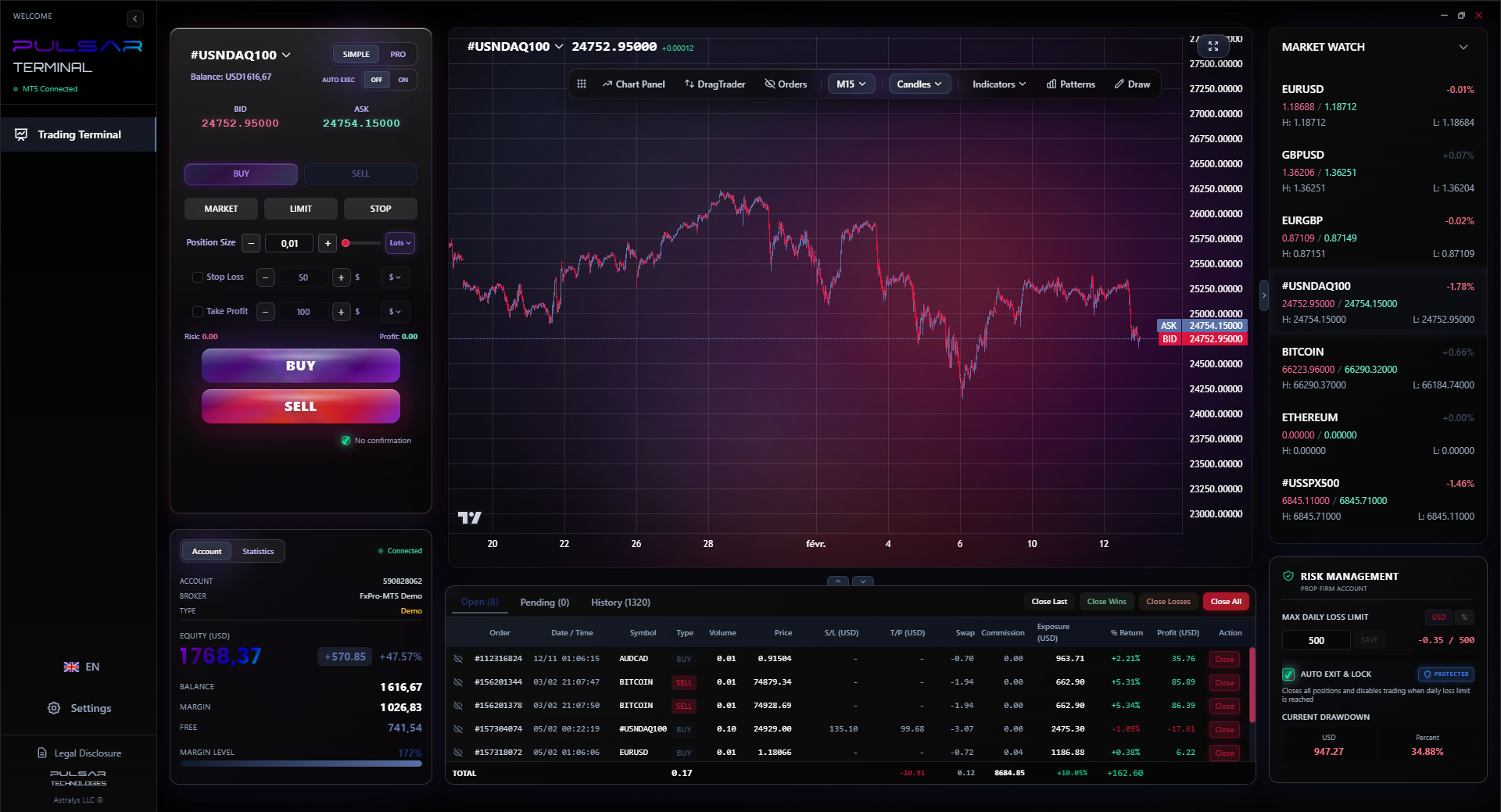
When you're building a strategy within strict US rules, managing multiple take-profit levels and moving stops to breakeven manually is a hassle; Pulsar Terminal automates this directly on your MT5 platform, letting you focus on analysis.
Pulsar Terminal
The all-in-one MT5 companion: drag-and-drop orders, multi-TP/SL, trailing stop, grid trading, Volume Profile, and prop firm protection. Used by 1,000+ traders daily.
“Real mentorship for a US trader is boring: it's broker webinars, NFA handbooks, and a carefully kept trade journal.”
When consuming any trading education, watch for these signals that the provider doesn't understand the US market:
- They talk about 'unlimited use' or 'choose your use.' Immediate disqualification. They don't know CFTC Rule 43.
- They demonstrate a strategy involving multiple opposite positions on the same pair. They're hedging. You can't.
- They use platforms or brokers you've never heard of (e.g., Deriv, Exness, XM). These brokers are not NFA members and cannot legally serve you. (Check out our reviews of Exness or XM to see the offerings they have for other regions - this is what you're missing, but also what you're protected from).
- They sell 'prop firm challenges' with daily loss limits based on balance, not equity. US prop firm rules are different. Their challenge parameters won't match what's available here.
- They recommend trading during Asian session only for 'calm markets.' For a US trader, this means trading in the middle of the night. It's unsustainable and ignores when the USD is most active.
- They claim you can start with $100 and make 20% a month consistently. With our use and spreads, that's not a strategy, it's a lottery ticket. Run.
Real education talks about risk first, about margin call probabilities, about the psychological toll of a 5% drawdown. If they're only showing you the wins, they're selling a dream, not a profession.
“Your search for the 'best Asia forex trading mentor Malaysia' is just a distraction from the hard work of building your own edge.”
Here’s what you do today, in this order:
- Open a Demo Account with FOREX.com, OANDA, and tastyfx. Not with some offshore broker. Get used to the platforms, the spreads, and the order entry rules. Practice dealing with FIFO. I spent 3 months on demo just learning how to manage multiple lots under US rules before risking a cent.
- Consume Your Broker's Education. Go through every webinar, course, and guide they offer. It's tailored to your environment. Take notes.
- Develop a Simple, Documented Strategy. Pick one major pair. Define your entry (e.g., RSI indicator > 70 for a short, with bearish candle confirmation). Define your stop loss (always 1.5x ATR). Define your take profit (2x your risk). Write it down.
- Trade it on Demo for 100 Trades. Record every trade in a journal. Not just P&L, but your reasoning. After 100 trades, you'll know if it has an edge. My first profitable strategy had a 38% win rate but a 2.5:1 reward-to-risk. It worked because I stuck to the rules for 100 trades straight.
- Fund a Live Account with Money You Can Lose. Start small. The goal for your first $1,000 is not to double it. The goal is to not blow it up. To experience the emotion of a live spread and slippage on a real US broker.
- Consider a CTA. Only after you have a year of consistent, disciplined live trading under your belt, consider hiring a CFTC-registered CTA for personalized coaching. You'll be a knowledgeable client who can ask smart questions.
The path is slower. It's less glamorous. There's no secret society or magic indicator. But it's legal, it's protected, and it's sustainable. That's the only 'best' path that matters.
💡 Winston's Tip
Journal every trade. Not just the outcome, but the regulatory friction you felt. Did FIFO force a suboptimal exit? Note it. This journal becomes your blueprint for a US-compliant strategy.
FAQ
Q1Can I legally use a trading signal service from Asia if I'm in the US?
Technically, you can receive the signals. However, applying them is the problem. The signals will likely assume you can use high use, hedge, and ignore FIFO - all of which are illegal on a US platform. The trades will either fail to execute or put you in a risky, unmanaged position. It's a direct path to losses.
Q2Why are there so few forex brokers in the US compared to other countries?
The CFTC's $20 million minimum capital requirement for RFEDs is a massive barrier to entry. Combine that with strict compliance costs and liability, and most firms decide it's not worth it. The ones that remain (FOREX.com, OANDA, etc.) are heavily capitalized and scrutinized, which is why your funds are safer here.
Q3A mentor says I can use a VPN to open an account with a non-US broker. Is this a good idea?
It's a catastrophically bad idea. It violates the broker's terms of service (they will ask for proof of residency). If they discover you're a US resident, they will immediately freeze and close your account, possibly confiscating funds. More importantly, you voluntarily give up all CFTC/NFA protections. If the broker disappears with your money, you have zero recourse.
Q4What's the biggest practical difference between trading with US vs. Asian rules?
Position sizing and trade management. A 50:1 use cap means you need 2-4 times the account capital to take the same trade size as someone with 100:1 or 200:1. The FIFO rule forces you to manage your oldest trade first, which complicates scaling out of multiple lots. Strategies must be built from the ground up with these limits in mind.
Q5Are there any US-based forex trading mentors you recommend?
I don't recommend specific individuals, as their quality can change. I recommend you search the NFA's BASIC database for registered Commodity Trading Advisors (CTAs). Anyone legit will be registered there. Then, vet them thoroughly: ask for a verified track record, understand their fee structure, and ensure their strategy is compatible with retail US use limits.
Q6Is meta-trader 4 (MT4) different on a US broker?
The software is the same, but the backend configuration is different. Your US broker's MT4 server will enforce the FIFO rule and prevent hedging. You won't see the option to open an opposite position on the same pair if one is already open. The platform itself might also have fewer symbols (no CFDs, for example) than an offshore MT4.
Prof. Winston's Lesson
Key Takeaways:
- ✓US regulation (CFTC/NFA) defines your entire trading universe.
- ✓Maximum use is 50:1 on majors - build all plans around this.
- ✓FIFO and no-hedging rules kill most complex offshore strategies.
- ✓Only trade with NFA-member brokers (FOREX.com, OANDA, tastyfx).
- ✓Real education is broker-provided and free.
How useful was this article?
Click a star to rate
Weekly Trading Insights
Free weekly analysis & strategies. No spam.
About the Author
James Mitchell
Senior Trading Analyst
Based in New York with over 9 years of trading experience. Focuses on major USD pairs, prop firm challenges, and the US regulatory landscape.
Comments
Risk Disclaimer
Trading financial instruments carries significant risk and may not be suitable for all investors. Past performance does not guarantee future results. This content is for educational purposes only and should not be considered investment advice. Always conduct your own research before trading.
You Might Also Like

Cara Trading Forex Sukses: 7 Prinsip dari Trader Profesional
Cara trading forex sukses dengan 7 prinsip trader pro: manajemen modal, disiplin, journal trading, backtest. Data nyata, bukan janji profit palsu.
Jam Trading Forex Terbaik untuk Trader Indonesia: Panduan Lengkap dengan Tabel Waktu
Panduan jam trading forex untuk trader Indonesia. Tabel 4 sesi dunia, jam emas 20:00-00:00, sesi mana yang harus dihindari. Data akurat + tips dari trader berpengalaman.
Top 5 Sàn Forex Uy Tín Nhất 2026: Review Jujur dari Trader Indonesia
Top 5 sàn forex uy tín 2026 untuk trader Indonesia. Review jujur: spread, deposit, withdraw, dukungan lokal. Exness, XM, IC Markets & lebih.
Get Pulsar Terminal
All these calculators are built into Pulsar Terminal with real-time data from your MT5 account. One-click position sizing, automatic risk management, and instant calculations.
Get Pulsar Terminal