


Here's a hard truth most trading gurus won't tell you: reading the right book won't make you profitable, but reading the wrong ones will absolutely lose you money.

Rajesh Sharma
Senior Forex Analyst ·  India
India
☕ 10 min read
What you'll learn:
Here's a hard truth most trading gurus won't tell you: reading the right book won't make you profitable, but reading the wrong ones will absolutely lose you money. In India, where regulations restrict what you can trade and how, choosing your education is even more critical. I've spent over ₹50,000 on trading books in my career - some were gold, most were garbage. Let me save you that trouble and show you which books actually help you navigate the USD/INR market, manage your psychology, and avoid the regulatory pitfalls that trap so many new traders.
You might think YouTube or a Telegram signal group is enough. Trust me, it's not. India's forex market operates under the RBI's Foreign Exchange Management Act (FEMA), which means you're playing a different game than traders in London or New York. You can't legally trade EUR/USD with a foreign broker. Your playground is the NSE and BSE with INR pairs like USD/INR, EUR/INR, GBP/INR, and JPY/INR.
A good book gives you the foundational theory that free online content often skips. It teaches you why a support level holds, not just where to draw the line. This is crucial because when you're trading on Zerodha Kite or Upstox and that USD/INR chart starts moving against you, you need to understand the mechanics, not just follow a hunch.

Warning: Many popular international trading books assume you have access to global markets and use of 1:500. Applying those strategies directly to India's regulated, lower-use environment is a recipe for blown accounts. You must adapt what you learn.
The best books to learn forex trading for Indians bridge this gap. They provide universal principles you can then apply within our specific constraints, like the RBI's rule that you can only take a position up to $10 million per exchange without proving underlying exposure (a recent 2024 change that killed a lot of speculative strategies).
“Reading the right book won't make you profitable, but reading the wrong ones will absolutely lose you money.”
These are the books I wish someone had handed me on day one. They're not about getting rich quick. They're about building a trader's brain.
1. 'Technical Analysis of the Financial Markets' by John J. Murphy This is the bible. Don't even think about looking at a chart before you've digested this. Murphy explains everything from basic trendlines to complex intermarket analysis. When I first started, I ignored the chapter on volume. Big mistake. I took a short position on GBP/INR based on a perfect head-and-shoulders pattern, but volume was declining. The pattern failed, and I lost ₹8,000. Murphy would have warned me. The principles apply perfectly to reading USD/INR futures charts on your domestic platform.
2. 'Japanese Candlestick Charting Techniques' by Steve Nison Charting is a language, and candlesticks are its alphabet. Understanding a doji, a hammer, or an engulfing pattern on your 15-minute USD/INR chart is a fundamental skill. This book teaches you to see the battle between bulls and bears in each price bar. It's not just pattern recognition, it's understanding market psychology - which is half the battle in trading.
3. 'Currency Trading for Dummies' by Kathleen Brooks and Brian Dolan Don't let the title fool you. This is a brilliantly clear explanation of how the forex market works: what a pip really is, how the spread eats into your profits, and what moves currency pairs. For an Indian trader, it clarifies why the USD/INR might react to US non-farm payroll data or domestic RBI policy announcements. It's the manual you should read before you even open a demo account.

Pro Tip: Read these three in order: Dummies (for mechanics), Candlesticks (for chart reading), then Murphy (for full technical analysis). Trying to read Murphy first is like trying to run before you can walk.

💡 Winston's Tip
A book is a map, not the territory. The real learning happens when you apply its lessons to the live, messy price action of the USD/INR chart. Don't confuse reading with trading.
“Your primary job as a trader isn't to pick winners, it's to manage risk.”
You can have the best strategy in the world and still lose money. I did, for years. My charts were perfect, my RSI indicator was aligned, but I'd panic-sell or get greedy. These books address the real problem: you.
'Market Wizards' by Jack Schwager This isn't a how-to manual. It's a series of interviews with the most successful traders of the 80s and 90s. You'll notice none of them talk about a secret indicator. They talk about discipline, risk management, and surviving losing streaks. Reading this during my first major drawdown (a ₹25,000 loss over two weeks) changed my perspective. It normalized failure and taught me that consistency beats brilliance every time.
'The New Trading for a Living' by Dr. Alexander Elder Elder is a psychiatrist who became a trader, so he gets the mind. His 'Three M's' model - Mind, Method, Money - is golden. The 'Money' section on risk management alone is worth the price. He gives you concrete rules, like never risking more than 2% of your capital on a single trade. I started using a strict 1% risk rule after reading this, and it's the single biggest reason I'm still trading today. It prevents any one loss from becoming a disaster.
The Classic: 'Reminiscences of a Stock Operator'
Written in 1923, this fictionalized biography of trader Jesse Livermore is shockingly relevant. It's a cautionary tale about ego, use, and the emotional cycles of the market. When you read his famous line, 'The market is never wrong. Opinions are,' you'll start to stop fighting the price action on your USD/INR chart and learn to follow it instead.
“Your primary job as a trader isn't to pick winners, it's to manage risk.”
Now you know the basics and have the right mindset. These books help you put it all together into a plan.
'Day Trading and Swing Trading the Currency Market' by Kathy Lien Lien is a master at blending fundamental and technical analysis. This is vital for Indian traders because our rupee is heavily influenced by RBI policy, oil prices, and foreign inflows. She teaches you how to read an economic calendar and gauge the impact of news on different timeframes. This helped me shift from frantic scalping to more relaxed swing trading on the 4-hour charts, which suits the slower pace of INR pairs.
'The Three Dimensional Approach to Forex Trading' by Anna Coulling This book introduces volume-price analysis (VPA) to forex. While spot forex doesn't have centralised volume, Coulling teaches you to use tick volume as a proxy. On platforms like Zerodha, you get actual volume data for currency futures. Learning VPA helped me confirm breakouts on USD/INR. A breakout on high volume? I'd enter. A breakout on thin volume? I'd stay away. It filtered out so many false signals.
A Critical Tool for Execution As you develop strategies, you'll realize that precise order management is key. Setting multiple take-profit levels or moving a stop to breakeven shouldn't be a manual chore. This is where the right tools come in. Managing trades efficiently is half the battle, and having a platform that lets you drag-and-drop orders and automate rules can make the difference between a good plan and a profitable one.
💡 Winston's Tip
If a book doesn't make you slightly uncomfortable by challenging your assumptions, it's not teaching you anything new. Growth happens at the edge of your understanding.
“Mastery of one approach is better than dabbling in ten. Most failures come from constantly switching strategies.”
The trading section of any bookstore is full of landmines. Here’s what to avoid.
1. Books with Titles Like 'The Secret Forex Millionaire System' or 'Double Your Money in a Month' If it sounds like a get-rich-quick scheme, it is. These books are usually 200 pages of fluff leading to a basic strategy like 'trade the MACD indicator crossover.' They never account for transaction costs or the psychological toll of real trading.
2. Books That Ignore Risk Management Any book that spends 90% of its pages on entry signals and only a passing mention of stop-losses is dangerous. Your primary job as a trader isn't to pick winners, it's to manage risk. A book that doesn't drill this home is setting you up for a margin call.
3. Outdated Books That Assume Unlimited use Many classic texts were written before global regulations tightened. Strategies built on 1:400 use will get you into serious trouble in India, where use on exchanges is much lower and using offshore brokers for high use is illegal for retail traders. Always contextualize the advice.
4. The 'One-Size-Fits-All' Strategy Book No single strategy works forever. Markets change. The USD/INR behaves differently in a risk-on environment versus a risk-off panic. Avoid books that claim their single indicator or pattern works in all conditions. Look for books that teach you how to think and adapt, not what to think.

Example: A book might show a beautiful backtest of a strategy on EUR/USD making 500% returns. What it won't show is that the strategy requires holding trades over weekends (carrying swap costs) and uses use of 1:100. Try that with USD/INR futures on the NSE with lower use and different volatility, and you'll likely lose money.
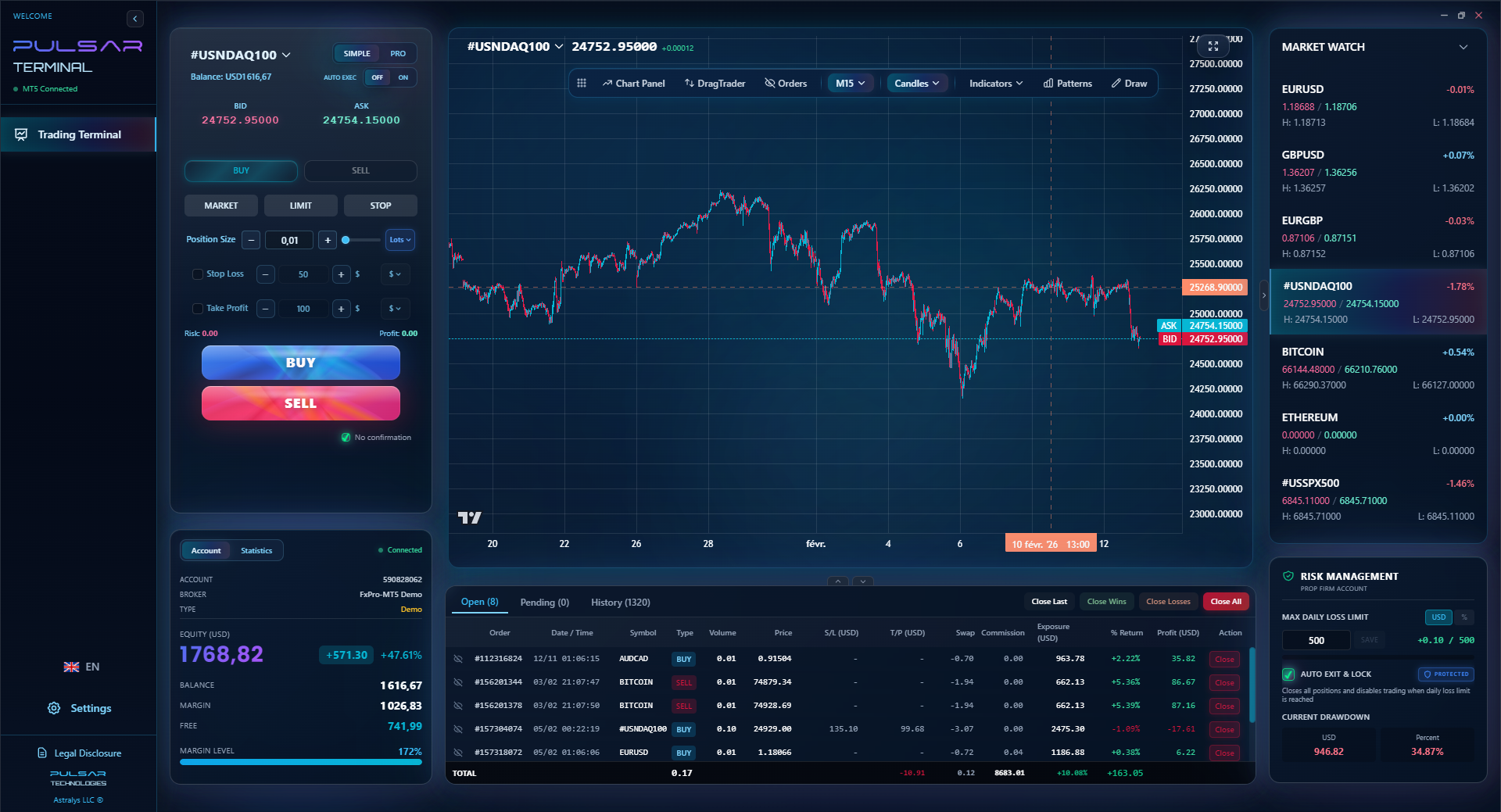
Once you have a strategy from these books, executing it cleanly is critical. Tools like Pulsar Terminal automate complex order management on MT5, letting you focus on analysis instead of manual clicks.
Pulsar Terminal
The all-in-one MT5 companion: drag-and-drop orders, multi-TP/SL, trailing stop, grid trading, Volume Profile, and prop firm protection. Used by 1,000+ traders daily.
“Mastery of one approach is better than dabbling in ten. Most failures come from constantly switching strategies.”
Knowledge without practice is useless. Here's a practical plan to turn reading into results.
Weeks 1-4: Foundation & Demo Trading
- Read: Currency Trading for Dummies and Japanese Candlestick Charting Techniques.
- Action: Open a demo account with a SEBI-regulated broker like Zerodha or Angel One. Don't touch an international broker demo yet - you need to learn on the platforms and instruments you'll actually use. Practice identifying candlestick patterns on the USD/INR chart. Don't trade yet, just observe and label.
Weeks 5-8: Psychology & Paper Trading
- Read: Market Wizards and the psychology sections of The New Trading for a Living.
- Action: Start paper trading with a fixed notional capital, say ₹100,000. Use Elder's 2% risk rule (so, max ₹2,000 risk per trade). Your goal isn't profit, it's to follow your rules. Log every trade, including your emotional state. Use a position size calculator for every single entry.
Weeks 9-12: Strategy & Review
- Read: Technical Analysis of the Financial Markets and Day Trading and Swing Trading the Currency Market.
- Action: Based on Murphy and Lien, develop a simple, rule-based strategy. Maybe it's trading pullbacks to the 20-period moving average on the USD/INR hourly chart. Backtest it visually on your demo for the past 3 months. Then trade it live on your demo for 4 weeks. Review your trade log weekly. Are you following your rules? Where are you failing?
This process turns abstract concepts from the best books to learn forex trading into muscle memory. It's slow, but it's the only way that works.
💡 Winston's Tip
Your trading journal is the most important book you'll ever write. It's the honest record of how you apply - or fail to apply - the wisdom from all the other books on this list.
“The best books become so ingrained you forget where you learned them - they just become how you see the market.”
Books give you the foundation, but the market is a living thing. Here’s how to keep learning.
1. The Right Broker Platform Your broker’s platform is your laboratory. For Indian traders, Zerodha’s Kite or Upstox Pro are excellent starting points. If you're exploring international brokers (with full awareness of the regulatory gray area for non-INR pairs), research their platforms carefully. For advanced tools on MT5, some traders use companion apps. I've found that tools which help visualize order grids or automate trade management let me focus more on analysis. For instance, managing a multi-level take-profit strategy on a volatile pair like XAU/USD (gold) is far simpler when the platform handles the partial closures automatically.
2. Continuous Market Analysis Follow the RBI's monthly policy statements and the US Federal Reserve announcements. The USD/INR lives and dies by these events. Read economic analyses from credible sources, not social media influencers.
3. Community & Mentorship (Carefully) Find a community of serious Indian traders, not a signal group. Discuss concepts from the books, share chart analyses, and talk about psychology. A good mentor won't give you trades, they'll help you spot flaws in your process.
4. Instrument-Specific Deep Dives Once you're comfortable with USD/INR, understand the unique drivers of other pairs. The EUR/USD guide, for example, teaches you about Eurozone and US macroeconomic interaction, which still influences global risk sentiment and indirectly affects the INR.
Remember, the goal isn't to collect books, it's to internalize principles. The best books to learn forex trading are the ones that become so ingrained you forget where you learned them - they just become how you see the market.
FAQ
Q1Can I legally trade forex in India?
Yes, but with strict limits. You can only trade INR-based currency pairs (like USD/INR, EUR/INR) on SEBI-regulated Indian exchanges (NSE, BSE) through a domestic broker. Trading international pairs like EUR/USD with foreign brokers is not permitted for Indian retail traders under FEMA rules.
Q2Which is the best book for a complete beginner in India?
Start with 'Currency Trading for Dummies.' It explains the market in simple terms without assuming any prior knowledge. Immediately after, get 'Japanese Candlestick Charting Techniques' to learn how to read the price charts you'll see on Zerodha or Upstox.
Q3Are books about trading US stocks or forex from the 1990s still relevant?
The core principles of psychology and risk management are timeless (like in 'Market Wizards'). However, the technical strategies and especially the use assumptions are often outdated. You must adapt the tactics to India's lower-use, INR-centric market.
Q4How much money do I need to start practicing after reading these books?
Start with a demo account (₹0). When moving to real money, the minimum margin for one USD/INR futures lot on the NSE is around ₹2,500. However, I recommend starting with at least ₹50,000 in capital so you can trade small position sizes and practice proper risk management without the pressure of being under-capitalized.
Q5Do I need to understand complex math to be a good trader?
No. Basic arithmetic for calculating position size, risk-reward ratios, and percentages is all you need. Trading is more about probability, psychology, and discipline than advanced mathematics. Use a position size calculator to handle the numbers for you.
Q6Should I focus on one trading strategy from a book?
Initially, yes. Pick one simple strategy from a reputable book and practice it relentlessly on a demo account for at least 2-3 months. Mastery of one approach is better than dabbling in ten. Most failures come from constantly switching strategies after a few losses.
Q7Are audiobooks or summaries good enough for learning forex trading?
For conceptual books like 'Market Wizards,' an audiobook is fine. For technical books with charts, like Murphy's or Nison's, you need the physical or ebook to see the diagrams. Never rely on summaries for core technical material - you'll miss the crucial details.
Prof. Winston's Lesson
Key Takeaways:
- ✓Start with 'Currency Trading for Dummies' before any complex text.
- ✓Never risk more than 2% of your capital on a single trade.
- ✓Practice on a USD/INR demo account for 3 months minimum.
- ✓Log every trade, including your emotional state.
- ✓Adapt international strategies to India's regulated, low-use environment.
How useful was this article?
Click a star to rate
Weekly Trading Insights
Free weekly analysis & strategies. No spam.
About the Author
Rajesh Sharma
Senior Forex Analyst
Trading Indian and South Asian markets for over 10 years. Started with NSE currency derivatives before moving to international forex. Specializes in USD/INR and emerging market pairs.
Comments
Risk Disclaimer
Trading financial instruments carries significant risk and may not be suitable for all investors. Past performance does not guarantee future results. This content is for educational purposes only and should not be considered investment advice. Always conduct your own research before trading.
You Might Also Like

Cara Trading Forex Sukses: 7 Prinsip dari Trader Profesional
Cara trading forex sukses dengan 7 prinsip trader pro: manajemen modal, disiplin, journal trading, backtest. Data nyata, bukan janji profit palsu.
Jam Trading Forex Terbaik untuk Trader Indonesia: Panduan Lengkap dengan Tabel Waktu
Panduan jam trading forex untuk trader Indonesia. Tabel 4 sesi dunia, jam emas 20:00-00:00, sesi mana yang harus dihindari. Data akurat + tips dari trader berpengalaman.
Top 5 Sàn Forex Uy Tín Nhất 2026: Review Jujur dari Trader Indonesia
Top 5 sàn forex uy tín 2026 untuk trader Indonesia. Review jujur: spread, deposit, withdraw, dukungan lokal. Exness, XM, IC Markets & lebih.
Get Pulsar Terminal
All these calculators are built into Pulsar Terminal with real-time data from your MT5 account. One-click position sizing, automatic risk management, and instant calculations.
Get Pulsar Terminal