


I lost $1,200 in 2018 because I picked a broker based on a slick ad and a promise of 'unlimited use.' The platform froze during a USD/PHP spike, my stop-loss was ignored, and my account was liquidated.
Miguel Reyes
Forex Analyst ·  Philippines
☕ 10 min read
What you'll learn:
- 1The Philippine Regulation Reality Check (It's Not What You Think)
- 2What Actually Matters: Key Criteria for Filipino Traders
- 3Broker Breakdown: Top Contenders for Filipino Traders (2026)
- 4Navigating Costs, use, and the USD/PHP Pair
- 5Getting Started: A Step-by-Step Safety Checklist
- 6Final Verdict & My Personal Pick
I lost $1,200 in 2018 because I picked a broker based on a slick ad and a promise of 'unlimited use.' The platform froze during a USD/PHP spike, my stop-loss was ignored, and my account was liquidated. When I complained, the 'support' email bounced. That painful lesson taught me that for Filipino traders, finding the right broker isn't about bonuses; it's about survival. You're navigating a market where local regulation is absent, and your protection hinges entirely on the broker's international credibility and operational integrity. Let's cut through the noise.
First, let's get this straight: no online forex broker holds a specific 'BSP license' for retail trading in the Philippines. The Bangko Sentral ng Pilipinas (BSP) and the Securities and Exchange Commission (SEC) don't license these platforms. Trading itself isn't illegal for you as an individual, but you're on your own.
The SEC regularly puts out advisories warning about the risks of trading CFDs with unregistered, offshore firms. They're not wrong. In April 2025, the BSP tightened rules on forex contracts (Circular No. 1212), aiming to curb pure speculation through banks. This doesn't directly stop you from using an international broker, but it sets a tone of caution that you should absolutely adopt.
What this means for you is simple: your primary line of defense is the broker's international regulation. You must look beyond Philippine shores for your safety net. A broker regulated by a top-tier authority like the UK's FCA or Australia's ASIC is obligated to follow strict rules on client fund segregation, fair pricing, and dispute resolution. That's your real protection.

Warning: If a broker's main selling point is being 'locally licensed' for forex trading, run. They are either misrepresenting themselves or operating under a dubious license. Always verify their international regulatory status first.

💡 Winston's Tip
A broker's withdrawal policy is their true character. If they make it difficult to get a small amount out, they'll make it impossible to get a large amount out. Test this first.
Forget the flashy marketing. When you're looking for the best broker for forex trading in the Philippines, these are the non-negotiable boxes to check.
Regulation & Safety of Funds
This is priority number one. Tier-1 regulators are the gold standard. Look for brokers licensed by the UK Financial Conduct Authority (FCA), the Australian Securities and Investments Commission (ASIC), or the Cyprus Securities and Exchange Commission (CySEC). These bodies require brokers to keep your money in segregated accounts, separate from the company's operational funds. If the broker goes under, your capital isn't part of the bankruptcy estate.
Deposit & Withdrawal Methods (The Local Angle)
This is where many international brokers fail Filipino traders. You need smooth, affordable local payment options. The best brokers for the Philippine market support direct deposits via GCash, Maya, and online banking transfers to local banks. Withdrawal times are critical. I've used brokers where withdrawals took 10 business days; it's unacceptable. The good ones process withdrawals back to your e-wallet or bank within 24-48 hours.
Trading Costs: Spreads, Commissions, and Swaps
Every pip counts. You need to understand the true cost. There are two main account types: spread-only and commission-based.
| Account Type | Typical EUR/USD Spread | Commission | Best For... |
|---|---|---|---|
| Spread-Only | 1.0 - 1.5 pips | $0 | Beginners, longer-term swing trading. Easier to calculate costs. |
| RAW/ECN | 0.0 - 0.3 pips | $3 - $7 per round lot | Scalpers, high-volume traders, algorithmic trading. Lower overall cost at high volumes. |
Don't forget swap rates (overnight financing charges). If you're holding trades for days, these can eat into profits, especially on pairs involving the PHP. Always check the broker's swap calculator.
Platform & Tools
MetaTrader 4 (MT4) is still king in the Philippines for a reason. It's stable, familiar, and supports countless custom indicators and Expert Advisors (EAs). MT5 is gaining ground, offering more timeframes and built-in economic calendar features. Some brokers also offer cTrader (clean, great for scalping) or direct TradingView integration. Choose a broker that offers your preferred platform.

Pro Tip: Before depositing real money, test the broker's platform execution with a demo account. Place trades during Asian session open (8 AM PHT) and London/New York overlap. Watch for slippage and requotes, especially on news events. This tells you more about their liquidity than any sales pitch.
“High use is a risk accelerator, not a wealth accelerator.”
Based on regulation, local payment support, and trading conditions, here are the brokers I and many seasoned traders here consistently look at. Remember, 'best' depends on your style.
For Beginners & Low-Cost Entry: XM XM gets a lot of flak for marketing, but their offer is solid for newbies. A $5 minimum deposit is the lowest barrier to entry. They're regulated by CySEC and ASIC, and they offer solid educational materials in Tagalog. Their spreads are decent on standard accounts, and they support local bank transfers. I started a small $100 account here in 2019 to test a new strategy; execution was reliable for my swing trading style.
For Raw Spreads & Serious Trading: IC Markets & Pepperstone These are the workhorses for active traders. IC Markets and Pepperstone offer true ECN/RAW accounts with spreads from 0.0 pips on majors like EUR/USD. Their commissions are competitive ($3.50 and $3.50 per lot round turn, respectively). Both are heavily regulated (ASIC, FCA) and offer superb platform choice (MT4, MT5, cTrader). Pepperstone's integration with TradingView is a killer feature for chartists. Funding can be done via international wire or cards, which is a slight hurdle, but worth it for the conditions.
For Seamless Local Transactions: Exness Exness has mastered the local payment game. Deposits and withdrawals via GCash and local banks are famously fast, often instant. They offer insane use (up to 1:2000), which is a double-edged sword. Their regulation is a mix of Tier-1 (FCA for EU clients) and global (FSA). For a Filipino trader prioritizing quick access to funds, they're a major player. Just be hyper-aware of the risks that come with ultra-high use.
The Institutional Choice: Interactive Brokers (IBKR) If you're moving beyond retail and into larger account sizes, IBKR is in a league of its own. Regulated across nine top-tier jurisdictions, it's the definition of secure. Direct market access, incredibly low spreads (0.2 pips on EUR/USD), and commissions starting at $2 per side. The platform (TWS) has a steep learning curve, and minimums aren't for tiny accounts, but for professionalism and cost, it's unmatched.
A quick note on others: FOREX.com is a giant with a strong reputation, but their $100 minimum and slightly higher RAW account commission ($6) place them just behind IC Markets/Pepperstone for pure cost. Fusion Markets is another great low-cost alternative with commissions as low as $2.25.
💡 Winston's Tip
The spread is the silent tax on every trade. A 2-pip spread means the market has to move 2 pips in your favor just for you to break even. Choose your account type wisely.
The Real Cost of Trading
Let's put costs into a real Philippine peso example. Say you trade 1 standard lot (100,000 units) of EUR/USD.
- On a spread-only account with a 1.2 pip spread: Cost = 1.2 pips * $10 per pip = $12 (≈ PHP 705) gone the moment you enter the trade.
- On a RAW account with a 0.1 pip spread + $3.50 commission: Cost = (0.1 * $10) + $3.50 = $4.50 (≈ PHP 264).
The RAW account saves you PHP 441 on that single trade entry. This is why active traders gravitate towards commission-based models. Use a position size calculator to always know your exact risk in pesos before clicking buy or sell.
The use Trap
Brokers advertise use of 1:500, 1:1000, even 1:2000. It's tempting. Here's the cold truth: high use is a risk accelerator, not a wealth accelerator. On a $1,000 account with 1:500 use, you can control a $500,000 position. A mere 0.2% move against you wipes out your entire account. I learned this the hard way early on. The BSP's cautious stance of 1:10 for local entities exists for a reason. For most retail traders, I wouldn't recommend using more than 1:20 to 1:50. It forces discipline.
Trading USD/PHP
This is our 'home' pair, and it trades differently than EUR/USD. Liquidity is lower, which often means wider spreads (think 5-10 pips vs. 1 pip on EUR/USD). This makes it terrible for scalping. It's also heavily influenced by BSP policy, remittance flows, and local political news. Trading it requires a macroeconomic view. If you do trade it, ensure your broker's spread on USD/PHP is reasonable during your preferred trading hours.
“In the Philippine market, where local oversight is minimal, your broker's integrity is your primary line of defense.”
- Verify Regulation: Go to the regulator's official website (e.g., fca.org.uk, asic.gov.au). Use the broker's disclosed regulatory number to confirm their license and check for any past disciplinary actions.
- Test the Platform: Open a demo account. Trade actively for two weeks. Experience execution speed, test customer support response, and familiarize yourself with the platform's tools.
- Start Small: When you go live, make the minimum deposit. Don't throw in your life savings. Your first goal is to test the real money withdrawal process. Withdraw a portion of your deposit back to your GCash or bank. If it arrives smoothly and promptly, that's a huge green flag.
- Document Everything: Keep records of all trades, deposit/withdrawal confirmations, and communications with support. This is crucial for tax purposes and any potential disputes.
- Manage Your Risk Religiously: Use stop-losses on every single trade. Never risk more than 1-2% of your account on a trade. Understand what a margin call is and avoid it at all costs.
Warning: Be wary of 'investment groups' on social media that pressure you to use a specific, obscure broker. This is a common scam setup (like the infamous 'Pig Butchering' scam). Always do your own, independent broker research.
Finally, remember the tax man. The BIR considers trading profits as 'Other Income,' taxable at the graduated rate (up to 35%). Keep clean records. It's not the broker's job to remind you.
💡 Winston's Tip
Your first trade with a new broker shouldn't be your biggest idea. It should be a small, boring trade to see how their platform executes and how their support responds when you have a question.
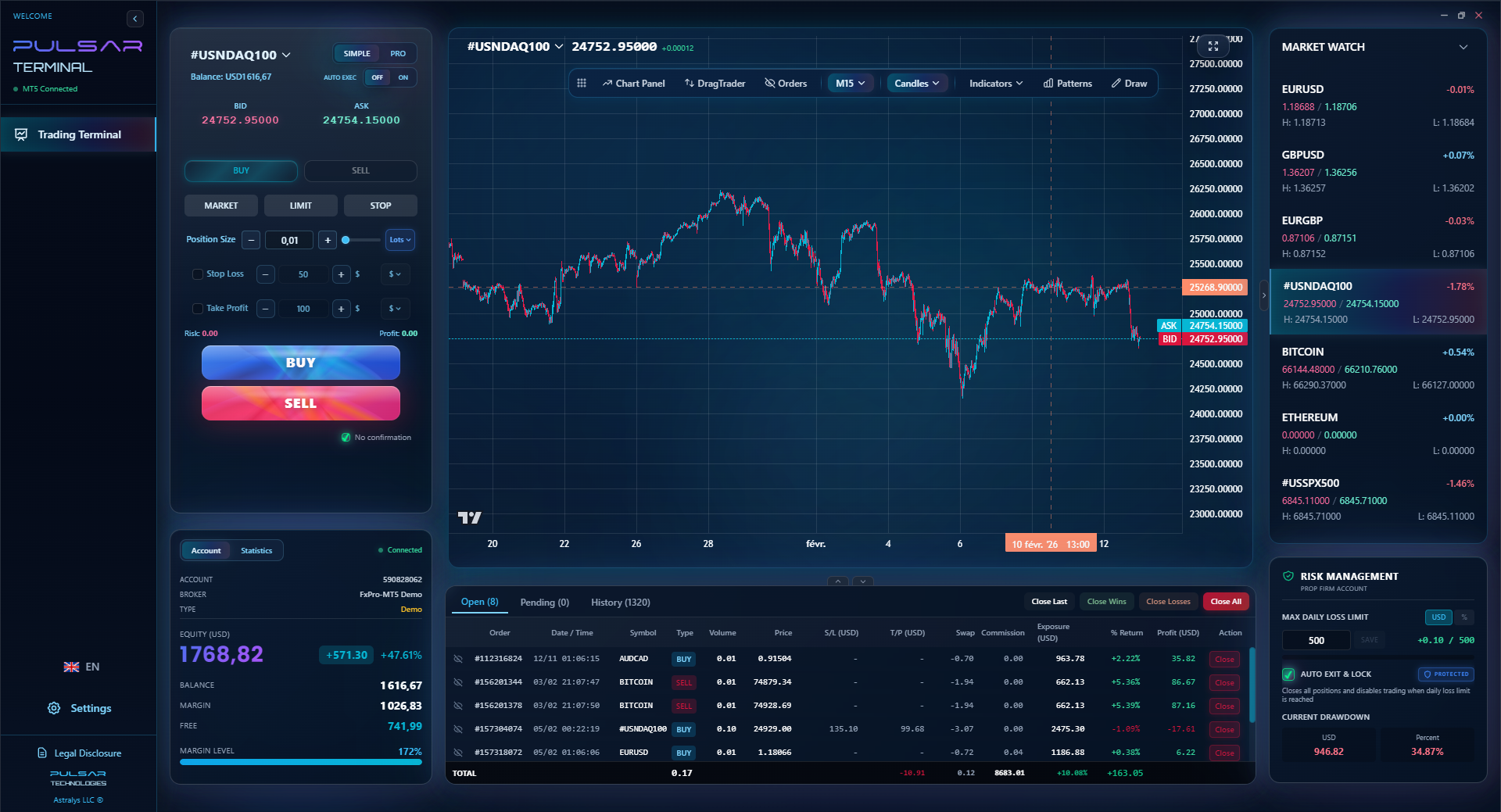
Managing complex trades and risk manually on MT4/MT5 is error-prone; a tool like Pulsar Terminal automates trailing stops, breakeven orders, and multi-TP strategies directly on your charts.
Pulsar Terminal
The all-in-one MT5 companion: drag-and-drop orders, multi-TP/SL, trailing stop, grid trading, Volume Profile, and prop firm protection. Used by 1,000+ traders daily.
So, who is the best broker for forex trading in the Philippines? There's no single winner, but there's a right choice for your profile.
- For the absolute beginner who needs Tagalog support and a tiny starting capital: XM.
- For the active trader (scalper, day trader) who needs the lowest possible costs and strong platforms: IC Markets or Pepperstone.
- For the trader who prioritizes instant, hassle-free deposits and withdrawals in PHP: Exness (but use low use!).
- For the serious, large-account trader moving towards professional execution: Interactive Brokers.
My personal main account has been with IC Markets for over 5 years. Why? Consistency. The spreads on their Raw Spread account are as advertised, I've never had a withdrawal take more than one business day back to my Wise account, and their MT4 platform has never frozen on me, even during NFP volatility. I trust their ASIC regulation. In 2021, I caught a strong move on XAU/USD using a combination of MACD divergence and support on the 4-hour chart. I entered at $1789 and rode it to $1835. The execution was flawless, and the profit reflected the chart price, not some manipulated spread. That's what you're paying for.
Your broker is your business partner. Choose one that is boringly reliable, transparent with costs, and regulated by adults. Avoid the ones shouting about Lamborghinis and 2000:1 use. In the Philippine market, where local oversight is minimal, that partner's integrity is the only thing standing between you and a repeat of my $1,200 lesson.
FAQ
Q1Is forex trading legal in the Philippines?
Yes, for individual retail traders, it is legal. There's no law that criminalizes you for trading currencies online. However, no international retail forex broker is licensed by the Philippine SEC or BSP. You are trading through offshore, internationally regulated entities, which the SEC regularly warns the public about due to the risks involved.
Q2What is the best payment method for funding my forex account in the Philippines?
The most convenient methods are local e-wallets like GCash and Maya, and direct online banking transfers to a local bank account provided by the broker. These offer faster processing and lower fees compared to international credit/debit card payments or bank wires. Always check which local methods your chosen broker supports.
Q3How much money do I need to start forex trading?
You can start with as little as $5 (approx. PHP 290) with brokers like XM. However, starting with such a small amount is mainly for learning the platform. To trade practically with proper risk management (not over-leveraging a tiny account), a more realistic starting capital is between $200 to $500 (PHP 11,500 - 29,000).
Q4Do I have to pay taxes on my forex trading profits?
Yes. According to the BIR, income from forex trading is generally classified as 'Other Income' and is subject to the graduated income tax rates, which can go up to 35% for resident citizens. You are responsible for declaring this income and paying the appropriate tax.
Q5What use should I use as a beginner in the Philippines?
Use the lowest use possible. Despite brokers offering up to 1:2000, I strongly advise beginners to never exceed 1:10 or 1:20. High use is the fastest way to blow up your account. It magnifies both profits and losses. The BSP's cautious 1:10 limit for local entities is a good guideline for risk management.
Q6Can I trade the Philippine Peso (USD/PHP) with these international brokers?
Yes, most major international brokers offer the USD/PHP currency pair. However, be aware that spreads are typically much wider than on major pairs like EUR/USD (often 5-10 pips vs. under 1 pip), making it less suitable for short-term strategies. Liquidity is also lower.
Q7How do I know if a broker is trustworthy?
Check their international regulation with a Tier-1 authority (FCA, ASIC, CySEC). Read independent reviews from reputable sources (not just the broker's site). Test their customer service with questions before depositing. Finally, start with a small deposit and test the withdrawal process. A trustworthy broker makes it easy to get your money back.
Prof. Winston's Lesson
Key Takeaways:
- ✓Philippine SEC does not license retail forex brokers; rely on Tier-1 international regulation.
- ✓Test withdrawal speed with a small deposit before committing serious capital.
- ✓For active trading, RAW/ECN accounts often have lower total costs than spread-only.
- ✓Never use more than 1:20 use as a beginner, regardless of what's offered.
How useful was this article?
Click a star to rate
Weekly Trading Insights
Free weekly analysis & strategies. No spam.
About the Author
Miguel Reyes
Forex Analyst
Trading forex part-time from Manila since 2020, now full-time. Focuses on USD/PHP and major pairs during the Asian session. Former BPO worker who learned trading through free YouTube courses and demo accounts.
Comments
Risk Disclaimer
Trading financial instruments carries significant risk and may not be suitable for all investors. Past performance does not guarantee future results. This content is for educational purposes only and should not be considered investment advice. Always conduct your own research before trading.
You Might Also Like

Cara Trading Forex Sukses: 7 Prinsip dari Trader Profesional
Cara trading forex sukses dengan 7 prinsip trader pro: manajemen modal, disiplin, journal trading, backtest. Data nyata, bukan janji profit palsu.
Jam Trading Forex Terbaik untuk Trader Indonesia: Panduan Lengkap dengan Tabel Waktu
Panduan jam trading forex untuk trader Indonesia. Tabel 4 sesi dunia, jam emas 20:00-00:00, sesi mana yang harus dihindari. Data akurat + tips dari trader berpengalaman.
Top 5 Sàn Forex Uy Tín Nhất 2026: Review Jujur dari Trader Indonesia
Top 5 sàn forex uy tín 2026 untuk trader Indonesia. Review jujur: spread, deposit, withdraw, dukungan lokal. Exness, XM, IC Markets & lebih.
Get Pulsar Terminal
All these calculators are built into Pulsar Terminal with real-time data from your MT5 account. One-click position sizing, automatic risk management, and instant calculations.
Get Pulsar Terminal