


So you're in California and you want to learn to trade forex.
James Mitchell
Senior Trading Analyst
☕ 10 min read
What you'll learn:
- 1What Actually Makes a Forex Course Worth It?
- 2In-Person California Bootcamps & Workshops
- 3Top Online Courses for California Traders
- 4Community College & University Programs
- 5Mentorship vs. Self-Study: The California Balance
- 6Red Flags: How to Avoid the Scams
- 7Putting It All Together: Your California Trading Education Plan

So you're in California and you want to learn to trade forex. You've probably seen a thousand ads promising six-figure returns from a beach in Malibu. How do you find a course that's legit and actually teaches you how to survive in the markets? I've been trading for over 12 years, and I've wasted money on bad courses so you don't have to. Let's cut through the hype and look at what the best courses of forex trading in California really offer, from Silicon Valley tech to old-school LA mentors.
Before we get to the list, let's talk about what you're really buying. A good course isn't about fancy indicators or secret formulas. It's about a structured path to understanding price action, risk management, and your own psychology. I learned this the hard way. Back in 2015, I dropped $2,500 on a course that was 90% motivational fluff and 10% recycled chart patterns. My account bled out in three months.
A worthwhile course needs three things. First, a clear methodology you can actually follow, not just theory. Second, real trade examples with entry, exit, and, crucially, the stop loss. Third, ongoing support or a community. Trading is lonely, and having people to ask questions is huge. Watch out for anyone who guarantees profits or focuses only on the wins. If they don't spend as much time on losing trades and margin call prevention as they do on entries, walk away.

Warning: The most expensive course isn't always the best. Some of the most valuable lessons I got were from a $300 online mentor who focused purely on position size calculator discipline and journaling. Price tag doesn't equal quality.

💡 Winston's Tip
The first $500 you spend on trading education should go towards learning risk management and position sizing, not a fancy indicator system. Survival comes first.
“A good course isn't about fancy indicators or secret formulas. It's about a structured path to understanding price action, risk management, and your own psychology.”
There's something about being in a room with other traders. The energy, the immediate feedback - it can accelerate learning if you find the right group. In California, you generally have two types: the expensive LA/SF 'mastermind' and the more practical, shorter workshop.
The High-End Mastermind
These are often multi-day events in luxury hotels. I attended one in Santa Monica in 2022 that cost $4,800. The content on institutional order flow was actually solid, but the real value was the networking. I met two fund managers and a broker who gave me insights into Asian session liquidity I still use. Was it worth five grand? Only because of the connections, not the curriculum.
The Weekend Intensive
More common and affordable ($300-$1,000). Look for ones run by active traders, not just educators. A good one will have you looking at live charts, placing simulated trades, and drilling scalping strategy or swing trading setups. I found a great one in San Diego focused purely on the EUR/USD guide London open. The guy running it traded that single session, and his specificity was refreshing.
The bottom line: For in-person learning in California, target workshops with a narrow focus (e.g., 'Forex Price Action for the US Session') led by someone who still trades. Avoid the generic 'Become a Millionaire Trader' seminars.

Pro Tip: Before you book a bootcamp, ask the organizer for a sample trade journal or a recording of a live market analysis session. If they can't or won't provide it, that's a major red flag.

“The most expensive course isn't always the best. Some of the most valuable lessons I got were from a $300 online mentor who focused purely on position size discipline.”
This is where most people, including myself, get their real education. The advantage is you can learn at your own pace and from instructors worldwide. The disadvantage? It's easy to get lost in a sea of content. Here are the types that work well for the California lifestyle and timezone (PST).
Market-Specific Courses for the PST Schedule: As a California trader, the London session starts at midnight or 1 AM, and New York opens at 6:30 AM. A great course will acknowledge this. I took an online course from a Canadian trader that was brilliant but focused on the London-New York overlap, which is brutal for West Coast sleep schedules. Look for courses that offer strategies for the US session only, or better yet, for the Asian session (which happens in our late afternoon/evening). A course that teaches you to trade the XAU/USD guide (Gold) during Asian hours, for instance, can be a perfect fit.
Platform-Specific Training: Many courses now integrate directly with platforms. The best ones I've seen don't just teach a strategy; they teach you how to code it into an EA or set up alerts on TradingView. Given California's tech vibe, this resonates. A course that includes modules on using the MACD indicator in confluence with volume on MT5, for example, is giving you practical, actionable skills.
My Personal Online Pick: If I had to recommend one broad online structure for a beginner in California, it would be Babypips.com (free school) followed by a paid mentorship that focuses on risk management. The free foundation is unbeatable. Then, spend $500-$1,000 on a mentor who will review your trades. This combo saved me after my early failures.
Finding the best courses of forex trading in California often means looking online for global experts who understand your specific timezone challenges.

“The most expensive course isn't always the best. Some of the most valuable lessons I got were from a $300 online mentor who focused purely on position size discipline.”
You might be surprised, but some of the most grounded financial education happens here. I'm not talking about getting a Finance PhD. I'm talking about extension courses or certificate programs at places like UCLA Extension or local community colleges.
The Pros: The credibility is high. The instructors are often former industry professionals, not internet gurus. The curriculum is regulated and focuses on fundamentals: macroeconomics, how central banks work, how the spread definition is determined by liquidity providers. This is the 'why' behind the 'what' you see on your charts. I took a 'Global Currency Markets' night class at a community college in Orange County years ago. It cost about $400 and gave me a rock-solid understanding of interest rate differentials that I use every day.
The Cons: Don't expect to learn a specific trading system or how to use MT5. These courses give you the engine, not the driving lessons. You'll learn what a pip definition is from a theoretical standpoint, but not necessarily how to set a 20-pip stop loss on a volatile pair. You need to pair this knowledge with practical trading experience.
Is it Worth It? For the serious trader who wants to move beyond technical analysis, absolutely. It builds a foundation that makes you more adaptable when market regimes change. For someone who just wants to start trading next week, it might feel too slow. Think of it as a long-term investment in your trading IQ.
💡 Winston's Tip
Before paying for any course, demand to see the instructor's trading journal for the last 3 months. A real trader has one. A guru will make excuses.
“Finding the best courses of forex trading in California often means looking online for global experts who understand your specific timezone challenges.”
This is the core debate. California has a culture of both fierce independence (self-study) and high-priced coaching (mentorship). Which path is right?
The Self-Study Route: This means books, free online resources, YouTube, and demo trading. It's cheap and teaches resilience. My first two years were pure self-study. I devoured books, practiced on a demo account, and slowly developed a feel for RSI indicator divergences. The huge benefit? You learn from your own mistakes, which sticks with you. The downside? It's slow, and you will develop bad habits you don't even know are bad. I developed a terrible habit of moving my stop losses, which took another mentor to help me break.
The Mentorship Route: A true mentor is a coach, not just a course seller. They look at your trades, point out your psychological biases, and hold you accountable. In California, you can find these through trading communities or referrals. A good mentor will charge a monthly fee ($200-$500/month) or a large upfront sum for personalized access. I paid a mentor $3,000 for three months of weekly screen-sharing sessions. He caught my stop-loss moving habit in our first session. That alone was worth the fee.
The best approach for most? A hybrid. Use self-study (like Babypips) to get the basics. Then, find a short-term, focused mentorship to refine your execution and psychology. This is often the most efficient way to find the best courses of forex trading in California - it's not one product, but a combination.

Example: My Hybrid Learning Cost Breakdown:
- Babypips School: $0
- 3 Trading Books: $90
- 6 Months Demo Trading: $0
- 3-Month Focused Mentorship: $3,000
- Total: $3,090 Compared to a single $5,000 'premium' course, this gave me foundational knowledge + personalized correction of my worst mistakes.

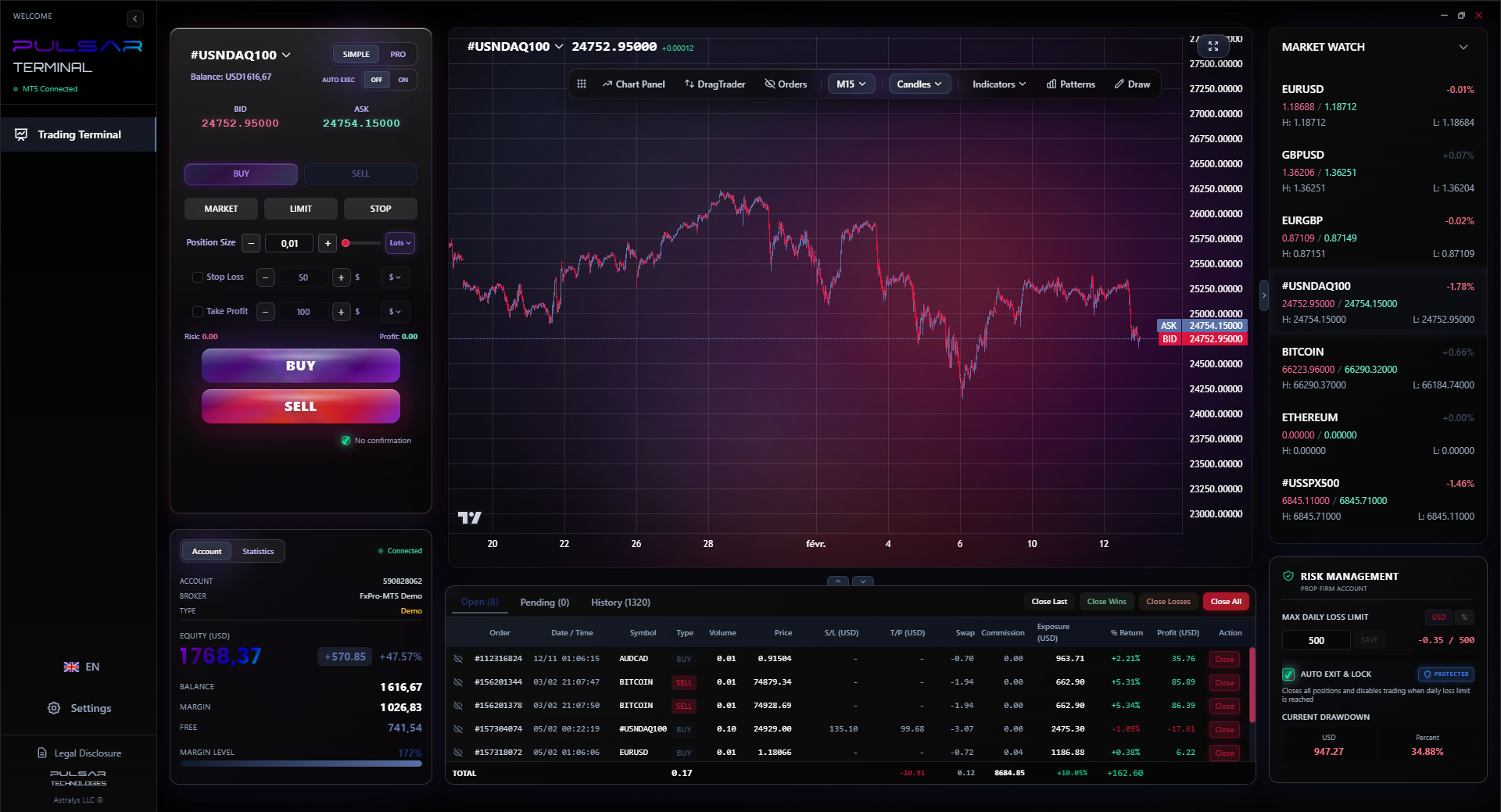
A mentor can teach you a trailing stop strategy, but tools like Pulsar Terminal automate it directly on your MT5 charts, removing emotional hesitation.
Pulsar Terminal
The all-in-one MT5 companion: drag-and-drop orders, multi-TP/SL, trailing stop, grid trading, Volume Profile, and prop firm protection. Used by 1,000+ traders daily.
“Finding the best courses of forex trading in California often means looking online for global experts who understand your specific timezone challenges.”
California, land of sunshine and startups, also has its share of trading charlatans. Here’s how to spot them a mile away.
1. The Lamborghini Profile Pic: If the main selling point is the instructor's wealth, not their teaching, run. Real traders are usually more low-key. We know the market can humble anyone, anytime.
2. Guaranteed Returns or 'Risk-Free' Trading: This is illegal and impossible. Any course promising this is a scam, full stop. The only guarantee in trading is that you will have losing trades.
3. Vague Curriculum: If the course outline says things like 'Master the Markets' or 'Learn Secret Strategies' without listing specific topics (e.g., 'Building a Trading Plan,' 'Backtesting a Moving Average Crossover System'), they're hiding a lack of substance.
4. Pressure to Use a Specific Broker: Some 'educators' are just affiliate marketers for Exness review or XM review. While these might be good brokers, the course should be broker-agnostic. If they push one hard, they're likely getting a kickback on your deposits.
5. No Proof of Live Trading: They should be able to show a verified, long-term track record (not just a few cherry-picked trades). Ask for a Myfxbook link or similar. If they get defensive, you have your answer.
My rule: If it feels like an infomercial, it probably is. Trust the courses that feel more like a classroom and less like a car dealership.
“The best approach for most? A hybrid. Use self-study to get the basics, then find a short-term, focused mentorship to refine your execution.”
Alright, let's build a realistic, step-by-step plan for someone starting in Los Angeles, San Francisco, or San Diego.
Phase 1: The Free Foundation (Months 1-2)
- Go through the entire Babypips School. Take notes.
- Open a demo account with a reputable broker like IC Markets review or Pepperstone review. Don't even think about real money yet.
- Watch the free webinars from those brokers. They're often surprisingly good for basics.
Phase 2: Skill Building & Finding Your Style (Months 3-6)
- Pick ONE market (e.g., EUR/USD) and ONE timeframe (e.g., 4-hour chart).
- Paper trade a simple strategy based on support/resistance or a single indicator.
- Keep a detailed trading journal. This is non-negotiable.
- Consider a small investment here: Either a $400 community college course on economics OR a focused online course ($200-$600) on your chosen strategy.
Phase 3: Mentorship & Refinement (Month 6+)
- Once you have 6 months of demo/journal data, look for a mentor.
- Your goal is no longer to learn basics, but to fix your specific execution errors and psychological leaks.
- This is where you might invest $1,000-$3,000 for 2-3 months of personalized coaching.
Phase 4: Going Live (With Extreme Caution)
- Start with a micro account. The goal is to preserve capital, not get rich.
- Your first live trades should be 1/10th the size of your demo trades. The psychology is completely different.
- Continue journaling and periodic mentor check-ins.
The best courses of forex trading in California aren't a single magic bullet. They're a tailored curriculum you build for yourself, mixing free resources, structured education, and personalized coaching. It's a marathon, not a sprint - perfect for a state where the good life is about the long game.
FAQ
Q1What is the average cost of a good forex trading course in California?
It varies wildly. A solid weekend workshop can be $300-$1,000. A complete online course might be $500-$2,000. High-end masterminds or year-long mentorships can run $5,000 to $20,000. My advice? Start with free resources and don't spend more than $1,000 until you've demo traded for at least 6 months and know exactly what you need to learn.
Q2Are there any free forex trading courses worth taking in California?
Absolutely. Babypips.com is the gold standard free school and is based in the US. Many brokers like XM review offer extensive free educational libraries and webinars. Also, check the YouTube channels of established brokers or educators - look for those providing analysis, not sales pitches. The free stuff can give you 80% of the knowledge you need.
Q3Can I learn forex trading at a California community college?
Yes, but manage your expectations. You'll learn the fundamental 'why' of the markets - economics, monetary policy, market structure. You won't learn a specific day-trading system or much hands-on platform training. It's excellent foundational knowledge that will make you a smarter trader in the long run, but you'll need to combine it with practical trading education elsewhere.
Q4What's the biggest mistake people make when choosing a forex course?
They buy based on the instructor's promised results or lifestyle, not the course's educational structure. They look for a 'secret' instead of a solid, repeatable process focused on risk management. The second biggest mistake is jumping into a very expensive course before they know the basics. You don't need a $5,000 course to learn what a pip definition is.
Q5Is in-person training in California better than online?
Not necessarily 'better,' but different. In-person is great for networking and immediate Q&A, but it's often more expensive and less flexible. Online courses let you learn from global experts on your own schedule. For most people starting out, a quality online course is more practical and cost-effective. You can always add an in-person workshop later for specialization.
Q6How do I know if a forex trading mentor is legitimate?
Ask for three things: 1) A verifiable, multi-year track record (like a Myfxbook link), 2) Testimonials from past students you can actually contact, and 3) A sample of their teaching style (e.g., a recording of a live analysis or a sample trade review). A legitimate mentor will be transparent. If they're evasive or only show screenshots of profits, they're likely a fraud.
Prof. Winston's Lesson
Key Takeaways:
- ✓Start with free foundational education (Babypips).
- ✓Demo trade for 6+ months before spending real money.
- ✓Invest in mentorship to fix specific psychological errors.
- ✓Never buy a course that guarantees profits or hides its curriculum.
How useful was this article?
Click a star to rate
Weekly Trading Insights
Free weekly analysis & strategies. No spam.
About the Author
James Mitchell
Senior Trading Analyst
Based in New York with over 9 years of trading experience. Focuses on major USD pairs, prop firm challenges, and the US regulatory landscape.
Comments
Risk Disclaimer
Trading financial instruments carries significant risk and may not be suitable for all investors. Past performance does not guarantee future results. This content is for educational purposes only and should not be considered investment advice. Always conduct your own research before trading.
You Might Also Like

Cara Trading Forex Sukses: 7 Prinsip dari Trader Profesional
Cara trading forex sukses dengan 7 prinsip trader pro: manajemen modal, disiplin, journal trading, backtest. Data nyata, bukan janji profit palsu.
Jam Trading Forex Terbaik untuk Trader Indonesia: Panduan Lengkap dengan Tabel Waktu
Panduan jam trading forex untuk trader Indonesia. Tabel 4 sesi dunia, jam emas 20:00-00:00, sesi mana yang harus dihindari. Data akurat + tips dari trader berpengalaman.
Top 5 Sàn Forex Uy Tín Nhất 2026: Review Jujur dari Trader Indonesia
Top 5 sàn forex uy tín 2026 untuk trader Indonesia. Review jujur: spread, deposit, withdraw, dukungan lokal. Exness, XM, IC Markets & lebih.
Get Pulsar Terminal
All these calculators are built into Pulsar Terminal with real-time data from your MT5 account. One-click position sizing, automatic risk management, and instant calculations.
Get Pulsar Terminal