


Here's a Texas-sized truth: 61% of U.S.
James Mitchell
Senior Trading Analyst
☕ 9 min read
What you'll learn:
- 1Why Texas Forex Education is Different (It's All About Regulation)
- 2Review: The Top Texas Forex Courses for 2026
- 3What Actually Makes a Course Worth It? (The 4 Must-Haves)
- 4Red Flags: What to Run From in Texas
- 5Pair Your Course with the Right U.S. Broker
- 6My Personal Advice for New Texas Traders
- 7Beyond the Course: Your Lifelong Learning Plan
Here's a Texas-sized truth: 61% of U.S. forex traders have a bachelor's degree, and 20% have a master's. Yet, the vast majority still lose money. Education clearly isn't the whole answer. As a trader who's seen countless 'gurus' come and go, I'll tell you straight - most courses are overpriced hype. But in a state as big as Texas, there are a few legitimate programs that actually teach you how to navigate the uniquely restrictive U.S. market, where use is capped at 1:50 and the FIFO rule dictates your every move. Let's cut through the noise and find the best courses of forex trading Texas has to offer for someone who wants to trade legally and sustainably.
You can't talk about trading in the U.S., Texas included, without starting with the rules. The CFTC and NFA have built a wall around retail forex that changes everything you learn. A strategy that works with a 1:500 use account from an offshore broker like Exness will blow up a U.S. account faster than you can say 'margin call.'
Our playground has strict boundaries: a max of 1:50 use on majors, the FIFO rule (you close your oldest position first), and a ban on hedging. This forces a completely different approach to risk and trade management. A good Texas-based course won't just teach you candlestick patterns; it will drill into you how to build a position-sizing model that works with low use. I learned this the hard way early on. I tried to copy a scalping strategy I saw from a European trader, not accounting for the wider spreads and lower use here. What was a 5-pip target for him required a 12-pip move for me to make the same percentage return. My position size calculator became my most important tool overnight.

Warning: If a course doesn't explicitly address U.S. regulations and how they impact strategy design, run. It's likely teaching generic, often illegal-for-you, concepts.
The good news? This regulatory cage forces discipline. It weeds out the reckless gamblers faster. A proper education here focuses on precision, patience, and capital preservation above all else.

💡 Winston's Tip
A course that doesn't make U.S. regulations its first chapter is teaching you to drive on the wrong side of the road. The rules define the game.
I've looked at the syllabuses, talked to graduates, and even sat in on a few introductory sessions. Here's my take on the main contenders for the title of best courses of forex trading Texas.
WealthWay Auxiliary
This is the structured, classroom-style option. They promise a full journey from 'what is a pip' to live trading sessions. Their emphasis on the trader's mindset and financial independence is a strong point. Psychology is 80% of the game, and most courses gloss over it. If you need a complete, step-by-step curriculum that holds your hand, this is a solid bet. Just be prepared for the price tag to match the depth.
FXD Sniper
Newer on the scene (founded 2023), FXD Sniper appeals to the self-starter. They focus heavily on price action - reading the raw movement of the chart without a clutter of indicators. This is a powerful skill. Their pitch on 'personalized mentorship' is key. In trading, having someone to review your charts and call out your biases is useful. I remember a losing streak where I kept forcing trades on GBP/USD. A mentor looked at my journal and said, 'You're trading revenge, not the chart.' He was right. I took a week off.
The Knowledge Academy Forex Trading Masterclass
This is the intensive, bootcamp option. A 1-day masterclass in Dallas or Austin is perfect for the busy professional who wants condensed, high-level insight. It's less about making you a trader in a day and more about giving you the correct framework and advanced tools. Think of it as a strategic primer. You'll need to put in hundreds of hours of screen time afterward, but you'll start on the right path.

Example: Let's compare them at a glance:
| Course | Style | Best For | Key Focus |
|---|---|---|---|
| WealthWay Auxiliary | complete Program | The beginner who wants structure | Mindset & Full Process |
| FXD Sniper | Mentorship & Price Action | The self-directed learner | Chart Reading & Discipline |
| Knowledge Academy | 1-Day Intensive | The analyst/professional | Strategic Framework & Tools |
“A strategy that works with 1:500 use will blow up a U.S. account faster than you can say 'margin call.'”
Forget the flashy Lamborghini thumbnails. A worthwhile course has these four pillars, non-negotiable.
1. U.S. Regulatory Reality Check: Every lesson should be filtered through the 1:50 use lens. How do you manage a swing trading position with that? They must teach the FIFO rule's impact on trade management. If they mention hedging, they should immediately follow with 'but you can't do that here, so here's the alternative.'
2. Live Trade Analysis & Journal Review: Pre-recorded 'winning' trades are useless. I want to see the instructor in a live market, dealing with slippage, explaining why they didn't take a setup, and reviewing their own journal entries. The best lesson I ever got was watching a pro dissect three losing trades in a row.
3. Iron-Clad Risk Management Blueprint: This is the golden ticket. The course must give you a complete, rules-based system for position sizing, stop-loss placement, and daily loss limits. It should integrate directly with a position size calculator. My rule is never to risk more than 1% per trade, and I use a trailing stop after a 1:1 risk-to-reward is hit - a technique that's saved me thousands.
4. Post-Course Support & Community: Learning in a vacuum is impossible. Does the course offer ongoing Q&A, a community forum, or mentorship? When the market goes crazy and you're in a trade, having access to a calm, experienced voice is worth the course fee alone.
The cowboy mentality doesn't work in forex. Here's what separates the educators from the entertainers.
- The 'Get Rich Quick' Vibe: Any promise of consistent weekly returns or an 'easy' system is a scam. Trading is a brutal profession. I had a 7-month period where I basically broke even. It was humbling and normal.
- No Discussion of Losses: If every example trade is a winner, they're lying. A credible instructor shares their losers and, more importantly, why they were losers. I once took a long on EUR/USD based on a shaky MACD indicator crossover and ignored rising bond yields. Lost 2% of my account. It was a textbook example of ignoring fundamentals.
- Pushing Specific Brokers Hard: Be wary if the course has a 'preferred' broker they push aggressively, especially if it's not a major U.S.-regulated firm like FOREX.com or OANDA. Their affiliate commission might be clouding their judgment.
- Over-Reliance on Secret Indicators: You don't need a secret sauce. The core tools - like support/resistance, RSI indicator, and simple moving averages - are all you need. Complexity is the enemy of execution.

Pro Tip: Before you buy, ask for a sample module or a recording of a live session. If they say no, that's your answer. A legitimate educator isn't afraid to show their teaching style.
💡 Winston's Tip
The value of a course is measured in the red trades it helps you avoid, not the green ones it promises. Seek out instructors who proudly show their losses.
“The cowboy mentality doesn't work in forex. Complexity is the enemy of execution.”
Your education is only as good as your trading environment. In Texas, you're limited to a handful of CFTC-regulated brokers. This isn't a bad thing - it means your funds are protected.
FOREX.com and OANDA are the giants for a reason. They offer strong platforms (MT4, MT5, their own), solid educational resources that can complement your course, and reliable execution. I've used FOREX.com for years; their spreads on EUR/USD are consistently tight, which matters when you're working with 1:50 use.
The key is to choose a broker whose platform you gel with. If your course teaches specific MACD indicator settings or chart layouts, make sure your broker's platform can accommodate that. Don't get fancy here. Stability and regulation are king.
Remember, these brokers enforce the rules. You will get a margin call if you over-use. They will close your oldest position first under FIFO. Your course should prepare you for this reality, not fight against it.
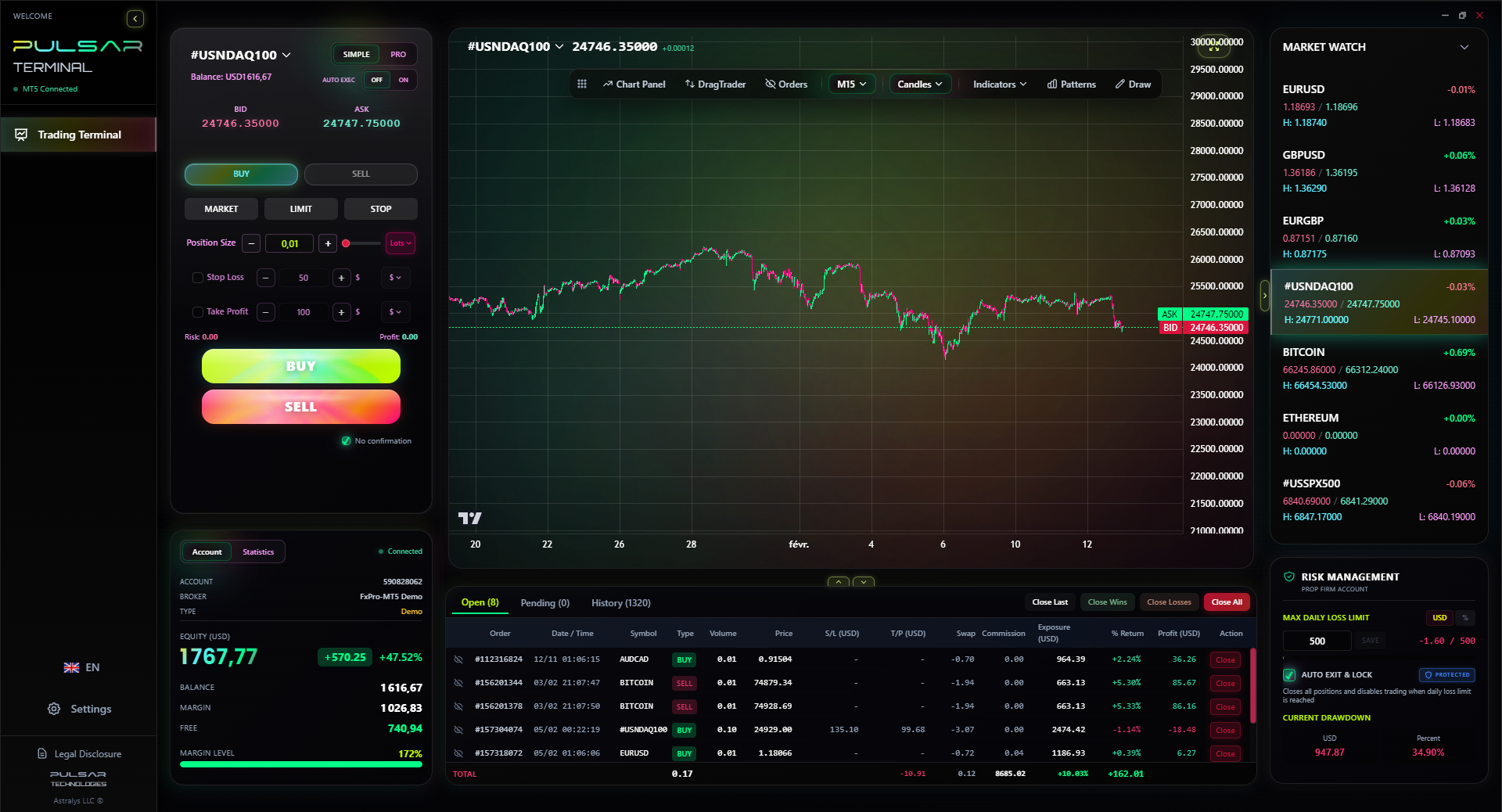
Managing trades under the strict U.S. FIFO rule requires precision, which is where a tool like Pulsar Terminal's drag-and-drop order management on MT5 becomes indispensable.
Pulsar Terminal
The all-in-one MT5 companion: drag-and-drop orders, multi-TP/SL, trailing stop, grid trading, Volume Profile, and prop firm protection. Used by 1,000+ traders daily.
Twelve years in, here's what I wish someone had told me in Houston instead of Dallas.
First, treat the cost of a course as your first risk capital. If you can't afford to lose the course fee, you can't afford to trade. Start with a demo account, but know that it's a lie. The psychology is completely different. Move to a live micro account with a few hundred dollars as soon as you have a plan. The goal isn't profit; it's to execute your plan under real emotional pressure.
Second, specialize. Texas has major economic ties to energy and Mexico. This creates unique flows in pairs like USD/MXN or even CAD pairs. While I mostly trade majors like EUR/USD and XAU/USD (gold), understanding how oil prices move the Canadian dollar has given me an edge. Find a niche and know it better than anyone.
Finally, build your system before you take a course. Try to learn the basics for free from reputable sources. Then, use the course to fill the specific gaps in your knowledge - maybe it's their specific risk management framework or their read on order flow. You'll get 10x more value if you're not starting from zero.
“Treat the cost of a course as your first risk capital. If you can't afford to lose the fee, you can't afford to trade.”
A course gives you a foundation. The building is up to you. Your education never stops.
1. The Trading Journal is Your Real Teacher: This isn't optional. Record every trade: entry, exit, spread, time, the chart setup, and - critically - your emotional state. Review it weekly. You'll find your personal pitfalls. I found I was terrible at trading the 30 minutes after major U.S. news releases. So I stopped. Problem solved.
2. Follow the Right Voices: Don't follow tipsters. Follow economists, central bank watchers, and market analysts. Understand why the Fed's rate decisions move the dollar. In 2024, catching the shift from hikes to cuts was a huge opportunity.
3. Technology is Your Co-Pilot: Use tools to enforce your discipline. This is where platforms and add-ons shine. Setting automated alerts for key levels means you don't have to stare at the screen, reducing emotional fatigue.
The market will humble you. I've had winning streaks of 15 trades and losing streaks of 8. The course that prepares you for that psychological rollercoaster, within the strict U.S. rulebook, is the one that's truly valuable.
💡 Winston's Tip
Your trading journal will teach you more about yourself than any course ever will. The course gives you the language; the journal writes your story.
FAQ
Q1Are online forex trading courses from outside Texas legal for U.S. residents?
Yes, taking an online course from anywhere in the world is perfectly legal. The critical issue is the content. Many international courses teach strategies using high use, hedging, or other techniques prohibited for U.S. retail traders. You must adapt their lessons to fit within the 1:50 use, FIFO, and no-hedging rules enforced by the CFTC.
Q2How much should I expect to pay for a good forex trading course in Texas?
Prices vary wildly. A 1-day intensive like The Knowledge Academy masterclass can cost several hundred dollars. complete mentorship programs like FXD Sniper or WealthWay can run into the thousands. My rule: don't pay more than you're willing to completely lose. View it as an investment in education, not a ticket to profits. There are also many high-quality, free resources from regulated U.S. brokers to start with.
Q3Can I use MetaTrader 5 (MT5) with U.S. brokers in Texas?
Yes, but not all U.S. brokers offer it. FOREX.com supports MT5, which is great because it's a more advanced platform than MT4. However, due to U.S. regulations, even on MT5, you are still bound by the 1:50 use limit and FIFO rule. The platform itself doesn't override national regulations.
Q4What's the single most important thing a Texas forex course should teach?
Without a doubt, it's risk management tailored to U.S. use limits. A strategy that requires 1:200 use to work is dead on arrival here. The course must teach you how to calculate position sizes that make sense with 1:50, how to set stops that don't get you wiped out by normal volatility, and how to build equity slowly and sustainably.
Q5Is it better to learn forex trading in a classroom setting or online?
It depends on your learning style. If you need structure and direct interaction, a local Texas classroom or live online mentorship (like FXD Sniper offers) is better. If you're self-motivated and prefer to learn at your own pace, a well-structured online course with community support can be just as effective. The key is the quality of the content and the instructor's engagement, not the delivery method.
Q6After taking a course, how much starting capital do I really need in Texas?
This is crucial. With 1:50 use, you need more capital to see meaningful returns without taking insane risks. You can technically start with $100 at some brokers, but realistically, I'd say a $2,000-$5,000 account allows you to practice proper position sizing (risking 0.5-1% per trade) and actually learn money management without being stopped out by a few bad trades. Never trade with money you can't afford to lose.
Prof. Winston's Lesson
Key Takeaways:
- ✓U.S. regulations (1:50 use, FIFO) dictate your entire strategy.
- ✓A valid course focuses on risk management above all else.
- ✓Always verify a course teaches legal U.S. practices.
- ✓Pair your education with a stable, CFTC-regulated broker.
How useful was this article?
Click a star to rate
Weekly Trading Insights
Free weekly analysis & strategies. No spam.
About the Author
James Mitchell
Senior Trading Analyst
Based in New York with over 9 years of trading experience. Focuses on major USD pairs, prop firm challenges, and the US regulatory landscape.
Comments
Risk Disclaimer
Trading financial instruments carries significant risk and may not be suitable for all investors. Past performance does not guarantee future results. This content is for educational purposes only and should not be considered investment advice. Always conduct your own research before trading.
You Might Also Like

Cara Trading Forex Sukses: 7 Prinsip dari Trader Profesional
Cara trading forex sukses dengan 7 prinsip trader pro: manajemen modal, disiplin, journal trading, backtest. Data nyata, bukan janji profit palsu.
Jam Trading Forex Terbaik untuk Trader Indonesia: Panduan Lengkap dengan Tabel Waktu
Panduan jam trading forex untuk trader Indonesia. Tabel 4 sesi dunia, jam emas 20:00-00:00, sesi mana yang harus dihindari. Data akurat + tips dari trader berpengalaman.
Top 5 Sàn Forex Uy Tín Nhất 2026: Review Jujur dari Trader Indonesia
Top 5 sàn forex uy tín 2026 untuk trader Indonesia. Review jujur: spread, deposit, withdraw, dukungan lokal. Exness, XM, IC Markets & lebih.
Get Pulsar Terminal
All these calculators are built into Pulsar Terminal with real-time data from your MT5 account. One-click position sizing, automatic risk management, and instant calculations.
Get Pulsar Terminal