


You're probably asking yourself: is there really a 'best' Expert Advisor that can just print money while I sleep? I spent years and a decent chunk of my own capital trying to find out.

David van der Merwe
Emerging Markets Trader ·  South Africa
☕ 11 min read
What you'll learn:
You're probably asking yourself: is there really a 'best' Expert Advisor that can just print money while I sleep? I spent years and a decent chunk of my own capital trying to find out. The short answer is no, there's no magic bullet. But the real answer is more nuanced. Finding a reliable EA isn't about chasing mythical 100% win rates; it's about matching a tool's logic to your broker's conditions, your risk tolerance, and the brutal reality of the ZAR market. Let me walk you through what I've learned, the expensive mistakes I made, and how to actually use automation to your advantage without getting cleaned out.
An Expert Advisor (EA) is just a piece of software that runs on MetaTrader 4 or 5. You attach it to a chart, and it places and manages trades based on its programmed rules. No emotions, no second-guessing. Sounds perfect, right?
Here's where it gets real for us in South Africa. Our market isn't like trading from London or New York. First, you've got the FSCA's use cap of 30:1 for retail traders. That immediately changes the math for any EA built for 500:1 use you might find online. An EA that over-leverages on a foreign broker's demo will blow your FSCA-regulated account here.
Then there's the Rand. It's a wild animal. An EA that works smoothly on EUR/USD might choke on USD/ZAR's volatility. I learned this the hard way in 2020. I bought a popular 'grid' EA that performed beautifully on majors in backtests. I ran it on USD/ZAR. The spread widened during a news event, the EA kept placing orders trying to catch the mean reversion, and I got a margin call for R8,000 before I could manually intervene. The EA didn't understand local liquidity.

Warning: Never run an EA on a ZAR pair without extensive demo testing that includes South African market hours (7am-5pm SAST). The liquidity and spread behavior are unique.
Finally, your choice of broker is critical. Not all EAs play nice with all broker types. An EA designed for ECN raw spreads will haemorrhage money on a standard account with a 2-pip spread on EUR/USD. You need to match the tool to the environment.
My single most expensive lesson cost me R15,000. It was for an EA sold with gorgeous backtests showing exponential equity curves. The sales page was all about 'set and forget.' I funded an account at a broker I didn't usually use (big mistake), loaded it up, and let it run. For two weeks, it made small, steady profits. Then, in one night, it placed 47 micro-lots on GBP/JPY during a quiet Asian session. A spike hit, all positions went negative, and it didn't have a hard stop-loss coded. Wiped the account.
The problem? I bought the EA's story, not its logic. I never understood how it opened positions, how it managed risk, or what market conditions it was designed for. I just trusted a pretty graph.

Pro Tip: If you can't explain an EA's core strategy in one simple sentence (e.g., 'It trades breakouts on the 15-minute chart using the ATR for stops'), don't trade it. You must understand its engine to know when it's broken.
Now, I treat EA purchases like hiring an employee. I interview them (demo test), I understand their job description (the strategy), and I monitor their performance. Never, ever go live based on a vendor's statement alone. Always use a position size calculator with ultra-conservative numbers when you start testing with real money.

💡 Winston's Tip
An EA is a disciplined employee, not a genius. Hire it to follow rules, not to think. Your job is to manage the risk and fire it if the market changes.
“I bought the EA's story, not its logic. That R15,000 lesson taught me to never trust a pretty graph again.”
The EA landscape changes. What worked in 2020 might fail now. Based on current market structure, here's what I'm looking for.
1. Adaptive Risk Management: This is non-negotiable. The EA must have a way to reduce lot size after a loss or during high volatility. Static lot sizes are a one-way ticket to ruin. Look for settings that tie position size to account equity or use volatility metrics like ATR.
2. Broker & Spread Compatibility: A good EA will have settings to check spread before entry. If the spread on USD/ZAR jumps from 50 to 300 pips (it happens), the EA should skip the trade. This saved me countless times with my current setup.
3. Time & Session Controls: The best EA for forex trading in South Africa needs to know when not to trade. It should let you lock it out during major news events (like SARB announcements or local budget speeches) and during illiquid sessions if it's not designed for them.
4. Simple Logic Over Complexity: The most strong EAs I've used have 3-4 clear entry conditions. The ones with 15 oscillators and 10 moving averages always overfit the past data and fail in real-time. I'd take a simple MACD indicator crossover EA I understand over a 'neural network' black box any day.
5. Reliable Backtesting & Forward Testing: Don't just look at the profit. Look at the maximum drawdown. If the backtest shows a 40% drawdown, can your psychology handle that? You must then forward test on a demo for at least 2-3 months, through different market phases.
Let's break down common EA types and their reality check for a South African trader.
Trend-Following EAs
These try to catch big moves. They work brilliantly in strong, sustained trends (like USD strength in early 2025) and can make fantastic returns. The catch? They get chopped to pieces in ranging markets. You need the discipline to endure 5-10 losing trades in a row waiting for the big winner. Most people quit the EA right before the trend starts.
Grid & Martingale EAs
These place buy and sell orders at set intervals, aiming to profit from market oscillations. They're seductive because they show constant small profits. I call them 'account assassins.' They work until a strong trend comes along that doesn't reverse. Then, you run out of margin. Given the ZAR's propensity for sharp, trending moves, I consider these exceptionally dangerous for local traders.
Mean Reversion EAs
These bet that price will return to an average. They can work well in ranging markets on pairs like EUR/USD. However, on a pair like USD/ZAR, which can trend for weeks on commodity flows, they can be just as dangerous as grid systems.
Price Action & Breakout EAs
My personal preference. These wait for consolidation and then trade the breakout. They have clearer logic (trade when price moves beyond a recent high/low) and defined stop-loss points. They lose more often than they win, but their risk-to-reward ratios are better. This suits a swing trading mindset.

Example: My main EA is a breakout type. It wins about 45% of the time. But its average winner is 2.8 times the size of its average loser. That's a mathematical edge I can understand and trust, even during losing streaks.
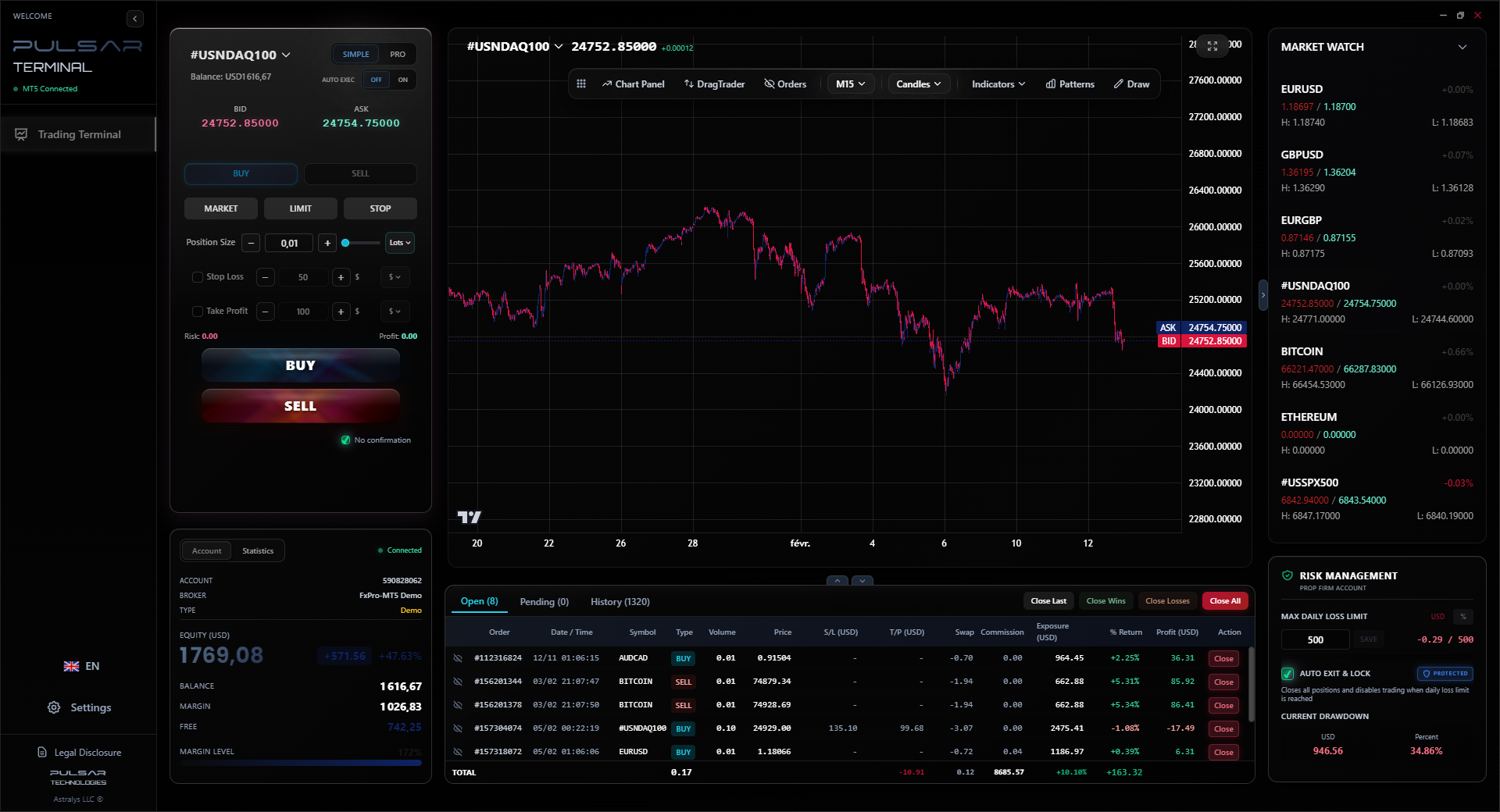
Managing multiple take-profit levels and trailing stops is a headache for any EA strategy, but tools like Pulsar Terminal automate this directly on your MT5 chart, letting you focus on strategy instead of order management.
Pulsar Terminal
The all-in-one MT5 companion: drag-and-drop orders, multi-TP/SL, trailing stop, grid trading, Volume Profile, and prop firm protection. Used by 1,000+ traders daily.
“Automation is a tool for implementing your strategy, not for creating one.”
Your EA is only as good as its execution. Here’s a blunt comparison of what matters for automated trading with local brokers.
| Broker | FSCA Regulated? | Key for EAs | The Catch for Automation |
|---|---|---|---|
| IC Markets | Via global entity (ASIC) | Raw spreads (0.0 pips on EUR/USD), fast execution. | Not a direct FSCA entity, but widely used by SA algo traders for pricing. |
| FP Markets | Via juristic rep | Excellent ECN pricing, supports MT4/MT5. | Same as above. You're dealing with their international entity. |
| XM Group | Yes (FSP #) | Low min deposit ($5), good for small EA tests. | Spreads on standard accounts can widen. |
| AvaTrade | Yes (FSP #45984) | Fixed spreads, stable for certain EA logic. | Inactivity fees, and fixed spreads are wider on average. |
| Tickmill | Yes | Very competitive spreads, good execution. | A solid all-rounder for EAs. |
The Funding Headache: You must fund these accounts through the proper exchange control channels. Use your R1 million single discretionary allowance or the larger R10 million foreign capital allowance. I fund my international broker via a bank transfer as an 'investment,' and I keep every single receipt and SARS declaration. If your bank blocks it, you're not following the correct process. Using a ZAR-denominated account with a local broker like Khwezi can simplify this but may limit your EA's potential due to higher spreads.
The Tax Reality: SARS wants its share. Every trade your EA makes is a taxable event. You need a broker that provides a detailed, downloadable trade history statement. I use a simple spreadsheet to track my EA's daily P&L, because at tax time, 'my robot did it' is not an excuse. This is non-negotiable.
💡 Winston's Tip
The 'edge' of an EA isn't just its win rate. It's (Win Rate * Avg Win) - (Loss Rate * Avg Loss) - Trading Costs. If that number isn't strongly positive in long-term testing, you're just donating to the broker.
Let me be vulnerable. I've blown up two accounts with EAs. The first was the R15,000 grid disaster I mentioned. The second was a R25,000 account in 2022. I was using a trend-following EA on a standard account with Pepperstone (ASIC). The spreads were low, but commissions killed the edge. The EA made 100 trades a month. At $7 round turn per lot, that was $700 in commissions. The EA made $800 in profit. My net gain was $100, or about R1,800 at the time. For the risk and drawdown, it was pathetic. I was profitable, but only for the broker.
The turnaround came when I switched my focus from 'profit' to 'costs and logic.'
My Current Setup (2024-2026):
- Broker: I use an ECN account with IC Markets. The spreads are near zero, and I pay a commission. This is essential for my high-frequency breakout EA.
- EA: A custom-coded breakout EA. I paid a developer R5,000 to build it to my specs. Logic: It identifies a 24-hour range, waits for a pullback, and enters on a break of the high/low with a 1:2 risk-reward. Stop-loss is based on ATR.
- Results (12-month period, real account): Starting capital: R50,000. Total trades: 487. Win Rate: 41%. Total Profit: R18,550. Max Drawdown: R6,200 (12.4%). Commissions & Spreads Paid: ~R3,100.
It's not glamorous. It's a 37% return with controlled risk. The key? I know every line of its logic. When it has a losing week (and it does), I don't panic and shut it off. I know it's working as designed.
“Our market isn't like trading from London or New York. The Rand is a wild animal, and your EA needs to know that.”
This is the ultimate crossroads.
Buying an EA:
- Pros: Quick, less technical knowledge needed.
- Cons: Expensive (good ones cost R5,000-R50,000), you don't own the logic, they can become obsolete, and 95% are scams.
- My Rule: Only buy from communities with verifiable, long-term real performance (like MyFxBook live tracks for years). Never from a flashy sales page.
Building an EA:
- Pros: You control everything. It fits your exact strategy. Once built, the cost is zero.
- Cons: You need to learn MQL4/5 coding (steep curve) or pay a developer.
- The Hybrid Path (What I Did): I learned to code simple strategies myself. For anything complex, I hire a coder on a site like Freelancer or MQL5.com. I provide the exact trading rules in painstaking detail (entry, exit, money management, error handling). I pay by the hour for testing and tweaks. This gives me full ownership.
Pro Tip: Before you hire a coder, trade your strategy manually for at least 50 trades. Write down every rule, every exception. This 'trading manual' becomes your developer's brief. It saves thousands in revision fees.
💡 Winston's Tip
Before you automate a strategy, you must be able to trade it manually and be profitable. Automation magnifies efficiency, not incompetence. If you lose manually, the EA will just lose faster.
Don't rush this. Going live is the last step.
- Demo Test: Minimum 3 months on a demo account that mimics your live broker's spreads and execution. Don't cheat by using a perfect demo.
- Strategy Understanding: Can you explain the EA's core rule? If not, go back to step one.
- Risk Check: Use your position size calculator. Set the EA's lot size so that the maximum historical drawdown would not lose more than 15-20% of your account. Be conservative.
- Broker Sync: Is your live broker type (ECN vs Standard) the same as your demo? Are you sure about the swap rates, commissions, and deposit/withdrawal process?
- Infrastructure: Do you have a stable, always-on internet connection? A VPS (Virtual Private Server) is a R200-R400/month investment that's worth every cent. It runs your MT4 and EA 24/7 from a data center.
- Monitoring Plan: You are not 'set and forget.' You are 'set and monitor.' Schedule a 10-minute daily check to ensure it's running, hasn't errored, and the market conditions are normal.
- Psychological Prep: Are you ready to watch it lose for two weeks straight without interfering? If not, you're not ready.
Automation is a powerful tool, but it's a tool for implementing your strategy, not for creating one. The 'best EA for forex trading' is the one that faithfully executes a strategy you understand and trust, on a broker that doesn't eat your edge, with a risk level that lets you sleep at night. It took me years and significant losses to internalize that. I hope this guide helps you get there faster and cheaper than I did.
FAQ
Q1Is forex trading with EAs legal in South Africa?
Yes, absolutely. Using Expert Advisors for automated trading is completely legal. The key is to trade through a broker that is either directly regulated by the Financial Sector Conduct Authority (FSCA) or a reputable international regulator. The legality of the tool isn't the issue; it's the legality and safety of the broker you use it with.
Q2What is the best broker in South Africa for running EAs?
There's no single 'best,' as it depends on your EA's strategy. For EAs that make many trades (like scalpers), you need a broker with ultra-low, stable spreads and fast execution, such as IC Markets or FP Markets. For slower EAs, a locally FSCA-regulated broker with a ZAR account might be more convenient for funding. Always prioritize execution quality over minor differences in minimum deposit.
Q3How much money do I need to start trading with an EA?
I strongly advise not starting with less than R20,000. Why? You need a buffer. Even a good EA will have drawdowns. Starting with R5,000 means a 20% drawdown (R1,000) could trigger emotional shutdown or over-use. With R20,000, that same R1,000 loss is only 5%. This psychological space is critical for letting the EA's edge play out over time.
Q4Do I need a VPS to run an EA?
If you plan to run the EA 24/5, yes, it's essential. Your home PC loses power, your internet drops, you close your laptop. A Virtual Private Server (costing ~R300/month) runs MetaTrader and your EA from a secure data center with no downtime. It's a small operational cost that protects your trading capital.
Q5How are EA profits taxed by SARS?
SARS views frequent forex trading profits as income from a business or trade. This means your net profit (total wins minus total losses, minus allowable expenses like data, VPS fees, broker commissions) is added to your other income and taxed at your marginal rate. You must keep impeccable records of every trade statement. The EA does the trading, but you are 100% responsible for the tax liability.
Q6Can I use a free EA from the internet?
You can, but be extremely cautious. Many are outdated or contain hidden 'gotchas.' Some might even have malicious code. Always, always test a free EA on a demo account for a full quarter before considering it for live funds. Understand its logic completely. Often, free EAs are simplistic and won't hold up in live markets, but they can be a good starting point for learning.
Q7What's a realistic monthly return from a good EA?
Anyone promising more than 5-10% per month consistently is likely lying or taking insane risk. My own EA, which I consider strong, averages about 2-4% per month after costs. In a great trending month, it might hit 8%. In a bad choppy month, it might lose 3%. The goal is consistent, risk-managed growth over years, not explosive monthly gains that inevitably blow up.
Prof. Winston's Lesson
Key Takeaways:
- ✓Test any EA for 3+ months on a demo matching your live broker.
- ✓Understand the core strategy in one simple sentence.
- ✓Prioritize ECN brokers for low-cost, high-frequency EAs.
- ✓Factor all costs: spread, commission, swap, VPS.
- ✓Never risk more than 2% of capital on any single EA trade.
How useful was this article?
Click a star to rate
Weekly Trading Insights
Free weekly analysis & strategies. No spam.
About the Author
David van der Merwe
Emerging Markets Trader
Johannesburg-based trader with 11 years in emerging market currencies. Specializes in ZAR pairs, FSCA-regulated trading, and South African market analysis.
Comments
Risk Disclaimer
Trading financial instruments carries significant risk and may not be suitable for all investors. Past performance does not guarantee future results. This content is for educational purposes only and should not be considered investment advice. Always conduct your own research before trading.
You Might Also Like

Cara Trading Forex Sukses: 7 Prinsip dari Trader Profesional
Cara trading forex sukses dengan 7 prinsip trader pro: manajemen modal, disiplin, journal trading, backtest. Data nyata, bukan janji profit palsu.
Jam Trading Forex Terbaik untuk Trader Indonesia: Panduan Lengkap dengan Tabel Waktu
Panduan jam trading forex untuk trader Indonesia. Tabel 4 sesi dunia, jam emas 20:00-00:00, sesi mana yang harus dihindari. Data akurat + tips dari trader berpengalaman.
Top 5 Sàn Forex Uy Tín Nhất 2026: Review Jujur dari Trader Indonesia
Top 5 sàn forex uy tín 2026 untuk trader Indonesia. Review jujur: spread, deposit, withdraw, dukungan lokal. Exness, XM, IC Markets & lebih.
Get Pulsar Terminal
All these calculators are built into Pulsar Terminal with real-time data from your MT5 account. One-click position sizing, automatic risk management, and instant calculations.
Get Pulsar Terminal