


Here's a hard truth: 90% of traders who pick a 'perfect' broker based on a guru's recommendation still lose their accounts within a year.
James Mitchell
Senior Trading Analyst
☕ 10 min read
What you'll learn:
- 1Why Most Asia Forex Mentor Students Fail (It's Not the Course)
- 2The 3 Non-Negotiable Broker Criteria (Forget the Bonuses)
- 3Top Broker Candidates for AFM Strategies (A Realistic Review)
- 4The Account Type Trap: Standard, Raw, Zero?
- 5MT4, MT5, and the Tools You Actually Need
- 6Position Sizing: The Real Secret No Broker Will Tell You
- 7The Boring Stuff That Saves You: Verification & Taxes
- 8The Final Step Before You Deposit

Here's a hard truth: 90% of traders who pick a 'perfect' broker based on a guru's recommendation still lose their accounts within a year. The problem isn't the broker list. It's the mismatch between a student's strategy, psychology, and the raw mechanics of the platform they're using. I've seen Asia Forex Mentor students nail the theory but get wrecked by slippage on news trades or margin calls from poor position sizing. Let's cut through the hype and talk about what actually matters when you're putting real money on the line.
Axeel's course is solid. The psychology and price action frameworks are legit. I know, because I used similar concepts to turn a corner in my own trading. The failure point isn't the education. It's the transition from simulated perfection to messy, real-world execution.
Students learn a clean strategy, then go to a broker with wide spreads that eat their 1:1 risk-reward for breakfast. They practice on a demo with instant fills, then get partial fills on a live account during London open, throwing their entire plan out the window. The emotional gap between theory and practice is where accounts get vaporized.
I made this exact mistake. After my first mentorship, I funded an account with a well-marketed broker. My first real trade was a textbook pin bar rejection on the GBP/USD. I entered, my stop was 15 pips away. The spread was normally 2 pips. On entry? It widened to 8 pips instantly. I was down 8 pips before the market even moved. That's not trading, that's getting mugged by your broker's execution desk. I closed the trade for a loss, frustrated, and broke my number one rule: I doubled my size on the next setup to 'make it back.' You can guess how that ended.

Warning: The broker you choose is a strategic variable in your system. A scalping strategy will die at a broker with high latency and wide spreads, just as a swing trading strategy will bleed to death from overnight swap fees at the wrong broker.

If you're serious, you'll ignore the deposit bonus and the 'free VPS' offers. They're distractions. Your broker is your connection to the market. You need a clear, fast, and honest pipe. Here's what to test, in order of importance.
1. Execution Quality & Slippage
This is everything. Does your limit order get filled at the price you set, or does it 'slip' a pip or two against you? On stop entries, does it fill you at the worst possible price during volatility? You need a true ECN/STP broker that passes your order directly to liquidity providers. Test this yourself. Place small limit orders in a live account (even a $100 one) during quiet hours and volatile hours (like during the EUR/USD guide London-New York overlap). Compare your requested price to your filled price.
2. Spreads & Commissions (The Total Cost)
Look at the all-in cost. A 'zero spread' account that charges a $7 round-turn commission per lot is often more expensive than a raw spread account with a 1.0 pip spread. Calculate your cost per trade for your typical position size. For a scalping strategy, this cost is your primary enemy. For swing trades, it's less critical, but it still adds up.
3. Withdrawal Reliability & Safety
Can you get your money out? And how long does it take? This is the ultimate test of a broker's legitimacy. Read independent reviews - not just the glossy ones on their site. Look for patterns. Do people complain about 'verification delays' that magically appear when they're in profit? A good broker processes withdrawals in 1-3 business days, no drama.

Example: Let's say you trade 2 lots of EUR/USD. Broker A has a 0.8 pip spread, no commission. Cost: 0.8 pips * 2 lots = $16. Broker B has a 0.1 pip spread but a $5 per lot commission. Cost: (0.1 pips * 2 lots = $2) + ($5 commission * 2 lots * 2 sides = $20) = $22. Broker B is actually more expensive.

💡 Winston's Tip
A broker's customer service is best tested when you're trying to withdraw profits, not when you're depositing. Their speed and attitude then tells you everything.

“Your broker will happily let you trade with 500:1 use. This is how you get a margin call.”
I'm not going to give you a lazy 'top 5' list. Based on the criteria above and what works with price action trading (needing clean charts and fast execution), here are brokers I've used or have had serious students report back on. Remember, your location matters for regulation and availability.
| Broker | Best For | Key Strength | Potential Drawback |
|---|---|---|---|
| IC Markets | Raw Spread Scalping | Consistently tight spreads, true ECN execution. One of the best raw feeds for active traders. | Their platform can be overwhelming for beginners. Customer service is functional, not coddling. IC Markets review has more details. |
| Pepperstone | All-Rounder Reliability | Excellent execution via Razor account, very reputable ASIC regulation, great for both manual and algo traders. | Slightly higher minimum deposit than some. Their commission structure can be confusing at first glance. Pepperstone review. |
| Exness | Traders in Restricted Regions | Unique offerings for certain countries, allows for very small cent account trading. | Model varies by region; not always pure ECN. Do your due diligence on the specific entity you're signing up with. Exness review. |
I have personal live account experience with IC Markets and Pepperstone. My IC Markets Raw Spread account shows an average EUR/USD spread of 0.1 pips on the history. That's the real deal. But I keep a Pepperstone account for when I want to run a longer-term swing trading idea with more comfort on the regulatory side.

Pro Tip: Don't just pick one from a list. Open a demo AND a tiny live account ($100-200) with your top two choices. Trade them side-by-side for a month. The difference in feel, fills, and costs will be glaringly obvious. This is the only research that matters.
This is where new traders get paralyzed. It's simpler than it looks.
- Standard/Commission-Free Accounts: The broker adds a mark-up to the spread to make their money. It's simple, but you often pay more in the long run, and spreads can widen dramatically. Avoid these if you're trading frequently or with precise entries.
- Raw Spread/ECN Accounts: You get the raw interbank spread (often 0.0 pips on majors) but pay a commission per lot. This is almost always cheaper for active traders. The cost is transparent and consistent. This is what I use for 90% of my trading.
- 'Zero' Spread Accounts: A marketing term. Usually, it's a raw spread account. Read the fine print for the commission.
For an Asia Forex Mentor student trading price action, you want to see the purest price movement possible. A raw spread account on MT4 or MT5 gives you that. The spread definition is a fixed, known cost (the commission), not a variable one that can jump and kill your stop-loss placement.
I learned this after blowing a $500 account. I was on a standard account, trying to scalp. A news event hit, the spread on GBP/JPY blew out to 15 pips. My stop-loss, which I thought was 10 pips away, was instantly triggered because the spread widened through it. The trade never had a chance. That loss was 100% due to my poor broker/account type choice, not my analysis.

“The real edge doesn't come from the platform itself, but from how you use it.”
AFM teaches on MT4. It's the industry standard for a reason: stable, ubiquitous, and supports countless custom indicators. MT5 is more powerful (better backtesting, more timeframes) but not all brokers offer it, and the script language is different.
Stick with MT4 unless you have a specific need for MT5's features. The real edge doesn't come from the platform itself, but from how you use it.
You need two things from your platform:
- Reliability: It shouldn't freeze during news. Ever.
- Order Management Efficiency: Can you set a stop-loss and take-profit quickly? Can you move stops to breakeven without fumbling?
This is where third-party tools become force multipliers. Manually moving stops for 5 trades while the market is moving is a great way to make a mistake. I started using a trade management terminal that let me set a trailing stop or move all stops to breakeven with one click. It removed emotion and hesitation. If you're trading multiple lots, being able to set multiple take-profit levels (scaling out) is a game-saver for psychology. You bank some profit early and let the rest run.
Drawing tools matter, too. Clean trend lines, easy Fibonacci retracements - if your platform's tools are clunky, you'll start skipping your analysis. Don't let a bad toolset break your process.
💡 Winston's Tip
If you find yourself constantly blaming 'spread widening' or 'slippage' for your losses, the problem is 90% likely your entry timing and 10% the broker. Fix your strategy first.

This is the single most important paragraph in this article. Your broker will happily let you trade with 500:1 use. They'll show you how a $1,000 account can control $500,000. This is how you get a margin call.
use is a tool, not a goal. Asia Forex Mentor teaches risk management, and you must apply it ruthlessly. I don't care if your broker offers 1000:1. You should never, ever use more than 10:1 effective use on your account balance.
Here's my rule, born from pain: Risk 1% of your account per trade. Full stop. On a $5,000 account, that's $50. If your stop-loss is 20 pips away on the EUR/USD, your position size calculator tells you to trade 0.25 lots. Not 1 lot. Not 2 lots. 0.25 lots.
In 2018, I had a 7-trade winning streak. I felt invincible. I increased my risk to 3% per trade. The 8th trade was a loss. The 9th was a loss. In two trades, I gave back 40% of the profits from the previous 7. My psychology was shattered. I broke my system. All because I got greedy and my broker's high use made it seductively easy to do so. The best forex broker asiaforexmentor students use is the one that allows them to implement tiny, disciplined position sizes without friction.
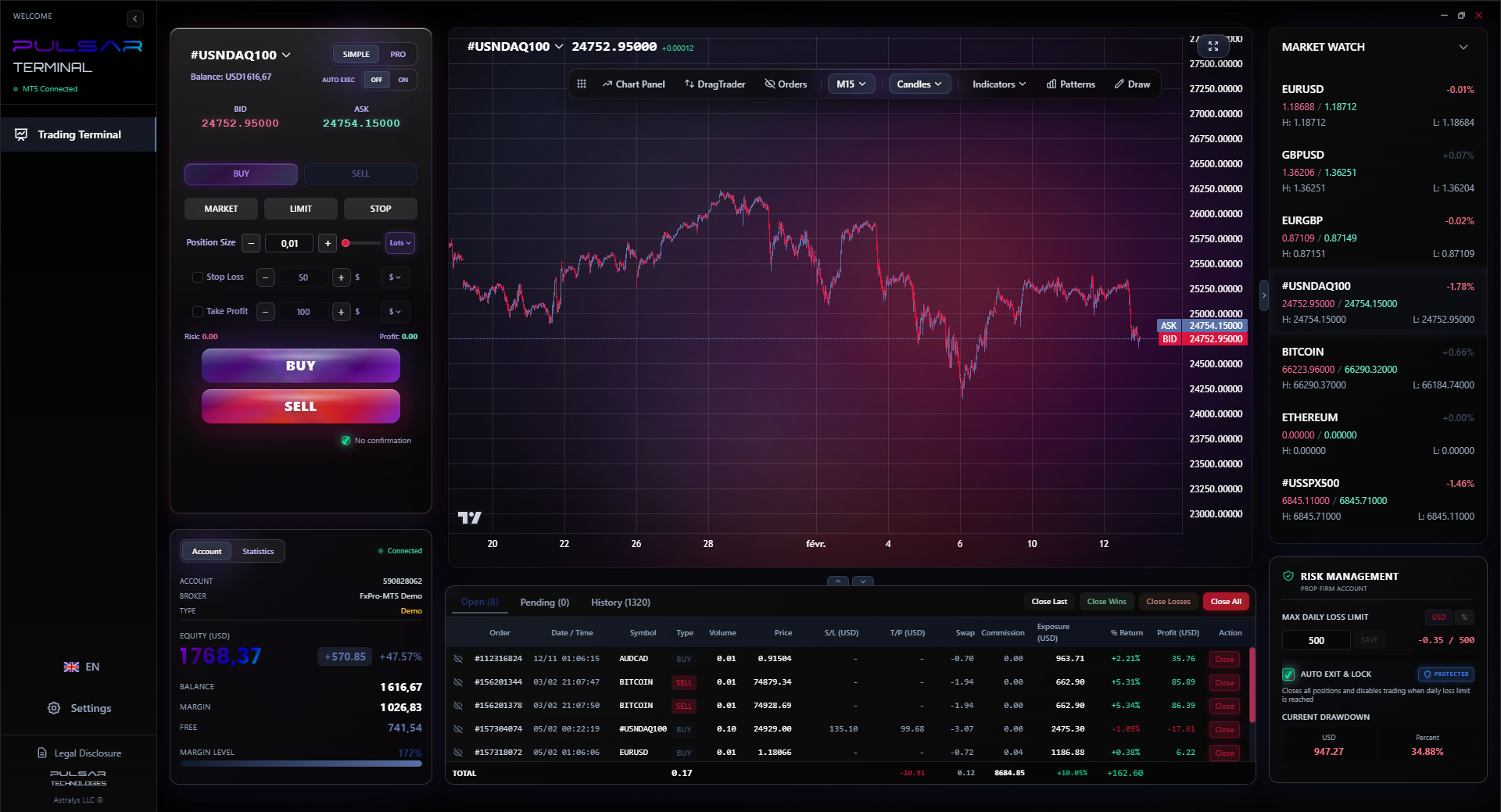
Managing multiple trades and moving stops to breakeven manually is error-prone; a tool like Pulsar Terminal automates this directly on your MT4/MT5 platform, enforcing the discipline AFM teaches.
Pulsar Terminal
The all-in-one MT5 companion: drag-and-drop orders, multi-TP/SL, trailing stop, grid trading, Volume Profile, and prop firm protection. Used by 1,000+ traders daily.
“Take 20% of the amount you were going to deposit and fund the account with that. Trade it for one full month.”
Pick a broker regulated in a serious jurisdiction (ASIC, FCA, CySEC). This means they must segregate client funds. Your money isn't their operating capital. When you sign up, they will ask for ID and a proof of address. Do this immediately. Don't wait until you're in profit and want to withdraw, because that's when they'll freeze your account until you comply, potentially while a good trade is running.
And talk to a local accountant about taxes before you become consistently profitable. Is forex trading capital gains or income in your country? What records do you need to keep? Your broker will give you a trade history statement at year-end. Keep your own log as well. The tax man doesn't care about your MACD indicator divergence. He cares about numbers. Getting this wrong can wipe out a year of profits.
You've done your research. You've picked a broker with tight spreads, raw execution, and good regulation. You've decided on an ECN account. Stop.
Take 20% of the amount you were going to deposit and fund the account with that. Trade it for one full month. With real money. Go through the full cycle: deposit, execute trades, request a small withdrawal.
Does the execution match the demo? Was the withdrawal processed in 48 hours as promised? Did you encounter any hidden fees? This live, small-scale test is your final audit. It's cheap insurance. If something feels off, you can walk away having lost only a little time and a tiny amount of money, not your entire trading capital.
The best forex broker asiaforexmentor principles align with isn't a brand name. It's the broker that becomes an invisible, reliable partner. One that executes your orders faithfully, charges a fair price, and gets out of the way so you can focus on what actually matters: your trading decisions.
FAQ
Q1Does Asia Forex Mentor officially recommend a specific broker?
No, and any reputable educator shouldn't. Broker suitability depends entirely on your location, strategy, and account size. AFM provides principles; you must do the legwork to find a broker that aligns with them, focusing on execution and cost structure.
Q2I have a small account ($500). Which broker is best?
Focus on brokers with low minimum deposits for their ECN/Raw accounts (some go as low as $200). Pepperstone and IC Markets are good starts. Crucially, you must use micro-lots (0.01). With a $500 account, risking 1% ($5) means your position size will be tiny. This is normal and correct. Don't chase high use to trade bigger.
Q3What's more important, low spreads or low commissions?
The total cost per trade. Calculate it. For most active traders on majors, a raw spread account with a commission is cheaper than a wide, commission-free spread. Use the example in the article: (Spread in pips * Lot Size) + (Commission * Lots * 2) = Total Cost. Compare.
Q4Is MetaTrader 4 or 5 better for AFM strategies?
MT4 is perfectly sufficient. The price action concepts are platform-agnostic. MT5 has advantages for advanced backtesting and trading more asset types, but its different scripting language means some custom MT4 indicators won't work. If you're starting out, the widespread support and stability of MT4 is the pragmatic choice.
Q5How do I test a broker's execution before funding?
You can't fully test it without real money. Demos often have perfect, idealized execution. The only true test is to open a live account with the minimum deposit, place a few small market and limit orders during different session overlaps (like London open), and compare your requested price to your filled price in the account history. Then, request a $50 withdrawal to test that process.
Q6I'm in a country with limited broker options. What should I do?
Safety first. Use a broker regulated by a major authority that accepts clients from your region, even if costs are slightly higher. Exness has a wide reach, but verify the specific regulatory entity you're under. Never use an unregulated broker for the sake of lower costs; you're risking your entire capital.
Prof. Winston's Lesson
Key Takeaways:
- ✓Test execution with a small live account, not a demo.
- ✓Calculate total cost (spread + commission), not just one.
- ✓Never use more than 10:1 effective use.
- ✓Risk 1% per trade, regardless of account size.
- ✓Withdrawal reliability is the ultimate broker test.
How useful was this article?
Click a star to rate
Weekly Trading Insights
Free weekly analysis & strategies. No spam.
About the Author
James Mitchell
Senior Trading Analyst
Based in New York with over 9 years of trading experience. Focuses on major USD pairs, prop firm challenges, and the US regulatory landscape.
Comments
Risk Disclaimer
Trading financial instruments carries significant risk and may not be suitable for all investors. Past performance does not guarantee future results. This content is for educational purposes only and should not be considered investment advice. Always conduct your own research before trading.
You Might Also Like

Cara Trading Forex Sukses: 7 Prinsip dari Trader Profesional
Cara trading forex sukses dengan 7 prinsip trader pro: manajemen modal, disiplin, journal trading, backtest. Data nyata, bukan janji profit palsu.
Jam Trading Forex Terbaik untuk Trader Indonesia: Panduan Lengkap dengan Tabel Waktu
Panduan jam trading forex untuk trader Indonesia. Tabel 4 sesi dunia, jam emas 20:00-00:00, sesi mana yang harus dihindari. Data akurat + tips dari trader berpengalaman.
Top 5 Sàn Forex Uy Tín Nhất 2026: Review Jujur dari Trader Indonesia
Top 5 sàn forex uy tín 2026 untuk trader Indonesia. Review jujur: spread, deposit, withdraw, dukungan lokal. Exness, XM, IC Markets & lebih.
Get Pulsar Terminal
All these calculators are built into Pulsar Terminal with real-time data from your MT5 account. One-click position sizing, automatic risk management, and instant calculations.
Get Pulsar Terminal