


Here's a myth I hear all the time from South African traders: 'I need an Australian broker for the best regulation.' It's not that simple, mate.

David van der Merwe
Emerging Markets Trader ·  South Africa
☕ 11 min read
What you'll learn:
Here's a myth I hear all the time from South African traders: 'I need an Australian broker for the best regulation.' It's not that simple, mate. Choosing the best forex broker Australia has to offer means navigating a maze of ASIC rules, FSCA licenses, and our own SARB exchange controls. I've traded with a few of them, made some costly mistakes with others, and I'm here to set the record straight. Let's cut through the marketing fluff and find a broker that actually works for us, here in SA.
It's a fair question. We have local brokers, after all. But there are a few solid reasons an Aussie broker might land on your shortlist.
First, the Australian Securities & Investments Commission (ASIC) has a tough reputation. They're up there with the UK's FCA in terms of strictness. For a long time, that meant better fund security and a lower chance of outright scammy behaviour. They forced brokers to hold client money in segregated accounts, which is a big deal.
Second, some of the world's biggest and most technologically advanced brokers are headquartered there. Think Pepperstone, IC Markets, FP Markets. They built their reputations on razor-thin spreads and reliable execution, which is catnip for active traders and scalpers.
But here's the critical part for us: many of these top Australian brokers have also gotten themselves licensed right here by the FSCA. That's the golden ticket. It means you get the tech and pricing of a global player, but with the local protection and, crucially, the easy ZAR deposit and withdrawal options that come with an FSCA license. You're not just dealing with an offshore entity; you're dealing with their officially recognized South African branch.
I learned this the hard way early on. I signed up directly with an ASIC broker's international entity, lured by their 1:500 use. Depositing was a nightmare involving international wire fees, and when I needed help, their support was in a completely different time zone. Getting my money back took weeks. Now, I only consider brokers that have a proper local presence.

Warning: If an 'Australian' broker offers you sky-high use (like 1:500) while claiming to be ASIC-regulated, be very suspicious. ASIC caps use for retail traders at 1:30 for major pairs. That offer likely means you're being onboarded under a different, offshore license, which strips away the very protection you wanted.

💡 Winston's Tip
A broker's true colours show during withdrawals, not deposits. Always do a small withdrawal test first.
This is where most people get tripped up. You can't just look at one license. You need to understand the stack.
The ASIC Layer
ASIC is the Australian watchdog. If you open an account under their jurisdiction, you get strong consumer protections, including negative balance protection and segregated funds. But you also get their rules: that 1:30 use cap I mentioned, and strict limits on bonus promotions. It's safe, but restrictive.
The FSCA Layer (The One You Actually Want)
The Financial Sector Conduct Authority is our home team. A broker with an FSCA license can operate here legally. More importantly for you, it means:
- They have a local entity that must follow South African law.
- Deposits and withdrawals in ZAR are simple, usually via instant EFT.
- Customer support understands our market and our hours.
- They likely have an OTC Derivatives Provider (ODP) license, which is now mandatory for any firm offering CFDs and forex to South Africans.
The FSCA doesn't impose hard use limits, so a broker licensed here might offer more flexible terms than under pure ASIC rules.
The SARB Hurdle
Don't forget the South African Reserve Bank. We have exchange controls. You have a Single Discretionary Allowance (R1 million per year) and a Foreign Investment Allowance (R10 million per year, with tax clearance) to move money offshore. If you deposit directly to an unlicensed offshore broker, you're technically using this allowance. Using an FSCA-licensed broker's local entity often simplifies this, as the transaction is domestic until it's hedged internally by the broker.

Pro Tip: Always check the broker's website footer. For South African clients, it should clearly display an FSCA license number (e.g., FSP No. 12345). If it only shows ASIC, CySEC, or some offshore island regulator, you're not dealing with their local arm. Start your search with our Exness review or XM review, as both have strong FSCA-regulated offerings for SA traders.
“Choosing a broker is about finding the right balance between global pricing and local convenience.”
Let's get down to brass tacks. Spreads, commissions, and minimum deposits. I'm pulling these from live accounts and recent tests. Remember, spreads vary by account type and market conditions.
| Broker | Key Regulation for SA | Min. Deposit (ZAR approx.) | Avg. EUR/USD Spread | Commission (per lot) | Best For |
|---|---|---|---|---|---|
| FP Markets | ASIC & FSCA | ~R900 ($50) | 0.0 pips (Raw) / 1.1 pips (Std) | $6 round turn | Raw spreads, MT4/MT5 purists |
| Pepperstone | ASIC & FSCA | ~R3,600 ($200) | 0.0 pips (Razor) / 0.6 pips (Std) | $3.50 | Active traders, scalping strategy |
| AvaTrade | ASIC & FSCA | ~R1,850 ($100) | 0.8 - 0.9 pips | None (wider spread) | Beginners, automated trading |
| IG | ASIC & FSCA | ~R18 (£1) | 0.9 pips | None | All-rounder, huge asset range |
| IC Markets | ASIC (Global entity) | ~R900 ($50) | 0.0 pips (Raw) | $7 round turn | ECN execution, low latency |
A quick story about commissions: I used to be scared of them. I'd always choose the 'commission-free' account with a 1.5 pip spread. Then I did the math on my typical scalping volume. On 10 standard lots a month, a 1.5-pip all-in cost is $150. On a raw spread account with a 0.1 pip spread + $3.50 commission, the cost is $35 + $35 = $70. I was literally paying more than double for the privilege of not seeing a commission line item. Madness.
Minimum deposits are low across the board, but please, for your own sake, don't start live trading with R900. That's a recipe for a margin call on your first trade. A realistic starter account for proper risk management is more like R5,000 to R10,000. Use our position size calculator to see why.

Example: Trading 1 mini lot (0.1) on EUR/USD. On a 'commission-free' account with a 1.5 pip spread, your cost to enter is $1.50. On a raw account with a 0.1 pip spread + $3.50 commission per standard lot, your cost is $0.01 (spread) + $0.35 (commission) = $0.36. The raw account is 76% cheaper on that trade.
This is the make-or-break for a smooth experience. If funding your account is a mission, you'll hate trading there.
The good news is that FSCA-licensed brokers have this nailed. The standard is Instant EFT. You select your bank (Absa, FNB, Nedbank, Standard Bank, Capitec), log in via a secure portal, and the money is in your trading account in minutes. No fees, no waiting days for a wire to clear.
Other common methods include:
- Credit/Debit Cards: Visa/Mastercard. Usually instant, but some banks might block international forex transactions. Call them first.
- E-wallets: Skrill, Neteller, Sticpay. Fast, but watch for fees on both the broker's and the e-wallet's side.
- Bank Wire: The old-school method. Takes 2-5 business days and you'll likely pay a bank fee (R100+).
Withdrawals are typically processed back to the original payment method. Instant EFT withdrawals are often same-day. Card withdrawals take 2-5 business days. This is one area where I've had zero issues with brokers like Pepperstone and FP Markets locally. The money always arrives as promised.
Contrast that with my early experience trying to withdraw from an unlicensed offshore broker. It took 14 days, three support tickets, and they finally sent it via an international wire that cost me $45 in receiving fees. Never again.
💡 Winston's Tip
The 'commission-free' account is almost always the most expensive one for anyone trading more than a few lots a month. Do the math.
“That 1:500 use offer isn't a feature; it's a hazard sign disguised as an opportunity.”
We're a MetaTrader nation. MT4 is still the king, but MT5 is gaining serious ground, especially for trading things like XAU/USD (gold) or indices where the hedging and timeframes are better. Any broker worth considering will offer both.
cTrader is the sleek, modern alternative loved by many pro-level traders for its clean execution and advanced charting. It's a great choice if you're into algorithmic trading.
But here's my personal evolution: I started on MT4, glued to basic indicators like the RSI indicator and MACD indicator. As my swing trading strategies got more complex, I needed more. I now run MT5 with a powerful companion app that adds tools I can't live without: Volume Profile, advanced order types like multi-target partial closes, and automated trailing stops.
Why does this matter when choosing a broker? You need to know if your broker's version of MT4/5 supports the tools you want. Some brokers have plugins or allow third-party tools, others are locked down. If you're planning to use advanced trade management, check their support pages or ask their sales team directly.
The best brokers also offer their own web and mobile platforms. These are fantastic for monitoring positions, doing quick analysis, or placing a trade when you're not at your desk. I use Pepperstone's mobile app almost daily just to check my stops and the overall market mood.
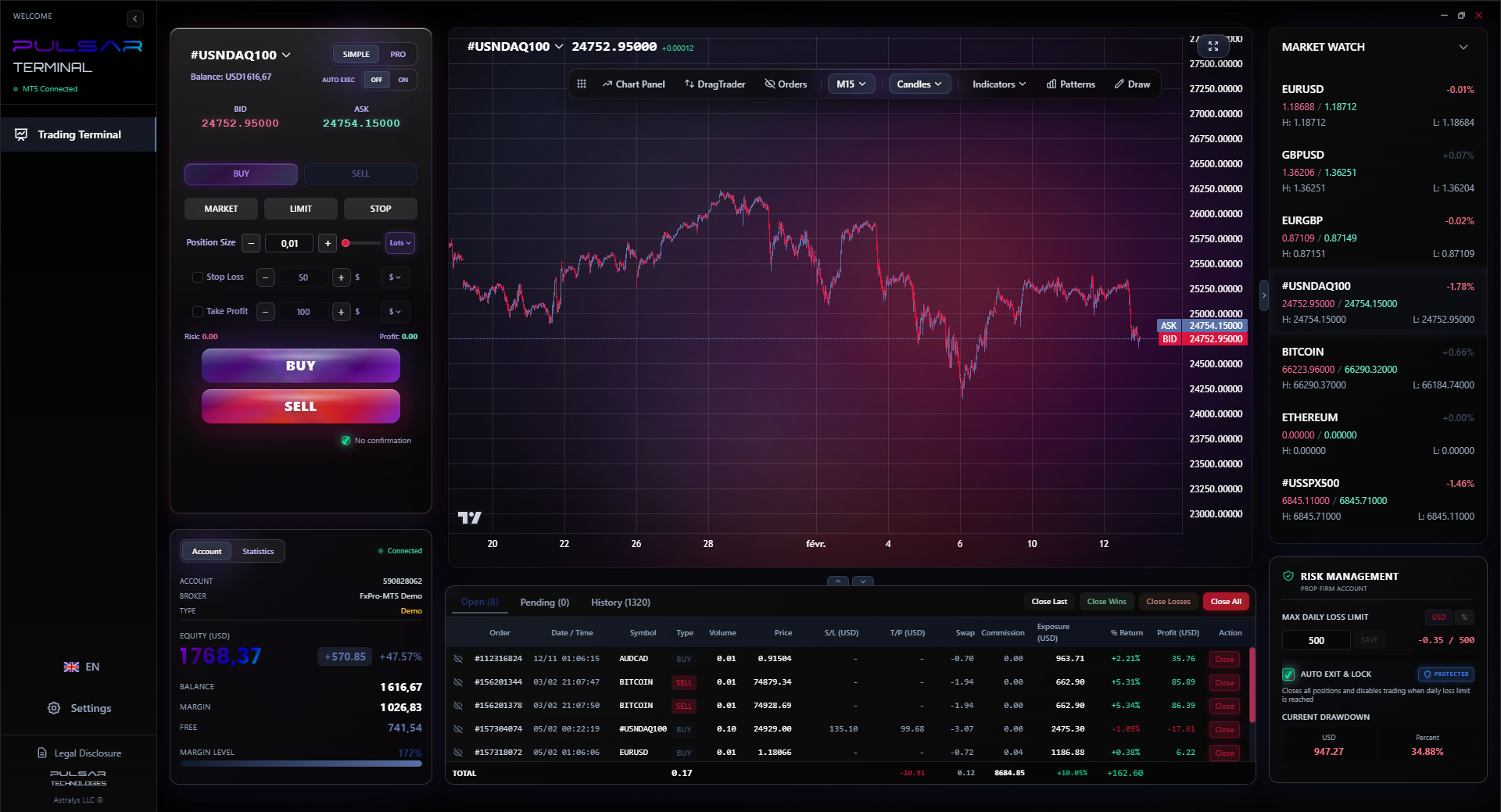
Managing complex trades on MT5 is easier with tools that let you set multiple take-profit levels and automate trailing stops, features built right into Pulsar Terminal.
Pulsar Terminal
The all-in-one MT5 companion: drag-and-drop orders, multi-TP/SL, trailing stop, grid trading, Volume Profile, and prop firm protection. Used by 1,000+ traders daily.
Let me save you some pain and money by sharing where I and others have stumbled.
Pitfall 1: Chasing the Highest use. You see 1:500 and think it's free money. It's a debt trap. With a R5,000 account, 1:500 use gives you R2.5 million in buying power. A 0.2% move against you wipes you out. I blew up my first account this way in 2015. Stick to 1:30 or lower, especially when starting. It forces you to be disciplined.
Pitfall 2: Ignoring the Total Cost. Look beyond the advertised 'spread from 0.0 pips'. Is there a commission? What's the typical spread during the Asian session vs. London open? For EUR/USD, a good all-in cost (spread + commission) for an active trader is under 0.8 pips. Use a demo account to test this in real market conditions.
Pitfall 3: Not Testing the Withdrawal Process. This is crucial. Before you deposit serious money, do a small test. Deposit R500, trade a bit (or not), then try to withdraw it. If it's fast, easy, and free (or low cost), you're golden. If it's a bureaucratic nightmare, walk away.
Pitfall 4: Overlooking Local Support. When your trade is going haywire at 10 PM and you need help, a 24/5 international chat line is okay. But having a local phone number or support team that operates in SA business hours is infinitely better. You want someone who understands what an 'instant EFT' failure looks like from our side.
Finally, always verify the broker's regulatory status directly on the FSCA's website. Don't just trust the logo on their site.
“Your first test with a new broker shouldn't be a trade, it should be a withdrawal.”
So, who is the best forex broker Australia has for South Africans? There's no single winner, but there's a clear winner for different types of traders.
If you're a cost-focused, active trader or scalper, and you're comfortable with a commission-based model, Pepperstone or FP Markets are top-tier. Their raw spreads are consistently tight, their FSCA licensing is in order, and their execution is reliable. I have live accounts with both and can vouch for their performance. Pepperstone's Razor account was a game-changer for my high-frequency strategies.
If you're a beginner or prefer a simpler, all-inclusive spread, AvaTrade or IG are excellent choices. Their platforms are user-friendly, they offer great educational resources, and you don't need to worry about commission calculations. IG's minimum deposit is laughably low, which is great for testing.
For the ECN purist who wants direct market access and doesn't mind using the broker's global entity (with the associated SARB considerations), IC Markets remains a powerhouse. Just know what you're getting into regulation-wise.
My personal setup? I run my main swing trading account with an FSCA-licensed broker for the ZAR convenience and local support. I keep a smaller, high-frequency account with a global broker for specific strategies. This diversification also spreads the counterparty risk.
Start with a demo account. Test the platforms, test the execution speed, and get a feel for the costs. Then, make a small live deposit and test the full cycle - deposit, trade, withdraw. Only then should you commit your serious trading capital. Do that, and you'll be miles ahead of most traders just chasing a brand name.
FAQ
Q1Is it legal for South Africans to use Australian forex brokers?
Yes, it's legal. However, for the best protection and easiest banking, you should use an Australian broker that also holds a Financial Services Provider (FSP) license from South Africa's FSCA. This means they are legally authorized to operate here. Using an offshore entity without an FSCA license is riskier and complicates deposits/withdrawals.
Q2What is the use limit with ASIC-regulated brokers?
If you are onboarded as a retail client under the broker's Australian ASIC license, use is capped at 1:30 for major currency pairs and lower for minors and exotics. If a broker offers you much higher use (like 1:500), you are likely being signed up under a different, offshore license (e.g., in the Seychelles), which does not offer the same level of ASIC consumer protection.
Q3How do I deposit ZAR into an Australian broker?
If the broker is FSCA-licensed for South Africa, you will typically deposit via Instant EFT directly from your South African bank account (Absa, FNB, etc.) into their local ZAR account. The process is domestic, fast, and usually fee-free. Other methods include credit/debit cards and e-wallets like Skrill.
Q4Do I pay tax on forex trading profits in South Africa?
Yes. Profits from forex trading are generally considered taxable income by SARS. You should declare them as part of your annual income tax return. It's highly recommended to keep detailed records of all your trades, deposits, and withdrawals, and to consult with a tax professional who understands trading.
Q5What is the minimum amount I need to start trading forex?
Technically, you can start with as little as R70-R900, depending on the broker and account type. However, from a risk management perspective, this is far too low. A more realistic minimum to trade properly, using sensible position sizing and surviving normal market swings, is between R5,000 and R10,000. Always use a position size calculator.
Q6Which trading platform is most popular in South Africa?
MetaTrader 4 (MT4) is still the most widely used platform by South African traders due to its familiarity, abundance of indicators, and expert advisors (EAs). MetaTrader 5 (MT5) is growing rapidly as it offers more timeframes, instruments, and a better hedging system. Many top brokers offer both.
Prof. Winston's Lesson
Key Takeaways:
- ✓Always verify the FSCA license number on the regulator's website.
- ✓Calculate total cost: spread + commission, not just one or the other.
- ✓Start with at least R5,000 for realistic, manageable risk.
- ✓Test the withdrawal process before committing serious capital.
How useful was this article?
Click a star to rate
Weekly Trading Insights
Free weekly analysis & strategies. No spam.
About the Author
David van der Merwe
Emerging Markets Trader
Johannesburg-based trader with 11 years in emerging market currencies. Specializes in ZAR pairs, FSCA-regulated trading, and South African market analysis.
Comments
Risk Disclaimer
Trading financial instruments carries significant risk and may not be suitable for all investors. Past performance does not guarantee future results. This content is for educational purposes only and should not be considered investment advice. Always conduct your own research before trading.
You Might Also Like

Cara Trading Forex Sukses: 7 Prinsip dari Trader Profesional
Cara trading forex sukses dengan 7 prinsip trader pro: manajemen modal, disiplin, journal trading, backtest. Data nyata, bukan janji profit palsu.
Jam Trading Forex Terbaik untuk Trader Indonesia: Panduan Lengkap dengan Tabel Waktu
Panduan jam trading forex untuk trader Indonesia. Tabel 4 sesi dunia, jam emas 20:00-00:00, sesi mana yang harus dihindari. Data akurat + tips dari trader berpengalaman.
Top 5 Sàn Forex Uy Tín Nhất 2026: Review Jujur dari Trader Indonesia
Top 5 sàn forex uy tín 2026 untuk trader Indonesia. Review jujur: spread, deposit, withdraw, dukungan lokal. Exness, XM, IC Markets & lebih.
Get Pulsar Terminal
All these calculators are built into Pulsar Terminal with real-time data from your MT5 account. One-click position sizing, automatic risk management, and instant calculations.
Get Pulsar Terminal