


I remember staring at my screen in 2019, watching a USD/ZAR trade go completely against me.

David van der Merwe
Emerging Markets Trader ·  South Africa
☕ 11 min read
What you'll learn:
- 1Why Most Day Traders Fail in South Africa (And How to Avoid It)
- 2The Core Principles: More Than Just Indicators
- 3The Strategy in Action: The London Breakout
- 4Tools for Confirmation (Keep It Simple)
- 5Brokers & Execution: Getting the Edge in SA
- 6The Psychology & The SARS Reality
- 7Adapting the Strategy: Scalping vs. Swing
- 8Putting It All Together: Your First Week
I remember staring at my screen in 2019, watching a USD/ZAR trade go completely against me. I'd entered at R14.85, convinced the Rand would weaken further. I didn't set a stop loss, thinking 'I know this market.' Two hours later, I was down R2,400 as the pair plummeted to R14.65. That loss, on a single, poorly managed trade, taught me more than any winning streak ever could. It wasn't just about the wrong direction; it was a complete failure in strategy and discipline. From that mess, I built what I genuinely believe is the best forex day trading strategy for our local context - one that respects the FSCA's 30:1 use limit, accounts for our unique tax situation with SARS, and works with the liquidity of our daytime London and New York sessions.
Let's be brutally honest. The stats saying 51% to 89% of retail traders lose money aren't just numbers; they're real people in our Telegram groups who go quiet after a bad month. In South Africa, failure often comes from a specific cocktail of local and universal mistakes.
First, there's the use trap. Even with the FSCA's 30:1 cap, it's easy to over-use a small account. Thinking you can turn R5,000 into R50,000 in a month is a surefire path to a margin call. Then there's the USD/ZAR siren song. It's our home pair, but it's an exotic. The spreads are wider - sometimes 50-100 pips compared to 0.6 on EUR/USD. That means the price has to move significantly just for you to break even, which is a huge handicap for a day trader.

Warning: Trading USD/ZAR as a primary day trading pair is like trying to sprint in sand. The high spread cost eats into profits on short-term moves. Use it for longer-term plays, not your main day trading engine.
Finally, there's a lack of a concrete, written plan. A strategy isn't a vague feeling. It's a documented set of rules for entry, exit, and risk that you follow even when you're emotional. Without it, you're just gambling with a fancy charting software license.
I learned this after my USD/ZAR disaster. I had no plan, just a hunch. Now, my entire trading day is governed by a one-page checklist. It's boring, but boring is profitable.

💡 Winston's Tip
A stopped loss is a paid-for lesson. A held loss is an open tab at a bar you can't afford. Always know the price of your lesson before you enter.
This strategy isn't about a secret indicator. It's a framework. Think of it as your trading constitution. It has three non-negotiable pillars that work specifically well under South African conditions.
1. Trade the London-New York Overlap (3 PM - 5 PM SAST). Our time zone is a massive advantage. The most liquid period of the day, when both London and New York are active, happens right in our mid-to-late afternoon. This means tighter spreads and cleaner, stronger trends. I do 80% of my trading in this window. The Asian session? I mostly ignore it for day trades - it's too range-bound.
2. Risk a Maximum of 1% Per Trade. This is the golden rule. On a R50,000 account, that's R500 risk per trade. No exceptions. It protects you from a string of losses wiping you out. Use a position size calculator every single time. This discipline alone will put you ahead of 70% of traders.
3. Focus on Major Pairs, Not Exotics. Your bread and butter should be EUR/USD, GBP/USD, USD/JPY, and maybe AUD/USD. The spreads are tiny (often under 1 pip), and the liquidity is enormous. This gives your strategy room to breathe. Save USD/ZAR for swing trades where the spread cost matters less.

Pro Tip: Set a daily loss limit of 3%. If you lose R1,500 on a R50k account, you're done for the day. Walk away. This prevents 'revenge trading,' which is how bad days become catastrophic months.
These principles create a container. The actual entry and exit signals happen inside this container of good time, low cost, and strict risk management.
“Trading USD/ZAR as a primary day trading pair is like trying to sprint in sand.”
Alright, here's the meat of it. My go-to setup is the London Breakout. It's simple, visual, and exploits that high-volume window we have access to.
The Setup (Before 3 PM SAST)
I'm looking at the 1-hour chart of EUR/USD. I draw two horizontal lines: one at the high of the Asian/London early session range, and one at the low. The price has been bouncing between these two levels, consolidating. This 'range' is the spring coiling.
I wait for 3 PM SAST. As volume picks up, I watch for a strong, sustained candle to close outside of this range. That's the breakout signal. The key is the close - not just a wick poking out.
The Entry and Stop Loss
If the candle closes above the range high, I go long on the next candle's open. My stop loss goes 1 pip below the opposite side of the range (so below the range low for a long trade). This defines my risk (R).
Real Trade Example: On March 12, 2026, EUR/USD ranged between 1.0920 and 1.0945. At 3:30 PM SAST, a strong hourly candle closed at 1.0950. I entered long at 1.0951 on the next open.
- Stop Loss: 1.0919 (1 pip below 1.0920). My risk was 32 pips.
- With my 1% rule on a R100,000 account (R1,000 risk), my position size calculator told me to trade 0.31 lots.
- My first profit target was set at 1:1.5 Risk/Reward (1.0951 + (32*1.5) = 1.0999).
- The price hit 1.1001 later that afternoon. I banked R1,500.
It's mechanical. No guessing. The range defines everything. For a deeper look at trading this pair, our EUR/USD guide breaks down its unique behaviors.
I use only two indicators to filter and confirm the breakout. More than that, and you get analysis paralysis.
1. The 20-Period Exponential Moving Average (EMA) on the 1-Hour Chart. This acts as a dynamic trend filter. If price is above the 20 EMA, I only look for long breakouts. If it's below, I only look for short breakouts. It keeps me trading in the direction of the underlying momentum. In a ranging market, price will chop around the EMA, telling me to wait for a clearer range to form.
2. The RSI indicator (Relative Strength Index) on the 1-Hour Chart. I don't use it for overbought/oversold signals. Instead, I look for RSI Trendline Breaks. I draw a trendline on the RSI itself during the consolidation. If the RSI breaks its trendline before or simultaneously with the price breaking the chart range, it adds a huge layer of confirmation to the trade.
That's it. A range, a volume time, the 20 EMA for bias, and RSI for confluence. I tried adding the MACD indicator and Stochastic, but it just made me second-guess clean setups. Simplicity wins.

Example: In the EUR/USD trade above, price was above the 20 EMA (bullish bias). The RSI, which had been coiling between 45 and 55, spiked to 62 on the breakout candle, breaking its own downtrend line. Three confirmations: time, price, momentum.
“A strategy isn't a vague feeling. It's a documented set of rules you follow even when you're emotional.”
Your strategy is only as good as your broker's execution. In South Africa, you must use an FSCA-regulated broker for protection. But regulation alone isn't enough for day trading. You need speed and low cost.
For this London Breakout strategy, spreads are critical. A 0.8 pip spread vs. a 0.1 pip spread might not seem like much, but over dozens of trades, it's thousands of Rands. You want raw spread accounts, even if they charge a small commission.
Local Broker Reality Check:
| Broker | FSCA Regulated? | EUR/USD Spread (Typical) | Good For Strategy? |
|---|---|---|---|
| IC Markets | Yes (Global entity) | 0.0 - 0.2 pips + comm | Excellent |
| Pepperstone | Yes | 0.0 - 0.3 pips + comm | Excellent |
| XM | Yes | From 0.8 pips, no comm | Okay, but wider spread |
| Exness | Yes | From 0.0 pips, variable | Good, but check stability |
| AvaTrade | Yes | From 0.9 pips | Less ideal for scalping |
I personally use IC Markets for their Razor account. The spreads are consistently tight during our key trading hours. I've also had good fills with Pepperstone on their Razor account. Exness can be good, but I've occasionally seen spreads widen unexpectedly, which can mess with a precise breakout entry.
Platform choice is key. MT4 or MT5 is the standard. The strategy's simple tools work on both. The real trick is having a platform that lets you manage trades quickly once you're in. This is where having the right tools glued onto your MT5 becomes a game-saver.
💡 Winston's Tip
Your trading platform is your cockpit. If you're fumbling with basic orders while the market moves, you've already crashed. Get your tools in order before engine start.
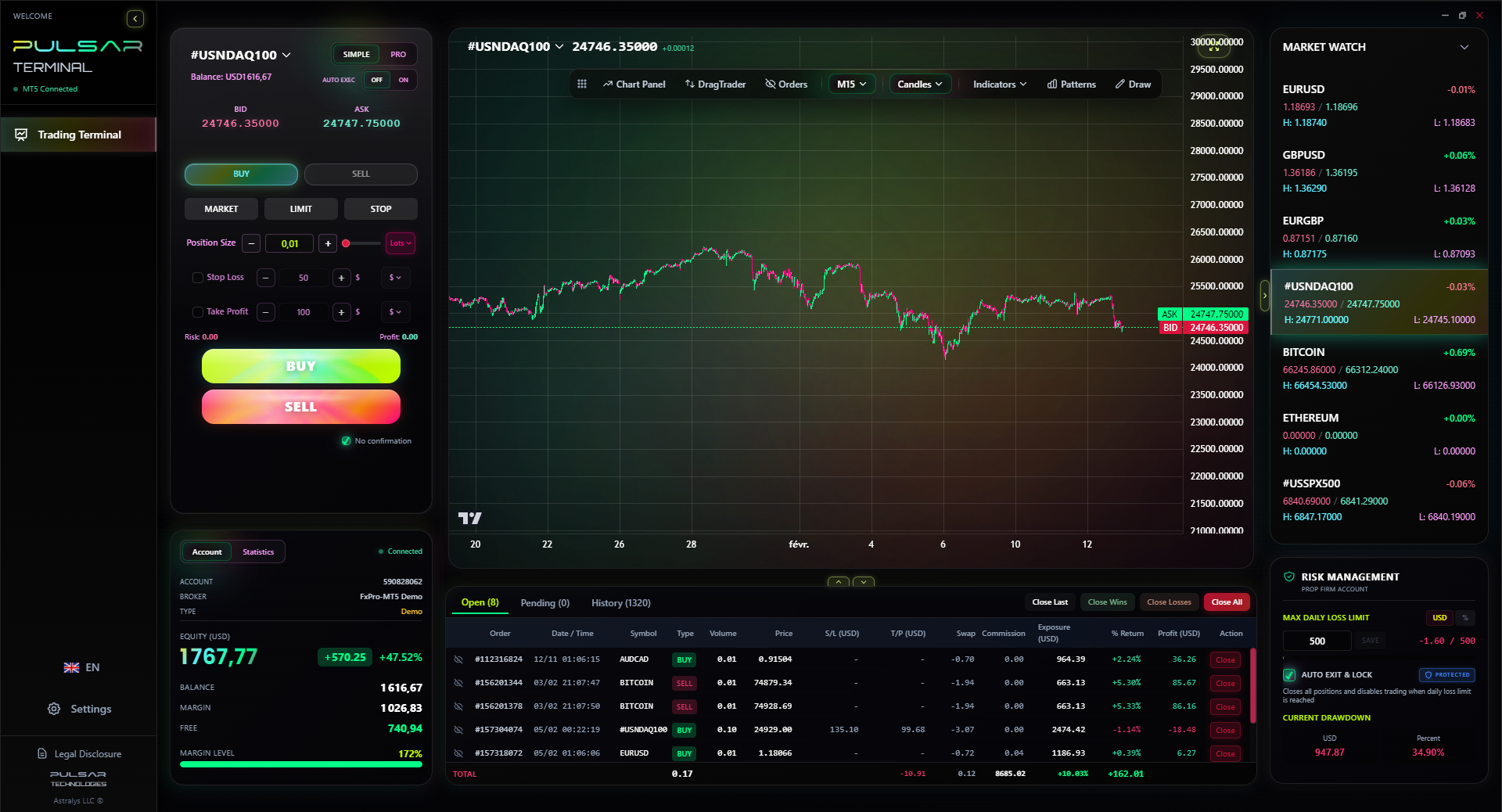
Managing multiple profit targets and a trailing stop on a fast-moving breakout is stressful, which is why I use Pulsar Terminal to automate those orders directly on my MT5 charts.
Pulsar Terminal
The all-in-one MT5 companion: drag-and-drop orders, multi-TP/SL, trailing stop, grid trading, Volume Profile, and prop firm protection. Used by 1,000+ traders daily.
You can know the strategy cold, but if your head isn't right, you'll fail. In South Africa, psychology is tied to two extra pressures: isolation and tax.
Trading can be lonely. You're not on a trading floor. You're in your home office in Joburg or Cape Town. This leads to over-trading out of boredom, especially in the quiet morning hours. Stick to your trading window. Use the rest of the day for analysis, exercise, or your other job.
The biggest psychological shift? Booking losses. A stopped-out trade is not a failure; it's the cost of doing business. That R500 loss is a controlled expense. Holding a losing trade, hoping it comes back, is what destroys accounts.
Now, for the very real South African element: SARS. As of 2026, they are actively looking at forex trading income. This isn't a side note; it's central to your profitability.
- Your profits are taxable as income, not capital gains, if you're trading frequently (which you are as a day trader). That means it's added to your salary and taxed at your marginal rate (up to 45%).
- You must keep impeccable records. Every trade, deposit, withdrawal. Your broker statements are your bible. I use a simple spreadsheet: Date, Pair, P/L in ZAR, Running Total.
- You pay tax on your net profit for the tax year. If you make R200,000 but have R50,000 in losses, your taxable income is R150,000.
Factor this into your goals. Want R300,000 after-tax profit? You might need to gross closer to R500,000. It changes your position sizing and profit targets over the long run. Ignoring this is an expensive mistake.
💡 Winston's Tip
SARS doesn't care about your 'feeling' on a trade. They care about the number at the bottom of your P&L statement. Trade like an accountant is watching every click.
“Your profits are taxable as income. Ignoring this is an expensive mistake.”
The London Breakout is a pure day trade - in by 3 PM, out by bedtime. But what if your schedule or personality doesn't fit that?
For Scalping (5-15 minute trades): You can use the same core principle but on a smaller scale. Find the range on a 5-minute chart during the London-New York overlap. The breakout will be faster and more frequent. The catch? You need a broker with even tighter spreads and instant execution. Your risk per trade should be smaller, maybe 0.5%. This is high-intensity and not for beginners. I tried this in 2021 and blew up a R20,000 account in two weeks because the speed amplified my emotional errors.
For Swing Trading (holds for days): This is where you can bring USD/ZAR back into play. Move to the 4-hour or daily chart. Look for consolidation ranges over several days. A breakout here has more significance. Your stop loss is wider, so your position size must be smaller. This suits people with full-time jobs who can only check charts once a day. The tax implication is the same, but the psychological pressure is far lower.
The core idea - trading breakouts from consolidation - remains timeless. You're just changing the time frame and the instrument to match your life.
Don't jump in with real money. Here's your onboarding plan.
Week 1-2: Demo Account Drill. Open a demo account with a broker like IC Markets or XM. Practice only during the 3 PM - 5 PM SAST window. Your goal isn't profit; it's process. Can you identify a clear range? Can you place the stop loss correctly? Can you set the profit target and walk away? Do this 20 times.
Week 3-4: Live Micro-Lots. Fund a live account with the minimum you can - maybe R2,000. Trade in micro lots (0.01). Your goal is to make 5 disciplined trades following the full system. The financial result is irrelevant. You're paying for the emotional education of seeing real money on the line. Can you still click the button when your heart is pounding?
Month 2 Onwards: Scaling Up. If you've consistently followed your rules for a month on micro lots, you can consider scaling your position size gradually. Always, always use your 1% risk rule.
Remember, this is a marathon. The best forex day trading strategy is the one you can execute consistently, without emotion, year after year. It accounts for our market hours, our regulator's rules, and our taxman's demands. It's not sexy. It's a job. But it's a job that can work, right here from South Africa.
FAQ
Q1What's the minimum capital needed to start this day trading strategy in South Africa?
While some brokers let you start with R180, that's unrealistic for proper risk management. To use the 1% rule effectively, I'd recommend a minimum of R10,000. This allows you to risk R100 per trade and absorb a few losses without blowing your account. Starting with R2,000-R5,000 in micro lots for practice is fine, but to trade standard mini lots (0.1) with breathing room, R10k is a more serious starting point.
Q2Can I use this strategy on USD/ZAR?
I don't recommend it for the day trading version of this strategy. The spread on USD/ZAR is often 50-100 pips, which is enormous. Your breakout would need to be massive just to cover costs. This strategy works best on major pairs like EUR/USD where the spread is under 1 pip. Save USD/ZAR for swing trading on higher time frames where the spread cost is a smaller percentage of the expected move.
Q3How do I declare my forex profits to SARS, and what rate will I pay?
You declare your net profit (total profits minus total losses and allowable expenses) in your annual tax return under 'Other Income.' It's not capital gains. This income is added to your salary and taxed at your marginal income tax rate. If you're in the 36% tax bracket and make R100,000 net profit from trading, you'll owe SARS roughly R36,000. Keep every single trade statement from your broker as proof.
Q4Is 30:1 use from FSCA brokers enough for day trading?
Absolutely, and it's safer. On a R10,000 account, 30:1 gives you buying power of R300,000. For a 1% risk trade (R100), you're only using a fraction of that available use. The problem isn't too little use; it's traders using all 30:1 on one trade. The FSCA limit protects you from yourself. More use just means you can blow up your account faster.
Q5What's the most common mistake you see South African traders make?
Two things tie for first: trading USD/ZAR like it's a major pair, and not accounting for taxes. The first increases your costs dramatically. The second means you think you're profitable until SARS sends you a bill that wipes out a quarter of your year's work. Plan for both from day one.
Q6Can I do this strategy if I have a 9-5 job?
Yes, but you'll need to adapt. The core London-New York overlap (3-5 PM SAST) is after standard work hours. You can practice the strategy on demo during your lunch break to learn it, then execute live trades in the evening. Alternatively, adapt it to a swing trading approach on the 4-hour chart, where you only need to check your trades once or twice a day.
Prof. Winston's Lesson
Key Takeaways:
- ✓Risk a maximum of 1% of your capital on any single trade.
- ✓Trade major pairs (EUR/USD) during the 3-5 PM SAST liquidity window.
- ✓Always factor in a 25-45% tax liability on your net profits for SARS.
- ✓Use an FSCA-regulated broker with raw spreads for execution.
How useful was this article?
Click a star to rate
Weekly Trading Insights
Free weekly analysis & strategies. No spam.
About the Author
David van der Merwe
Emerging Markets Trader
Johannesburg-based trader with 11 years in emerging market currencies. Specializes in ZAR pairs, FSCA-regulated trading, and South African market analysis.
Comments
Risk Disclaimer
Trading financial instruments carries significant risk and may not be suitable for all investors. Past performance does not guarantee future results. This content is for educational purposes only and should not be considered investment advice. Always conduct your own research before trading.
You Might Also Like

Cara Trading Forex Sukses: 7 Prinsip dari Trader Profesional
Cara trading forex sukses dengan 7 prinsip trader pro: manajemen modal, disiplin, journal trading, backtest. Data nyata, bukan janji profit palsu.
Jam Trading Forex Terbaik untuk Trader Indonesia: Panduan Lengkap dengan Tabel Waktu
Panduan jam trading forex untuk trader Indonesia. Tabel 4 sesi dunia, jam emas 20:00-00:00, sesi mana yang harus dihindari. Data akurat + tips dari trader berpengalaman.
Top 5 Sàn Forex Uy Tín Nhất 2026: Review Jujur dari Trader Indonesia
Top 5 sàn forex uy tín 2026 untuk trader Indonesia. Review jujur: spread, deposit, withdraw, dukungan lokal. Exness, XM, IC Markets & lebih.
Get Pulsar Terminal
All these calculators are built into Pulsar Terminal with real-time data from your MT5 account. One-click position sizing, automatic risk management, and instant calculations.
Get Pulsar Terminal