


You've seen the ads.

Olumide Adeyemi
West African Trading Pioneer ·  Nigeria
☕ 9 min read
What you'll learn:
- 1What Exactly Is a Forex EA (And Why It's Not Magic)
- 2Why 99% of EAs Fail for Nigerian Traders (The Local Factors)
- 3The Actual Types of EAs: Pros, Cons, and Cold Hard Numbers
- 4How to Choose an EA (If You're Still Determined)
- 5A Smarter Alternative: Learn to Code Your Own Rules (Seriously)
- 6The Final Verdict & Real Cost Breakdown in Naira
You've seen the ads. The 'millionaire-making robot' that works while you sleep, promising consistent profits with zero effort. Here's a fact that'll save you money: over 95% of retail traders who buy a 'best forex EA' end up losing their entire deposit within a year. I've tested dozens, from cheap N50,000 Naira scripts to $5,000 'institutional' systems. The failure isn't in the code, it's in a fundamental misunderstanding of how markets work, especially with Nigeria's unique broker spreads and liquidity. Let's cut through the hype.
An Expert Advisor (EA) is just a piece of software that runs on MetaTrader 4 or 5. It's a set of rules: 'If price does X, then place order Y.' That's it. There's no AI, no sentience. It's a glorified calculator that follows instructions, good or bad.
The biggest myth is that an EA can 'adapt' to any market. It can't. A strategy coded for the tight, liquid spreads of London session EUR/USD will hemorrhage money on USD/NGN or even GBP/JPY during Asian hours where spreads widen. I learned this the hard way in 2019. I bought a popular grid EA, loaded it on a USD/ZAR pair with an international broker. It worked for two weeks, netting about $300. Then one Thursday during a low-liquidity period, the spread ballooned from 3 pips to 25 pips. The EA, blindly following its rules, placed five orders at the worst possible price. I lost $1,200 in 90 seconds. The EA did exactly what it was told. I was the idiot for not understanding the spread definition risk on exotic pairs.

Warning: No EA can predict news events like CBN monetary policy announcements or unexpected Naira volatility. If your EA doesn't have a hard-coded 'news filter' to shut off trading, it's a ticking bomb.
The 'best forex EA' marketed globally often ignores our local reality. Failure is almost guaranteed if you don't account for these three things.
Broker Spreads & Execution
Look at the data. The average EUR/USD spread on a standard account with a popular broker here is around 0.9 pips. On a raw ECN account like those from IC Markets or Pepperstone, it can be 0.0 pips plus a commission. Now, imagine a scalping EA that targets 5-pip profits. On the ECN account, that's feasible. On the standard account, the spread eats nearly 20% of your profit target before you even start. The EA's edge is gone. Many cheap EAs are just repackaged scalpers that can't overcome our typical broker costs.
Deposit & Withdrawal Realities
Let's talk numbers. You fund your account with ₦200,000. Your EA runs a martingale or grid strategy (which I strongly advise against). It hits a losing streak and triggers a margin call. You need to deposit more to keep it alive. But your bank transfer to your international broker takes 3 business days. The EA is dead by Tuesday. Automated strategies require instant, reliable funding access, which isn't always our reality.
The 'Set and Forget' Fantasy
This is the killer. You install the EA, hit 'start', and walk away. A week later, you check and you're down 30%. Why? Market conditions changed. The EA kept trading. The seller's disclaimer always says 'past performance is not indicative of future results,' but you ignored it. I did too. In 2020, I ran a trend-following EA on XAU/USD. It made 15% in a strong trending month. The next month, gold went into a tight consolidation range. The EA kept getting whipsawed, giving back all profits plus 8% of my capital. I was 'forgetting' to monitor what the tool was doing. A tool needs a mechanic.

Example: An EA with a 60% win rate sounds great. But if the average losing trade is twice the size of the average winner, you lose money. You need to calculate the risk/reward, not just the win rate. Use our position size calculator to model scenarios before letting an EA trade live.

💡 Winston's Tip
If you can't trade a strategy profitably yourself for 6 months on demo, automating it will only lose money faster. The EA amplifies you, it doesn't replace you.
“Over 95% of retail traders who buy a 'best forex EA' end up losing their entire deposit within a year.”
Not all EAs are created equal. Here’s a breakdown of the main categories you’ll find, stripped of the marketing fluff.
| EA Type | How It (Supposedly) Works | The Ugly Truth | Suitable For? |
|---|---|---|---|
| Scalping EA | Makes dozens of tiny trades daily for 5-10 pips profit. | Gets destroyed by spread widening and slippage. Requires ultra-low latency (hard in NG). | Almost no one. Requires a true ECN broker like Exness raw spread account. |
| Grid/Martingale EA | Places buy & sell orders at fixed intervals above/below price. Averages down on losses. | The 'holy grail' that blows most accounts. It assumes infinite capital and no sustained trend. | Gamblers, not traders. Will eventually cause a total loss. |
| Trend-Following EA | Uses indicators like MACD or moving averages to catch big moves. | Can work, but suffers in ranging markets (which is 70% of the time). You need serious patience. | Disciplined swing traders who can tolerate long drawdowns. |
| Mean Reversion EA | Trades on the assumption price will return to an average (e.g., using RSI). | Works brilliantly in a range, gets slaughtered in a strong trend. You must know the market regime. | Experienced traders who actively monitor market conditions. |
My only long-term success came with a modified trend-following EA. I didn't buy it. I paid a coder N150,000 to build it to my specific rules for trading EUR/USD. The key? I only run it when the daily chart is in a clear trend (ADX > 25). I turn it OFF during consolidations. It's not autonomous. It's a tool I switch on and off.
If you're going to try one, do it like a scientist, not a lottery buyer.
Demand a Verified Track Record: Not just screenshots. A real Myfxbook link with a multi-year history. Check the 'Quality Score' – it shows if the history is verified by the platform. Look for a stable equity curve, not a vertical line up. Vertical lines up mean vertical lines down are coming.
Test It YOURSELF with Nigerian Conditions:
- Use a Demo Account: For at least 3-6 months. Not 2 weeks.
- Replicate Local Costs: Set your demo spread to 1.0-1.5 pips on majors to mimic common local broker conditions. Add a 50ms execution delay.
- Test Through Different Cycles: Does it survive a trending period, a ranging period, and high-volatility news?
Understand Every Setting: What does 'Magic Number' mean? What's the stop loss logic? If the seller can't explain it simply, walk away. You are responsible for what the EA does with your money.
Start Absurdly Small: If you fund with $1000, run the EA on a micro lot (0.01) only. Let it prove itself with real money for a full quarter before even thinking of scaling. Your goal in month one is not profit. It's data collection.

Pro Tip: The best use of an EA isn't for full automation. It's for trade management. Use it to automatically move stops to breakeven, or to take partial profits at set levels. This removes emotion from the hardest part of a trade – managing it.
💡 Winston's Tip
The only 'edge' an EA should provide is perfect, emotionless execution of YOUR rules. If you don't have clear rules, you have nothing to execute.
“The tool is not the trader. You are.”
This is the single best piece of advice I can give you. Instead of searching for the 'best forex EA,' become the creator of your own.
You don't need a computer science degree. The MQL4/MQL5 language used for MetaTrader is relatively straightforward for basic logic. There are countless free tutorials on YouTube. For the price of a shady EA (N300,000+), you can pay a reputable freelance coder on platforms like Upwork or Fiverr (check reviews carefully) to code YOUR specific strategy.
Why this is a game-changer:
- It Forces Discipline: You have to define your entry, exit, stop loss, and risk management rules with absolute clarity. Most traders never do this.
- It Fits YOUR Psychology: You code the risk parameters you're comfortable with. No more martingale if you hate it.
- You Own It: No monthly fees, no fear of the seller disabling it.
I started by coding a simple alert indicator. Then I coded an EA that just placed a trade with a stop loss and take profit based on a moving average cross. It was terrible as a strategy, but the process taught me more about market structure than any course. Now, I use tools to execute my manual plans flawlessly. For instance, if I see a setup on a chart, I can use a tool to instantly place a trade with a pre-set 1:2 risk-reward ratio and a trailing stop – no fumbling, no emotional hesitation. This kind of precision is what separates survivors from casualties.
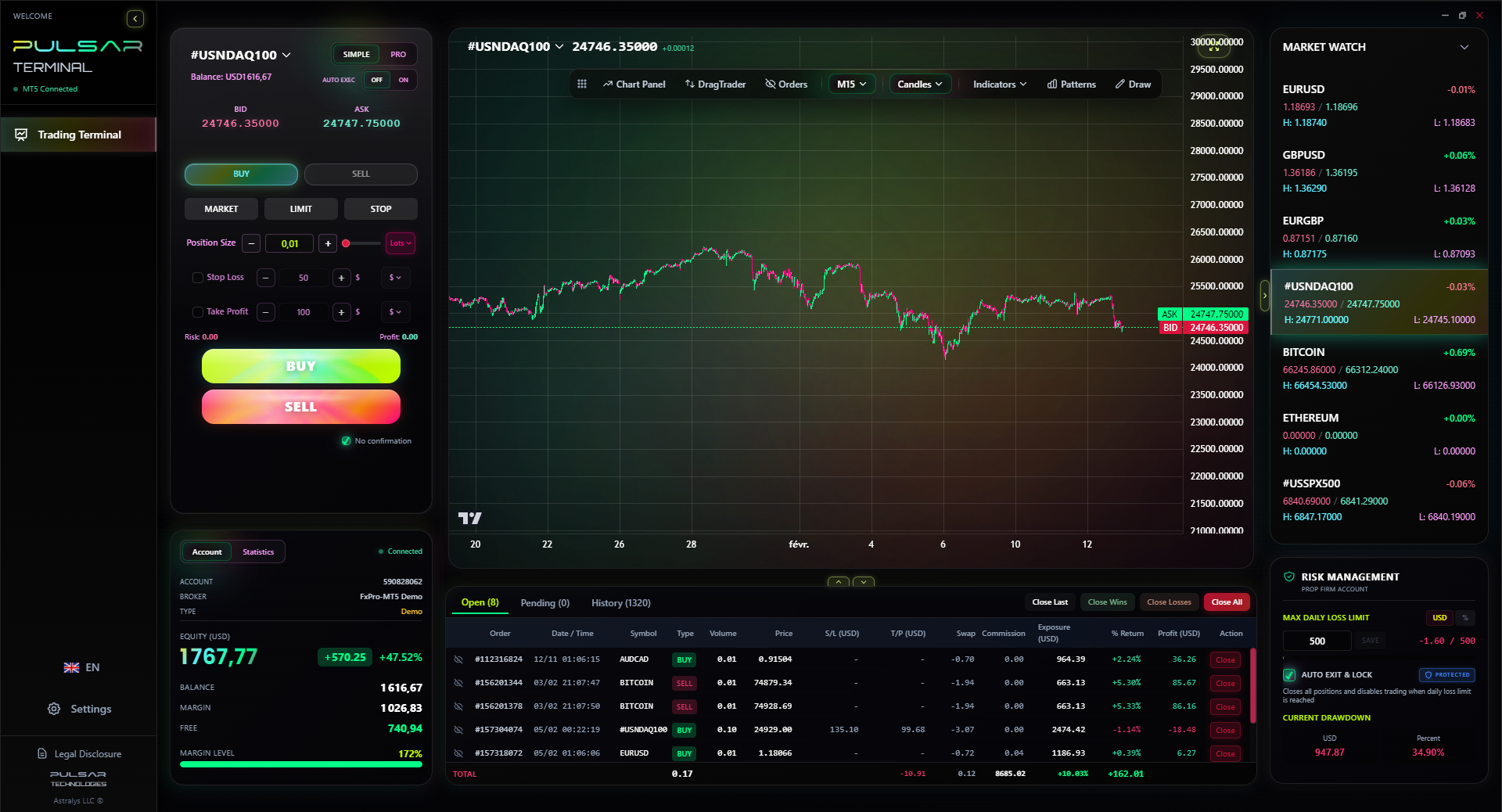
This is where a platform like Pulsar Terminal shines. It's not an EA that trades for you. It's a powerful MT5 add-on that lets you build and execute complex trade management rules visually. Think of it as giving you a surgeon's tools instead of hoping a robot does the surgery.
Instead of hoping a black-box EA makes decisions for you, use a tool like Pulsar Terminal to flawlessly execute your own proven trading plan with advanced order types and risk management on MT5.
Pulsar Terminal
The all-in-one MT5 companion: drag-and-drop orders, multi-TP/SL, trailing stop, grid trading, Volume Profile, and prop firm protection. Used by 1,000+ traders daily.
So, is there a 'best forex EA' for Nigeria? The honest answer is no. There's no single software that will print money. The closest you'll get is a strong, well-tested tool that executes a specific, logical strategy under specific conditions, which you monitor and manage.
Let's break down the real costs in Naira:
- The Gambler's Route: Buy a 'guaranteed' EA for $500 (~₦700,000). Run it on a $500 account. Statistical probability of blowing the account within a year: >90%. Total likely loss: ₦700,000 + ₦700,000 = ₦1.4M.
- The Builder's Route:
- Education (Basic MQL5 course): ₦50,000
- Freelancer to code your simple strategy: ₦120,000
- Six months of demo testing & small live testing capital: ₦200,000
- Total investment: ₦370,000.
Even if your custom EA fails, you keep the knowledge, the code, and the discipline. You've bought an education, not a scam. The second path builds a skill. The first path builds regret.
Your edge in the market will never come from a piece of software you bought. It comes from your patience, your risk management, and your understanding of price action. Use technology to remove human error from execution, not to replace human judgment. Start by mastering a single strategy manually, perhaps through scalping or swing trading. Once you can consistently demo trade it, then, and only then, consider automating the execution. The tool is not the trader. You are.
FAQ
Q1What is the most profitable forex EA?
There is no universally 'most profitable' EA. Profitability depends entirely on current market conditions (trending vs ranging), your broker's spreads, and your risk settings. Any EA seller claiming consistent high profits is likely showing a backtest optimized for past data, which is useless for future trading.
Q2Is forex EA trading profitable in Nigeria?
It can be, but not because of the EA itself. It's profitable only if the underlying trading strategy is sound AND the trader actively manages the EA, turning it off during unsuitable market conditions (like around CBN announcements). Most Nigerians lose money with EAs because they adopt a 'set and forget' mentality with products not designed for our broker spreads and liquidity.
Q3Which forex broker is best for EA trading in Nigeria?
You need a broker with stable, fast execution and low, consistent spreads. International brokers like IC Markets, Pepperstone, and Exness (with their Raw Spread accounts) are popular choices among serious EA users in Nigeria because they offer MetaTrader platforms and ECN-style pricing. Avoid brokers with frequent requotes or wide variable spreads.
Q4How much does a good forex EA cost?
Price is no indicator of quality. I've seen $50,000 EAs fail and free ones work in specific conditions. A better question is: 'What is the cost of testing and implementing?' Budget for months of demo testing, potential small live losses, and possibly hiring a coder (₦100,000 - ₦500,000) to build or customize one for you. The initial purchase price is the smallest cost.
Q5Can I use a free forex EA?
You can, but you must test it even more rigorously. Many free EAs are basic scripts, old commercial EAs that are no longer effective, or even 'trojan horses' that trade against you. Never run a free EA on a live account without at least 3-6 months of demo testing across different market environments.
Q6Do professional traders use EAs?
Yes, but not in the way you think. Pros use algorithmic systems for high-frequency trading (which you can't access) or, more commonly, they use automated tools for trade management - like moving stops to breakeven, scaling out of positions, or executing complex order types. They rarely use a single, black-box EA to make all trading decisions.
Q7What is the success rate of forex EA?
The success rate of the EA as a product is near 0%. The success rate of a trader who uses an EA as a disciplined tool is higher, but that's because of the trader's skill, not the EA. Over 95% of retail accounts that rely on purchased EAs fail. Your focus should be on becoming a profitable trader first; automation comes last.
Prof. Winston's Lesson
Key Takeaways:
- ✓95% of purchased EAs lead to total account loss.
- ✓Test any EA for 3-6 months on demo with Nigerian spreads.
- ✓Price is not an indicator of an EA's quality or success.
- ✓Learn to code or hire a coder; it's cheaper than buying failure.
- ✓Use automation for execution, not for decision-making.
How useful was this article?
Click a star to rate
Weekly Trading Insights
Free weekly analysis & strategies. No spam.
About the Author
Olumide Adeyemi
West African Trading Pioneer
One of Nigeria's most active forex trading educators. 8 years of experience trading from Lagos. Specializes in low-capital strategies and prop firm challenges for African traders.
Comments
Risk Disclaimer
Trading financial instruments carries significant risk and may not be suitable for all investors. Past performance does not guarantee future results. This content is for educational purposes only and should not be considered investment advice. Always conduct your own research before trading.
You Might Also Like

Cara Trading Forex Sukses: 7 Prinsip dari Trader Profesional
Cara trading forex sukses dengan 7 prinsip trader pro: manajemen modal, disiplin, journal trading, backtest. Data nyata, bukan janji profit palsu.
Jam Trading Forex Terbaik untuk Trader Indonesia: Panduan Lengkap dengan Tabel Waktu
Panduan jam trading forex untuk trader Indonesia. Tabel 4 sesi dunia, jam emas 20:00-00:00, sesi mana yang harus dihindari. Data akurat + tips dari trader berpengalaman.
Top 5 Sàn Forex Uy Tín Nhất 2026: Review Jujur dari Trader Indonesia
Top 5 sàn forex uy tín 2026 untuk trader Indonesia. Review jujur: spread, deposit, withdraw, dukungan lokal. Exness, XM, IC Markets & lebih.
Get Pulsar Terminal
All these calculators are built into Pulsar Terminal with real-time data from your MT5 account. One-click position sizing, automatic risk management, and instant calculations.
Get Pulsar Terminal