


Most new traders in South Africa think you can trade any pair at any time and still make money.

David van der Merwe
Emerging Markets Trader ·  South Africa
☕ 9 min read
What you'll learn:
Most new traders in South Africa think you can trade any pair at any time and still make money. They'll jump on GBP/JPY at 2 PM our time and wonder why it's barely moving. I made that exact mistake early on, burning through R2,000 in a week trying to force trades during our quiet afternoons. The truth is, your location and the market session you're trading in are everything. Let me show you which pairs actually work when, using our SA time zone and the brokers we actually use.
Our biggest advantage in South Africa is our time zone. We're perfectly positioned to catch two major market sessions live without pulling all-nighters. But if you get the timing wrong, you're basically trading in slow motion with wider spreads.
Here's the reality: liquidity - the amount of money flowing through a pair - changes dramatically throughout the day. When London opens at 10:00 AM our time (9:00 AM in summer), the market wakes up. Volume spikes, spreads tighten, and price actually moves with purpose. Trade the same pair at 8:00 PM our time, and you're dealing with the thin, volatile Asian session where a single large order can cause a spike that ruins your stop loss.
I learned this the hard way trading USD/ZAR during off-hours. The spread would balloon from 50 pips to over 150 pips after 5 PM. A move that should have been a R500 loss turned into a R1,800 nightmare because I was trading when no one else was. Your broker matters here too. A broker like IC Markets review or Exness review will generally keep spreads more stable during peak times than a broker with less liquidity.

Warning: Trading exotic pairs like USD/ZAR or EUR/TRY outside of their primary session is asking for trouble. The lack of liquidity means your execution price can be wildly different from what you see on your chart.
“Your location and the market session you're trading in are everything.”
This is where we make our money. London is the largest forex hub in the world, accounting for over 30% of all global volume. When those traders log on, the market comes alive.
The Major Pairs Playground
During the London overlap with the European markets (10 AM to about 12 PM SA time), stick to the Euro and Pound pairs. EUR/USD, GBP/USD, and EUR/GBP are your bread and butter. The spreads are at their absolute tightest. I've seen EUR/USD spreads hit 0.0 pips on a raw account from Pepperstone review during this window. That's free real estate for a scalping strategy.
Don't Ignore the Crosses
GBP/JPY and EUR/JPY also come alive here. They're more volatile than the majors, offering bigger moves. A good setup on GBP/JPY during London can easily net 80-100 pips. But remember, with greater reward comes greater risk. Use a tighter position size calculator on these. I once got greedy on a GBP/JPY trade, used my normal EUR/USD lot size, and watched a 120-pip move against me wipe out a day's profits in 20 minutes.
A Real Trade Example
On March 15th, I took a short on EUR/USD at 1.0925 at 10:30 AM SA time. London had just opened, and price rejected a key resistance level on the 15-minute chart. My stop was at 1.0945 (20 pips), and I took half profit at 1.0895 (30 pips) and let the rest run. It hit my second target at 1.0870 later that afternoon. The high volume meant my orders were filled instantly at the price I wanted.

💡 Winston's Tip
The first 90 minutes of a session often show you the day's character. If price can't break the Asian high in the first London hour, it's likely a range day. Adjust your strategy.
“Boring is profitable. EUR/USD has the tightest spreads, deepest liquidity, and most predictable behaviour.”
From 3 PM to 7 PM SA time, London and New York are both open. This is the most volatile and liquid period of the entire trading day. It's when major economic data (like US Non-Farm Payrolls) drops, and big institutional moves happen.
The USD Pairs Take Center Stage
All USD pairs are in play, but EUR/USD and GBP/USD still dominate. USD/JPY and USD/CAD become particularly interesting as they react to North American flows and oil prices (for the Loonie). This is the best time for swing trading entries if you're looking to catch the daily trend.
Managing the Volatility
This overlap can be wild. I've seen 50-pip moves in EUR/USD happen in under 5 minutes during this session. It's thrilling but dangerous. Your risk management has to be impeccable. Always know where your margin call level is. If you're not comfortable with the speed, stick to the first hour of London instead.

Pro Tip: At around 6 PM SA time, liquidity starts to drop as London traders go home. Be cautious of false breakouts after this time. Price often retraces a big New York move in the Asian session.
“Boring is profitable. EUR/USD has the tightest spreads, deepest liquidity, and most predictable behaviour.”
Unless you're a serious night owl, this session is mostly for planning, not live trading for us. The Tokyo and Sydney markets drive this session, and the focus shifts to the Asian and commodity currencies.
The Right Pairs for the Quiet Hours
If you are trading early before work, AUD/USD, NZD/USD, and USD/JPY are your main options. They'll have the most reliable movement. Pairs like AUD/JPY and NZD/JPY are also active. The moves are generally slower and more range-bound than London or New York.
What This Session Is Really For
I use the Asian session (checking charts around 7 AM) to identify key support and resistance levels that held overnight. It sets the stage for the London open. A strong bounce off a level in Asia often gets tested again when London volume hits. This is a great way to plan your trades for the main event.
Trading exotic pairs here is risky. While USD/CNH or AUD/SGD might move, the spreads are often too wide to make it worthwhile for a retail trader. Stick to the majors and common crosses.
💡 Winston's Tip
Your most important tool isn't an indicator; it's a clock. If you're losing, check the time. You're probably trading outside the liquidity windows.
“The best thing you can do for your trading after 7 PM is to not trade at all.”
We have to talk about our home pair. USD/ZAR is unique. It's highly sensitive to local politics, SARB announcements, and commodity prices. Its trading window is very specific.
The Only Time to Trade It
The only time USD/ZAR has decent liquidity and manageable spreads is during the London and early New York overlap. That's when international banks and funds are actively pricing in Rand risk. Even then, expect spreads of 40-80 pips on a good day. Compare that to the 0.6 pip average on EUR/USD, and you see the cost of trading exotics.
A Costly Lesson
I once left a USD/ZAR stop loss order active overnight. A political headline hit at 2 AM SA time during thin Asian liquidity. The spread widened to over 200 pips, and my stop was triggered at a horrific price, turning a small 30-pip risk into a 180-pip loss. Never leave exotic pair orders unattended.

Example: A 50-pip win on USD/ZAR sounds great. But if you paid a 50-pip spread to enter and exit, you made nothing. You need much larger targets to overcome the transaction cost. A 150-pip minimum target is a good rule of thumb.
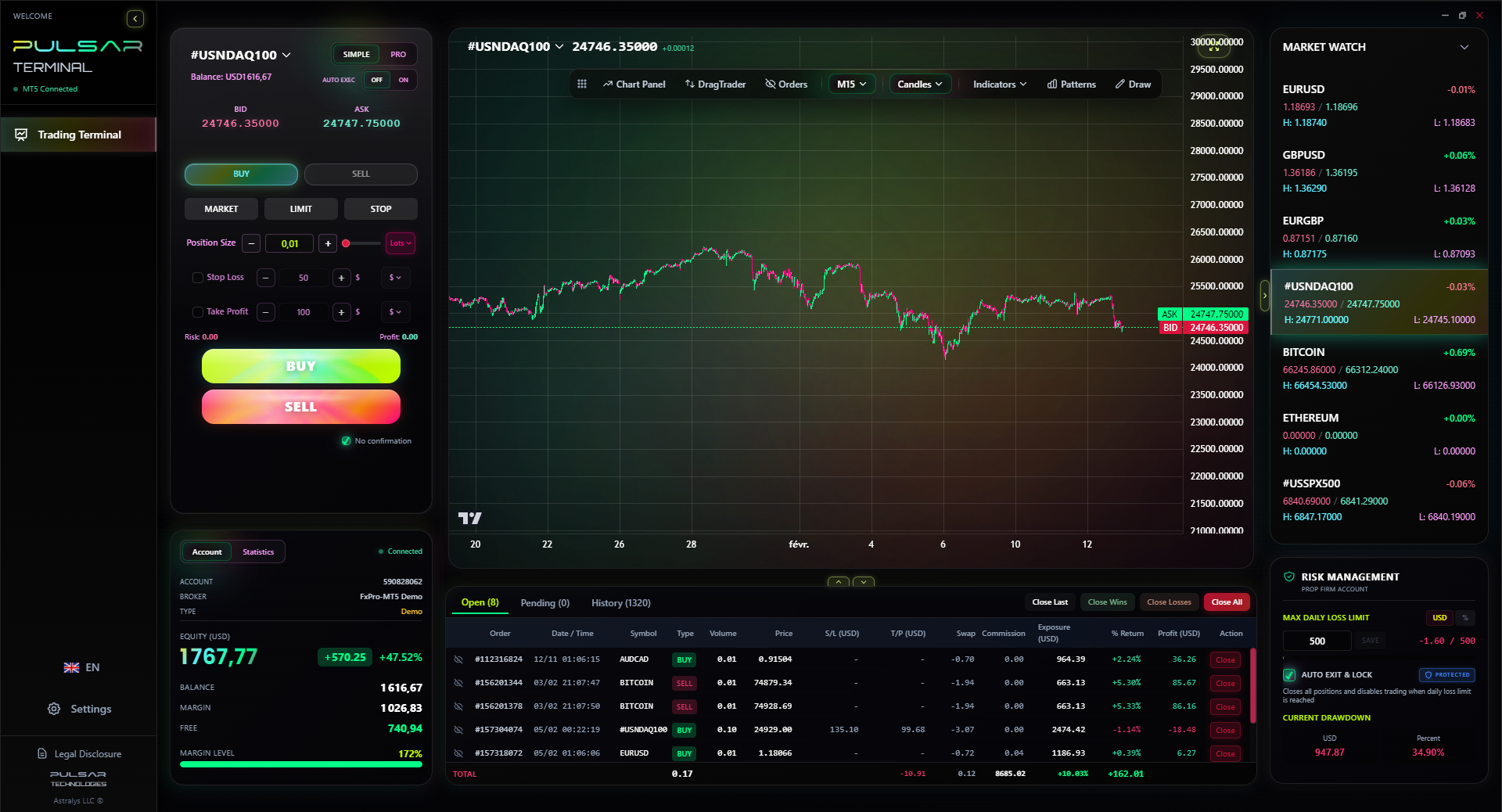
Managing multiple trades across different sessions is complex, but tools like Pulsar Terminal let you set multi-level take-profits and trailing stops on MT5 automatically, so you can lock in profits from a London trade while you sleep.
Pulsar Terminal
The all-in-one MT5 companion: drag-and-drop orders, multi-TP/SL, trailing stop, grid trading, Volume Profile, and prop firm protection. Used by 1,000+ traders daily.
“The best thing you can do for your trading after 7 PM is to not trade at all.”
Your profit is entry price minus exit price minus costs. Those costs change by session, and your broker choice is critical.
| Session (SA Time) | Recommended Pair | Typical Spread (Good Broker) | Typical Spread (Poor Liquidity) |
|---|---|---|---|
| London (10 AM-12 PM) | EUR/USD | 0.2 - 0.6 pips | 1.2+ pips |
| NY Overlap (3 PM-7 PM) | GBP/USD | 0.8 - 1.2 pips | 2.0+ pips |
| Late NY / Asia (8 PM-4 AM) | USD/JPY | 0.7 - 1.0 pips | 1.5+ pips |
| Asia (Early AM) | AUD/USD | 0.9 - 1.5 pips | 2.5+ pips |
The Commission Factor: For active traders, a raw spread account with a commission can be cheaper. Let's say you trade 5 lots of EUR/USD per day.
- On a "commission-free" account with a 1.0 pip spread: Cost = 5 lots * 1.0 pip = 5 pips daily.
- On a raw account with 0.1 pip spread + $7 commission per lot: Cost = (5 lots * 0.1 pip) + (5 lots * $7 * ~0.0001 per pip) = 0.5 pips + ~3.5 pips = ~4 pips daily. The raw account wins. Brokers like IC Markets review excel here. Always do the math based on your trading volume.
Swap rates also matter if you hold trades overnight. A long EUR/USD position might pay or charge a small amount daily based on the interest rate differential. It's a small factor for day traders but crucial for long-term swing trading. Check your broker's swap sheet.
💡 Winston's Tip
Write down the average spread for your favourite pair at 10 AM, 3 PM, and 8 PM SA time for a week. The difference will shock you into better timing.
“Your most important tool isn't an indicator; it's a clock.”
Here’s a practical routine for a South African day trader, based on what actually works.
7:00 AM: Check charts. Did the Asian session respect yesterday's key levels? Note any major news due for London or NY. Set alerts for EUR/USD, GBP/USD around those levels.
9:45 AM: Final prep. London opens in 15 minutes. Have your charts clean. Decide on your key pair for the morning - probably EUR/USD. Get your position size calculator ready.
10:00 AM - 12:00 PM: Trading Window 1. Focus on the London open move. Look for breakouts or rejections on the 15-min or 1-hour chart. This is your most reliable time to trade. Use the MACD indicator or RSI indicator for confluence, but keep it simple.
2:30 PM - 3:00 PM: Review. Take a break. Analyse any US pre-news sentiment.
3:30 PM - 6:00 PM: Trading Window 2. The NY overlap. If you have a good trend from London, look for continuation pullbacks. Be extra cautious if major news is released at 4 PM SA time.
After 7:00 PM: Stop. London is closed. Unless you're a night owl scalping a few pips on USD/JPY, close your platform. Plan tomorrow's trades. The best thing you can do for your trading after 7 PM is to not trade at all.
FAQ
Q1I can only trade after 5 PM SA time. What pairs should I use?
Your options are limited but workable. Focus on USD pairs during the first hour of the New York session (before 6 PM SA time) - USD/CAD or USD/JPY. After 7 PM, the market gets thin. You could try AUD/USD or NZD/USD as the Asian session starts to warm up, but expect slower, smaller moves. Avoid European pairs like EUR/GBP entirely at this time.
Q2Is the 30:1 use limit in South Africa a problem for this strategy?
Not at all. In fact, it protects you. With 30:1, you need about R3,333 in margin to trade 1 standard lot of EUR/USD. This forces sensible position sizing. The strategies here are about catching 30-80 pip moves. You don't need 500:1 use to profit from that. Good risk management will make you more money than insane use ever will.
Q3Why do you recommend EUR/USD so much? Isn't it boring?
Boring is profitable. EUR/USD has the tightest spreads, deepest liquidity, and most predictable behaviour around sessions. It's like a wide, well-paved highway. GBP/JPY might be a more exciting mountain pass, but the chances of crashing are higher. Master the highway first. You can read our full EUR/USD guide for specific strategies.
Q4How much money do I need to start trading these sessions effectively?
With our use limits, you need enough to withstand normal volatility. To trade a single mini lot (0.1) on EUR/USD with a sensible 20-pip stop loss, you need about R1,500-R2,000 to keep your risk below 2% of your account. A realistic starter amount for active trading is R5,000-R10,000. You can start a micro account with R150, but you'll be very limited in what you can do.
Q5Should I trade Gold (XAU/USD) during these sessions?
Gold often moves inversely to the USD and is great during the New York overlap, especially if there's US dollar news. It can be volatile, so use wider stops. It's a fantastic alternative if the major forex pairs are stuck in a range. We have a dedicated XAU/USD guide that breaks this down.
Q6What's the biggest mistake SA traders make with session trading?
Trying to trade the Rand (USD/ZAR) like it's EUR/USD. They see the big swings and think it's easy money. They ignore the massive spreads and its sensitivity to local news at odd hours. Trade it only during peak London/NY hours, with targets at least 3 times the spread, and never leave a trade unattended.
Prof. Winston's Lesson
Key Takeaways:
- ✓Trade EUR/USD & GBP/USD from 10 AM - 12 PM SA time for best results.
- ✓Avoid exotic pairs like USD/ZAR outside London/NY overlap.
- ✓A 50-pip spread on USD/ZAR requires a 150-pip target to profit.
- ✓Use a raw spread account if trading more than 3 lots daily.
- ✓New York overlap (3-7 PM) is for volatility, London open is for reliability.
How useful was this article?
Click a star to rate
Weekly Trading Insights
Free weekly analysis & strategies. No spam.
About the Author
David van der Merwe
Emerging Markets Trader
Johannesburg-based trader with 11 years in emerging market currencies. Specializes in ZAR pairs, FSCA-regulated trading, and South African market analysis.
Comments
Risk Disclaimer
Trading financial instruments carries significant risk and may not be suitable for all investors. Past performance does not guarantee future results. This content is for educational purposes only and should not be considered investment advice. Always conduct your own research before trading.
You Might Also Like

Cara Trading Forex Sukses: 7 Prinsip dari Trader Profesional
Cara trading forex sukses dengan 7 prinsip trader pro: manajemen modal, disiplin, journal trading, backtest. Data nyata, bukan janji profit palsu.
Jam Trading Forex Terbaik untuk Trader Indonesia: Panduan Lengkap dengan Tabel Waktu
Panduan jam trading forex untuk trader Indonesia. Tabel 4 sesi dunia, jam emas 20:00-00:00, sesi mana yang harus dihindari. Data akurat + tips dari trader berpengalaman.
Top 5 Sàn Forex Uy Tín Nhất 2026: Review Jujur dari Trader Indonesia
Top 5 sàn forex uy tín 2026 untuk trader Indonesia. Review jujur: spread, deposit, withdraw, dukungan lokal. Exness, XM, IC Markets & lebih.
Get Pulsar Terminal
All these calculators are built into Pulsar Terminal with real-time data from your MT5 account. One-click position sizing, automatic risk management, and instant calculations.
Get Pulsar Terminal