


You're searching for the best forex robot, aren't you? That magic box that prints money while you sleep.

Olumide Adeyemi
West African Trading Pioneer ·  Nigeria
☕ 10 min read
What you'll learn:
You're searching for the best forex robot, aren't you? That magic box that prints money while you sleep. I get it. I spent years and a decent chunk of my own capital chasing that same dream. The truth is, finding a robot that works consistently in Nigeria's unique market is less about buying a product and more about adopting a system. Let me walk you through what I've learned - the hard way - so you can avoid the expensive mistakes I made.
A forex robot, or Expert Advisor (EA), is just a piece of software that runs on your trading platform (usually MT4 or MT5). It follows a set of programmed rules to open and close trades automatically. No emotion, no hesitation.
Sounds perfect, right? Here's the catch: it's only as good as the logic it's built on. A robot can't adapt to a market it wasn't designed for. I learned this painfully in 2019. I bought a popular 'grid trading' EA that was killing it on EUR/USD backtests. I loaded it up on my account with a $500 deposit. For two weeks, it made small, steady profits. Then, one Thursday during a major CBN policy announcement, USD/NGN spiked with unusual volatility. The robot kept placing its grid orders, completely unaware of the fundamental shift. It blew through every level of support I had set. I lost $387 in about 90 minutes. The robot did exactly what it was programmed to do. I was the idiot for not understanding its fatal flaw in a volatile, news-driven market like ours.

Warning: A robot is a tool, not a trader. You are still the captain. If you don't understand its strategy inside and out, you are guaranteed to lose money eventually.
Most robots fall into a few categories: scalpers (many small trades), grid/martingale systems (adding to losing positions), trend followers, or arbitrage bots. The 'best' one depends entirely on current market conditions and your risk tolerance.

💡 Winston's Tip
The first rule of Robot Club: you must understand Robot Club. If you can't explain its core strategy in one simple sentence, you don't own a robot, you own a liability.
You can't talk about robots here without talking about our reality. First, the broker matters immensely. Not all brokers are robot-friendly. Some have rules against certain strategies (like high-frequency scalping or hedging), and others have terrible execution speeds that will ruin a robot's entries and exits.
From my testing, brokers like Exness and IC Markets have been solid for EA trading because of their tight spreads and fast execution. Their NGN account options and acceptance of local payment methods are a big plus. I've run EAs on both their MT5 platforms for years. XM is another good option, especially for beginners due to their flexible use.
Funding is our eternal headache. With CBN restrictions, you can't just do a bank transfer to most international brokers. We use workarounds: crypto, e-wallets like Skrill, or peer-to-peer. This adds a layer of complexity. You need a broker that not only allows your robot but also lets you fund and withdraw without a month-long drama. I once had a profitable robot run for three weeks, but when I tried to withdraw the profit, the broker's P2P process was so slow the market turned and wiped the gains. A brutal lesson in liquidity management.
Then there's Naira volatility. A robot trading EUR/USD might be fine, but if you're trading USD/NGN (which many of us watch closely), you need a robot built for extreme volatility. The spreads can widen massively during liquidity crunches. A robot placing a stop-loss 20 pips away might get filled 50 pips worse if it triggers during a thin market period. You must account for this in your position size calculator and risk parameters.
“The 'best' forex robot is the one whose strategy you understand so well you could trade it manually.”
The forex robot market is flooded with lies. I've bought more than I care to admit. Here's how to spot the garbage.
The Guarantee: Any site promising "95% win rate" or "guaranteed profits" is lying. Full stop. Trading is probabilistic, not certain. If it were guaranteed, they'd be using it themselves, not selling it to you for $99.
The Backtest Mirage: Sellers love showing gorgeous, smooth equity curves from 2009-2024. It's easy to optimize a robot to fit past data perfectly - a process called "curve-fitting." The robot learns the past but fails in the future. Always ask for a forward test or live account statement. If they can't provide one, walk away.
The Price is Too Good (or Too Crazy): A robot for ₦5,000 is probably worthless code. A robot for $5,000 is probably an overhyped scam. The sweet spot for a legit, well-coded EA from a known developer is usually between $200 and $1,000. Even then, due diligence is key.
No Strategy Disclosure: You have the right to know the core logic. Is it a trend-following system using the MACD indicator? A mean-reversion bot using RSI? If the seller says "it's a proprietary secret," they're often hiding the fact that it's a dangerous martingale system that will blow your account given enough time.
My worst purchase? A "Gold Miner" EA in 2021. The sales page showed massive returns on XAU/USD. I paid $250. It turned out to be a simple grid system with no volatility filter. It worked until gold had a strong directional move, then it wiped out two months of gains in a single day. The spread widened during the London open, and the bot's orders were executed at terrible prices. I lost $520 on that experiment.
💡 Winston's Tip
Test a robot through a full Naira volatility cycle. If it can't handle a CBN announcement week, it's not built for your market.
After losing money on pre-made bots, I developed a strict process. This is how I evaluate any robot now.
Step 1: The Demo Gauntlet
I run the robot on a demo account for at least two months, preferably across different market conditions (ranging, trending, high news volatility). I don't just let it run. I watch it. Does it trade at sensible times? Does it respect news events? I compare its live demo trades to its historical backtest. If they deviate wildly, it's a red flag.
Step 2: The Micro-Live Test
If it passes the demo, I fund a live account with the absolute minimum - maybe $50 or $100. I run the robot with the smallest possible lot size. This isn't about profit. It's about testing real execution, spread impact, and slippage. You'd be amazed how many robots fail this simple stress test on a live account with a broker like Pepperstone or XM.
Step 3: Strategy Autopsy
I tear apart the settings. I need to understand every parameter: Take Profit, Stop Loss, trailing stop, magic number, risk per trade. I adjust them to see how fragile the strategy is. A good robot should have a reasonable range of settings that work, not one magical number.
Step 4: The 'Why' Check
For every trade the robot takes, I ask why. I look at the chart. Did it buy at support? Sell at a moving average cross? If I can't logically explain its entries after a week of watching, I shut it off. Blind trust is a recipe for a margin call.

Pro Tip: Never run a robot on your main account right away. Use a separate, small account specifically for testing. Treat the first $500 as tuition money you're okay with losing.
“Fully automated, set-and-forget trading is a fantasy sold to the desperate.”
This is the big crossroads. Buying is easier but risky. Building is harder but offers control.
Buying a Robot: Your best bet is communities like MQL5 Market. Look for developers with a long history, positive reviews, and who provide detailed statements of their own live accounts using the EA. Expect to pay a few hundred dollars for quality. Even then, assume you'll need to tweak settings for the NGN market's peculiarities.
Building Your Own: This is the path I eventually took. I learned to code simple EAs on MT4's MQL4 language. It's not as hard as you think for basic strategies. You start by automating your own manual strategy. For example, I first built a robot that simply automated my scalping strategy based on 5-minute support and resistance. It wasn't fancy, but I understood every line of code. The benefit? Total control. I could add a filter to pause trading during major CBN announcement times. I could adjust its sensitivity to spread widening.
The middle ground? Hire a programmer on a site like Upwork or Fiverr to code your strategy. This can cost from ₦50,000 to ₦200,000+, but you own the code outright. Be extremely specific in your requirements. Provide pseudo-code or even hand-drawn flowcharts.
| Aspect | Buying | Building/Hiring |
|---|---|---|
| Cost Upfront | Lower ($100 - $1000) | Higher (Time or ₦50k+) |
| Control | Low. You're stuck with their logic. | High. You design the rules. |
| Adaptability | Poor. Can't adjust to new regulations or Naira volatility. | Excellent. You can update it as needed. |
| Time Investment | Low (after purchase) | Very High (learning or managing a dev) |
| Long-term Value | Low (often becomes obsolete) | High (you own a lasting tool) |
Here's the uncomfortable truth I learned: Fully automated, set-and-forget trading rarely works long-term. The market evolves. Conditions change. A robot that profits in a strong trending market will lose money in a choppy, ranging market.
The most successful approach I've found - and what I use today - is semi-automation. I use robots as assistants, not masters.
- The Sentry: I have a robot that does nothing but scan for specific chart patterns I like (like pin bars at key levels). It sends me an alert on my phone. I then make the manual decision to trade or not.
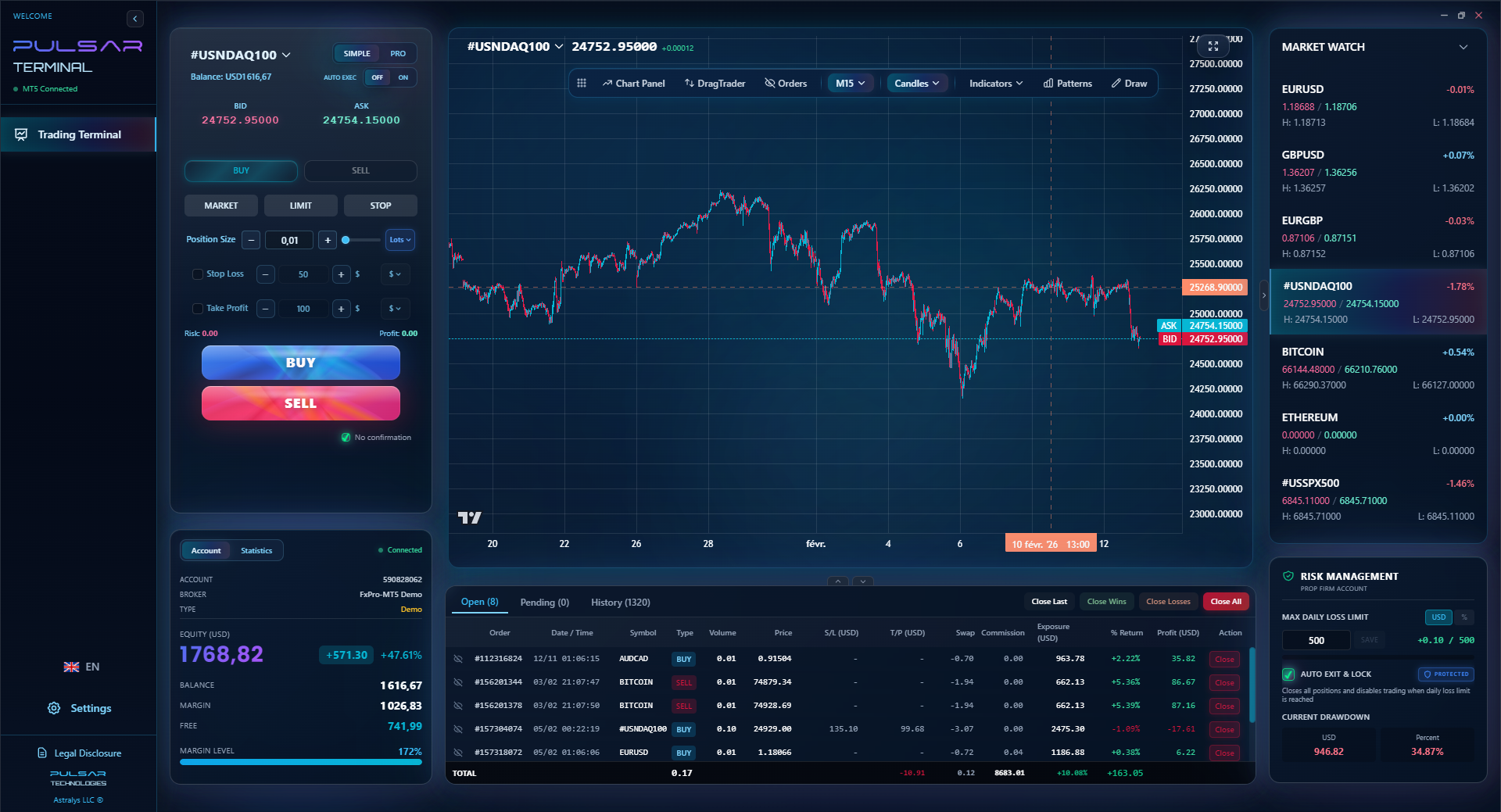
- The Trade Manager: This is my most valuable tool. I enter trades manually based on my swing trading analysis. Then, a robot manages the trade. It moves my stop to breakeven after a certain profit, it trails the stop, and it automatically takes partial profits at different levels. This removes all emotion from trade management. Tools like Pulsar Terminal for MT5 are built for this kind of functionality, letting you set multi-level exits with a few clicks.
- The Backtester: I use robots to rigorously test my manual trading ideas across years of data. This is perhaps their most powerful use.
Thinking a robot will make you rich without your involvement is a fantasy. The real 'best forex robot' is a combination of your own market understanding and automated tools that handle the execution and management grunt work.
💡 Winston's Tip
Your greatest edge isn't a robot's code; it's your patience. The ability to turn it off during nonsense market conditions is what separates pros from blown accounts.
Managing trades without emotion is the hardest part, which is why I use tools like Pulsar Terminal to automate stop-loss adjustments and partial profit-taking directly on my MT5 charts.
Pulsar Terminal
The all-in-one MT5 companion: drag-and-drop orders, multi-TP/SL, trailing stop, grid trading, Volume Profile, and prop firm protection. Used by 1,000+ traders daily.
“I lost $520 learning that a robot is just a tool. A very expensive, very literal tool.”
Feeling overwhelmed? Don't be. Here's a concrete plan to start smart.
- Pick a Broker & Platform: Choose a reputable, EA-friendly broker that accepts Nigerians. I'd recommend starting with Exness or XM for their ease of use. Download MT5 (it's more modern than MT4).
- Go Demo First: Open a demo account. Don't even think about live money yet.
- Find ONE Simple Robot: Go to the MQL5 Market. Filter by "Popular" or "Top Sellers." Avoid the crazy profit promises. Look for a robot with a clear, simple strategy description - maybe a moving average crossover bot. Download its free trial.
- Run Your Test: Put it on your demo EUR/USD chart. Use the default settings. Watch it for a week. Journal every trade it makes. Do you understand why it entered? Where is its stop loss? This isn't about profit; it's about education.
- Learn the Lingo: As you test, you'll have questions. Look up terms like pip, spread, slippage, backtesting. Understand how your broker's execution affects the robot.
- Micro-Fund a Live Test: Only after 2-3 months of successful demo testing should you fund a live account with $50-$100. Run the robot with the smallest possible trade size (0.01 lots). Your goal is to test real-world execution, not get rich.
The journey to finding a useful robot is a marathon. It took me three years of fails to find a management system I trust. Start slow, learn constantly, and never let the robot think for you. You are the strategist. Let it be the obedient soldier that follows your plan perfectly, every single time.
FAQ
Q1Is using a forex robot legal in Nigeria?
Yes, using automated trading software (Expert Advisors) is legal for individual traders in Nigeria. The key legal consideration is using a broker that is appropriately regulated. The new Investments and Securities Act (ISA) 2025 targets the platforms and service providers themselves, requiring them to register with the SEC. As an individual using software on an international platform, you are generally within the law, but always ensure your broker is reputable and regulated offshore.
Q2What is the best trading platform for forex robots in Nigeria?
MetaTrader 5 (MT5) is the best overall platform. It's the successor to MT4, has more advanced features for coding and testing robots, and is supported by almost every major broker that accepts Nigerian clients, like Exness, IC Markets, XM, and Pepperstone. Its MQL5 language and built-in Strategy Tester are industry standards for developing and running EAs.
Q3How much money do I need to start with a forex robot?
You can start testing with $0 on a demo account. For a meaningful live test that accounts for real spreads and slippage, I recommend a minimum of $50-$100. This allows you to trade micro lots (0.01) and properly test the robot's logic without risking significant capital. Remember, many brokers like FBS or Exness have very low minimum deposits suitable for this phase.
Q4Can a forex robot trade USD/NGN for me?
Technically, yes, if you can find or build one. However, I strongly advise against it, especially for beginners. The USD/NGN pair is highly sensitive to CBN policy, local liquidity, and can experience extreme volatility and spread widening. Most commercial robots are not built for this unique environment and could fail catastrophically. It's better to stick to major pairs like EUR/USD or GBP/USD where market conditions are more stable and predictable for automated systems.
Q5Why did my profitable demo robot fail on a live account?
This is the most common issue. Demo accounts often have perfect, instantaneous execution and fixed, ideal spreads. Live accounts have real-world slippage, variable spreads that widen during news or low liquidity, and sometimes requotes. A robot that doesn't account for these factors in its code will get different entry/exit prices live, which can turn a demo profit into a live loss. This is why the micro-live test is non-negotiable.
Q6Do I need a VPS to run a forex robot?
If you want 24/5 trading without your computer being on, yes. A Virtual Private Server (VPS) hosts your trading platform in a data center near your broker's servers, ensuring low latency and uptime. For scalping robots or any EA that trades on very short timeframes, a VPS is essential. For slower swing trading robots, you might get away without one, but it's a good practice for reliability. Some brokers like XM offer free VPS services if you maintain a certain account balance.
Prof. Winston's Lesson
Key Takeaways:
- ✓Demo test for 2 months minimum across different volatility regimes.
- ✓Allocate a maximum of 5% of your capital to any single robot test.
- ✓A robot must pass a $100 micro-live account test before earning more capital.
- ✓Semi-automation (your brain, its execution) beats full automation 90% of the time.
How useful was this article?
Click a star to rate
Weekly Trading Insights
Free weekly analysis & strategies. No spam.
About the Author
Olumide Adeyemi
West African Trading Pioneer
One of Nigeria's most active forex trading educators. 8 years of experience trading from Lagos. Specializes in low-capital strategies and prop firm challenges for African traders.
Comments
Risk Disclaimer
Trading financial instruments carries significant risk and may not be suitable for all investors. Past performance does not guarantee future results. This content is for educational purposes only and should not be considered investment advice. Always conduct your own research before trading.
You Might Also Like

Cara Trading Forex Sukses: 7 Prinsip dari Trader Profesional
Cara trading forex sukses dengan 7 prinsip trader pro: manajemen modal, disiplin, journal trading, backtest. Data nyata, bukan janji profit palsu.
Jam Trading Forex Terbaik untuk Trader Indonesia: Panduan Lengkap dengan Tabel Waktu
Panduan jam trading forex untuk trader Indonesia. Tabel 4 sesi dunia, jam emas 20:00-00:00, sesi mana yang harus dihindari. Data akurat + tips dari trader berpengalaman.
Top 5 Sàn Forex Uy Tín Nhất 2026: Review Jujur dari Trader Indonesia
Top 5 sàn forex uy tín 2026 untuk trader Indonesia. Review jujur: spread, deposit, withdraw, dukungan lokal. Exness, XM, IC Markets & lebih.
Get Pulsar Terminal
All these calculators are built into Pulsar Terminal with real-time data from your MT5 account. One-click position sizing, automatic risk management, and instant calculations.
Get Pulsar Terminal