


Here's a hard truth most 'gurus' won't tell you: over 90% of paid forex signal services fail to beat a simple buy-and-hold strategy over a year.

Olumide Adeyemi
West African Trading Pioneer ·  Nigeria
☕ 10 min read
What you'll learn:
- 1What Are Forex Signals, Really?
- 2The Different Types of Signal Providers
- 3How to Vet a Signal Service (The Nigerian Context)
- 4What Should It Cost? Setting Realistic Expectations
- 5How to Actually Use Signals (Without Blowing Your Account)
- 6Major Red Flags & Common Nigerian Scams
- 7The End Goal: Using Signals to Learn, Not Just Earn
Here's a hard truth most 'gurus' won't tell you: over 90% of paid forex signal services fail to beat a simple buy-and-hold strategy over a year. In Nigeria, where the promise of quick forex money is everywhere on Instagram, that number might be even worse. I've lost money following signals, and I've made money using them the right way. This isn't about finding a magic bullet, it's about learning how to use tools without letting them use you. Let's talk about what 'best' really means for a trader in Lagos, Abuja, or Port Harcourt.
At its core, a forex signal is just a suggestion. It's a message telling you what currency pair to trade, when to get in, where to set your stop loss, and where to take profit. They come through Telegram, WhatsApp, email, or inside a fancy app. The idea is simple: someone else does the analysis, you just execute the trade.
But here's where it gets messy. That 'someone else' could be a seasoned fund manager in London, a clever algorithm, or a guy in a cybercafe with a flashy car rented for Instagram photos. In Nigeria, you see all three types, but the last one is unfortunately common. A real signal should give you all the details: entry price, stop loss (SL), take profit (TP) levels, and the rationale. If it's just "BUY GBPUSD NOW!" with no plan, run. That's not a signal, it's gambling advice.
I learned this the expensive way early on. I paid 50,000 Naira for a 'VIP signal group' that just blasted orders. No explanation, no risk management rules. I blew a $500 account in two weeks following them blindly. The lesson? A signal without a strategy behind it is worthless. You need to understand the 'why' just as much as the 'what'.

💡 Winston's Tip
A signal is just a suggestion, not a command. Your job is to be the risk manager. If the suggested stop loss would blow 5% of your account, recalculate your position size. The trade size is more important than the trade direction.
“Price rarely equals quality. The guy with the most expensive Lamborghini signal service is usually just the best marketer.”
Not all signal services are created equal. Knowing who's sending the trade idea changes everything.
Human Analysts and Traders
These are individuals or small teams selling their trade ideas. The good ones are transparent, show a verified track record (not just screenshots), and explain their analysis. The bad ones... well, they're the 'gurus'. The major red flag? They focus more on their lifestyle (cars, money sprays) than on their trade history. A real trader talks about drawdowns and losing streaks, not just wins.
Algorithmic/Signal Bots
These are automated systems. They use code to generate signals based on technical indicators or price action. The appeal is they remove emotion. The danger is they can fail spectacularly when market conditions change. A bot that killed it in a ranging market might blow up when a strong trend hits. Always ask for long-term, real-money results, not a one-month demo test.
Copy Trading and MAM/PAMM Services
This is a step beyond signals. With copy trading, your account automatically mirrors the trades of a selected master trader. Platforms like Exness and XM offer this. A MAM/PAMM account is where a fund manager trades a pooled account. The upside is full automation. The downside is you have zero control once you allocate funds. You're betting entirely on that person's skill and risk discipline.

Warning: The most common scam in Nigeria is the "managed account" promise. Someone asks for direct access to your trading account or to send them money to trade for you. Never, ever do this. Use only regulated copy trading through your broker where you retain ownership and can withdraw anytime.
“If they're so profitable trading, why do they need my subscription money so badly?”
Before you pay one kobo, do this homework. It saved me from countless scams.
1. Demand a Verified Track Record: Anyone can Photoshop a winning trade. Ask for a link to a verified myfxbook.com or fxblue.com statement. These sites connect directly to the MT4/MT5 platform and verify results automatically. No verified track record? Immediate no. A good track record shows at least 6-12 months of consistent activity, includes the drawdown (the biggest peak-to-valley drop in equity), and has a reasonable win rate (55-65% is often more realistic than 90%).
2. Check the Risk Per Trade: What's their standard risk? If every trade risks 5% of the account to make 5%, that's a 1:1 risk-reward ratio. That's a tough way to make money long-term. The best forex signals I've used consistently aim for a minimum 1:1.5 or 1:2 risk-reward. This means they can be wrong more often than they're right and still be profitable. Ask them: "What's your average risk-reward ratio?" If they don't know, they're not serious.
3. Analyze the Communication: Are signals sent on time, with clear details? Is there a community or chat where they discuss the market? A provider who engages and educates is worth more than one who just sends orders. Also, see how they handle a losing streak. Do they go quiet? Make excuses? Or do they explain the market shift and adjust? I once followed a provider who vanished for a week after three losses. I left the group and never looked back.
4. Start Small: Never commit a large amount upfront. Most honest services offer a one-week or one-month trial. Use it. Test their signals on a demo account first, or with very small real money using proper position size calculator discipline. See if their style fits your personality. If you're a swing trader at heart, a scalping signal service will drive you mad.

Example: Let's say a signal service charges $100/month. You test them on a $200 demo account, risking 1% ($2) per trade as they suggest. Over a month, they give 20 signals. You track every one. Even on demo, this tells you their consistency, timing, and if you can actually follow the signals in real-time with your schedule.
💡 Winston's Tip
The only track record that matters is a verified, third-party one like myfxbook. Screenshots are the currency of liars. If they won't provide a live statement link, your conversation with them should be over.
“If they're so profitable trading, why do they need my subscription money so badly?”
In Nigeria, you'll see everything from "free signals" to services costing 200,000 Naira a month. Price rarely equals quality.
Free Signals: Usually a marketing tool. The provider makes money from broker rebates (when you trade through their link) or by upselling you to a paid tier. The signals might be decent, but expect less consistency and priority support. Never trust a free signal that asks for a direct 'appreciation' payment to your personal account.
Paid Subscriptions: A reasonable range for a proven service is between $50 and $200 per month. That's roughly 70,000 to 280,000 Naira. Anything vastly higher needs to have an extraordinary, verified track record. Ask yourself: if they're so profitable trading, why do they need my subscription money so badly? The best providers often have limited slots.
Realistic Profit Targets: This is critical. A provider promising 50% returns a month is lying, full stop. That's a Ponzi scheme waiting to happen. A professional, sustainable target is 5-15% per month, with an understanding that some months will be break-even or small losses. The goal is steady equity growth, not explosions.
My own benchmark? I don't expect signals to make me rich. I use them as a second opinion on my own analysis. If a service can consistently help me achieve a 3-5% monthly return while I manage my risk, it's worth a reasonable fee. One of my best ongoing costs is a $80/month service that gives me great ideas on XAU/USD and EUR/USD, which I then filter through my own rules.
“A signal without a strategy behind it is worthless. You need to understand the 'why' just as much as the 'what'.”
Buying the signal is only 10% of the work. The other 90% is how you manage it. Here's my process.
Step 1: The Filter. I don't take every signal. I have a checklist. Does this trade align with the broader market trend I see on my daily chart? Is the entry point near a key support or resistance level I've already marked? If the signal says BUY, but my reading of the MACD indicator on the 4-hour chart is showing bearish divergence, I might skip it. The signal is an idea, not a command.
Step 2: The Risk Check. The signal might say "set stop loss 50 pips away." But what does that mean for my account? If I have a $1,000 account, 50 pips on a standard lot is $500. That's insane. I always recalculate the stop loss distance into a monetary value that fits my risk. I never risk more than 1-2% of my account on any single signal. I use my own position size calculator every single time.
Step 3: The Execution & Management. This is where most fail. You get the signal, you enter the trade, and then you panic. You move the stop loss wider because you're scared of a small loss, or you close early out of greed. You have to follow the plan. If the signal's stop loss is hit, it's hit. Trust the process. If you find yourself constantly overriding the signals, then either the provider isn't a good fit for you, or you need to work on your trading psychology.

Pro Tip: Create a 'Signal Journal.' For every signal you take (or skip), record: the reason given, your own analysis, the entry/exit prices, and the outcome. After 50 trades, you'll have crystal-clear data on whether this service works for YOU. I found out I was terrible at executing their intraday scalps but great with their swing trades. I adjusted what I followed and my results improved instantly.
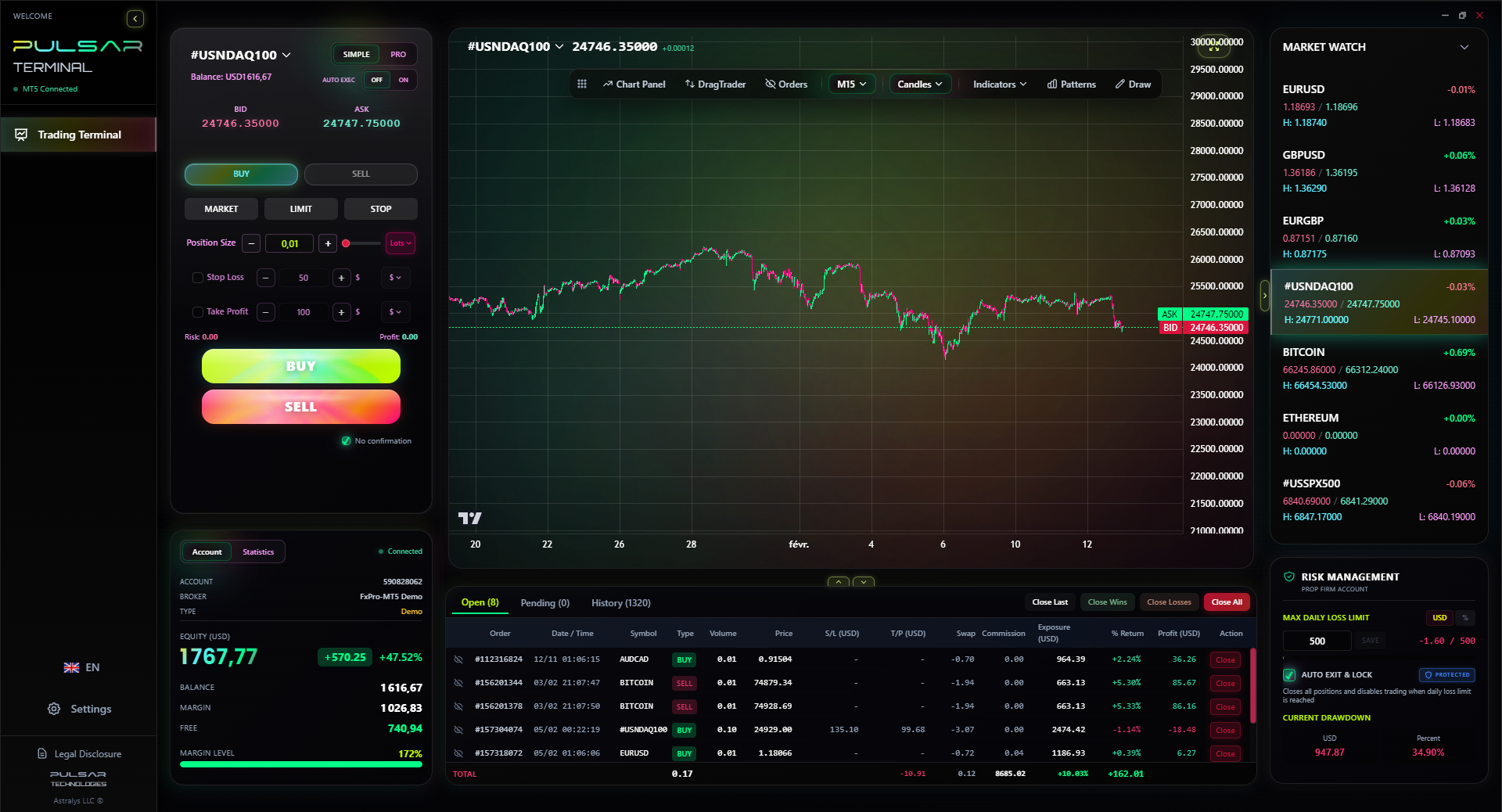
Manually managing multiple signal-based trades across different pairs is chaotic, but a tool like Pulsar Terminal lets you drag-and-drop orders and set multi-level take profits directly on your MT5 charts, keeping you in control.
Pulsar Terminal
The all-in-one MT5 companion: drag-and-drop orders, multi-TP/SL, trailing stop, grid trading, Volume Profile, and prop firm protection. Used by 1,000+ traders daily.
“A signal without a strategy behind it is worthless. You need to understand the 'why' just as much as the 'what'.”
Protect yourself. If you see any of these, block and move on.
- No Verified Live Track Record: The biggest one. Screenshots and forwarded 'profit' messages prove nothing.
- Guaranteed Profits: "We guarantee 80% monthly returns!" This is mathematically impossible in the long run. It's a guarantee of you losing your money.
- Pressure to Deposit Directly: They want you to send money to a Nigerian bank account, PayPal, or crypto wallet for 'management' or a 'special signal package.' This is outright theft.
- Over-the-Top Lifestyle Marketing: If their primary content is them in front of luxury cars and hotels, they are selling a dream, not a trading edge. Real traders are usually boring.
- Vague or Missing Strategy: They can't explain what confluence of factors (like RSI indicator levels, news events, price action) triggers their signals. If the answer is "our secret algorithm," be very skeptical.
- Unrealistic Win Rates: Claims of 95%+ win rates are fake. The market doesn't work that way. A high win rate often comes with very poor risk-reward (risking 10 pips to make 5).
I got caught by #3 early in my career. A 'well-respected' figure in a forum offered a 'can't lose' arbitrage opportunity if I sent $300 to his Perfect Money wallet. I did. He disappeared. That $300 lesson was cheaper than what it could have been later.
💡 Winston's Tip
Use signals as a learning lab. When one hits its take profit, don't just celebrate. Go mark up your chart. What did they see that you missed? That's how you grow from a follower into a trader.
“The goal is steady equity growth, not explosions. Anyone promising monthly explosions is holding a match near your money.”
The best use of a signal service, in my opinion, isn't just to make trades. It's to become a better trader yourself.
Think of it like having a mentor. When you get a signal, don't just place the order. Go to your chart. Try to figure out why they took that trade. Is it a bounce off the 200-period moving average? A breakout from a triangle pattern? A news play? Reverse-engineer their thought process.
Over time, you'll start to see patterns in their analysis. You'll begin to anticipate signals before they come. This is the golden point. You're no longer a follower, you're a student who's internalized the lessons. The signals become a validation tool for your own growing skills.
Eventually, you might find you need the signals less and less. Or, you might find a great provider whose analysis you truly trust, and you continue the partnership. But now, it's a conscious choice, not a dependency. That's the real freedom. You're not chasing the 'best forex signals' anymore, you're building the best version of your own trading judgment. Start by learning the basics, like what a pip really costs you and how the spread affects your entries, and build from there.
FAQ
Q1Are free forex signal groups on WhatsApp and Telegram legit?
Some can be, but extreme caution is needed. Many are run by unqualified individuals or are fronts for broker referral schemes. The signals are often low-quality and sent to hundreds of people, which can move the market against you. Treat them as entertainment or very early learning tools, never as a primary strategy. Always verify the ideas on your own chart first.
Q2What is a reasonable monthly return I should expect from following signals?
If a signal service helps you achieve a consistent 5-10% return per month on your trading capital, that is exceptional and sustainable. Anyone promising 20%, 50%, or more per month is almost certainly running a scam. Remember, professional hedge funds aim for 15-20% per year. Manage your expectations.
Q3How much should I pay for a forex signal service in Nigeria?
A credible service typically costs between $50 and $200 per month (approx. 70,000 - 280,000 Naira). You should never pay a massive upfront annual fee. Look for monthly subscriptions or short trials. The most expensive is rarely the best. Value is in verified performance and education, not the price tag.
Q4Can I get rich just by following forex signals?
No. This is a dangerous fantasy. Signals are a tool, not a wealth generator. Success depends on your risk management, position sizing, psychology, and ability to execute consistently. Blindly following signals with poor money management is a fast track to losing your entire account. The 'getting rich' part comes from your own discipline, not the signals.
Q5What's better: manual signals or a trading robot?
It depends. Manual signals from a good analyst can adapt to changing market conditions. A robot (Expert Advisor) is rigid but emotionless. Robots often fail when the market behavior they were built for changes. For beginners, a transparent manual service that explains its reasoning can be more educational. There's no universal 'better'.
Q6Is copy trading the same as using signals?
It's a more automated form. With signals, you receive an alert and manually place the trade. With copy trading (like on IC Markets or Pepperstone), your platform automatically replicates the master trader's moves. It's easier but you have even less control. Both require you to vet the provider's track record with extreme care.
Q7How long should I test a signal service before trusting it with real money?
Test for at least one full market cycle, which is typically 2-3 months. Paper trade (demo) every signal they provide during this period. Track all results in a spreadsheet. Only consider using real money if they show consistent, logical trading through different market conditions (ranging, trending, volatile) and you are comfortable with their risk parameters.
Prof. Winston's Lesson
Key Takeaways:
- ✓Demand a verified myfxbook track record, not screenshots.
- ✓Never risk more than 1-2% of your account on any single signal.
- ✓A realistic target is 5-15% per month, not 50%.
- ✓Test every service on demo for 2-3 months minimum.
- ✓Signals are for learning, not just blind following.
How useful was this article?
Click a star to rate
Weekly Trading Insights
Free weekly analysis & strategies. No spam.
About the Author
Olumide Adeyemi
West African Trading Pioneer
One of Nigeria's most active forex trading educators. 8 years of experience trading from Lagos. Specializes in low-capital strategies and prop firm challenges for African traders.
Comments
Risk Disclaimer
Trading financial instruments carries significant risk and may not be suitable for all investors. Past performance does not guarantee future results. This content is for educational purposes only and should not be considered investment advice. Always conduct your own research before trading.
You Might Also Like

Cara Trading Forex Sukses: 7 Prinsip dari Trader Profesional
Cara trading forex sukses dengan 7 prinsip trader pro: manajemen modal, disiplin, journal trading, backtest. Data nyata, bukan janji profit palsu.
Jam Trading Forex Terbaik untuk Trader Indonesia: Panduan Lengkap dengan Tabel Waktu
Panduan jam trading forex untuk trader Indonesia. Tabel 4 sesi dunia, jam emas 20:00-00:00, sesi mana yang harus dihindari. Data akurat + tips dari trader berpengalaman.
Top 5 Sàn Forex Uy Tín Nhất 2026: Review Jujur dari Trader Indonesia
Top 5 sàn forex uy tín 2026 untuk trader Indonesia. Review jujur: spread, deposit, withdraw, dukungan lokal. Exness, XM, IC Markets & lebih.
Get Pulsar Terminal
All these calculators are built into Pulsar Terminal with real-time data from your MT5 account. One-click position sizing, automatic risk management, and instant calculations.
Get Pulsar Terminal