


You've seen the Instagram pages.

Olumide Adeyemi
West African Trading Pioneer ·  Nigeria
☕ 11 min read
What you'll learn:
- 1The Myth vs. The Reality of a 'Successful' Trader
- 2The Core Skills (That Have Nothing to Do With a 'Strategy')
- 3Trading in Nigeria: The Local Context You Can't Ignore
- 4Building a Sustainable Edge (Not Finding a 'Signal')
- 5Picking Your Weapon: Broker Selection for Nigerian Traders
- 6The Mental Game: Where Most Nigerian Traders Fail
- 7The Path: From Beginner to Consistent
You've seen the Instagram pages. The flashy cars, the screens full of green trades, the promises of 'secret strategies.' Let me be blunt: that's performance art, not trading. The real best forex traders in Nigeria aren't the loudest ones on social media. They're the quiet professionals who survive year after year in a market that eats overconfident beginners for breakfast. I've blown up an account, I've chased losses, and I've learned the hard way what actually separates the winners from the wreckage. This isn't about getting rich quick. It's about building a skill set that lets you navigate the Naira's volatility and come out the other side with your capital intact.
The myth sold to most new traders is a fantasy of constant action and huge wins. The reality is boring, disciplined, and mostly about not losing.
When I started, I thought success meant catching every move. I'd be glued to the screen, trading EUR/USD on the 1-minute chart, convinced activity equaled productivity. I turned $500 into $1,200 in a week once. Felt like a genius. Then I gave it all back, plus another $300, in two bad days because I didn't know when to stop. That's the first lesson: the best forex traders define success by consistency, not by singular, risky wins.
The reality looks like this: a trader who risks 1% per trade, has a clear edge they've backtested, and spends more time reviewing their journal than looking for new signals. They understand that in Nigeria, with the CBN's frequent interventions and Naira volatility, patience is a weapon. A quiet month with a 3% return is a fantastic month. A wild month with a 15% gain is usually a red flag, a sign you're taking on too much risk that will eventually bite you.

Warning: If a 'guru' shows you a profit and loss statement with only winning trades, run. Every real trader has losses. The difference is how they're managed.
The skill isn't in predicting the market. It's in setting up your trades so that you're wrong often and still make money. That's the boring secret nobody wants to advertise.

💡 Winston's Tip
If you can't explain your edge in one sentence - 'I buy when price bounces off this weekly level with RSI divergence' - you don't have one. You're gambling.
“The real best forex traders in Nigeria aren't the loudest ones on social media.”
Forget about finding the holy grail indicator. The foundational skills of the best traders are managerial and psychological.
Risk Management Is Your Real Job
Your primary job isn't picking directions. It's deciding how much of your account you can afford to lose on a single idea. I use a simple position size calculator for every single trade. No exceptions. When the Naira makes a sudden move, emotion screams to double down. My calculator tells me the max lot size for my 1% risk. I listen to the calculator.
Here’s a concrete example from last month: I saw a setup on GBP/NGN. My entry was 1950. My stop loss was at 1935 (a 15-pip risk). My account was $2,000. 1% risk is $20.
The math: $20 / (15 pips) = $1.33 per pip. On GBP/NGN, 1 standard lot is roughly $10 per pip (it varies). So my max position was 0.13 lots. I took 0.12. It hit my stop. I lost $18. Annoying, but it didn't ruin my week. That's the discipline.
The Trading Journal You'll Actually Use
A journal isn't a diary. It's a forensic tool. The best traders I know review theirs weekly. Mine has columns for: Date, Pair, Setup (e.g., 'Daily support bounce'), Entry Price, Stop Loss, Take Profit, Exit Price, P&L, Risk %, Mistake Made. That last column is the most important.
My most common mistake for years was moving my stop loss further away 'to give the trade room.' It wasn't giving it room, it was refusing to accept I was wrong. The journal made the pattern undeniable. Now, if my analysis says the stop goes here, it's glued there.
Emotional Detachment Through Routine
You can't control the market, but you can control your process. My routine is sacred: pre-market analysis at 7 AM WAT before London opens, check economic calendar, set alerts, then walk away. I don't sit and watch. Watching a trade is like watching water boil; it tempts you to interfere. I set my orders based on my plan and let them work. This detachment is the only way to handle the stress, especially when trading volatile pairs like XAU/USD (Gold).
“A quiet month with a 3% return is a fantastic month. A wild month with a 15% gain is usually a red flag.”
Trading from Nigeria isn't the same as trading from London or New York. You have unique advantages and massive pitfalls.
The Regulatory Grey Zone: Yes, forex trading is legal with your own funds. But the 'poorly regulated' retail space means you are your own first line of defense. The CBN won't help you if you send money to a scam broker. This makes broker selection more critical than any trading decision. I only use brokers with top-tier international regulation like ASIC or FCA, even if they operate an offshore entity for Nigerian clients. I've had good execution experiences with IC Markets and Pepperstone for their raw spreads.
The Naira Volatility Trap: Trading Naira pairs (USD/NGN, GBP/NGN) is tempting. The moves can be huge. But they're also highly susceptible to CBN interventions that come out of nowhere. I treat these pairs like trading news events: extreme caution, tiny position sizes, or avoid them altogether. It's not a market for your main strategy.
The Tax Man Cometh: Remember the 10% capital gains tax to the FIRS. The best traders factor this into their profit targets. If you need a 10% net return, you need an 11% gross return. It sounds small, but over a year, poor tax planning can wipe out your edge. Keep clean records from day one.
Infrastructure Matters: Power outages and poor internet are non-negotiable risks. I have a UPS for my router and laptop, and a mobile data hotspot as a backup. I once got stopped out on a scalping trade because of a flickering light. That loss was 100% on me for not having a backup. Now, it's part of my overhead cost, just like spreads.
“A quiet month with a 3% return is a fantastic month. A wild month with a 15% gain is usually a red flag.”
An edge is a slight statistical advantage. It's not a guarantee. It's the reason you get paid for taking risk.
Price Action Over Indicators
Early on, I had charts cluttered with every indicator under the sun. It was noise. The best traders I've worked with focus primarily on price action - support, resistance, and market structure - and use one or two indicators for confirmation at most. I now use a simple combination: horizontal levels for key areas, and the RSI indicator to spot divergences on higher timeframes. That's it. Clean charts lead to clear decisions.
Specialization Beats Diversification
You don't need to trade 30 pairs. Find one or two you understand. I primarily trade EUR/USD and occasionally Gold. I know how EUR/USD typically reacts around the London open, how it behaves before major US data. I know nothing about the Australian Dollar's nuances, so I don't trade it. Specializing lets you understand the 'personality' of a market, which is more valuable than any generic strategy.
Backtesting, Not Guessing
Your edge must be proven, not felt. If you think a certain MACD indicator crossover works on the 4-hour chart, don't risk money on it. Go back and test it on 2-3 years of historical data. How many times did it work? What was the average win vs. the average loss? This is boring, manual work. This is what the best traders do before they ever place a live trade. I spent three weekends backtesting a simple support/resistance strategy. The data showed it was only 52% accurate, but the winning trades were twice as big as the losers. That was an edge. I could then trade it with confidence.
💡 Winston's Tip
Your first profitable system will feel boring. That's how you know it's sustainable. Excitement in trading is usually just pre-loss adrenaline.
“Your primary job isn't picking directions. It's deciding how much of your account you can afford to lose.”
Your broker is your business partner. Choosing based on who offers the highest use (like 1:2000) is a surefire path to a margin call. Here’s what actually matters.
Regulation & Safety of Funds: This is non-negotiable. Look for brokers licensed by ASIC (Australia), FCA (UK), CySEC (Cyprus), or FSCA (South Africa). These regulators enforce client money protection rules. Many top brokers serve Nigeria through their globally regulated entities. I trust my capital with a tightly regulated broker like those reviewed in our Pepperstone review or Exness review far more than a local outfit with flashy ads.
Trading Costs (The Silent Killer): Look beyond the 'commission-free' tag. It usually means wider spreads. You need to calculate the all-in cost.
| Broker Type | Typical EUR/USD Spread | Typical Commission | Total Cost per Standard Lot* |
|---|---|---|---|
| 'Commission-Free' Broker | 1.2 pips | $0 | $12.00 |
| Raw Spread/ECN Broker | 0.1 pips | $7 round turn | $8.00 |
*Assuming 1 pip = $10. The ECN broker is cheaper despite the commission.
For active traders, lower total costs directly increase profitability. Check the broker's specific spreads on the pairs you trade during your session times.
Execution & Slippage: Does your broker consistently fill you at the price you click? During news events, do you get massive slippage? A good broker has fast, reliable execution. This is where reading detailed reviews from other traders is useful.
Deposit/Withdrawal in Naira: This is a practical necessity. Brokers like HFM offer Naira accounts. Others allow deposits via local bank transfer or cards. Check the processing times and any fees. A 'free' deposit that takes 5 business days has an opportunity cost.

Pro Tip: Never choose a broker because they offer the highest use. Choose the one with the best combination of regulation, low total costs, and reliable Naira withdrawals. use is a tool, not a benefit. Using less than you're offered is a sign of maturity.
“Your primary job isn't picking directions. It's deciding how much of your account you can afford to lose.”
This is the final boss. You can have the best strategy and still lose if your head isn't right.
Ego is the Enemy: The market doesn't care about your opinion. The moment you start arguing with the price, you've lost. I had to learn to say 'I was wrong' quickly and often. Taking a small loss feels like failure. Letting it turn into a margin call is failure.
FOMO (Fear Of Missing Out) is a Capital Destroyer: You see a pair rocketing, you jump in late, the move reverses, and you're stuck. This happens constantly. The best trades often feel boring at the entry. The exciting, 'can't-miss' moves are usually traps. My rule: if I didn't plan for it, I don't trade it. Missed money is better than lost money.
The Prop Firm Psychology Trap: Many traders use prop firm challenges as a goal. This creates terrible pressure to hit a target by a deadline, which leads to overtrading. The mindset should be 'trade well to pass,' not 'pass at all costs.' Tools that automate daily loss limits can be a lifesaver here, forcing discipline you might not have in the heat of the moment.
Building Resilience: You will have losing streaks. Every trader does. The question is whether a 5-trade losing streak blows up your account or merely sets you back 5%. If the former, your position sizing is wrong. Resilience comes from knowing your system has been tested, and a bad week is within the expected statistical distribution. It's math, not misfortune.
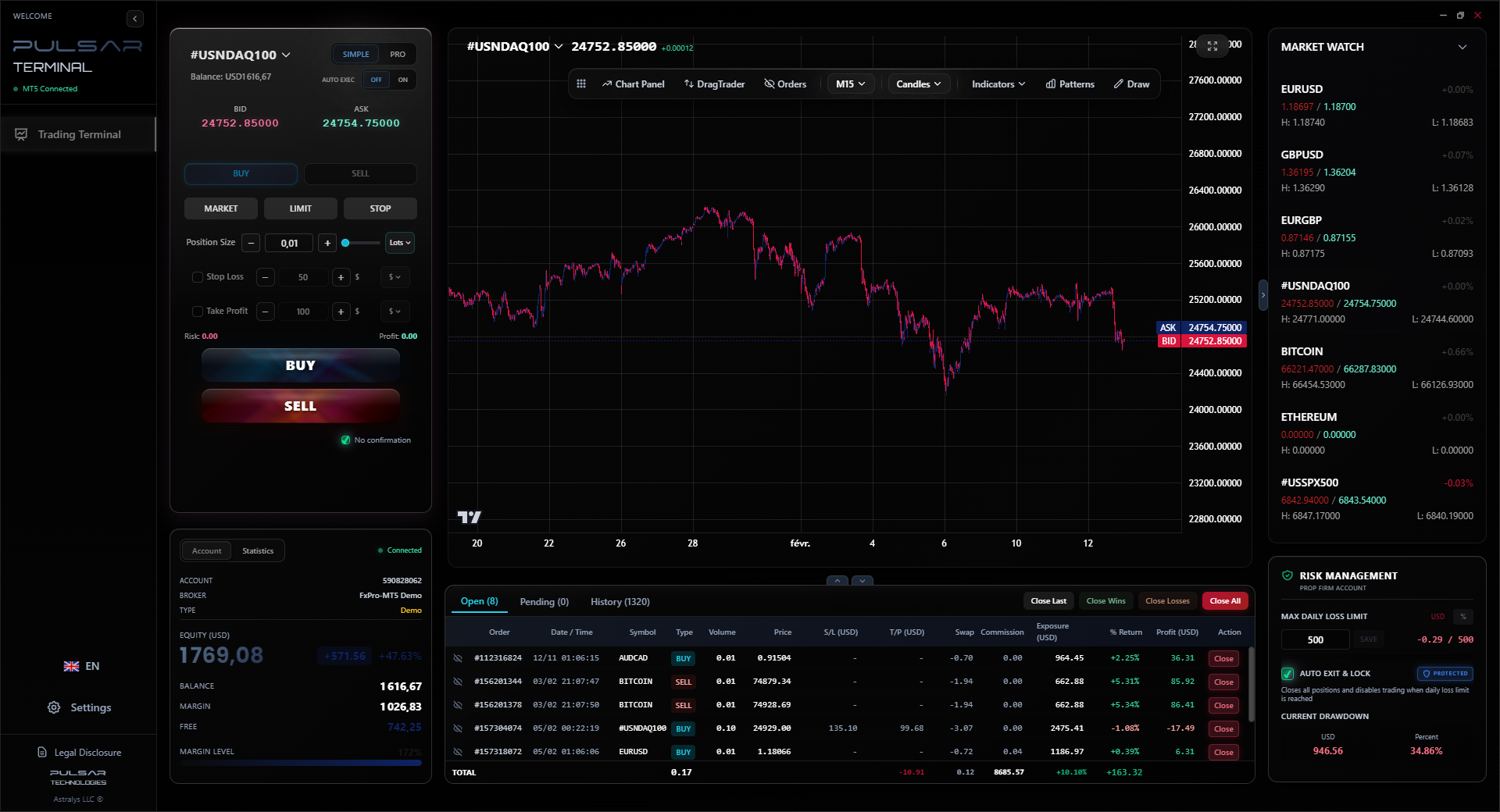
Managing the psychological pressure of a prop firm challenge or your own rules requires iron discipline, which is where tools like Pulsar Terminal can automate critical risk controls directly on your MT5 platform.
Pulsar Terminal
The all-in-one MT5 companion: drag-and-drop orders, multi-TP/SL, trailing stop, grid trading, Volume Profile, and prop firm protection. Used by 1,000+ traders daily.
“The skill isn't in predicting the market. It's in setting up your trades so that you're wrong often and still make money.”
There's no finish line. The best forex traders are permanent students.
Phase 1: Education & Demo (3-6 months): Learn the basics: what a pip is, what spread means, how use works. Trade a demo account religiously. Not to make 'fake' money, but to practice your process - entering, exiting, journaling - without emotion. Most fail here because they get bored and go live too soon.
Phase 2: Live Trading with Micro Risk (6-12 months): Fund a small live account. Your goal is not profit. Your goal is to execute 100 trades following your plan exactly. The profit/loss is irrelevant data at this stage. You're training your brain to handle real risk. Expect to lose this initial capital. Consider it tuition.
Phase 3: Scaling & Refinement (Ongoing): Once you can look at your last 100 trades and see a disciplined process, you can think about scaling your capital. This is where you refine your edge, maybe move from swing trading to a different style, and focus on increasing your risk-adjusted returns, not just your raw profits.
The entire journey hinges on one thing: treating trading as a professional skill-building exercise, not a lottery ticket. The market will be here tomorrow. Your job is to make sure you are too.
💡 Winston's Tip
Track your 'Pips Survived.' How many pips did your stop loss save you from losing? That's often more important than the pips you gained.
FAQ
Q1Who is the best forex trader in Nigeria?
There's no single 'best' trader. The truly successful ones are professionals who value privacy and consistency over fame. They're often fund managers, prop traders, or individuals who treat it as a serious business, not a side hustle they advertise on social media.
Q2Can you become a profitable forex trader in Nigeria?
Yes, absolutely. But profitability comes from risk management and psychology, not magical signals. You must account for local challenges like Naira volatility, infrastructure issues, and tax obligations. It's a harder road than many admit, but it's possible with extreme discipline.
Q3How much do the best forex traders make in Nigeria?
This is the wrong question. Focus on percentage returns, not absolute figures. A consistent trader might target 2-5% return on their risk capital per month. On a $10,000 account, that's $200-$500. Some months they'll make less, some they'll lose. Chasing huge monthly percentages is the fastest way to blow up your account.
Q4What is the number one mistake Nigerian forex traders make?
Using excessive use. Brokers here often offer 1:1000 or more. New traders see this as a chance to turn 50,000 NGN into millions quickly. In reality, it just magnifies losses and ensures a small move against you wipes out your account. The best traders rarely use more than 1:10 or 1:20 use.
Q5Do I need a mentor to become a successful trader?
You need education, not necessarily a paid 'guru'. A good mentor can shortcut some learning, but beware of charlatans. Most of what you need is in books, reputable online courses, and, most importantly, in your own trading journal. Your own data is your best teacher.
Q6Is forex trading taxable in Nigeria?
Yes. Profits are subject to a 10% Capital Gains Tax, payable to the Federal Inland Revenue Service (FIRS). You are responsible for declaring this income. Not accounting for tax in your profit targets is a major oversight.
Q7Which time frame is best for beginners in Nigeria?
Start with higher timeframes like the 4-hour or daily chart. They are less noisy and give you more time to think. The 1-minute and 5-minute charts favored by 'signal' sellers are a minefield of false moves and will destroy you through spreads and emotion.
Prof. Winston's Lesson
Key Takeaways:
- ✓Success is defined by consistency, not single wins.
- ✓Risk management is your primary job, not market prediction.
- ✓Your trading journal is your most important tool.
- ✓Choose brokers on regulation & costs, not use.
- ✓Excitement is often a warning sign, not an opportunity.
How useful was this article?
Click a star to rate
Weekly Trading Insights
Free weekly analysis & strategies. No spam.
About the Author
Olumide Adeyemi
West African Trading Pioneer
One of Nigeria's most active forex trading educators. 8 years of experience trading from Lagos. Specializes in low-capital strategies and prop firm challenges for African traders.
Comments
Risk Disclaimer
Trading financial instruments carries significant risk and may not be suitable for all investors. Past performance does not guarantee future results. This content is for educational purposes only and should not be considered investment advice. Always conduct your own research before trading.
You Might Also Like

Cara Trading Forex Sukses: 7 Prinsip dari Trader Profesional
Cara trading forex sukses dengan 7 prinsip trader pro: manajemen modal, disiplin, journal trading, backtest. Data nyata, bukan janji profit palsu.
Jam Trading Forex Terbaik untuk Trader Indonesia: Panduan Lengkap dengan Tabel Waktu
Panduan jam trading forex untuk trader Indonesia. Tabel 4 sesi dunia, jam emas 20:00-00:00, sesi mana yang harus dihindari. Data akurat + tips dari trader berpengalaman.
Top 5 Sàn Forex Uy Tín Nhất 2026: Review Jujur dari Trader Indonesia
Top 5 sàn forex uy tín 2026 untuk trader Indonesia. Review jujur: spread, deposit, withdraw, dukungan lokal. Exness, XM, IC Markets & lebih.
Get Pulsar Terminal
All these calculators are built into Pulsar Terminal with real-time data from your MT5 account. One-click position sizing, automatic risk management, and instant calculations.
Get Pulsar Terminal