


Let's get this straight.
Miguel Reyes
Forex Analyst ·  Philippines
☕ 10 min read
What you'll learn:
Let's get this straight. Most articles telling you to find the 'best forex trading platform in the Philippines' are missing the point entirely. They list a bunch of international brokers and call it a day. The real story is about navigating a regulatory grey zone where the 'best' platform is the one that lets you trade safely without getting your funds frozen or facing legal headaches. I've traded from Manila, Cebu, and even a beach in Palawan, and I'll show you what actually works for Filipino traders in 2024, based on the latest BSP and SEC advisories.
Before we talk platforms, you need to understand the ground rules. Trading forex as an individual isn't illegal. You're not breaking any law by buying EUR/USD from your laptop. The complication comes from how you fund your account and who you trade with.
The Bangko Sentral ng Pilipinas (BSP) controls the flow of money in and out of the country. Their main job is to protect the peso and stop money laundering. This means they watch large transactions. If you're depositing more than PHP 500,000 into an overseas broker, your bank will ask questions. They'll want to see documents proving where the money came from. It's not a blockade, it's a checkpoint.
Then there's the Securities and Exchange Commission (SEC). Their job is to protect Filipinos from investment scams. Because there are zero locally licensed online retail forex brokers, the SEC looks at international brokers with suspicion. In April 2024, they issued public advisories against big names like eToro and XM, stating they aren't registered to sell securities here. That doesn't mean your XM account will be shut down, but it does mean if you have a problem, you can't run to the SEC for help. You're on your own.
So, the 'best' platform operates in this space: accessible for deposits and withdrawals, but not so aggressively marketed in the Philippines that it draws the SEC's ire.

Warning: Acting as an introducing broker or sales agent for an unlicensed platform within the Philippines can lead to serious penalties, including fines up to PHP 5 million. Stick to trading for your own account.

💡 Winston's Tip
A platform is just a tool. The most expensive hammer won't teach you how to build a house. Master price action and risk management first, then worry about the software.
Forget the flashy ads. When you're trading from the Philippines, these are the non-negotiable features.
Deposit and Withdrawal Channels
This is your lifeline. The platform must support methods that work with Philippine banks. Local bank transfers (via Pesonet or Instapay) to a local entity are ideal but rare. Most of us rely on:
- E-wallets: GCash and Maya Pay are king. A platform that accepts direct deposits from these is golden. The process should be instant.
- International Bank Transfer: This works, but it's slow (2-5 days) and your bank will charge a fee (around PHP 500-1000). For larger amounts, you must be ready to explain the transaction to your bank.
- Cryptocurrency: Becoming more popular. You fund a local crypto wallet (like Binance P2P with GCash), then send crypto to the broker. It bypasses traditional banking hurdles but adds volatility risk during the transfer.
I once tried to withdraw $2,000 via international wire from a broker that only offered that method. It took 7 business days, and BDO deducted a PHP 850 fee. I switched to a broker with GCash processing, and now withdrawals hit my phone in under 4 hours.
Customer Support and Local Understanding
Does their support know what GCash is? Do they operate during Asian trading hours (not just London/NY)? When you call about a withdrawal, you don't want to spend 10 minutes explaining the Philippine banking system. Some brokers have dedicated Asian support desks; these are worth their weight in gold.
Regulatory Safety (The Offshore Kind)
Since local regulation isn't an option, you need strong international regulation. Look for brokers licensed by the Australian Securities and Investments Commission (ASIC) or the Cyprus Securities and Exchange Commission (CySEC). These are serious regulators that require client fund segregation. A broker like Pepperstone, with its ASIC license, offers more protection than a broker registered in a remote offshore jurisdiction.

Pro Tip: Always test the withdrawal process with a small amount first. If you can't get your money out easily, it's not the best platform for you, no matter how good the charts are.
“The 'best' platform operates in a space: accessible for deposits, but not so aggressively marketed that it draws the SEC's ire.”
Based on the criteria above, here are the platforms that consistently work for Pinoys. Remember, 'best' depends on your style. A scalper needs different things than a swing trader.
| Platform / Broker | Why It's a Contender | The Catch for Filipinos |
|---|---|---|
| MetaTrader 5 (via IC Markets) | IC Markets offers raw spreads, great execution, and supports MT5. Deposit/withdrawal via crypto (BTC, USDT) is smooth. Their ASIC regulation is solid. | No direct GCash/Maya. You'll need to use crypto as the intermediary, which adds a step. |
| cTrader (via Pepperstone) | Pepperstone is another ASIC-regulated powerhouse. cTrader is a fantastic, intuitive platform. They have a better grasp of the Asian market. | Similar to IC Markets, direct peso channels are limited. Bank transfers work but are slower. |
| MetaTrader 4/5 (via Exness) | Exness has made huge inroads in Asia. They often have local payment partners, meaning potentially easier peso deposits. Useful for scalping strategies. | Their regulatory structure is more international than focused on a single top-tier license. Some traders question long-term stability. |
| XM MT4/MT5 | XM is wildly popular here for a reason. Their platform is stable, and they've historically had good local support. | The 2024 SEC advisory specifically names them. This adds a layer of political risk, even if your individual account is safe. |
My personal workhorse is MT5 through IC Markets. The raw spreads on EUR/USD are consistently under 0.1 pips during London session, which saves me a fortune on my high-frequency trades. But I fund it exclusively with USDT via Binance P2P.
For a beginner who wants the simplest path, Exness might be easier to fund initially. Just know what you're trading off.
I learned about the 'best platform' the hard way. Back in 2019, I signed up with a broker that had slick marketing and promised easy PHP deposits. The deposits were easy. I built a $5,000 account swing trading gold (XAU/USD).
When I tried to withdraw my profits ($1,800), the nightmare began. 'Processing' took two weeks. Then they asked for notarized copies of my passport and a utility bill, which I sent. Then they said my bank details didn't match (they did). After a month of back-and-forth, they offered to return only my initial deposit, claiming my profitable trades violated some obscure bonus rule I'd accidentally clicked on.
I lost $1,800 of pure profit. The platform was 'easy' to use, but the company was predatory. The lesson? The trading platform (MT4) was fine. The broker behind it was garbage.
Another time, I got overconfident trading during a typhoon-induced internet outage. My stop-loss didn't trigger, and a news spike blew through my risk. I got a margin call and lost 30% of my account in minutes. No platform can save you from a bad connection and poor risk management. Always use a position size calculator and assume your internet could drop at any second.
Now, I prioritize broker integrity over everything. I'd rather have a slightly more complicated deposit process with a broker like IC Markets or Pepperstone than an easy one with a shady outfit.
💡 Winston's Tip
Test a broker's character with a withdrawal, not a deposit. Their true colors show when you ask for your money back.
“I lost $1,800 of pure profit because I prioritized a slick platform over a reputable broker.”
Let's talk about the software itself. The broker provides access, but you trade on the platform.
MetaTrader 5 (MT5) This is the industry standard for a reason. Every indicator, script, or Expert Advisor (EA) you can imagine is built for it. If you want to automate your trading or use community-developed tools, MT5 is the environment. Its depth is incredible, but its interface feels dated. Order execution is reliable. Most prop firms use MT5, so if that's your goal, get comfortable with it.
cTrader (by Pepperstone, etc.) cTrader is the sleek, modern challenger. Its charting is cleaner, and order entry feels more intuitive. Its standout feature is transparent, direct market access-style execution. You can see the depth of market (DOM), which is a huge advantage for certain strategies. For manual discretionary traders, cTrader is often more pleasant to use. However, its environment for automated trading (called cBots) is much smaller than MT5's.
Which is the best forex trading platform in the Philippines? For most Pinoy traders starting out, I'd lean towards MT5. The sheer volume of educational resources, free indicators (like the RSI or MACD), and community support tailored to it is unmatched. You'll find 100 YouTube tutorials for any MT5 question. For cTrader, maybe 10.

Example: On MT5, setting a multi-level take-profit for a gold trade is manual or requires a script. On cTrader, it's a built-in, drag-and-drop feature. This small difference can save you seconds and reduce errors during volatile news events.
Here's exactly what I'd do if I were starting fresh today in the Philippines.
- Define Your Style: Are you a day trader, a swing trader, or a long-term investor? This dictates your platform needs. A day trader needs ultra-low latency and tight spreads. A swing trader needs reliable overnight execution.
- Pick Your Broker First: Don't fall in love with a platform before checking the broker. Choose from the shortlist above (IC Markets, Pepperstone, Exness) based on your preferred funding method. Open a demo account with each.
- Test the Funding Pipeline: This is critical. Don't deposit a large amount immediately. Deposit the minimum (e.g., $50) via your chosen method (GCash, crypto, bank transfer). Then immediately request a withdrawal of that $50 back to yourself. Time it. If this process takes less than 48 hours, you're good. If it's a nightmare, move on.
- Learn the Platform on Demo: Spend a month trading on demo. Learn how to place every type of order, set stop-losses, and use a position size calculator. Understand what a pip and spread cost you in real peso terms.
- Go Live Small: When you switch to live, start with an amount you can afford to lose completely - maybe PHP 10,000. The psychology is different. Get used to that before scaling up.
I made the mistake of jumping straight to a $1,000 live account. The pressure made me override my own rules. Start small. The market isn't going anywhere.
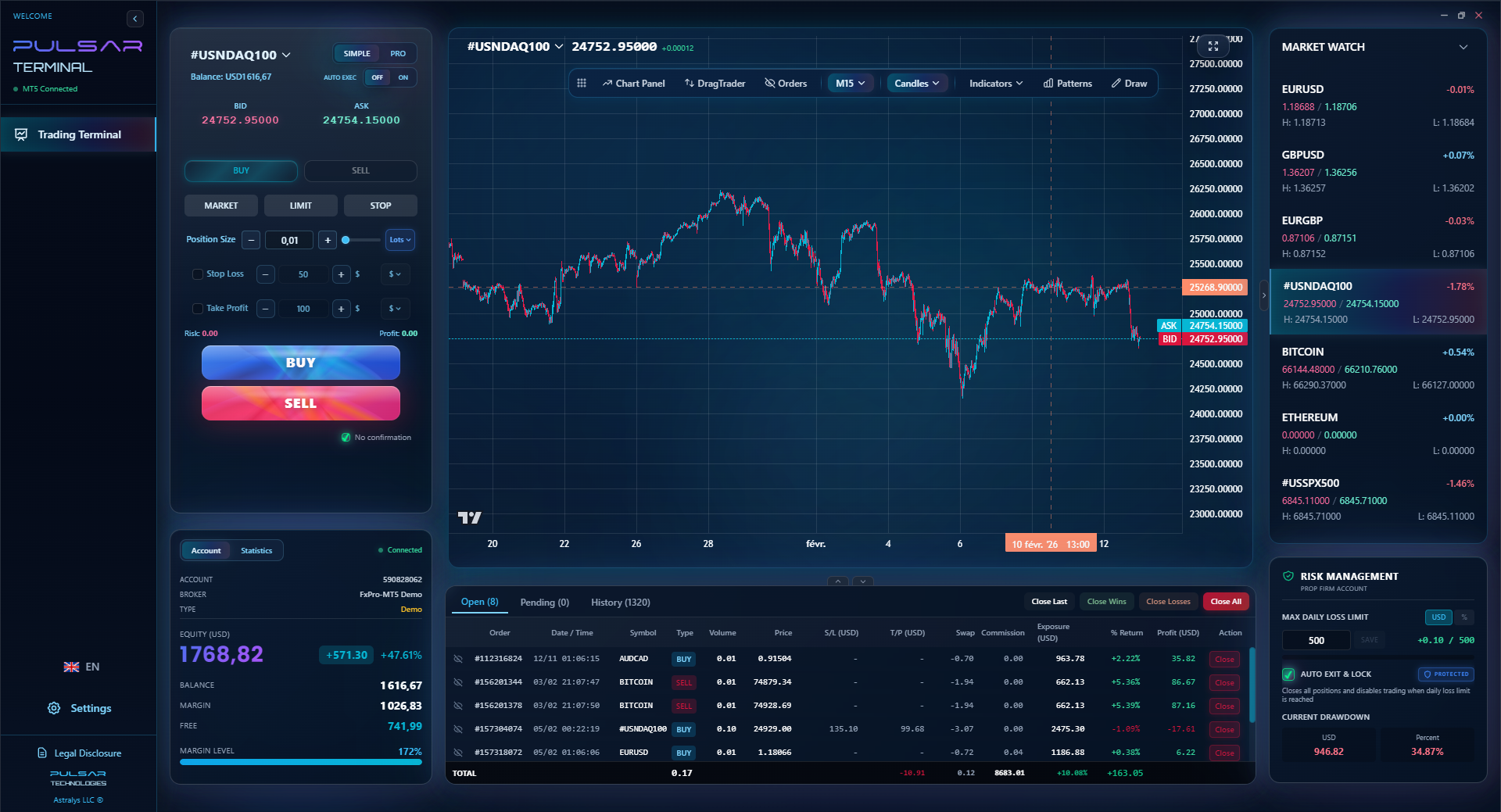
Managing complex trades with multiple take-profit levels is a headache on vanilla MT5, but Pulsar Terminal's drag-and-drop order system makes it intuitive and fast.
Pulsar Terminal
The all-in-one MT5 companion: drag-and-drop orders, multi-TP/SL, trailing stop, grid trading, Volume Profile, and prop firm protection. Used by 1,000+ traders daily.
“For most Pinoy traders, the answer is MetaTrader 5 offered by a reputable, internationally regulated broker.”
So, after all that, what's the best forex trading platform in the Philippines for 2024?
For the majority of Filipino traders - from beginners to experienced retail players - the answer is MetaTrader 5 offered by a reputable, internationally regulated broker like IC Markets or Pepperstone.
Why this combo? MT5 gives you the tools, the community, and the stability. A broker like IC Markets gives you the security of an ASIC license, which is the closest thing to 'regulation' you can get as a Pinoy trading internationally. The funding process via cryptocurrency, while an extra step, is reliable and avoids the scrutiny and fees of international bank transfers.
If you absolutely refuse to touch crypto and need peso-based deposits, then Exness with MT5 is a workable alternative, but you must go in with your eyes open about the different regulatory profile.
The platform is just the vehicle. Your skill, discipline, and risk management are the driver. No platform will make you a profitable trader. But choosing a bad one can definitely break you. Focus on a safe, reliable broker with a proven track record of processing Philippine withdrawals. Everything else is secondary.
Start with a demo, test the withdrawals, and never stop learning. Good luck, and trade safe, kabayan.
FAQ
Q1Is forex trading illegal in the Philippines?
No, trading forex for yourself is not illegal. The Bangko Sentral ng Pilipinas (BSP) regulates currency flows to prevent money laundering, and the Securities and Exchange Commission (SEC) warns against unlicensed investment solicitation. The legal risk is for companies or individuals soliciting investments from others without a license, not for individuals trading their own capital.
Q2Can I use GCash to fund my forex trading account?
Yes, but not directly with most international brokers. Some brokers (like Exness) sometimes have local payment partners that accept GCash. More commonly, you use GCash to buy USDT on a crypto P2P platform (like Binance), then transfer that crypto to your broker. It's an extra step but is often the fastest and most reliable method.
Q3Why did the SEC issue an advisory against XM?
The SEC issued the advisory in April 2024 because XM is not registered as a corporation in the Philippines and does not hold a license to sell or offer securities to Filipinos. This is a warning to the public that they operate outside local regulatory oversight. It doesn't mean individual accounts are frozen, but it means if you have a dispute with XM, the SEC will not be able to help you.
Q4What is the minimum amount to start forex trading in the Philippines?
You can start with as little as $50 (around PHP 2,800) on a micro account with many brokers. However, I strongly recommend starting with at least $200-$500 to properly manage position sizing and risk without being wiped out by a few bad trades. Always use a demo account first, regardless of the amount.
Q5Which is better for beginners, MT4 or MT5?
For a complete beginner, MT4 is slightly simpler. But MT5 is the future - it has more timeframes, better hedging capabilities, and a built-in economic calendar. Since most development is now for MT5, I'd suggest new traders start learning on MT5 to avoid having to switch later. The core concepts of placing trades and reading charts are identical.
Q6How are my profits from forex trading taxed in the Philippines?
This is a complex area and you should consult a local tax professional. Generally, trading profits can be considered either capital gains or ordinary income. The BIR has not issued crystal-clear guidelines for retail forex trading. Many traders treat it as business income and may be subject to graduated income tax rates. Keep careful records of all your trades, deposits, and withdrawals.
Prof. Winston's Lesson
Key Takeaways:
- ✓Regulatory safety trumps flashy platform features every time.
- ✓Always test the withdrawal process with a small amount first.
- ✓Funding via crypto (USDT) is often the most reliable path for Filipinos.
- ✓Start with a demo account for at least one full trading month.
How useful was this article?
Click a star to rate
Weekly Trading Insights
Free weekly analysis & strategies. No spam.
About the Author
Miguel Reyes
Forex Analyst
Trading forex part-time from Manila since 2020, now full-time. Focuses on USD/PHP and major pairs during the Asian session. Former BPO worker who learned trading through free YouTube courses and demo accounts.
Comments
Risk Disclaimer
Trading financial instruments carries significant risk and may not be suitable for all investors. Past performance does not guarantee future results. This content is for educational purposes only and should not be considered investment advice. Always conduct your own research before trading.
You Might Also Like

Cara Trading Forex Sukses: 7 Prinsip dari Trader Profesional
Cara trading forex sukses dengan 7 prinsip trader pro: manajemen modal, disiplin, journal trading, backtest. Data nyata, bukan janji profit palsu.
Jam Trading Forex Terbaik untuk Trader Indonesia: Panduan Lengkap dengan Tabel Waktu
Panduan jam trading forex untuk trader Indonesia. Tabel 4 sesi dunia, jam emas 20:00-00:00, sesi mana yang harus dihindari. Data akurat + tips dari trader berpengalaman.
Top 5 Sàn Forex Uy Tín Nhất 2026: Review Jujur dari Trader Indonesia
Top 5 sàn forex uy tín 2026 untuk trader Indonesia. Review jujur: spread, deposit, withdraw, dukungan lokal. Exness, XM, IC Markets & lebih.
Get Pulsar Terminal
All these calculators are built into Pulsar Terminal with real-time data from your MT5 account. One-click position sizing, automatic risk management, and instant calculations.
Get Pulsar Terminal