


I lost ₹47,000 on a single MCX Gold Mini contract in 2019.

Rajesh Sharma
Senior Forex Analyst ·  India
India
☕ 10 min read
What you'll learn:
- 1Why Gold Isn't Just Another Chart
- 2The Non-Negotiable First Step: The Volatility Filter
- 3Finding the Trend: Moving Averages, But Smarter
- 4Timing Your Entry: Momentum vs. Overbought/Oversold
- 5The Indian Context: Taxes, Costs, and Which Gold to Trade
- 6Putting It All Together: A Real Trade Example
- 7What Doesn't Work (So You Don't Have to Learn the Hard Way)
I lost ₹47,000 on a single MCX Gold Mini contract in 2019. The culprit? Blindly following a textbook RSI signal during Diwali season. The indicator said 'oversold,' but I forgot gold was in a structural uptrend fueled by wedding demand and a weak rupee. That painful lesson cost me, but it taught me the real secret: the best indicator for gold trading isn't a single line on a chart. It's a framework that blends price action with the unique rhythms of the Indian market. Let's break down what actually works.
Trading Nifty or Bank Nifty? You're mostly dealing with corporate earnings and global flows. Gold in India? That's a different beast. It's a currency hedge, a wedding essential, a festival purchase, and an inflation bunker all rolled into one. Your charts need to account for that.
Price action gets distorted by local events. A weak rupee makes imported gold more expensive, pushing up MCX prices even if international (XAU/USD) prices are flat. Major festivals like Diwali and Akshaya Tritiya see massive physical buying, which can create temporary but powerful bullish spikes on the MCX. If you're just looking at a standard MACD indicator without this context, you'll get whipsawed.
I learned this the hard way. I once shorted a Gold Guinea contract because the international chart showed a clear breakdown. What I missed was the RBI announcing a fresh tranche of Sovereign Gold Bonds that same week, sucking up investment demand and actually supporting local prices. My stop-loss got hit for a ₹8,500 loss. The global signal was right, but the local market didn't care.

Warning: Trading MCX Gold purely based on international (XAU/USD) charts is a classic rookie mistake. You must adjust for the USD/INR rate. A strong dollar and a weak rupee can mean MCX Gold is rising while XAU/USD is falling.

💡 Winston's Tip
The market doesn't care about your perfect RSI divergence if the RBI is hiking rates. Always know what's on the calendar for the week.
“The best indicator for gold trading isn't a single line on a chart. It's a framework.”
Before you even think about entries, you need to know the market's mood. Is gold moving 0.5% a day or 3%? Your position size and stop-loss depend entirely on this. This is where the Average True Range (ATR) becomes your best friend.
How I Use ATR on MCX Gold
I set my ATR to 14 periods on the daily chart. Let's say Gold Mini (100 grams) is trading at ₹79,000, and the daily ATR reads ₹1,200. That tells me the market's normal daily range is about ₹1,200. Therefore, placing a stop-loss tighter than ₹1,200 (about 1.5%) is basically gambling - you'll get stopped out by noise. I use this to calculate my risk. If my position size calculator says I can risk ₹5,000 on a trade, and the ATR suggests a logical stop is ₹2,400 away (2 * ATR), then I can trade roughly 2 lots (₹5,000 / ₹2,400). Without ATR, you're sizing in the dark.
During the COVID panic in March 2020, the ATR on Gold Mini exploded to over ₹3,500. That was the market screaming 'DANGER.' Anyone using their usual 1% stops got vaporized. I switched to swing trading with much wider stops or just stayed out. ATR isn't a directional indicator; it's a survival one. Ignore it at your peril.
“ATR isn't a directional indicator; it's a survival one. Ignore it at your peril.”
The old mantra 'the trend is your friend' is doubly true for gold. Gold trends can last for months or even years. Fighting them is a sure way to blow up your account. A simple 20-period and 50-period Exponential Moving Average (EMA) combo on the daily chart is my go-to.
Here's my rule: Price above both EMAs? Only look for buy setups. Price below both? Only look for sell setups. Price chopping between them? That's consolidation - stay out or reduce size dramatically. This one filter would have saved me from that Diwali loss I mentioned.
The 20/50 EMA Crossover Trap
Many traders wait for the 20 EMA to cross the 50 EMA for a signal. By the time that happens on a daily chart, you've often missed a big chunk of the move. I don't use the crossover as an entry. I use the EMA alignment as a context filter. My actual entry comes from price action or momentum (which we'll get to). For example, if price is above both EMAs and pulls back to the 20 EMA, that's a potential buy zone. This keeps you trading in the direction of the major force.

Pro Tip: Plot the 20 and 50 EMA on both the MCX Gold chart AND the USD/INR chart. If MCX Gold is trending up but USD/INR is trending up stronger (rupee weakening), you have a powerful confluence. The underlying trend is supercharged by currency moves.
💡 Winston's Tip
Your first job isn't to make money. It's to not lose money. Nail your risk management (ATR + position size) before you hunt for entries.
“ATR isn't a directional indicator; it's a survival one. Ignore it at your peril.”
This is where most traders get fancy and fail. You've identified an uptrend using the EMAs. The ATR shows manageable volatility. Now, when do you pull the trigger? This is the realm of the RSI and MACD.
RSI: The Misunderstood Workhorse Forget the simple 'buy below 30, sell above 70' rule. In a strong trend, RSI can stay overbought (above 70) or oversold (below 30) for weeks. In 2023, during a relentless gold rally, the daily RSI hovered between 60 and 75 for almost two months. Selling at 70 would have been a disaster.
My use for RSI is different. I look for failure swings and divergence. A failure swing is when RSI makes a new high (e.g., 75), pulls back, then fails to make a new high on the next price peak (e.g., only reaches 65). That's hidden weakness. Divergence is when price makes a new high but RSI makes a lower high. These are much more powerful signals than a static level. I also use the 50 level as a trend strength gauge in line with my EMAs.
MACD: For Confirmation, Not Prediction The MACD indicator is slow. I use it to confirm the momentum suggested by price and RSI. A bullish crossover (MACD line above signal line) while price is above the key EMAs adds conviction. A bearish crossover while price is below the EMAs is a strong 'don't buy' signal. I never enter a trade based solely on a MACD crossover. It's the final green light, not the starting pistol.
In practice, my best gold trades come from a trend pullback. Price is in an uptrend (above 20/50 EMA), pulls back to the 20 EMA, and the RSI dips to 50-55 (not 30) and starts turning up. That's where I look for a candlestick reversal pattern to enter. This combo kept me in a long Gold Petal trade from ₹5,200 to ₹6,100 in 2024.
“Fighting the trend in gold is a sure way to blow up your account.”
Your perfect technical setup means nothing if you get killed on execution costs or taxes. This is the unsexy, critical part of the best indicator for gold trading in India: knowing your numbers.
Choosing Your Weapon: MCX vs. ETF vs. SGB
| Instrument | Best For | Key Cost/Tax Consideration | My Take |
|---|---|---|---|
| MCX Futures | Active scalping or swing trading. | Brokerage + fees + 0.01% CTT + 18% GST on fees. Margins required. | This is where you apply the indicators. High use means your stops MUST be precise. Use that ATR! |
| Gold ETFs | Longer-term trend following without use. | STCG (within 12 months) taxed at 20%. LTCG (after 12 months) at 12.5%. | Great for implementing the 20/50 EMA trend strategy with less heartburn. No margin call risk. |
| SGBs | Investment, not trading. | 2.5% annual interest (taxable). Tax-free gains at maturity (8 years). | Not for trading. Your best 'indicator' here is the RBI's issue calendar and your long-term financial plan. |
The Brokerage Hit: On MCX, if you're paying a flat ₹50 per trade, a scalping strategy needs to make well over ₹100 per trade just to break even after slippage. This pushes you towards wider stops and swing-style trades where our indicator framework excels. I use brokers like Zerodha for ETFs and Angel One for MCX due to their reliable platforms, but always check the latest fee structure.
The GST Bite: Remember, the 18% GST on brokerage and exchange fees adds up. A ₹100 fee actually costs you ₹118. Factor this into your expected profitability. A strategy with a 55% win rate might be a loser after costs.
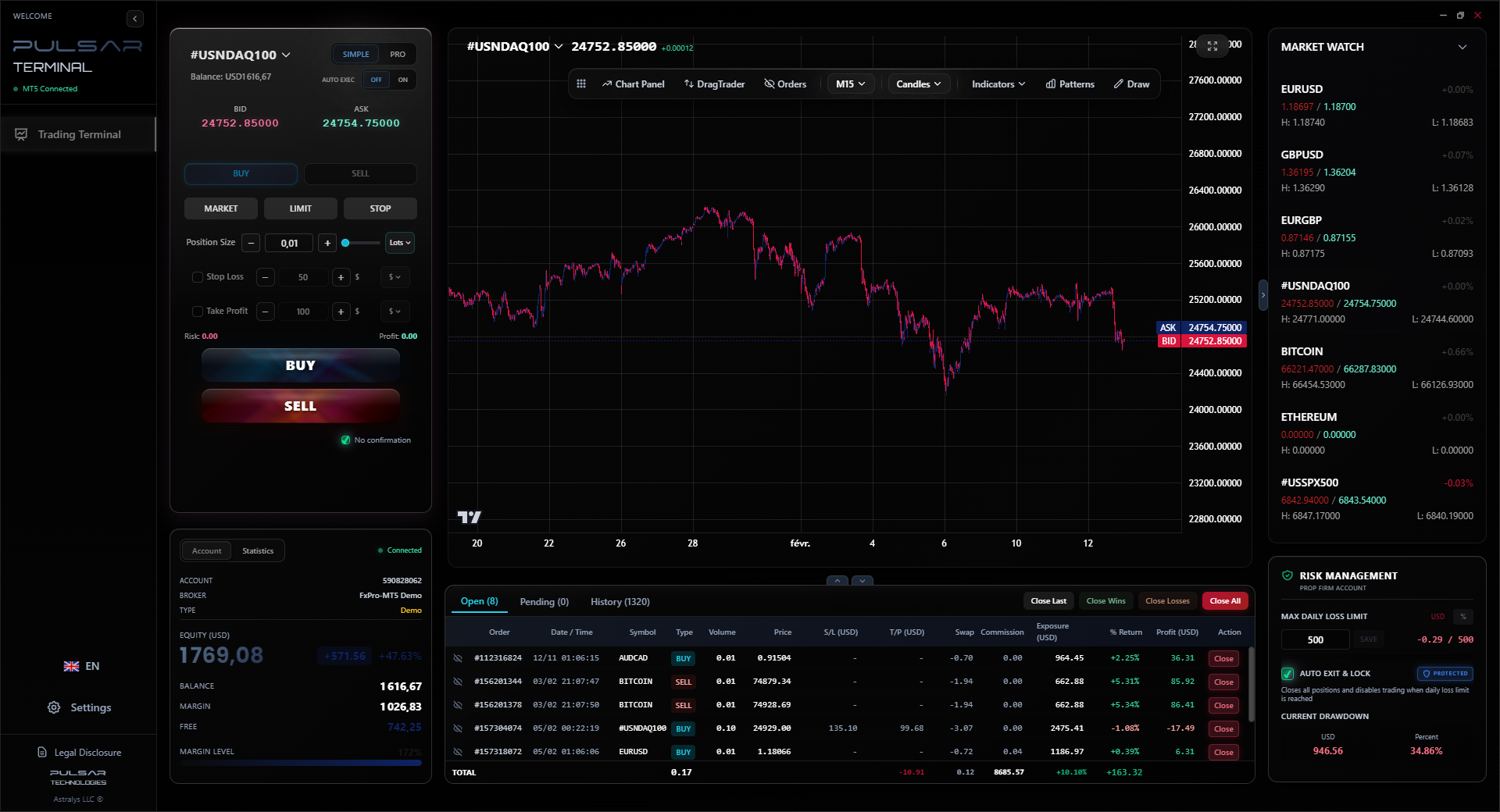
Managing multiple lots with different exits, like in the trade example, is far easier with a tool that lets you set multi-level take-profits and trailing stops directly on your MT5 chart.
Pulsar Terminal
The all-in-one MT5 companion: drag-and-drop orders, multi-TP/SL, trailing stop, grid trading, Volume Profile, and prop firm protection. Used by 1,000+ traders daily.
“Fighting the trend in gold is a sure way to blow up your account.”
Let's walk through a recent trade using this 'best indicator' framework. This was on MCX Gold Mini (100 grams) in January 2025.
- Context & Trend Filter: USD/INR was rising (weak rupee). MCX Gold daily chart was above its rising 20 and 50 EMA. Trend filter: BULLISH. Only look for buys.
- Volatility Check: Daily ATR was ₹1,100. Normal volatility. My risk per trade was set at ₹6,000.
- Entry Timing: Price pulled back from ₹80,500 to the 20 EMA near ₹79,200. The RSI indicator dipped from 65 to 52 and began to curl up. No divergence. On the 4-hour chart, a bullish engulfing candle formed right at the 20 EMA support.
- Execution & Risk: Entry: ₹79,250. My logical stop-loss was below the recent swing low at ₹78,100 (a ₹1,150 risk per lot). My ATR-based stop was wider (₹2,200), but price structure gave a tighter level. I went with the tighter stop. Position size: ₹6,000 risk / ₹1,150 stop = 5 lots. I took 3 lots to be conservative.
- Management & Exit: Price moved in my favor. I moved my stop to breakeven at ₹79,300 after a 1.5 ATR move. The rally continued. RSI hit 78 and price showed a small bearish divergence on the 4-hour chart. I took 2 lots off at ₹81,000. I trailed the stop on the last lot using the 4-hour 20 EMA and was stopped out at ₹81,450.
Result:
- Lot 1 & 2 Profit: (₹81,000 - ₹79,250) * 2 = ₹3,500
- Lot 3 Profit: (₹81,450 - ₹79,250) * 1 = ₹2,200
- Gross Profit: ₹5,700
- After costs (~₹300): ~₹5,400 net.
This wasn't about one magic indicator. It was a process: Trend (EMA) -> Volatility (ATR) -> Momentum/Entry (RSI/Price Action) -> Risk Management (Position Sizing) -> Trade Management. That's the system.
💡 Winston's Tip
If your chart looks like a rainbow, you're lost. Price, two moving averages, one oscillator. Keep it stupid simple.
“Your perfect technical setup means nothing if you get killed on execution costs or taxes.”
I've paid for these lessons, so you don't have to.
- Lagging Indicators on Low Timeframes: Using a 50-period SMA on a 5-minute chart for MCX Gold is useless. The noise will destroy you. Keep major trend indicators on the daily/weekly chart.
- Oscillators in Strong Trends: As discussed, selling just because the RSI is at 75 in a roaring bull market is a shortcut to the poorhouse. Use them within the trend context.
- Ignoring Macro Events: The RBI monetary policy, US Non-Farm Payrolls, and the Union Budget can override any technical setup. Have a calendar. If the RBI is announcing rates tomorrow, maybe don't open a new leveraged position today.
- Trading Without a Spread Check: This is more for international brokers, but if you're trading XAU/USD with a broker like Exness or IC Markets, check the spread during major news. It can widen from 20 pips to over 100, instantly putting you in a hole.
- Overcomplication: I once had a chart with 12 indicators. It looked impressive and told me absolutely nothing. Price, volume, two EMAs, ATR, and RSI. That's the toolkit. Master it.
FAQ
Q1Is the RSI or MACD better for gold trading?
Neither is 'better.' They do different jobs. Think of RSI as a gauge of speed and internal strength/weakness (via divergences). Think of MACD as a gauge of momentum direction and acceleration. I use RSI more for spotting potential reversals within a trend and MACD to confirm the overall momentum direction. Using them together within a trend framework is key.
Q2What is the best timeframe for trading MCX Gold?
It depends on your style, but I've found a top-down approach works best. Use the Daily chart to establish the trend (with your 20/50 EMAs and ATR). Use the 4-hour or 1-hour chart to fine-tune your entry using RSI and price action. Avoid going below 15 minutes for anything other than scalping, and even then, it's a tough game due to costs.
Q3How do I account for the rupee when trading MCX Gold?
You must watch the USD/INR pair. A falling rupee (USD/INR going up) makes dollar-priced gold more expensive in rupee terms, supporting MCX prices. Often, a strong uptrend in MCX Gold coincides with a weak rupee. I keep a simple USD/INR chart with a 20 EMA open next to my MCX chart. If both are trending up together, my conviction in a long MCX Gold trade is higher.
Q4What's a good starting capital for trading MCX Gold Mini?
Don't just think about the margin (around ₹80,000). Think about risk. If the daily ATR is ₹1,200, a sensible stop-loss might be ₹2,400 away. To risk just 1% of your capital on that trade, you'd need ₹2.4 lakhs (₹2,400 is 1% of ₹2.4L). Realistically, I wouldn't touch MCX Gold Mini with less than ₹3-5 lakhs in trading capital to allow for proper position sizing across a few trades. Starting with Gold Petal (1 gram) is a much cheaper way to learn.
Q5Are Bollinger Bands good for gold trading?
They can be, but understand their purpose. Bollinger Bands measure volatility and define relative 'highs' and 'lows.' In a ranging market, a touch of the lower band can be a buy signal. In a strong trend, price can ride the upper or lower band for extended periods. I find ATR more straightforward for measuring volatility for stop placement, and I use support/resistance levels instead of bands for entry zones.
Q6How are profits from MCX Gold futures taxed?
Profits from trading MCX Gold futures are treated as speculative business income. They are added to your total income and taxed according to your applicable income tax slab rate. You can offset futures trading losses against other speculative income. Remember to account for all costs (brokerage, CTT, GST on fees) when calculating your net profit for tax purposes.
Prof. Winston's Lesson
Key Takeaways:
- ✓Use 20/50 EMA to filter trend direction only.
- ✓Size positions using ATR, not guesswork.
- ✓RSI divergences trump overbought/oversold levels.
- ✓Always adjust MCX views for USD/INR moves.
- ✓Factor in all costs (GST, CTT) before calculating profit.
How useful was this article?
Click a star to rate
Weekly Trading Insights
Free weekly analysis & strategies. No spam.
About the Author
Rajesh Sharma
Senior Forex Analyst
Trading Indian and South Asian markets for over 10 years. Started with NSE currency derivatives before moving to international forex. Specializes in USD/INR and emerging market pairs.
Comments
Risk Disclaimer
Trading financial instruments carries significant risk and may not be suitable for all investors. Past performance does not guarantee future results. This content is for educational purposes only and should not be considered investment advice. Always conduct your own research before trading.
You Might Also Like

Cara Trading Forex Sukses: 7 Prinsip dari Trader Profesional
Cara trading forex sukses dengan 7 prinsip trader pro: manajemen modal, disiplin, journal trading, backtest. Data nyata, bukan janji profit palsu.
Jam Trading Forex Terbaik untuk Trader Indonesia: Panduan Lengkap dengan Tabel Waktu
Panduan jam trading forex untuk trader Indonesia. Tabel 4 sesi dunia, jam emas 20:00-00:00, sesi mana yang harus dihindari. Data akurat + tips dari trader berpengalaman.
Top 5 Sàn Forex Uy Tín Nhất 2026: Review Jujur dari Trader Indonesia
Top 5 sàn forex uy tín 2026 untuk trader Indonesia. Review jujur: spread, deposit, withdraw, dukungan lokal. Exness, XM, IC Markets & lebih.
Get Pulsar Terminal
All these calculators are built into Pulsar Terminal with real-time data from your MT5 account. One-click position sizing, automatic risk management, and instant calculations.
Get Pulsar Terminal