


Here's a stat that'll make you pause: only about 7% of traders pass a prop firm challenge on the first try.

James Mitchell
Senior Trading Analyst
☕ 11 min read
What you'll learn:
- 1Why MQL5 Still Matters (Even After the MetaQuotes Mess)
- 2How Prop Firm Rules Change Everything (Forget Backtests)
- 3Top MQL5 Strategy Architectures That Pass Challenges
- 4Coding Your EA for Compliance (The Boring, Essential Stuff)
- 5Choosing the Right US-Friendly Firm for Your MQL5 Strategy
- 6Real-World Testing & Optimization (The 90% Grind)
- 7Common Pitfalls That Get MQL5 Traders Rejected
- 8Future-Proofing: The 2026 Regulatory Shift

Here's a stat that'll make you pause: only about 7% of traders pass a prop firm challenge on the first try. I've blown my share of evaluation fees, trust me. The real kicker? Most of those failures come from using the wrong automated strategy. In the US, where the rules are tightening faster than a margin call, picking the right MQL5 Expert Advisor (EA) isn't just about profits - it's about navigating a minefield of new regulations and platform bans. Let's cut through the noise and talk about what actually works now.
You might've heard the sky fell in February 2024. MetaQuotes, the company behind MT5, pulled the plug on licenses for a bunch of prop firms serving US clients. Overnight, platforms like FTMO had to scramble. But here's the thing: MQL5, the language, didn't die. It just moved.
Many top-tier firms found workarounds through broker partnerships or migrated their systems to new front-ends while keeping MQL5 execution engines in the back. For you, the trader, this means the vast library of strategies, indicators, and EAs built over 15 years is still incredibly valuable. The logic of a well-coded trend-following EA doesn't care if it's displayed on cTrader or DXtrade.
My own experience? I had a volatility breakout EA that I'd tuned for years on MT5. When my preferred firm switched to Match-Trader, I thought I was sunk. But by working with their support (and a bit of clever DLL wrapping), I got it running. The key is to ask firms directly: "Do you support MQL5 Expert Advisors on your platform?" Don't assume.

Warning: Always verify EA compatibility before paying for a challenge. The firm's FAQ might say "EAs allowed," but that could mean only on their specific, restricted version of a platform. A 10-minute live chat can save you $300.
This is where most guys screw up. They build or buy an EA based on stellar backtests, then watch it blow the daily loss limit in three hours. Prop firm rules aren't market rules; they're a different game entirely.
The two big ones are Maximum Daily Loss and Overall Drawdown. A typical rule is a 5% daily loss and a 10% max drawdown from the starting balance. Your EA might have survived a 15% drawdown in 2018 on a backtest, but that's a fail in a prop challenge. The strategy must be built with these hard walls in mind.
The Consistency Mandate
Prop firms aren't looking for lottery winners. They're looking for consistent, low-correlation return streams. An EA that makes 50% one month and loses 9% the next is useless to them, even if it's net profitable. Their risk models hate volatility. Your MQL5 strategy needs to smooth out the equity curve. This often means reducing position size, taking profits earlier, and having tighter stops than your gut tells you.
I learned this the hard way with a mean-reversion scalper. On a personal account, it crushed. In a FundedNext challenge, it hit the daily loss limit twice in a week because it kept averaging into losing trades. The math worked in the long run, but the firm's rules didn't care about the long run. I had to add a hard "max two positions" rule and a time-based stop to the code.

Example: You have a $100,000 evaluation account with a 5% ($5,000) daily loss limit. Your EA opens a position with a 2-lot size on EUR/USD. A 25-pip move against you is a $500 loss (1 lot = $10/pip). Seems fine, right? But if your EA opens 10 similar correlated positions during a news event, a 25-pip swing now risks a $5,000 loss - instant fail. Your position size calculator logic must account for total open risk, not just per-trade risk.

💡 Winston's Tip
An old mentor of mine, Prof. Winston, used to say: 'The market doesn't give you a daily loss limit. Your stupidity does.' Code your EA to respect the firm's limits before it respects the market's direction.
“Only about 7% of traders pass a prop firm challenge on the first try. Most failures come from using the wrong automated strategy.”
Based on what firms actually want (consistency, manageability) and what the current US regulatory climate allows, these are the frameworks that work.
1. The Time-Filtered Trend Follower This isn't your granddad's "buy and hope" trend strategy. The best ones use multiple timeframes for confirmation (e.g., H4 trend direction, H1 for entry) and, crucially, only trade during high-probability, high-liquidity sessions. The EA is coded to be inactive during Asian session lows or major news releases. It uses a clear risk-reward ratio (think 1:1.5 or better) and a trailing stop to lock in profits. It wins by grinding, not gambling.
2. The Volatility-Adjusted Range Trader Markets range 70-80% of the time. This EA identifies consolidation zones using Average True Range (ATR) and places limit orders at support/resistance. The genius is in its adjustment: position size is inversely proportional to current volatility. Higher ATR? Smaller position. This keeps drawdowns incredibly shallow, which prop firm risk managers love. It's boring. It's beautiful.
3. The Multi-Instrument, Low-Correlation Portfolio EA This is advanced but powerful. Instead of one EA on one pair, you design a portfolio of EAs or a single EA that trades 3-5 non-correlated instruments (e.g., XAU/USD, EUR/USD, and US30). The MQL5 code manages the aggregate risk across all positions, ensuring the total account drawdown never nears the limit. This shows sophisticated risk management and is a huge green flag for firms.
What's Dead in the Water:
- Grid/Martingale Systems: Most firms explicitly ban these. They're seen as ticking time bombs that hide risk.
- High-Frequency Tick Scalping: Often flagged as "latency arbitrage" or "toxic flow." Firms will not pay you out.
- News Trading EAs: Too unpredictable and likely to violate daily loss limits in seconds. The scalping strategy that works is slower and more methodical.
The best MQL5 strategy in the world will fail if the firm's compliance engine rejects it. Your code needs to be a good citizen.
1. Hard-Code the Risk Parameters: Don't just rely on the platform's settings. Build the daily and total loss limits directly into your EA's logic. It should calculate running daily P&L and prevent new trades if the loss approaches, say, 80% of the daily max. This shows proactive risk management.
2. Avoid "Same Strategy" Flags: Firms use AI to detect if you're running the same EA across multiple accounts or if your strategy is identical to 100 other traders. Introduce some random, non-critical variability - like slightly different ATR periods or a random 1-5 minute trade start delay within a session.
3. Log Everything: Your EA should write detailed log files (trade time, reason, volatility reading, position size). If the firm ever questions a trade, you have a forensic record. It proves you're in control, not just running a black box.
I once had a payout delayed because my EA made a large trade right at a session open. The firm's algo flagged it as potential manipulation. Because I could send them the log showing the trade was triggered by a specific, documented volatility contraction pattern from the prior day, it was cleared in hours. Without that log, I'd have been waiting weeks.
Using a broker with strong infrastructure like IC Markets for testing can give you confidence in your EA's execution before you ever start a challenge.
“Passing is everything. Optimize your EA for the lowest maximum drawdown, not the highest net profit.”
Not all prop firms are created equal, especially post-2024. Your strategy needs the right home.
| Feature | Why It Matters for MQL5 |
|---|---|
| Platform | Does it truly support MT5/MQL5 EAs, or is it a watered-down version? cTrader has its own C# language, which is a total rewrite. |
| Profit Split & Scaling | A 50% split is standard, but look for firms that scale you up quickly to 80-90%. More capital means you can run your EA with safer, smaller relative positions. |
| Payout Frequency | If your EA is making steady gains, you want weekly or bi-weekly payouts, not monthly. Cash flow matters. |
| Maximum Drawdown Type | "Balance-based" drawdown is stricter but safer. "Equity-based" is more forgiving for swing trading strategies that might see floating losses. |
| Overnight/Weekend Holding | Can your EA hold trades over the weekend? Some firms ban it, others allow it but with higher margin requirements. |
Firms like The 5%ers and FundedNext have maintained good reputations for EA traders. They're transparent about their rules. Avoid any firm that's vague about its platform or has a history of rejecting payouts for "violations" they can't specifically detail.
Also, consider the payment method. If your EA is successful, you want fast, reliable payouts. Many are now using crypto (USDT) for speed. I switched to a firm offering USDT payouts and went from waiting 5 business days for a wire to getting paid in 4 hours. That's a game-changer for compounding your growth.
💡 Winston's Tip
Winston's Law of Automated Trading: 'A strategy you can't explain to a 10-year-old in one minute is a strategy you don't understand.' If your MQL5 logic is a tangled mess of indicators, simplify it. Complexity fails under pressure.
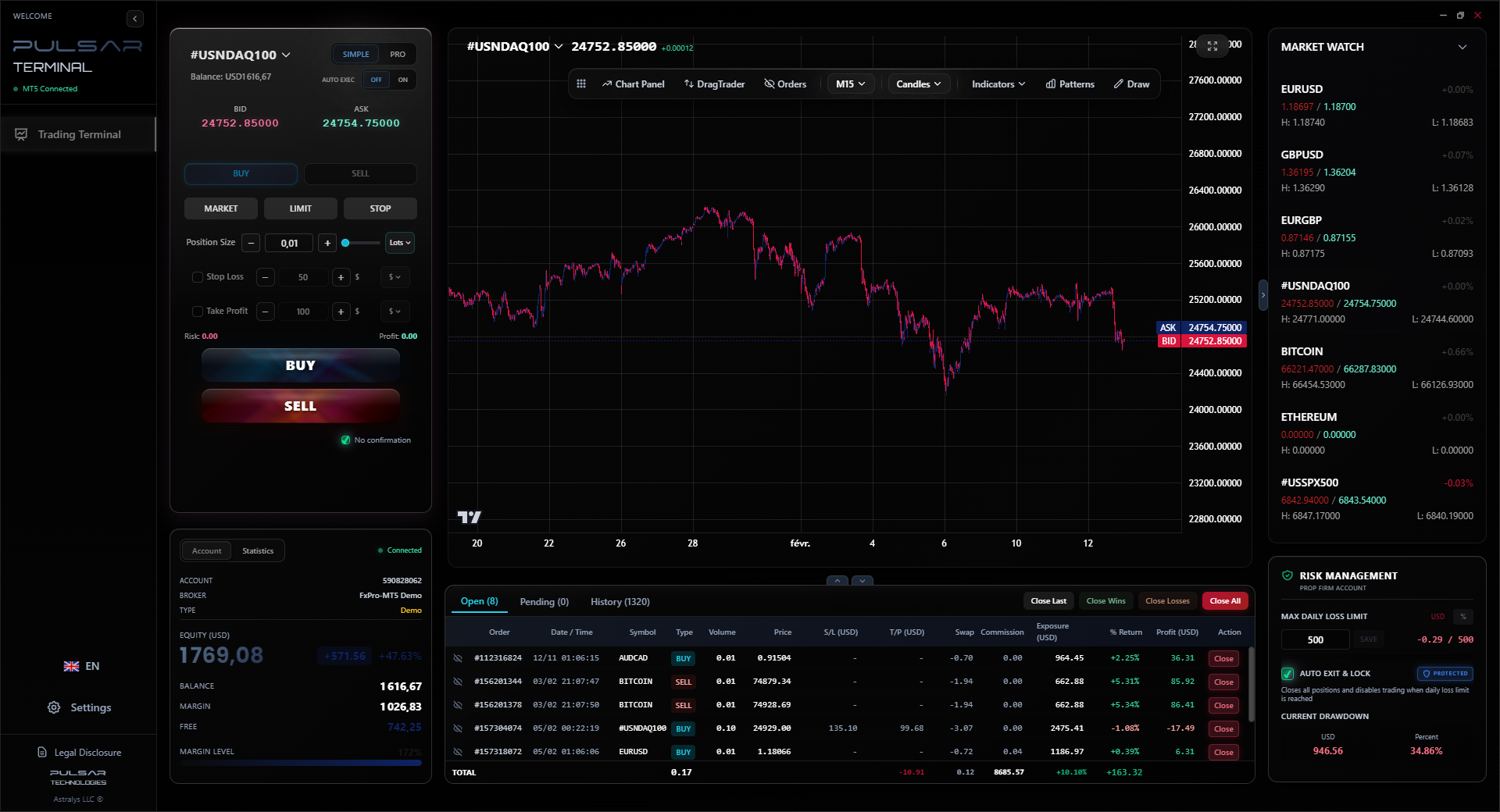
Managing multiple take-profit levels and trailing stops across dozens of automated trades is a headache; Pulsar Terminal automates this directly on your trading platform, letting your MQL5 strategy execute complex risk management flawlessly.
Pulsar Terminal
The all-in-one MT5 companion: drag-and-drop orders, multi-TP/SL, trailing stop, grid trading, Volume Profile, and prop firm protection. Used by 1,000+ traders daily.
You don't test a prop firm strategy on 10 years of EUR/USD data and call it a day. You test it against the rules.
Step 1: Forward Test in a Simulated Environment. Use a demo account that mirrors the prop firm's platform (spreads, commissions, use). Run your EA for a minimum of 3 months. Watch it like a hawk. Note every time it comes within 30% of the daily loss limit. That's a weak spot.
Step 2: Introduce "Friction." Prop firm data feeds can be slightly slower. Slippage can be worse. Add a 0.5-1 pip slippage assumption to your backtest. If the strategy still passes, you're more strong.
Step 3: The Drawdown Stress Test. This is critical. In your strategy tester, find the worst 2-week period in the last 5 years. What was the peak-to-trough drawdown? If it's over 8%, you need to go back to the coding stage. You might need to incorporate a MACD indicator divergence as a filter to sidestep the worst trends.
Here's a vulnerability: I optimized an EA for maximum net profit. It worked until a low-volatility, choppy month hit. The equity curve went sideways, then dipped 9.5%. Fail. I re-optimized for the lowest maximum drawdown instead, sacrificing some profit. The next challenge, it sailed through with a max drawdown of 6.2%. The profit was lower, but it passed. Passing is everything.

Pro Tip: Use a broker with raw spreads like Pepperstone for your final stage of live testing. The tighter the spreads, the more accurate your EA's performance will be before you put real challenge money on the line.
“By 2026, it's about building a legitimate, automated trading business that can withstand a spotlight.”
Let's talk about failure so you can avoid it. These are the instant red flags for prop firms.
Over-Leveraging in Code: Your EA calculates position size based on account balance. But if you're using 100:1 use on a $100k account, a 2-lot trade is actually massive risk. Code in a use multiplier that reduces size as effective use increases.
Ignoring Correlation During News: Your EA might trade GBP/USD and EUR/USD separately. But during a USD news event, they'll move as one. Your risk is doubled. Your code needs an "asset class" risk check.
Chasing the Challenge: The worst thing you can do is modify your EA to be more aggressive because you're at 7.9% profit and need 10% to pass. That's when you get a margin call in disguise. The strategy that passes is the one you don't touch during the evaluation.
Using "Guaranteed" EAs from Online Markets: Those $99 "Prop Firm Passer" EAs on MQL5.com? They're almost always curve-fitted garbage. They're built to pass a specific backtest, not to adapt to live, real-time rule enforcement. I wasted $250 on two of them before building my own.
The bottom line? The best MQL5 strategy for a prop firm is one that prioritizes the firm's survival rules over absolute profitability. It's a partner, not a predator.
💡 Winston's Tip
He'd scribble this on a chart: 'Backtests tell you what was possible. Forward tests tell you what is probable. The prop firm's rules tell you what is permissible.' Optimize for the last one.
By 2026, the CFTC is expected to formally classify many prop firms as Commodity Trading Advisors (CTAs). What does that mean for your MQL5 bot?
More scrutiny, more transparency. Firms will need to report more data. Your EA's trading activity will be part of that. Strategies that look like market manipulation (even unintentionally) will be caught faster. This makes clean, logical, rule-based coding even more important.
The rise of AI surveillance by the firms themselves means they'll detect pattern gaming instantly. Your strategy must be fundamentally sound, not just clever at avoiding triggers.
My advice? Start building now with a documentation-first approach. Comment your MQL5 code extensively. Have a plain-English document that explains every rule, filter, and risk parameter. When the firm (or a regulator) asks, "How does this work?" you can show them. That level of professionalism is what will separate funded traders from rejected ones in the coming years.
It's not just about finding the best MQL5 strategies for a prop firm anymore. It's about building a legitimate, automated trading business that can withstand a spotlight. The ones who get that will be the ones collecting consistent payouts while others wonder why their account was suddenly closed.
FAQ
Q1Can I still use MT5 with US prop firms in 2026?
It's complicated. Direct access to the standard MT5 platform from MetaQuotes is heavily restricted for US clients. However, many firms use alternative platforms (cTrader, DXtrade) that can still execute MQL5-based Expert Advisors through bridge technology or partnerships. Always confirm with the firm if your specific .ex5 EA file is supported before buying a challenge.
Q2What's the single biggest mistake MQL5 EA traders make in prop challenges?
Optimizing for total profit instead of maximum drawdown. An EA that makes 20% with a 15% drawdown will fail every time. You need to optimize and code for the lowest possible drawdown, even if it means your net profit is half as much. Passing the challenge is the only goal.
Q3Do prop firms allow fully automated trading with no oversight?
Most do, but with caveats. You can set your EA and let it run, but you are still responsible for monitoring it. If your EA starts malfunctioning (e.g., opening hundreds of trades due to a bug) and breaks the rules, you'll be held liable. Use tools that allow remote monitoring and set up alerts for unusual activity.
Q4How much should I expect to pay for a good MQL5 EA?
If you're buying one, a strong, well-coded EA from a reputable developer typically costs between $500 and $2,500. Be very wary of anything sold as a "guaranteed pass" for under $100. If you're hiring a coder, expect to pay $50-$150/hour for quality work. Remember, the evaluation fee you're protecting is also an investment.
Q5What's a 'toxic' strategy that will get me banned?
Firms hate strategies that exploit their infrastructure rather than the market. This includes latency arbitrage (trying to beat their price feed), tick scalping on stale quotes, and high-frequency order spamming. Also, any form of arbitrage between the firm's own prices or using a grid/martingale system to hide risk is usually a fast track to account termination.
Q6Is a higher profit split (like 90%) always better?
Not necessarily. A firm offering 90% might have much stricter rules, wider spreads, or slower payout times. A firm with a 70% split but excellent platform stability, tight spreads (check brokers like Exness for benchmark spreads), and reliable weekly payouts is often a better long-term partner for an automated strategy.
Q7Can I use the same EA on multiple funded accounts?
This is a major red flag. Firms use correlation software to detect this. If they see identical trading patterns across multiple accounts (even at different firms), they may deem it "account farming" and terminate all contracts. If you want to scale, use the firm's official scaling plan or trade different, non-correlated strategies.
Prof. Winston's Lesson
Key Takeaways:
- ✓Optimize for Max Drawdown, not Net Profit.
- ✓Hard-code the firm's daily loss limit (e.g., 5%) into your EA.
- ✓Test with 1-pip slippage and wider spreads.
- ✓A simple, explainable strategy always beats a complex black box.
- ✓Document every line of code. Transparency is your armor.
How useful was this article?
Click a star to rate
Weekly Trading Insights
Free weekly analysis & strategies. No spam.
About the Author
James Mitchell
Senior Trading Analyst
Based in New York with over 9 years of trading experience. Focuses on major USD pairs, prop firm challenges, and the US regulatory landscape.
Comments
Risk Disclaimer
Trading financial instruments carries significant risk and may not be suitable for all investors. Past performance does not guarantee future results. This content is for educational purposes only and should not be considered investment advice. Always conduct your own research before trading.
You Might Also Like

Cara Trading Forex Sukses: 7 Prinsip dari Trader Profesional
Cara trading forex sukses dengan 7 prinsip trader pro: manajemen modal, disiplin, journal trading, backtest. Data nyata, bukan janji profit palsu.
Jam Trading Forex Terbaik untuk Trader Indonesia: Panduan Lengkap dengan Tabel Waktu
Panduan jam trading forex untuk trader Indonesia. Tabel 4 sesi dunia, jam emas 20:00-00:00, sesi mana yang harus dihindari. Data akurat + tips dari trader berpengalaman.
Top 5 Sàn Forex Uy Tín Nhất 2026: Review Jujur dari Trader Indonesia
Top 5 sàn forex uy tín 2026 untuk trader Indonesia. Review jujur: spread, deposit, withdraw, dukungan lokal. Exness, XM, IC Markets & lebih.
Get Pulsar Terminal
All these calculators are built into Pulsar Terminal with real-time data from your MT5 account. One-click position sizing, automatic risk management, and instant calculations.
Get Pulsar Terminal