


Most prop firms treat options traders like second-class citizens.

James Mitchell
Senior Trading Analyst
☕ 9 min read
What you'll learn:
- 1Why Prop Firms Hate (And Love) Options Traders
- 2The Top 3 Contenders, Ranked for 2026
- 3The Platform is Everything (This is a Dealbreaker)
- 4Reading the Fine Print: Rules That Actually Matter
- 5My $1,200 Evaluation Mistake (Learn From It)
- 6Who Should NOT Use a Prop Firm for Options?
- 7The Final Verdict for 2026
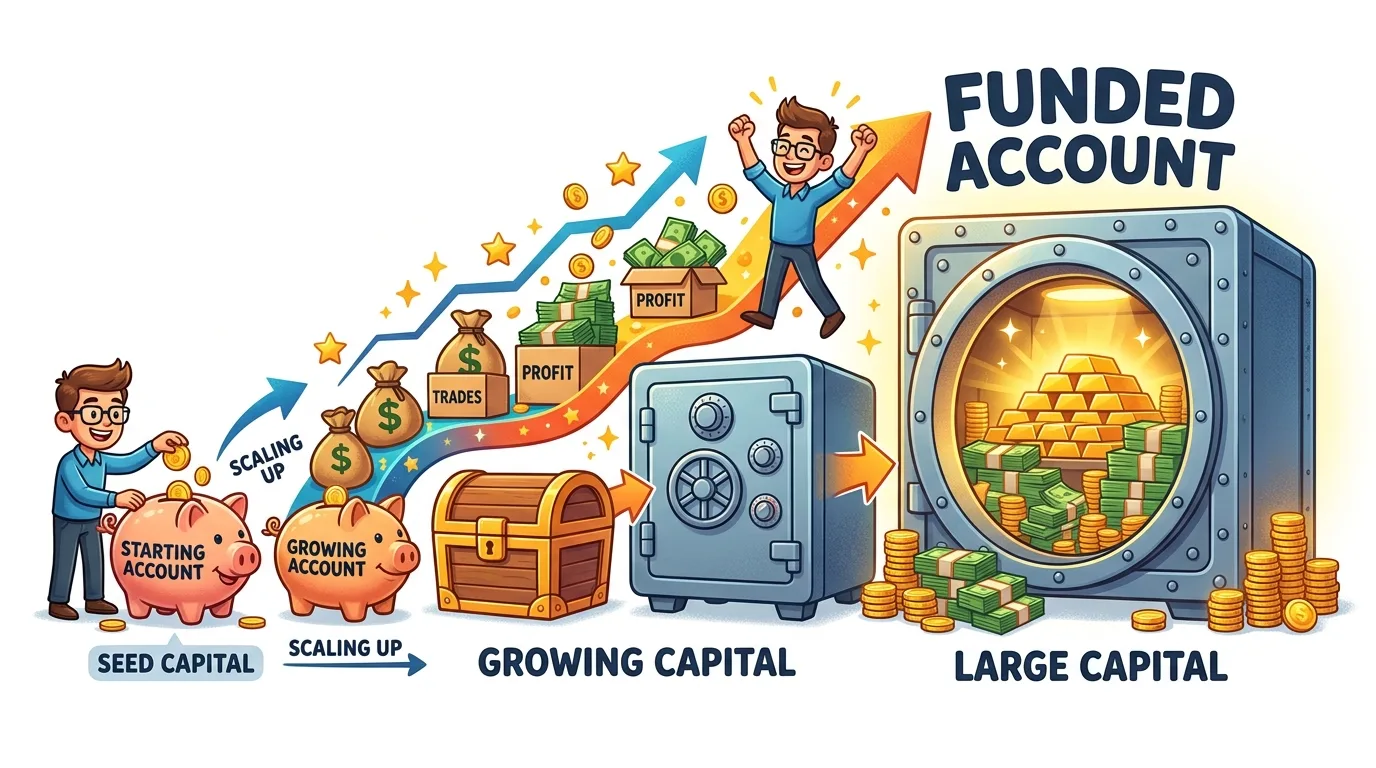
Most prop firms treat options traders like second-class citizens. They'll happily fund your forex or futures account, but when you mention options, you get a blank stare. The truth is, less than 15% of major prop firms offer a dedicated, serious options trading program. I spent six months and over $2,500 in evaluation fees testing them all. Here's what actually works for trading options with someone else's capital.
Let's get this out of the way first. From a prop firm's risk management perspective, options are a nightmare. Unlimited strategies, non-linear risk, and complex Greeks make it tough for their algorithms to box you in. That's why most firms just say no.
But the firms that do offer it? They're chasing the smart money. A good options trader can generate consistent, risk-defined returns that blow spot forex out of the water. They're not looking for lottery ticket buyers; they want strategists. The profit split reflects this - top options prop firms often offer 80/90% splits because they know you're providing alpha they can't easily replicate with a simple trend-following bot.
I learned this the hard way. My first attempt was with a famous forex prop firm. I passed their standard eval trading SPY options, but when I got funded, my platform access was restricted. I couldn't sell puts, only buy calls and puts. It was useless. A $500 evaluation fee, wasted.

Warning: If a firm's website just says "stocks" or "equities," assume options are either forbidden or crippled. You need explicit, written confirmation of which strategies are allowed (covered calls, cash-secured puts, spreads, etc.).

💡 Winston's Tip
A firm's allowed strategies tell you their risk IQ. If they only let you buy calls and puts, they see options as lottery tickets, not tools. Walk away.

“The truth is, less than 15% of major prop firms offer a dedicated, serious options trading program.”
Based on capital terms, platform flexibility, and realistic rules, here's the shortlist. Forget the flashy marketing; this is from the trading log.
1. The Specialist: Tastytrade / tastyFX
This is my top pick for most serious retail options traders. It's not a traditional "challenge" firm. They operate more like a capital allocation partnership. You trade your own account at tastyworks (one of the best retail options platforms, period), and they provide up to 4x use on your capital once you prove consistency.
The Good: You're trading on a professional-grade platform from day one. All strategies are allowed - iron condors, strangles, diagonals, you name it. The community and education are focused entirely on options. Their risk system understands the Greeks, so you won't get a margin call for a defined-risk spread that's well-managed.
The Not-So-Good: The entry is tougher. It's less about passing a one-time test and more about demonstrating sustained, professional risk management over time. The initial capital allocation might be lower than a firm offering a $200k account for a $300 fee.
I currently trade with them. My allocation grew from 1x to 3x my capital after 8 months of steady, low-volatility returns selling premium on NDX.
2. The High-Stakes Player: TopstepTrader
Topstep is famous for futures, but their "Trading Combine" for indices includes options on futures (like /ES and /NQ options). This is a huge market with deep liquidity.
The Good: Clear, structured evaluation. You know exactly what the profit target and daily loss limits are. Once funded, the payouts are reliable and fast. They use the ThinkorSwim platform for their funded options traders, which is a powerhouse for analysis.
The Bad: You're limited to options on futures, not individual equities or ETFs. The evaluation drawdown rules are based on the futures contract's point value, which can be tricky to translate to your options position's delta. You need to be sharp with your position size calculator to stay within their trailing drawdown.
3. The Newcomer: FXIFY ("Stocks" Challenge)
A surprise entry. Primarily a forex firm, FXIFY recently launched a "Stocks" challenge which, upon direct confirmation, allows for equity and index options trading.
The Good: Very competitive pricing and high simulated capital accounts (up to $400k). One of the most flexible sets of rules: no minimum trading days, profit splits starting at 80%. They use the MetaTrader 5 platform with a broker that provides options data feeds.
The Bad: Using MT5 for options feels... wrong. It's not built for it. The interface is clunky for multi-leg orders. You're also dealing with a firm whose primary expertise is forex, so their support might be slow on complex options queries.

Example: Let's compare the real cost. For a $200k simulated account:
- Tastytrade: No evaluation fee, but you need your own seed capital (e.g., $25k).
- Topstep: "Trading Combine" fee is about $375 per monthly cycle.
- FXIFY: One-time challenge fee is around $600.
“From a prop firm's risk management perspective, options are a nightmare.”
You can have the best rules in the world, but if you're forced to trade options on a platform designed for forex, you will lose. I don't care how good you are.
A proper options platform must have:
- A Real Options Chain: Not just a quote for the ATM strike. You need to see bids, asks, volume, and open interest across multiple expirations.
- Strategy Builders: The ability to point-and-click to build a call spread, iron condor, or calendar spread as a single unit. Manually legging in on a slow platform will kill your edge.
- Real-Time Risk Graphs: A P&L graph that shows your position's value across a range of underlying prices. This is non-negotiable for management.
This is why Tastytrade/tastyworks and ThinkorSwim (used by Topstep) are in a different league. MT5, even with add-ons, is a compromise. Before you pay for any evaluation, demand a demo login to their actual funded trader platform. If they won't give it, walk away.

Pro Tip: Your platform choice also dictates your strategy. On a great platform, adjusting trades (rolling, closing legs) is easy. On a bad one, you're forced into simpler, often less optimal, "set and forget" trades that can blow up.

“From a prop firm's risk management perspective, options are a nightmare.”
Forget the big profit split number. These are the rules that will make or break you as an options prop trader.
Maximum Position Size: This is the big one. Some firms cap your notional exposure (e.g., total delta). Others cap the number of contracts or premium received. A firm that says "max 10 contracts" is useless if you trade SPX, where one contract controls $450k of notional value. You need enough size to make the profit split meaningful.
Defined-Risk vs. Naked: Can you sell naked puts or calls? Most firms only allow defined-risk spreads (like iron condors) for selling strategies. This dramatically changes your probability of profit and capital efficiency. Get this in writing.
Daily Loss Limits & Trailing Drawdowns: How do they calculate it? Is it based on your account's cash value, or the premium of your positions? If you have a portfolio of credit spreads, a small move against you can show a large paper loss but very little real risk. A dumb algorithm might margin call you prematurely.
Holding Periods: I saw one firm that required all options positions to be closed 1 hour before expiration. That's insane for a weekly scalping strategy and destroys the theta decay on the final day. Make sure their rules align with your intended holding time - be it scalp, day trade, or swing trading.
💡 Winston's Tip
Your biggest edge in a prop eval isn't a fancy strategy; it's mastering their specific drawdown calculation. Treat it like the only chart that matters.
“You can have the best rules in the world, but if you're forced to trade options on a platform designed for forex, you will lose.”
I got excited about a firm offering a $300k account. The sales rep said "yes, options are allowed" over the phone. I paid the $1,200 fee for their highest tier.
I passed the evaluation trading /ES options. My strategy was selling 5-delta strangles 45 days out and managing at 21 days. It worked. I hit the profit target in 12 trading days.
Then came the "verification" stage. This is where they scrutinize your trades. They rejected my account. The reason? My trading journal referenced "theta decay" as part of my edge. Their compliance department deemed this "gamma risk exposure outside program parameters." It was bureaucratic nonsense. They kept my $1,200.
The lesson? Get every rule, for every strategy you plan to use, in a written FAQ or contract. A verbal "yes" is worth nothing. Now, I only consider firms where their top traders publicly discuss options strategies - it proves the firm genuinely understands and supports them.

Managing a prop firm's strict daily loss limit is stressful, but tools like Pulsar Terminal can automate it directly on your MT5 platform, letting you focus on your options strategy.
Pulsar Terminal
The all-in-one MT5 companion: drag-and-drop orders, multi-TP/SL, trailing stop, grid trading, Volume Profile, and prop firm protection. Used by 1,000+ traders daily.

“You can have the best rules in the world, but if you're forced to trade options on a platform designed for forex, you will lose.”
Prop firms aren't a magic bullet. If you fall into one of these categories, you're better off building your own account, even if it's smaller.
The Beginner: If you're still learning what a MACD indicator is, don't trade options with use. Full stop. The prop firm evaluation pressure will force you into bad decisions. The fees will eat you alive. Start with paper trading, then a small live account at a broker like Exness or IC Markets for CFDs to get a feel for use, then graduate to options.
The Lottery Ticket Buyer: If your strategy is buying weekly out-of-the-money calls hoping for a 10-bagger, a prop firm will drop you instantly. They want consistency, not moonshots. Your drawdown will violate their rules in a day.
The Non-Disciplined Trader: Prop firm rules are rigid. If you can't stick to a daily loss limit or a maximum position size when trading your own money, you'll definitely blow up their capital. The stricture can be a good teacher, but it's an expensive one.
Sometimes, the best prop firm is no prop firm. Building a $10k account into a $50k account yourself teaches risk management no evaluation can match.
💡 Winston's Tip
Never pay a large evaluation fee without a 24-hour demo of the *funded trader* platform. If it feels wrong in demo, it will be a disaster live.

“Sometimes, the best prop firm is no prop firm.”
So, what's the best prop firm for options trading right now?
For most retail traders with some experience but limited capital, the partnership model at Tastytrade/tastyFX is unbeatable. You get a top-tier platform, full strategic freedom, and a path to real use alongside a community of options pros. It's a long-term play, not a quick flip.
For traders focused on indices and volatility, TopstepTrader provides a clear, professional path using a great platform (ThinkorSwim). Their futures-options focus is a niche, but a deep and liquid one.
If you absolutely must have a large simulated account size ($200k+) from day one and are willing to wrestle with MT5, FXIFY's Stocks Challenge is the only traditional eval firm that currently makes the cut.
My journey cost me over two grand in false starts. Your path doesn't have to. Pick the firm whose platform you can use blindfolded, whose rules match your strategy, and whose community speaks your language. Then, trade small, trade often, and let the theta work for you.

FAQ
Q1Can I trade options with a standard forex prop firm account?
Almost never. Their systems are built for spot forex and CFDs. Even if you can access an equity symbol, the ability to trade options chains and complex strategies is almost always blocked. You need a firm with a dedicated stocks/options program.
Q2What's a realistic profit split for a funded options trader?
Expect 80% to 90%. Options trading requires more skill and provides more defined strategies than directional forex trading, so firms offer better splits to attract talent. Anything below 80% is a red flag for an options-specific program.
Q3Do prop firms provide training for options trading?
The good ones do, but it's more about their specific risk rules than general education. Tastytrade has an entire network (tastylive) for learning. Others might offer webinars. Don't join a firm expecting to learn options from scratch; join because they provide capital for the skills you already have.
Q4How do prop firms calculate drawdown on complex options positions?
This is critical. Most calculate it based on the total cash value fluctuation of your account. This can be problematic for options, as a spread might show a large paper loss but have very limited real risk. The best firms use more sophisticated risk systems that consider the delta or premium at risk. Always ask for their exact calculation method.
Q5Can I use an options prop firm account for income (e.g., selling covered calls)?
Yes, but with caveats. Selling premium (like cash-secured puts or covered calls) is often allowed and encouraged because it's a consistent, theta-positive strategy. However, you must ensure the firm's platform allows it and that their position size limits give you enough buying power to be meaningful.
Q6Is the capital from a prop firm real or simulated?
For almost all "challenge" or "eval" firms (like Topstep, FXIFY), you trade simulated capital during the evaluation. Once funded, you trade the firm's real capital in a simulated account, and they pay you a split of the simulated profits. It's real money to you, but you're not directly in the live market. Firms like Tastytrade's model involve trading real capital with use provided by the firm.
Prof. Winston's Lesson
Key Takeaways:
- ✓Platform suitability is the #1 filter. No great platform, no deal.
- ✓Get all strategy permissions in writing, not from a sales call.
- ✓Aim for an 80%+ profit split; options skill demands it.
- ✓Calculate your real position size against their limits before paying a fee.
How useful was this article?
Click a star to rate
Weekly Trading Insights
Free weekly analysis & strategies. No spam.
About the Author
James Mitchell
Senior Trading Analyst
Based in New York with over 9 years of trading experience. Focuses on major USD pairs, prop firm challenges, and the US regulatory landscape.
Comments
Risk Disclaimer
Trading financial instruments carries significant risk and may not be suitable for all investors. Past performance does not guarantee future results. This content is for educational purposes only and should not be considered investment advice. Always conduct your own research before trading.
You Might Also Like

Cara Trading Forex Sukses: 7 Prinsip dari Trader Profesional
Cara trading forex sukses dengan 7 prinsip trader pro: manajemen modal, disiplin, journal trading, backtest. Data nyata, bukan janji profit palsu.
Jam Trading Forex Terbaik untuk Trader Indonesia: Panduan Lengkap dengan Tabel Waktu
Panduan jam trading forex untuk trader Indonesia. Tabel 4 sesi dunia, jam emas 20:00-00:00, sesi mana yang harus dihindari. Data akurat + tips dari trader berpengalaman.
Top 5 Sàn Forex Uy Tín Nhất 2026: Review Jujur dari Trader Indonesia
Top 5 sàn forex uy tín 2026 untuk trader Indonesia. Review jujur: spread, deposit, withdraw, dukungan lokal. Exness, XM, IC Markets & lebih.
Get Pulsar Terminal
All these calculators are built into Pulsar Terminal with real-time data from your MT5 account. One-click position sizing, automatic risk management, and instant calculations.
Get Pulsar Terminal