


Looking for the best prop firms in 2025? Let's cut through the hype.

James Mitchell
Senior Trading Analyst
☕ 12 min read
What you'll learn:
- 1What Is a Prop Firm in 2025? (It's Not What You Think)
- 2The US Regulatory Minefield (What Changed in 2024)
- 3The Real Math: Costs, Splits, and Your Actual Take-Home
- 4Top Contenders for US Traders in 2025
- 5Rules of the Game & Strategies That Actually Pass
- 6Red Flags & How to Spot a Scam (or a Bad Deal)
- 7Final Verdict: Is It Worth It in 2025?
Looking for the best prop firms in 2025? Let's cut through the hype. The landscape has been rocked by regulation, platform bans, and a wave of firm closures. What worked in 2023 might get you banned or broke today. I've traded with over a dozen of these firms, passed some, blown a few, and cashed out from the good ones. This isn't about who has the flashiest ads; it's about who will actually give you a fair shot at their capital and then pay you without the drama.
Forget the old-school image of a Wall Street desk. Today's retail prop firm is a different beast. You're not getting hired. You're buying a test.
You pay a fee - let's call it what it is, an audition cost - to take a trading challenge. Pass it, and they give you a simulated account with "virtual" capital. You trade their rules, keep a chunk of the simulated profits, and they take the rest. If you lose too much, you're out. It's a performance-based filter, and a business model that's exploded. Search interest is up over 5,500% since 2020. Everyone and their cousin wants a piece.
Here's the critical part most beginners miss: You are almost never trading real money in a live market during the evaluation. You're trading a simulation. The firm's risk is your fee. Only when you're consistently profitable in their sim do they sometimes allocate real capital. This structure is why they've largely skirted direct SEC regulation (so far). They argue it's an educational service, not a fund manager. Whether that holds in 2025 is the billion-dollar question.

Warning: That "$100,000 account" you see advertised? It's not a briefcase of cash with your name on it. It's a number in a simulator. The firm's real risk is limited to your challenge fee and their operational costs. This alignment of incentives is why their rules can feel brutally restrictive.

💡 Winston's Tip
Never size a prop firm trade based on the account size. Size it based on your personal risk tolerance, as if it were your last $1,000. The big number is an illusion until it's in your bank account.
This is the most important section for any American trader. The rules of the game changed dramatically in early 2024, and they're still settling.
The MetaQuotes Massacre
In early 2024, MetaQuotes (the company behind MT4 and MT5) unofficially cracked down. They told brokers supporting prop firms to choose: serve prop firms or keep their US licenses. Overnight, giants like FTMO vanished from the US market. It was chaos. If your strategy was built on a specific MT4 Expert Advisor, you were toast. This single event wiped out dozens of firms and forced a massive migration to platforms like cTrader, TradeLocker, and NinjaTrader.
The good news? By late 2024, the dust settled. Many top firms, including FTMO, found new broker partners and came back. But the lesson was clear: your chosen firm's platform and broker backbone are not just features; they are existential risks. Always check what platform they use for US clients and who the backing broker is.
The SEC's Moving Target
The SEC has been circling. They tried to expand the "dealer" definition in 2024 to potentially snag prop firms, but a court slapped them down in late 2024. As of early 2025, that rule is dead. For now.
However, another change stuck: the amendment to Rule 15b9-1. This dragged more proprietary trading firms under FINRA oversight if they trade securities OTC. The bottom line? Regulatory pressure is intensifying. The CFTC is also eyeing these firms as potential Commodity Trading Advisors (CTAs).
What does this mean for you in practical terms? More rigorous KYC (Know Your Customer) checks. Expect to provide more ID. Firms are getting paranoid about money laundering and are tightening payout procedures. The wild west days are ending. When choosing from the best prop firms 2025 has to offer, prioritize those that are transparent about their compliance and have a clear US presence or partnership.

Pro Tip: Don't just ask "Are you regulated?" They'll all say they operate legally. Ask specifically: "Which broker do you use for US client trades, and is that broker regulated by the CFTC or SEC?" If they dodge, walk away.
“Your goal isn't just to find the highest profit split. It's to find the firm whose rules align with your strategy so you can actually reach the payout stage.”
Let's talk numbers, because this is where dreams get priced. I'll use my own experience to illustrate.
The Evaluation Fee: This is your ticket to the game. It ranges from a laughable $15 for a tiny account to over $1,000 for a $200k+ challenge. In 2023, I paid $297 for a $50,000 two-phase challenge with a well-known firm. I passed Phase 1 in two weeks, got overconfident, and blew the Phase 2 account in three days by ignoring my own position size calculator rules. That $297 was a very expensive lesson. Some firms offer "free retries" or discounts on resets - factor that in.
The Profit Split: This is the advertised golden carrot. 80/20, 90/10, even 100% for the first chunk. Apex Trader Funding, for instance, lets you keep 100% of the first $10,000. After that, it's 90/10. Sounds great, right? But remember, this is a split of the simulated profits until you're in a real funded phase. Here's a real example from a successful run:
- Firm: A competitor to FTMO.
- Account Size: $100,000 (simulated).
- Monthly Profit Target: $10,000 (10%).
- Profit Split: 80/20.
- My Gross Simulated Profit: $12,500.
- My 80% Take: $10,000.
- The Catch: The first payout had a 30-day waiting period. The firm paid on time via USDT. It was real money, but the psychological disconnect from trading a sim is real.
Other Hidden Costs:
- Withdrawal Fees: Some charge $30+ per bank transfer. Crypto withdrawals are often cheaper.
- Platform Fees: If they use NinjaTrader or Tradovate, you might need to pay for a data feed.
- Inactivity Fees: Yes, some will charge you if you don't trade.
The Brutal Statistics: The industry average pass rate is 5-10%. Only about 7% of traders who start a challenge ever see a payout. Firms like Apex report higher first-time pass rates (15-20%), which jumps to 40% if you use their reset option. This tells you most people fail quickly and pay for resets. That's a core part of their revenue.
Your goal isn't just to find the highest split. It's to find the firm whose rules align with your swing trading or scalping strategy so you can actually reach the payout stage.
Based on the post-2024 shakeup, platform stability, and trader feedback, here are the firms that have adapted and are serving US clients reliably. This isn't a ranking, but a breakdown of who's good for what.
| Firm | Best For | Key 2025 Advantage for US | Critical Consideration |
|---|---|---|---|
| DNA Funded | Multi-asset traders | Broker-backed (DNA Markets), uses TradeLocker. Very stable for US. | Profit split starts at 80%. Can use add-ons to get to 90%. |
| Apex Trader Funding | Futures traders | Incredibly flexible rules, high pass rates, 100% first $10k. | Focused solely on futures (no forex). |
| FTMO | Disciplined forex traders | Re-entered US via OANDA brokerage. MT5 available. Proven scaling to $2M. | Most rigorous 2-phase evaluation. Not for the impatient. |
| The5ers | Traders wanting huge scaling | Can scale up to $4M. One-time fee model. Allows news & algo trading. | Their "High Stakes" model has stricter drawdown rules. |
| Topstep | CME Futures traders | Actually finances real trading accounts. Registered in the US since 2012. | Also 100% on first $10k, but their "Trading Combine" is futures-only. |
| BrightFunded | Low-cost & transparent entry | Offers 0.0 pip spreads on majors, MT5, and a unique loyalty program. | A newer firm, but gained traction fast post-2024. |
Why These Made the List: They survived the MetaQuotes purge with clear alternative platforms. They have defined, navigable rules (I've traded with three of them). Their payout processes are documented and generally reliable. They aren't fly-by-night operations.
My Personal Experience with The5ers: In late 2024, I took their $100k Bootcamp challenge (fee: $499). The one-phase, no-time-limit structure suited my slower swing trading style. I used a simple MACD indicator crossover on the XAU/USD guide for direction and passed in about 6 weeks. The scaling plan is aggressive, which is motivating, but the daily margin call rule keeps you on a tight leash.

Example: Let's say you pass a $50k challenge with an 80/20 split. You make a $5,000 profit in your first funded month. Your payout is $4,000. If the firm charges a 3% withdrawal fee for crypto, you net $3,880. Always run these numbers before you get excited.
💡 Winston's Tip
The daily loss limit isn't a suggestion. It's a guillotine. Set a hard personal limit at 50% of the firm's limit. If you lose 2.5% in a day, you're done. Walk away. This builds the buffer you'll need to survive.
“The 5-10% pass rate is real. Most traders underestimate the psychological pressure of the daily loss limit.”
You can be a profitable trader and still fail a prop challenge. Their rules are designed to test specific behaviors: consistency, risk management, and discipline under constraints.
The Universal Deal-Breakers:
- Maximum Daily Loss: Usually 3-5% of your starting equity. Hit it, and your challenge is instantly failed. This is the number one killer. It forces you to cut losses immediately.
- Maximum Overall Loss (Drawdown): Typically 8-12%. This is tracked from your starting balance or your peak equity, depending on the firm. "Trailing drawdown" from your peak is tougher.
- Profit Target: Usually 8-10% for the evaluation. You must hit this without violating #1 or #2.
Strategy Implications:
- Scalping: Can work, but watch out for commission costs eating into your target. Firms with raw spreads (like 0.0 pips on EUR/USD guide) are better for this. The constant trading also increases your chance of accidentally hitting that daily loss limit on a bad sequence.
- Swing Trading: Ideal for most. Fewer trades mean fewer chances to make a catastrophic mistake. It aligns well with the multi-day/week profit target. This is my preferred approach for challenges.
- News Trading: Once forbidden, now allowed by some firms like The5ers. It's high-risk for a challenge because news spikes can instantly trigger your stop-loss and blow through your daily limit.
- Using EAs/Robots: Increasingly permitted, but they must be your own or thoroughly vetted. The firm will check for latency arbitrage or other forbidden strategies.
The single most important skill for passing isn't picking tops and bottoms. It's position sizing. Risking 0.5% per trade means you can withstand 6-10 losing trades in a day before hitting a typical 5% daily limit. Risking 2% per trade means 2-3 losses and you're done. Use a calculator, every single time.
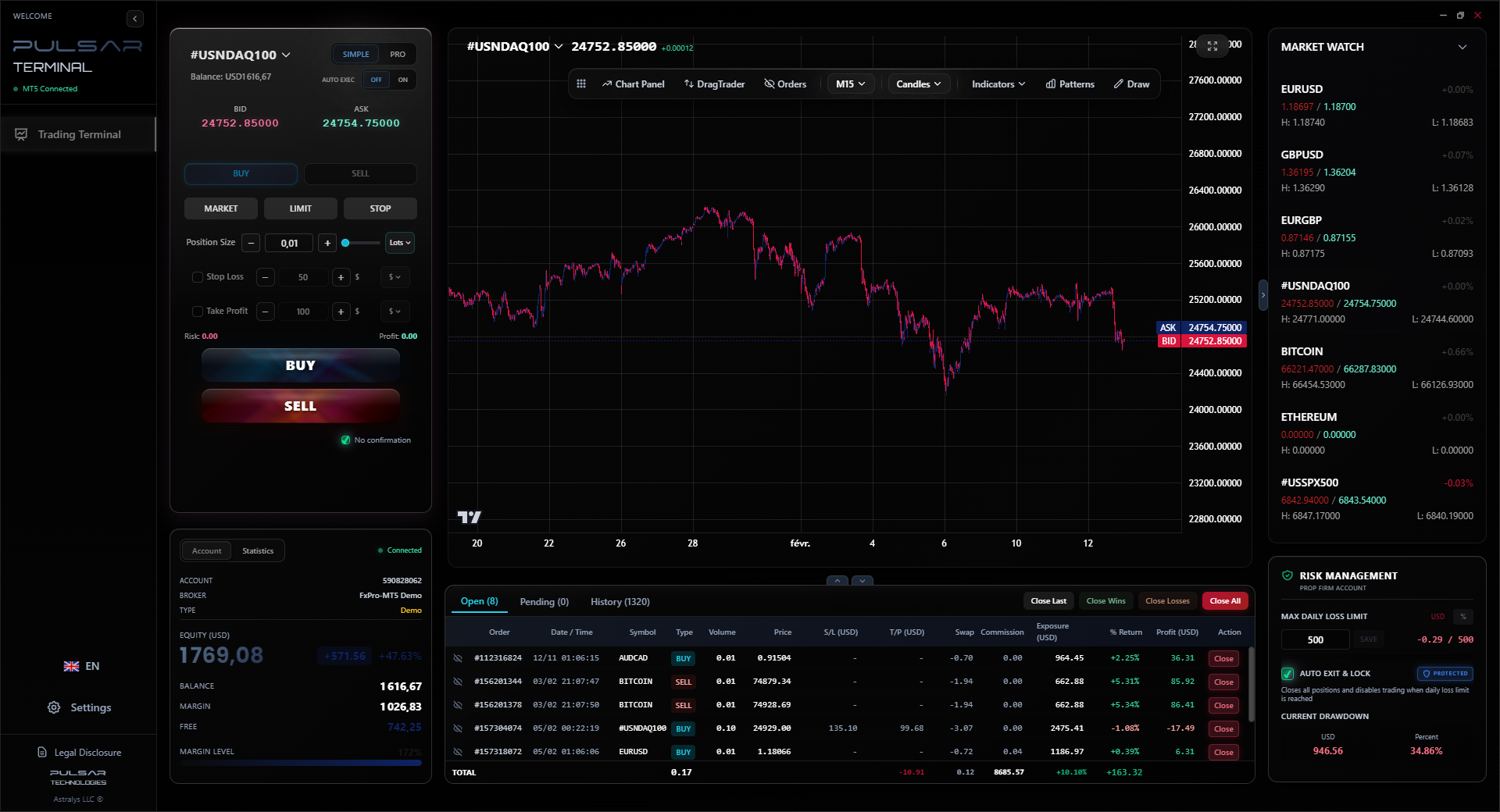
This is where a tool like Pulsar Terminal shines. Managing multiple trades with different take-profit levels and a trailing stop manually on MT5 is a headache. Automating that lets you focus on the next setup, not micromanaging open pip definition movements.
Managing the complex exit rules of a prop firm challenge is stressful; Pulsar Terminal automates multi-level take-profits and trailing stops directly on your MT5 chart, so you can focus on your next trade, not babysitting your current ones.
Pulsar Terminal
The all-in-one MT5 companion: drag-and-drop orders, multi-TP/SL, trailing stop, grid trading, Volume Profile, and prop firm protection. Used by 1,000+ traders daily.
The prop firm gold rush attracted some shady operators. Here's how to separate the legit from the laughable.
🚩 Major Red Flags:
- "Guaranteed Profit" or "Insider Signals": Run. This is a scam, full stop.
- Extremely Vague or Contradictory Rules: If you can't understand exactly what triggers a fail, they'll use it against you.
- No Clear Information on the Backing Broker: As discussed, this is a huge regulatory and stability risk.
- Overly Complex Fee/Payout Structure: If you need a PhD in finance to calculate your take-home, they're obfuscating.
- Poor or Aggressive Customer Support: Test them before you pay. Ask a detailed question about drawdown calculation. Slow, copy-paste, or rude replies are a bad sign.
- No Community Presence or Verified Reviews: Check ForexPeaceArmy, Trustpilot, and trader forums. Look for consistent patterns in complaints.
Yellow Flags (Proceed with Caution):
- Brand-New Firm with "Too Good" Offers: A new firm offering 100% splits, $1,000,000 accounts for a $99 fee is likely unsustainable or a scam.
- Excessive Marketing Hype: If their website feels more like a nightclub promo than a financial service, be wary.
- Changing Rules Frequently: Some adjustment is normal, but constant major changes signal internal chaos.
Do Your Homework:
- Search "[Firm Name] payout problem" or "[Firm Name] scam".
- Look for YouTube videos from established traders (not affiliate shills) doing live withdrawals.
- Read the Terms of Service. Yes, it's boring. Do it anyway. The devil is in the details, like how they define spread definition during news events.
My rule: If I have more than two unanswered questions or gut feelings after researching a firm, I skip it. There are plenty of legitimate options in the running for the best prop firms 2025 list without having to gamble on a questionable one.
“View the challenge fee as tuition. If you pass, great. If you fail, you paid for a masterclass in discipline.”
Honestly? It depends.
For the right trader, absolutely. If you have a proven, disciplined strategy but lack the capital, a prop firm is the fastest way to access serious trading size. Passing a challenge is a brutal but effective credential. It proves you can trade under pressure and follow rules. The structured environment can cure bad habits.
For most people, it's an expensive lesson. The 5-10% pass rate is real. Most traders underestimate the psychological pressure of the daily loss limit. They treat the simulated capital like monopoly money until they blow up, then blame the firm.
Here's my blunt advice:
- Don't start with a prop firm. Prove yourself consistently profitable with your own capital in a live account for at least 6 months. Track every trade.
- Paper trade their exact rules for a month before paying a fee. Use their simulated platform if they offer a free trial.
- Start small. Don't go for the $200,000 challenge because it looks sexy. Buy a $10k or $25k challenge. The risk management principles are identical, and the fee is lower if you fail.
- View the fee as tuition. If you pass, great. If you fail, you paid for a masterclass in discipline. Analyze why you failed. Was it overtrading? Poor position size calculator use? Ignoring your RSI indicator signals?
The industry is maturing. The clown firms are being weeded out by regulation and competition. The survivors in 2025 are more professional, but the bar is higher. Choose a firm that fits your trading soul, not just your wallet's dream. Do that, and you might just find yourself on the right side of the profit split.
FAQ
Q1Can I really make a living trading with a prop firm?
Yes, but it's a career, not a lottery. You need to pass their challenge first (5-10% do), then trade consistently within their rules month after month. Your income will be variable based on market conditions and your performance. It's not a stable salary, but it can provide significant capital use for a skilled trader.
Q2What's the biggest mistake traders make in prop firm challenges?
Oversizing. They see a $100,000 account and think in dollar terms, not percentage risk. They risk 2-3% per trade, have two bad trades, and instantly hit the 5% daily loss limit. They're done in an hour. The key is micro-sizing (0.5%-1% risk) to survive the inevitable losing streaks.
Q3Are prop firms legal in the United States?
Yes, the current model is legal. They operate as educational/simulated trading services, not as investment advisors or broker-dealers (which would require heavy SEC regulation). This legal gray area is under increasing scrutiny from the CFTC and SEC, so the rules could change, but as of early 2025, major firms are legally serving US clients.
Q4Which trading platform is best for US prop firm traders now?
There's no single 'best.' After the MT4/5 issues, firms diversified. cTrader and TradeLocker are excellent for forex/CFDs and are widely supported. NinjaTrader and Tradovate are the standards for futures. Your choice should be based on the firm you pick and the markets you trade.
Q5How long does it take to get a payout after passing a challenge?
Usually, there's a "funded account" period (often your first payout cycle) where you must trade for a set period (e.g., 14-30 days) and hit a small profit target before your first withdrawal. After that, payouts can be monthly, bi-weekly, or even daily. Read the firm's specific payout schedule carefully.
Q6Should I choose a firm with a high profit split or flexible rules?
Flexible rules, 100 times out of 100. A 90% split of nothing is zero. A 70% split of consistent profits is a real income. Prioritize firms whose rules (drawdown type, daily loss, allowed strategies) match how you actually trade. Surviving and making profits comes before optimizing the split.
Prof. Winston's Lesson
Key Takeaways:
- ✓Platform stability is now a primary risk (post-MetaQuotes).
- ✓Prioritize flexible rules over high profit splits.
- ✓Risk a maximum of 0.5-1% per trade in challenges.
- ✓The daily loss limit is the #1 account killer.
How useful was this article?
Click a star to rate
Weekly Trading Insights
Free weekly analysis & strategies. No spam.
About the Author
James Mitchell
Senior Trading Analyst
Based in New York with over 9 years of trading experience. Focuses on major USD pairs, prop firm challenges, and the US regulatory landscape.
Comments
Risk Disclaimer
Trading financial instruments carries significant risk and may not be suitable for all investors. Past performance does not guarantee future results. This content is for educational purposes only and should not be considered investment advice. Always conduct your own research before trading.
You Might Also Like

Cara Trading Forex Sukses: 7 Prinsip dari Trader Profesional
Cara trading forex sukses dengan 7 prinsip trader pro: manajemen modal, disiplin, journal trading, backtest. Data nyata, bukan janji profit palsu.
Jam Trading Forex Terbaik untuk Trader Indonesia: Panduan Lengkap dengan Tabel Waktu
Panduan jam trading forex untuk trader Indonesia. Tabel 4 sesi dunia, jam emas 20:00-00:00, sesi mana yang harus dihindari. Data akurat + tips dari trader berpengalaman.
Top 5 Sàn Forex Uy Tín Nhất 2026: Review Jujur dari Trader Indonesia
Top 5 sàn forex uy tín 2026 untuk trader Indonesia. Review jujur: spread, deposit, withdraw, dukungan lokal. Exness, XM, IC Markets & lebih.
Get Pulsar Terminal
All these calculators are built into Pulsar Terminal with real-time data from your MT5 account. One-click position sizing, automatic risk management, and instant calculations.
Get Pulsar Terminal