


Looking for the best prop firms for futures? You're not alone.

James Mitchell
Senior Trading Analyst
☕ 12 min read
What you'll learn:
- 1Futures Prop Firms 101: How They Really Work
- 2The Rulebook: What Makes or Breaks a Firm
- 3The Contenders: A Real Trader's Breakdown
- 4The Real Math: Fees, Payouts & What You Keep
- 5Platforms & Tools: Your Daily Workspace
- 6How to Actually Pass the Evaluation
- 7The Elephant in the Room: Regulation (2026 & Beyond)
- 8My Take: Who Should You Start With?

Looking for the best prop firms for futures? You're not alone. The market's flooded with options, all promising you the keys to a six-figure funded account. But here's the thing I've learned after 12 years: most of them are built to take your evaluation fee, not to fund you. The game is changing fast, especially with regulators finally paying attention. Let's cut through the hype and look at which futures prop firms are actually worth your time, money, and trading skill in 2026.
Before we get to the list, you need to understand the setup. Most prop firms aren't brokers. They're more like talent scouts with a very expensive audition process. You pay a fee (anywhere from $50 to $500) to take a "challenge" or "evaluation" on a simulated account. If you hit their profit target without breaking their rules (more on those later), they give you a funded account with their capital. You keep a big chunk of the profits - usually 80% to 90%.
Here's the kicker, and most new traders miss this: they make most of their money from those evaluation fees. The failure rate is over 90%. I'm not saying it's a scam, but the business model is heavily weighted toward you failing the test. That's why the rules are so critical. A firm with impossible rules isn't looking for traders; it's looking for customers.
For futures, you're typically trading contracts like the E-mini S&P 500 (ES), Micro E-mini (MES), Nasdaq (NQ), or crude oil (CL). You need a firm that gives you access to the platforms you like, whether that's NinjaTrader, Tradovate, or TradingView. Don't just look at the shiny funded account size. Look at the path to actually getting there and getting paid.

Warning: The regulatory landscape is shifting under our feet. The CFTC is looking hard at these firms, questioning if they should be registered as Commodity Trading Advisors (CTAs). By 2026, expect stricter rules, more transparency, and maybe even some firms shutting down or changing their model completely. Stick with established names.

💡 Winston's Tip
Professor Winston always said, 'The market charges tuition.' Think of your prop firm evaluation fee as that tuition. Pay it once, learn the lesson, and pass.
This is where you separate the good firms from the fee traps. You must read the rulebook like your trading life depends on it. Because it does.
Drawdown: Trailing vs. End-of-Day (EOD)
This is the biggest one. A trailing drawdown is a nightmare for most styles. Say you start a $50k account with a $2,500 max loss (5%). If you make $1,000, your loss limit might trail up to $51,000. Your peak balance becomes your new floor. One bad trade can wipe out days of work. It forces hyper-aggressive scalping strategy and creates insane pressure.
An End-of-Day (EOD) or Static drawdown is far more trader-friendly. Your loss limit is fixed based on your starting balance or calculated only once per day at the market close. This gives you room to breathe during the day, manage trades, and use sensible swing trading tactics. If a firm offers EOD drawdown, it's a massive green flag.
Profit Targets & Time Limits
Is the profit target realistic? 10% in 30 days is common, but watch out for 20% in 15 days - it often forces reckless trading. Also, check if there's a minimum trading day requirement. Some firms require you to trade 5-10 different days to prove consistency, which I think is fair.
The "Fine Print" Stuff
- News Trading Restrictions: Some firms don't allow trading 5 minutes before/after major news events. If you're a news trader, this kills your strategy.
- Weekend Holding: Can you hold positions over the weekend? For futures traders, this matters.
- Scaling Plans: How do you grow your account? The best firms have clear, automatic scaling plans where they increase your capital after you hit certain profit milestones.
I learned this the hard way early on. I passed a challenge with a firm that had a hidden rule about a "consistency corridor." Even though I hit the profit target, they said my daily profits were too variable and failed me. My $289 fee was gone. Always, always read the full FAQ.

“The business model is heavily weighted toward you failing the test.”
Based on the current (early 2026) landscape, trader feedback, and rule fairness, here are the firms that consistently come up. Remember, this is my opinion, not financial advice.
| Firm | What I Like | What I Don't Like | Best For... |
|---|---|---|---|
| Apex Trader Funding | Huge selection of account sizes. One-step evaluation with no time limit on most plans. Offers EOD drawdown. 100% of first $25K profit. | Uses a monthly subscription model ($85-$105/mo) even after you're funded. Payouts are only twice a month. | Traders who want flexibility and no time pressure. |
| Topstep | The original futures prop firm. Great reputation, solid platform (TopstepX). Very clear rules. 100% of first $5K-$10K. | Stricter rules (trailing drawdown on most accounts). More expensive evaluation fees. | Disciplined traders comfortable with their specific rule set. |
| Bulenox | Simple, straightforward rules. 100% of first $10K. Fast(ish) payouts. Often runs sales on evaluations. | Customer support can be slow. Platform choice is more limited. | Budget-conscious traders looking for a clean deal. |
| Tradeify | No activation fee. Payouts are weekly. Has both forex and futures. | Newer firm, so long-term track record is less proven. | Traders who hate hidden fees and want frequent payouts. |
| My Funded Futures | No activation fee. EOD drawdown on most accounts. Good profit split (80%-90%). | Smaller firm, less brand recognition. | Traders prioritizing EOD drawdown and low upfront costs. |

Pro Tip: Don't get dazzled by the "100% profit split" offer. It's almost always only on the first $5K-$25K. After that, it drops to the standard 80/90 split. It's a nice bonus, but don't pick a firm solely for that.
Let's talk numbers, because this is where dreams get budgeted.
The Evaluation Fee: This is your ticket to the game. It's a sunk cost. Treat it as a tuition fee, not an investment. I budget for two attempts minimum when trying a new firm. Prices range from a $65 monthly subscription at Apex for a $5K account to a $499 one-time fee for a $150K account elsewhere.
The Activation/Subscription Fee: This is the sneaky one. You pass your challenge... congrats! Now pay us $150 to "activate" your funded account. Some firms are ditching this (which is great), but others bake it into a monthly fee. Apex's model means you're always paying them, which eats into your profits but also keeps the account open if you blow it.
The Profit Split: You make $10,000 on your funded account. The firm takes their 10%-20%, so you get $8,000-$9,000. Seems simple. But then you request a payout.
Payout Processing: This is critical. Some firms pay weekly, some bi-weekly, some monthly. Firms like Blue Guardian advertise a 24-hour guarantee. Others can take 5-7 business days. The fastest method is usually crypto (USDT, Bitcoin). Bank wires can take ages and have fees. Always factor in the payout threshold. If you need to make $1,000 before you can withdraw, that's your first goal.
Here's a real example from last year: I passed a $100K challenge with a firm (not listed above). Fee: $299. I made $8,200 in the funded account. My split was 80%, so $6,560. They had a $1,000 minimum payout and processed bi-weekly via wire for a $25 fee. My net take-home after all that was $6,535. It took 16 days from trade to bank account. Was it worth it? Yes, but the delay was frustrating.
💡 Winston's Tip
In trading, you control three things: entry, exit, and size. In a prop challenge, size is the only one that matters. Master it.

“Your number one job is to stay away from the max loss line.”
You could have the best rules in the world, but if you're forced to trade on a clunky platform, you'll lose. Most futures prop firms partner with a specific broker or platform provider.
- NinjaTrader & Tradovate: These are the kings for futures in the prop space. Clean interfaces, good charting, and reliable execution. Most top firms offer one or both.
- TradingView: Growing in popularity. If you live on TradingView charts, find a firm that integrates with it directly.
- R|Trader & Sierra Chart: More for advanced, institutional-style traders. Powerful but steep learning curves.
- Prop Firm Platforms: Some, like TopstepX, have their own. They're usually simplified and designed around their specific rules.
Your platform choice affects everything: your speed, your analysis, and your sanity. Before you buy a challenge, see if they offer a free demo on their platform. Get a feel for it.

Example: Trading the E-mini S&P 500 (ES) requires quick decisions. A platform with 500ms of latency versus 50ms is a huge difference. A good platform also has strong tools for setting stop-losses and take-profits, which is non-negotiable for managing a prop firm's strict drawdown. Tools that automate partial closures or trailing stops can be a lifesaver.
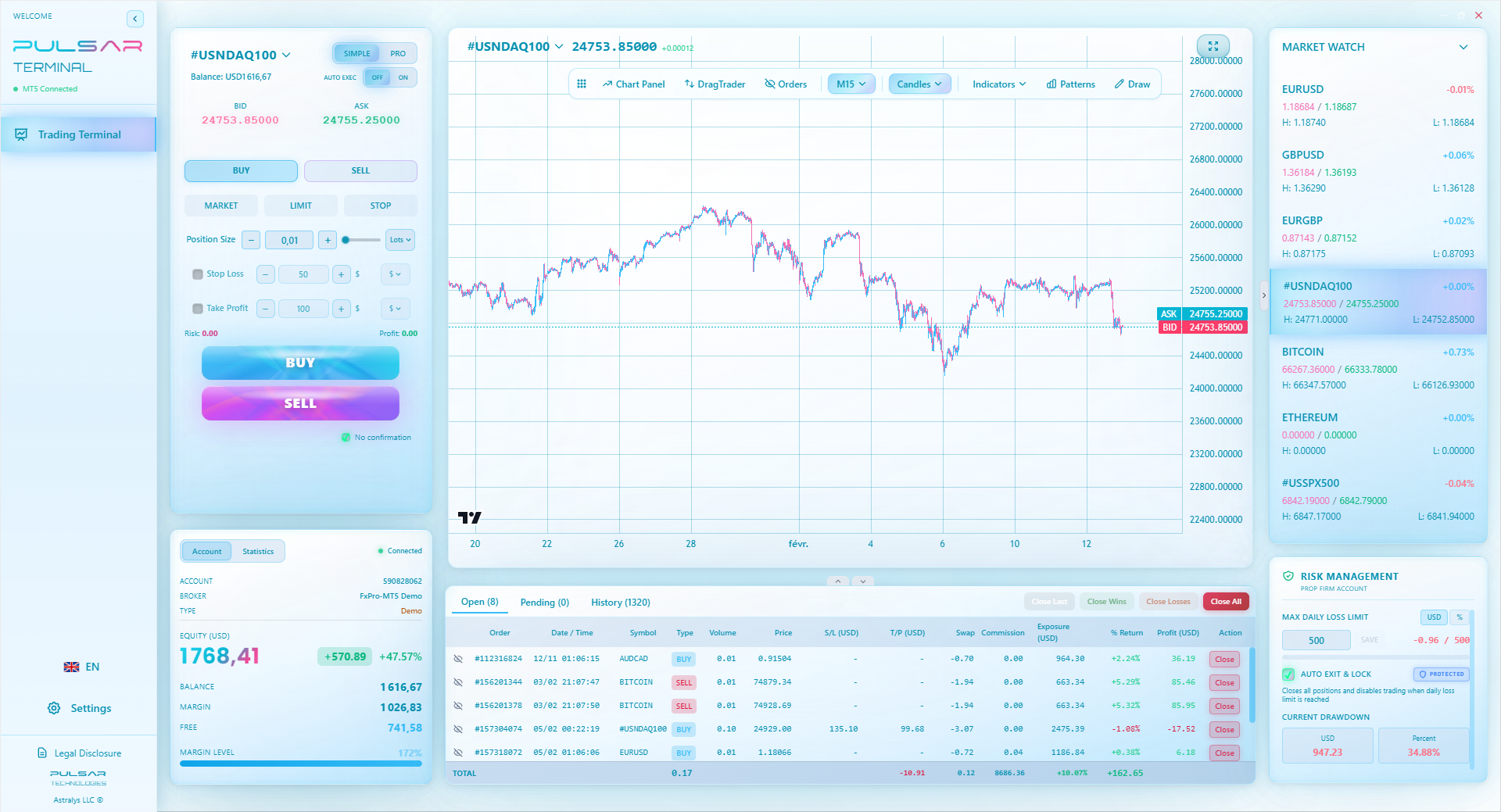
This is where external tools can bridge the gap. If you're using a platform like MT5 that's a bit barebones, a companion app can add the features you need without the prop firm having to upgrade their whole system.
Managing a prop firm's strict daily loss limit is stressful; Pulsar Terminal's prop firm daily loss protection feature can automatically halt your trading if you near that limit, saving your account.
Pulsar Terminal
The all-in-one MT5 companion: drag-and-drop orders, multi-TP/SL, trailing stop, grid trading, Volume Profile, and prop firm protection. Used by 1,000+ traders daily.
Okay, you've picked a firm with fair rules. Now, how do you not become part of the 90% failure statistic?
-
Trade Small, Shockingly Small. You are not there to get rich on the eval. You are there to pass. On a $50K account, your daily profit target might be $500 (1%). You could try to make that in one trade. Or, you could make $100 per day for 5 days. The second way is infinitely safer. Use micro contracts (MES, MNQ) even if the account allows the big ones. It's about controlling the position size calculator like a dictator.
-
The Drawdown is Your Only Boss. Your number one job is to stay away from the max loss line. I literally draw a bright red line on my chart showing where my account would hit the margin call. Every trade is planned with a stop-loss that keeps me far from that red line.
-
Hit the Minimum Days, Then Stop. If they require 5 trading days, trade 5 of the calmest, lowest-volatility days you can find. Make your tiny profit and log off. Once you hit the profit target, STOP TRADING. The number of people who pass and then trade themselves back below the target is a tragedy.
-
Have a Real Strategy. Don't just wing it. Use a strategy you've backtested. Whether it's based on the MACD indicator divergence or simple support/resistance, have a plan. The eval is not the time to experiment.
My personal method? I trade the MES, aiming for a 5-point move ($25) per contract. My stop is always 4 points ($20). My risk is tiny relative to my account, and I only need 20 of those wins over a couple of weeks to pass most challenges. It's boring. It works.

“A prop firm is a tool, not a strategy. It won't make you a profitable trader.”
We can't ignore this. The party is getting a chaperone. For years, prop firms operated in a gray area, calling themselves "evaluation service" companies to avoid CFTC and NFA oversight. That's changing.
The CFTC is now asking: if a firm charges a fee, gives you simulated capital, and then shares real profits with you... aren't they acting like a Commodity Trading Advisor (CTA)? CTAs have to register, get audited, and follow strict rules to protect clients.
What this means for you in 2026:
- More Legitimacy: The shadiest firms will be forced out. The ones that remain will be more transparent.
- Possible Rule Standardization: We might see less of the predatory trailing drawdown rules as standards emerge.
- Slower Changes? Firms might be less quick to offer new, trader-friendly perks as they focus on compliance.
- Your Protection: Your funds (both fees and profits) should be safer in segregated accounts.
It's a net positive, but it brings uncertainty. If you're choosing a firm now, lean toward the established ones with a long track record. They're more likely to navigate the regulatory shift successfully. A fly-by-night firm might just disappear with your payout request.
💡 Winston's Tip
A rulebook is a risk document. Read it not to see what you can do, but to find the single rule that will break you. Then build your strategy around it.
If you're a new futures trader looking for the best prop firms for futures to try first, here's my blunt advice.
Start with Apex Trader Funding or My Funded Futures. Why? The EOD drawdown. It removes the single biggest psychological weapon these firms have against you. The subscription model at Apex is annoying, but it also lowers the initial sting. You're not dropping $300 on a one-shot eval. For many, that makes the mental game easier.
If you're a very disciplined day trader who can handle pressure, Topstep is the gold standard for a reason. Their rules are tough but clear, and their reputation is solid.
Whatever you do, start small. Buy the smallest, cheapest evaluation they offer. Prove you can navigate their rules on a $5K or $10K account before you even think about the $100K challenge. Use that first attempt as a paid learning experience. Track every trade. Figure out where their rules pinch you.
Finally, remember this: a prop firm is a tool, not a strategy. It won't make you a profitable trader. It will only amplify the trader you already are. If you're not consistently profitable in your own personal account with real risk, you won't be in a prop challenge. Work on your craft first - master your EUR/USD guide or XAU/USD guide strategy, get your psychology tight. Then, and only then, use a prop firm to scale up. Good luck.

FAQ
Q1What is the easiest prop firm to pass for futures?
Firms with End-of-Day (EOD) drawdown rules are generally easier to pass than those with trailing drawdowns. They give you more intraday flexibility. Look at Apex Trader Funding or My Funded Futures for EOD models. 'Easiest' also means a reasonable profit target (8-10%) and no crazy time limits.
Q2Can you really make money with futures prop firms?
Yes, but it's a two-step process: first you have to be a consistently profitable trader, then you have to navigate their specific rules. The profit splits are real. I've taken multiple five-figure payouts from firms like Topstep and Apex. However, the vast majority of traders lose their evaluation fees and never see a funded account.
Q3What's the catch with prop firms?
The main catch is the business model is designed to collect evaluation fees. The rules (like trailing drawdowns, high profit targets in short times) are often structured to make passing statistically very difficult. They profit from the 90%+ who fail. The second catch is the fees - activation fees, monthly subscriptions, and payout thresholds all eat into your profits.
Q4Do prop firms affect your taxes?
Yes, absolutely. In the US, the profits you receive from a prop firm are considered taxable income. You will receive a 1099 form from the firm (if they're legitimate). You are responsible for reporting this income and paying the appropriate taxes. Keep detailed records of all your payouts.
Q5What's better for futures: a prop firm or a personal broker account?
It depends. A personal account (with a broker like Interactive Brokers) gives you total control and all your profits. But you're limited by your own capital. A prop firm gives you use to trade much larger size, but you give up a chunk of profits and must follow their rules. Start with a personal account to prove your strategy. Use a prop firm to scale it once you're confident.
Q6Are there any prop firms with no evaluation?
Truly, no. Every legitimate firm has some form of assessment process. Some offer a "one-step" evaluation with no specific time limit (like Apex), but you still have to prove you can hit a profit target without violating their loss limits. Any firm offering instant, no-test funding is likely a scam.
Prof. Winston's Lesson
Key Takeaways:
- ✓Trade 10x smaller in an eval than you think you should.
- ✓EOD drawdown rules are a sign of a trader-friendly firm.
- ✓Budget for at least two failed evaluation attempts.
- ✓The 100% profit split is only on the first $5K-$25K.
How useful was this article?
Click a star to rate
Weekly Trading Insights
Free weekly analysis & strategies. No spam.
About the Author
James Mitchell
Senior Trading Analyst
Based in New York with over 9 years of trading experience. Focuses on major USD pairs, prop firm challenges, and the US regulatory landscape.
Comments
Risk Disclaimer
Trading financial instruments carries significant risk and may not be suitable for all investors. Past performance does not guarantee future results. This content is for educational purposes only and should not be considered investment advice. Always conduct your own research before trading.
You Might Also Like

Cara Trading Forex Sukses: 7 Prinsip dari Trader Profesional
Cara trading forex sukses dengan 7 prinsip trader pro: manajemen modal, disiplin, journal trading, backtest. Data nyata, bukan janji profit palsu.
Jam Trading Forex Terbaik untuk Trader Indonesia: Panduan Lengkap dengan Tabel Waktu
Panduan jam trading forex untuk trader Indonesia. Tabel 4 sesi dunia, jam emas 20:00-00:00, sesi mana yang harus dihindari. Data akurat + tips dari trader berpengalaman.
Top 5 Sàn Forex Uy Tín Nhất 2026: Review Jujur dari Trader Indonesia
Top 5 sàn forex uy tín 2026 untuk trader Indonesia. Review jujur: spread, deposit, withdraw, dukungan lokal. Exness, XM, IC Markets & lebih.
Get Pulsar Terminal
All these calculators are built into Pulsar Terminal with real-time data from your MT5 account. One-click position sizing, automatic risk management, and instant calculations.
Get Pulsar Terminal