


I remember staring at my screen at 1:45 PM SAST, my finger hovering over the sell button on USD/ZAR.

David van der Merwe
Emerging Markets Trader ·  South Africa
☕ 11 min read
What you'll learn:
- 1Why Timing is Your Secret Weapon (It's Not Just About Being Awake)
- 2The Best SAST Times to Trade (And What to Trade Then)
- 3Trading the ZAR Pairs: Your Home Court Advantage
- 4Brokers, Costs, and the FSCA Rules You Must Know
- 5My Trading Routine (And the Mistakes I Made for You)
- 6Essential Tools and Final Advice for the SA Trader
I remember staring at my screen at 1:45 PM SAST, my finger hovering over the sell button on USD/ZAR. The London session was in full swing, but New York hadn't opened yet. The chart was dead flat. Then, like clockwork, the first big US economic data hit at 2:00 PM SAST. The pair dropped 80 pips in three minutes. That's the moment I truly learned that in forex, timing isn't just everything, it's the only thing. For us trading from South Africa, our unique time zone (SAST) is both a challenge and a secret weapon if you know how to use it.
Most new traders think the market is just 'open' or 'closed.' That's a quick way to lose money. The forex market's 24-hour cycle is broken into distinct sessions: Sydney, Tokyo, London, and New York. Each has its own personality, liquidity, and volatility. Trading the EUR/USD at 3 AM SAST is a completely different beast to trading it at 3 PM SAST.
The magic - and the danger - happens when these sessions overlap. That's when the big banks, hedge funds, and institutional money are all active at once. Volume spikes, spreads tighten, and price can move with real conviction. For a retail trader like you and me, that's where we find our best opportunities. Trading during sleepy, low-volume periods is like fishing in a pond that's just been drained. You might get a nibble, but you're mostly just waiting for something that isn't there.
I learned this the hard way early on. I tried scalping strategy the GBP/JPY during the late Sydney session (around 5 AM SAST). The spread was 4 pips wide on a normal day, and price would just chop in a 10-pip range for hours. I was paying more in spread costs than I could possibly make. My broker's spread definition page suddenly made a lot more sense. I was fighting the market's natural rhythm.

Example: Let's say you trade a standard lot (100,000 units) on EUR/USD.
- During London/NY Overlap: Spread is 0.8 pips. Your cost to enter the trade is $8 (0.00008 * 100,000).
- During Sydney Session: Spread widens to 2.5 pips. Your cost is now $25. You're down $17 before the trade even moves. That adds up fast.

💡 Winston's Tip
The market pays you for patience, not for presence. Don't sit in front of a quiet chart out of obligation. Your best trade might be to walk away until the clock hits your session.
Alright, let's get specific. Here’s your cheat sheet for the best time to trade forex in South Africa, using our local SAST clock. Forget GMT conversions; this is your schedule.
The Golden Hours: London & New York Overlap (2:00 PM - 6:00 PM SAST)
This is the main event. London is in its afternoon, and New York is opening up. This 4-hour window is when over 70% of the day's forex volume often trades. Liquidity is insane, spreads are at their tightest, and trends can really get going. This is prime time for any strategy, but especially for momentum trading. I do most of my trading right here.
What to trade:
- EUR/USD, GBP/USD, USD/JPY: The majors love this window. You'll see clean moves.
- USD/ZAR: Our home pair gets massive attention here from both European and US players reacting to emerging market flows and commodity news.
- Gold (XAU/USD): Often treated like a currency, gold is highly reactive to USD moves during this session. Check our dedicated XAU/USD guide for specifics.
The Morning Boost: London & Tokyo Overlap (9:00 AM - 11:00 AM SAST)
This is a solid secondary window. London traders are having their coffee and digging into the day, while Tokyo is wrapping up. It's less chaotic than the afternoon but still offers good movement, especially in pairs involving the Yen or Euro.
What to trade:
- EUR/JPY, GBP/JPY, AUD/JPY: The 'Yen crosses' are most active with Tokyo open.
- EUR/USD: Starts to wake up as London gets going.
The Quiet Times to Avoid (Or Use for Planning)
- Sydney Session (Midnight - 9:00 AM SAST): Generally quiet, wide spreads. I use this time for analysis, planning my day, and setting alerts. Trading here is tough.
- Late New York / Asian Morning (After 10:00 PM SAST - Midnight): Volume falls off a cliff. Avoid new entries unless you're a night owl with a very specific plan.

Warning: These times shift by one hour when Europe or the US observes Daylight Saving Time and SA does not (we don't use it). From around late March to late October, the London/NY overlap is often 3:00 PM - 7:00 PM SAST. Always double-check your trading platform's server time against SAST.
“Trading USD/ZAR with a 50-pip stop loss is like bringing a knife to a gunfight. You need room for its natural volatility.”
Trading USD/ZAR, EUR/ZAR, or GBP/ZAR is where you, as a South African trader, can have a real edge. You're closer to the local news, you feel the economic mood, and you understand the political headlines in a way a trader in London might not. But these pairs are wild. They're less liquid than the majors and can gap like crazy on local news.
The best time to trade forex in South Africa for ZAR pairs has two key windows:
- 9:00 AM - 11:00 AM SAST: When local banks and corporates are active at the Johannesburg Stock Exchange (JSE) open. You get the first reaction to local data (like CPI or SARB announcements) released at 10:00 AM.
- 2:00 PM - 6:00 PM SAST: When international liquidity floods in during the London/NY overlap. This is often where the bigger, sustained trends develop based on global risk sentiment.
A trade I remember vividly: USD/ZAR was at R18.45. South African inflation data came in much hotter than expected at 10:00 AM SAST. The pair dropped 150 pips to R18.30 in 15 minutes as the Rand strengthened on rate hike bets. I was ready, went long on a pullback to R18.35, and rode it back up to R18.55 over the London session as the initial panic faded and global USD strength took over. That two-phase move - local news reaction, then global trend absorption - is classic ZAR behavior.

Pro Tip: ZAR pairs have much higher volatility. A 100-pip stop loss on EUR/USD is conservative. On USD/ZAR, it can get taken out by normal noise. Always use a position size calculator and account for the higher value per pip definition. A 50-pip move on USD/ZAR is worth a lot more in Rands than a 50-pip move on EUR/USD.
You can't talk trading in SA without talking about the Financial Sector Conduct Authority (FSCA). They're our watchdog. Trading with an FSCA-regulated broker isn't just a suggestion, it's your first line of defence. It means client funds should be segregated, and the broker has to follow some basic rules of conduct.
Many international brokers like IC Markets review, Pepperstone review, and XM review have FSCA licenses to operate here. It gives you peace of mind. You can also use global brokers, but then you're dealing with foreign regulations and potentially trickier ZAR deposits/withdrawals.
Now, about costs. They'll eat you alive if you're not careful.
- Spreads: This is your main cost. During our prime London/NY overlap, expect tight spreads on majors (0.5-1.0 pips on EUR/USD is common). On USD/ZAR, 30-50 pips is normal. It widens massively off-hours.
- Commissions: Some brokers offer raw spreads but charge a commission per lot (e.g., $7 per 100k). Do the math: a 0.1 pip spread + $7 commission might be cheaper than a 0.8 pip spread with no commission.
- Overnight Financing (Swap): If you hold a trade past 10:00 PM SAST (your broker's rollover time), you pay or earn swap. For ZAR pairs, holding a long USD/ZAR (buying USD, selling ZAR) usually costs you daily because SA interest rates are higher. This makes swing trading ZAR pairs carry a cost.
Here’s a quick comparison of what you might see:
| Broker Type | EUR/USD Spread (Prime Time) | USD/ZAR Spread (Prime Time) | Key Feature for SA Traders |
|---|---|---|---|
| FSCA Regulated (Int'l) | 0.7 pips | 35 pips | Local support, ZAR accounts, MT4/5 |
| Global 'Raw' Account | 0.1 pip + $5 commission | 25 pips + commission | Ultra-tight pricing, but maybe no FSCA |
I made a mistake once not calculating swap. I went long GBP/ZAR on a Wednesday, aiming for a swing trading play. I held over the weekend (3 nights of swap). The trade went my way by 120 pips, but the swap charges wiped out over a third of the profit. The market gave, and the broker took right back.
💡 Winston's Tip
Treat swap charges like a daily rental fee on your position. If you wouldn't rent a car for R200 a day to drive 2km, don't hold a trade with heavy negative swap for a small target.
“Your edge as a South African trader isn't just timing, it's context - you understand the headlines moving the Rand in a way a foreigner never will.”
Let me walk you through a typical Tuesday in my trading life, based in Cape Town. This routine evolved from years of getting it wrong.
6:30 AM SAST: Wake up. Check if any major Asian session news (China data, BoJ) has caused gaps. I glance at USD/ZAR, but I don't trade. It's too thin.
8:00 AM - 9:00 AM SAST: Planning hour. I review the charts I marked up the night before. I look for key levels on EUR/USD and GBP/USD. I check the economic calendar for the day: what's due at 10:00 AM SAST locally? What's due at 2:00 PM SAST (US data)? I write down my game plan: 'If USD/ZAR holds below R18.50 after CPI, look for short setups after London open.'
9:30 AM - 11:00 AM SAST: Watch the London/Tokyo overlap. Sometimes I take a trade on a Yen cross if my setup is perfect. More often, I watch how price reacts to the levels I identified. This session often sets the tone.
1:30 PM SAST: Final prep for the big overlap. All alerts set. I make sure my kids are sorted, my phone is on silent. This is focus time.
2:00 PM - 5:00 PM SAST: Trading window. I'm at my screens. I'm not trading every minute, but I'm engaged. This is when I executed that USD/ZAR trade I mentioned earlier. I also rely heavily on the MACD indicator and RSI indicator on lower timeframes here to catch momentum shifts as big data drops.
The Big Mistake: My routine used to be chaotic. I'd try to trade the 10:00 AM SAST data, then the 2:00 PM SAST data, then the 4:00 PM SAST Fed speech. I was overtrading, stressed, and my results were random. Now, I often pick one key event or session and trade that deliberately. Sometimes, that means I only place one or two trades all day. Quality over quantity.
Managing risk during these volatile windows is non-negotiable. A fast market can blow through a sloppy stop loss. Using a trailing stop or a breakeven function once a trade is in profit can save you from a winner turning into a loser.
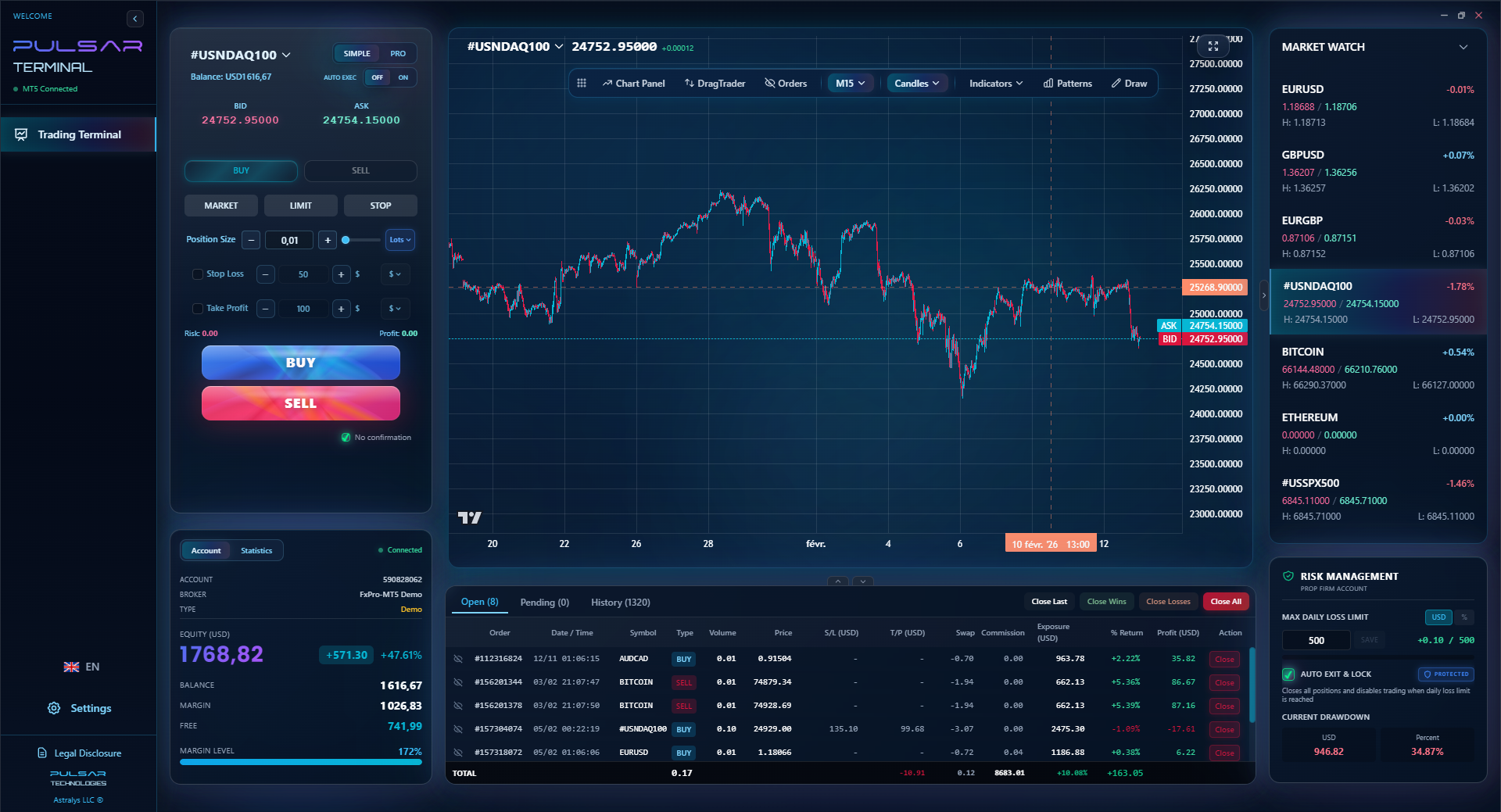
When trading fast-moving sessions, managing multiple trades and setting advanced stops is critical; Pulsar Terminal's drag-and-drop orders and multi-TP/SL tools on MT5 let you do this without taking your eyes off the chart.
Pulsar Terminal
The all-in-one MT5 companion: drag-and-drop orders, multi-TP/SL, trailing stop, grid trading, Volume Profile, and prop firm protection. Used by 1,000+ traders daily.
You need the right gear. A reliable internet connection is obvious, but here’s what else:
- Economic Calendar: Set it to SAST. Know when local SARB meetings, budget speeches, and US Non-Farm Payrolls (2:30 PM SAST) are happening.
- MetaTrader 4/5: It's the standard for a reason. Most FSCA brokers offer it. Learn it inside out.
- A Good Broker Platform: Speed matters. During the 2:00 PM overlap, you don't want your order screen freezing. Test your broker's platform under pressure with small trades first. I've had good execution experiences with brokers like Exness review during high volatility, but you must test for yourself.
Your mindset is your most important tool. You have to accept that you can't catch every move. The market is open 24 hours, but you shouldn't be. Protect your sleep, protect your capital, and protect your mental energy.
Final piece of advice: Backtest your strategy against the different sessions. You'll likely find your win rate on EUR/USD is far higher between 2-4 PM SAST than between 2-4 AM SAST. Let data, not hope, guide your trading hours.
Finding the best time to trade forex in South Africa is about aligning your strategy with the market's rhythm. Trade when the market is alive, protect your capital when it's asleep, and use your local knowledge on the ZAR as a strategic edge. Now, go look at the clock. Is it time to trade, or time to plan?
FAQ
Q1What is the single best hour to trade forex from South Africa?
For pure volatility and opportunity, the first hour of the London and New York overlap, from 2:00 PM to 3:00 PM SAST, is often the most explosive. This is when key US economic data is frequently released, colliding with peak London liquidity.
Q2Can I trade successfully only in the evenings after work (after 5 PM SAST)?
It's tough. The peak liquidity of the London/NY overlap is winding down by 5 PM SAST. The New York session alone can still offer moves, but it's generally less volatile. You might find some opportunities on USD pairs reacting to late US news, but your options are more limited compared to the afternoon.
Q3Does the best trading time change on Fridays?
Yes, significantly. Liquidity often dries up in the late afternoon (after 4 PM SAST) as traders close positions ahead of the weekend. The New York session close (around 10 PM SAST) can see some weird, thin-market moves. I avoid entering new swing trading positions late on Friday.
Q4I want to trade USD/ZAR. Is the timing different?
Slightly. While it's still most active during the London/NY overlap, pay extra attention to the JSE open (9 AM SAST) for local reaction and the time around 10 AM SAST when local economic data is published. These can cause sharp, immediate moves in ZAR pairs.
Q5What's the biggest risk of trading during off-peak SAST hours?
Wider spreads and 'slippage.' With fewer participants, your broker's spread can double or triple. A market order might get filled at a much worse price than you expected. This can turn a potentially good trade into an instant loser. Always check live spreads before clicking.
Q6Are FSCA-regulated brokers safer?
They provide a crucial layer of protection for South African residents. The FSCA ensures a degree of operational standards and requires client fund segregation. It also gives you a local authority to complain to if something goes wrong. It's the strongest safety net available to SA traders.
Q7How do I manage swap costs if I want to hold a ZAR trade for days?
You have to factor it into your profit target. If holding a long USD/ZAR position costs you R50 per night in swap, and you plan to hold for 5 days, you need the trade to move 250 pips just to break even on costs. Sometimes, the trend is strong enough to justify it. Often, it's not. Use your broker's swap calculator before entering.
Prof. Winston's Lesson
Key Takeaways:
- ✓Trade the 2-6 PM SAST overlap for 70% of your volume.
- ✓USD/ZAR spreads can hit 50 pips; size accordingly.
- ✓Local 10 AM SAST data causes sharp, short-term ZAR moves.
- ✓Swap costs on ZAR pairs can erase small swing trade profits.
- ✓FSCA regulation is your baseline safety requirement.
How useful was this article?
Click a star to rate
Weekly Trading Insights
Free weekly analysis & strategies. No spam.
About the Author
David van der Merwe
Emerging Markets Trader
Johannesburg-based trader with 11 years in emerging market currencies. Specializes in ZAR pairs, FSCA-regulated trading, and South African market analysis.
Comments
Risk Disclaimer
Trading financial instruments carries significant risk and may not be suitable for all investors. Past performance does not guarantee future results. This content is for educational purposes only and should not be considered investment advice. Always conduct your own research before trading.
You Might Also Like

Cara Trading Forex Sukses: 7 Prinsip dari Trader Profesional
Cara trading forex sukses dengan 7 prinsip trader pro: manajemen modal, disiplin, journal trading, backtest. Data nyata, bukan janji profit palsu.
Jam Trading Forex Terbaik untuk Trader Indonesia: Panduan Lengkap dengan Tabel Waktu
Panduan jam trading forex untuk trader Indonesia. Tabel 4 sesi dunia, jam emas 20:00-00:00, sesi mana yang harus dihindari. Data akurat + tips dari trader berpengalaman.
Top 5 Sàn Forex Uy Tín Nhất 2026: Review Jujur dari Trader Indonesia
Top 5 sàn forex uy tín 2026 untuk trader Indonesia. Review jujur: spread, deposit, withdraw, dukungan lokal. Exness, XM, IC Markets & lebih.
Get Pulsar Terminal
All these calculators are built into Pulsar Terminal with real-time data from your MT5 account. One-click position sizing, automatic risk management, and instant calculations.
Get Pulsar Terminal