


I lost R8,200 in under 90 seconds.

David van der Merwe
Emerging Markets Trader ·  South Africa
☕ 10 min read
What you'll learn:
- 1Why News Matters More Than Your Chart (Especially for the ZAR)
- 2The Global Heavy Hitters (What Moves the Majors)
- 3South Africa's Home Game: The Local Events That Rule the Rand
- 4The Trading Calendar: Your New Best Friend
- 5Practical Strategies: What to Actually Do
- 6Pitfalls That Will Bury You (And How to Avoid Them)
- 7Putting It All Together: A Weekly Plan for a SA Trader
I lost R8,200 in under 90 seconds. It was a Thursday afternoon, and I was short on EUR/USD. The US CPI inflation print hit the wires. The number wasn't just high, it was a shocker. The market didn't just move, it gapped. My stop-loss? Useless. The spread blew out to over 20 pips, and my broker's platform lagged just long enough for the loss to be catastrophic. That day, I learned the hard way that trading around the biggest forex news events isn't optional knowledge. It's survival.
You can have the perfect trend line, a textbook RSI divergence, and a MACD crossover that looks like a work of art. None of it matters when a central bank governor opens their mouth or a jobs report prints a surprise. For South African traders, this is doubly true. The Rand (ZAR) is what we call an 'emerging market currency.' It's more volatile, more sensitive to global risk sentiment, and reacts like a startled springbok to local political drama.
Think of it this way: the EUR/USD might twitch on a news release. USD/ZAR can jump 200 pips in a heartbeat. That's not just movement; that's a margin call waiting to happen if you're on the wrong side. The FSCA's use cap of 30:1 for retail traders is there for a reason, and news events are the exact moment you'll be grateful for it. Trading without an awareness of the economic calendar is like driving in Johannesburg with your eyes closed. You might get away with it for a block or two, but the collision is inevitable.

Warning: Your technical analysis means nothing during high-impact news. Liquidity dries up, spreads widen dramatically, and stop-loss orders can be executed at terrible prices (slippage). I've seen USD/ZAR spreads go from 3 pips to 50 pips during a SARB announcement. If your trade relies on a tight stop, you will get taken out.
“Trading without an awareness of the economic calendar is like driving in Johannesburg with your eyes closed.”
These are the events that shake the US Dollar (USD), Euro (EUR), and British Pound (GBP). When these big pairs move, they drag everything else with them, including the ZAR crosses.
US Non-Farm Payrolls (NFP)
The first Friday of every month, 15:30 SAST. This is the king. It measures US job creation. I don't care if you're trading USD/ZAR or GBP/JPY, you need to know when this is. The market reacts to the deviation from the forecast. A surprise of +50k jobs can send the USD soaring. I once made R5,000 in two minutes on a short EUR/USD trade after a strong NFP, but I've also been stopped out on five separate trades simultaneously when I got the direction wrong. The volatility is insane.
US Consumer Price Index (CPI) & Federal Reserve Decisions
Inflation data directly dictates what the US Federal Reserve will do with interest rates. A high CPI print means higher rates for longer, which typically strengthens the USD. The Fed's actual interest rate decision and, more importantly, the press conference by the Chair (like Jerome Powell) are critical. The market doesn't trade the fact of a rate hike; it trades the future path of hikes hinted at in the statement.
European Central Bank (ECB) & Bank of England (BoE) Decisions
Similar to the Fed, but for the Euro and Pound. Their decisions create huge moves in EUR/USD and GBP/USD. As a South African, if you're trading EUR/ZAR or GBP/ZAR, you're getting a double whammy: the European news and the subsequent ZAR reaction to global risk flows.

Example: Let's say the Fed hikes rates by 0.50%. USD strengthens. EUR/USD falls 100 pips. If you're long EUR/ZAR, you're fighting the drop in EUR/USD and a potential drop in EUR/ZAR if the ZAR also strengthens on risk-off flows. It's a complex interaction. This is where a solid swing trading plan that accounts for news cycles is essential, not just a scalping strategy that gets shredded by volatility.

💡 Winston's Tip
The market's reaction to news is about expectation vs. reality. A 'good' number that was already expected is often a sell signal. Your job is to know what's priced in.
“The market doesn't trade the fact of a rate hike; it trades the future path of hikes hinted at in the statement.”
This is where you, as a local trader, can have an edge. You understand the context, the politics, the players. These events cause the most predictable (and violent) moves in ZAR pairs.
South African Reserve Bank (SARB) Interest Rate Decision
Happens every two months. The SARB's Monetary Policy Committee (MPC) announces the repo rate. This is the single biggest driver of USD/ZAR in the short term. A hike to fight inflation supports the Rand. A hold or cut can crush it. The tone of the statement and the MPC's vote split (e.g., 3-2 for a hike) are just as important as the number itself. I always clear any ZAR-related positions at least an hour before this announcement.
National Budget Speech
Delivered by the Finance Minister, usually in February. This outlines government spending, taxes, and debt forecasts. The market looks for fiscal discipline. A budget perceived as reckless or increasing debt too fast will hammer the ZAR. A credible, austere budget can trigger a sharp rally. It's a fundamental health check on the country.
CPI & Unemployment Data
South Africa's own inflation and jobs numbers. High inflation pressures the SARB to hike, which can be ZAR-positive. Shockingly high unemployment (we're often above 32%) is a chronic weight on the currency, reflecting deep economic problems.
Political & Credit Rating Events
Moody's, S&P, and Fitch credit rating announcements. A downgrade into deeper sub-investment grade (junk status) is a major negative. Also, major political events like ANC conference outcomes or significant policy announcements (like on Eskom or land reform) can cause sudden volatility. I got caught long USD/ZAR when a positive political headline hit the wires; the pair dropped 300 pips in an hour, wiping out a week's profits. I learned to never underestimate local political risk.
“The market doesn't trade the fact of a rate hike; it trades the future path of hikes hinted at in the statement.”
You must use an economic calendar. I use mine every morning, without fail. Here’s what I look for:
- The Event: What's being released (e.g., US Retail Sales).
- The Time: In SAST. Set an alarm.
- The Forecast: The consensus number economists expect.
- The Previous: The last released number.
- The Impact: Usually denoted by bulls or stars (High, Medium, Low).
My Rule: I only adjust my trading for 'High' impact events. For a 'High' impact event on a currency I'm exposed to, I have three choices:
- Close the position before the news. This is what I do 80% of the time. Taking profit or a small loss is better than the gamble.
- Widen my stop-loss dramatically to absorb the expected volatility. This requires a much larger account to maintain proper position size.
- Trade the news intentionally. This is a specific, risky strategy and not for the faint-hearted. It requires speed, a good news feed, and an understanding that spreads will be wild. Most retail traders lose money trying this.
Brokers like Exness and IC Markets have decent economic calendars built into their platforms, but I prefer an independent source to avoid any conflict of interest.
💡 Winston's Tip
If you wouldn't walk into a lion's den unarmed, don't hold a position through major news without a plan. The plan is usually to not be there.
“News trading often reveals a lack of patience. The market will always be there after the announcement. Your capital might not be.”
Theory is great, but what do you do? Here’s my blunt advice, forged from years of mistakes.
Strategy 1: The Avoidance Play (Recommended for 95% of Traders) Simply don't trade 15 minutes before and 30 minutes after a major High-impact news release on your pair. Go make some coffee. Your charts will be chaotic, filled with false spikes (wicks) that trigger stops and then reverse. The spread is your enemy here. This strategy has saved me more money than any brilliant trade I've ever taken.
Strategy 2: The Pending Order Fade (Advanced) This is for when you have a strong directional bias after the initial news spike. Let's say USD/ZAR spikes 150 pips higher on a SARB rate hold. You believe it's an overreaction. You could place a limit order to SELL at a level slightly below the spike's high, anticipating a pullback. Your stop-loss goes above the spike high. The key? You wait for the initial 1-2 minute madness to settle before placing the order. Never enter a market order during the chaos.
Strategy 3: The Volatility Expansion Setup (Swing Focus) Use big news events as a catalyst to find new trends. Don't trade the first 30 minutes. After that, look at the new price range. Has USD/ZAR broken a key weekly high after the news? That new momentum might be tradable for the next few days. The news provides the energy; you look to ride the resulting wave once the water is less choppy.

Pro Tip: Your broker matters immensely during news. Some brokers have terrible slippage and requotes. I've found ECN/STP brokers like Pepperstone or XM generally have better execution during volatile times, though no one is perfect. Test your broker's execution during smaller news events first.
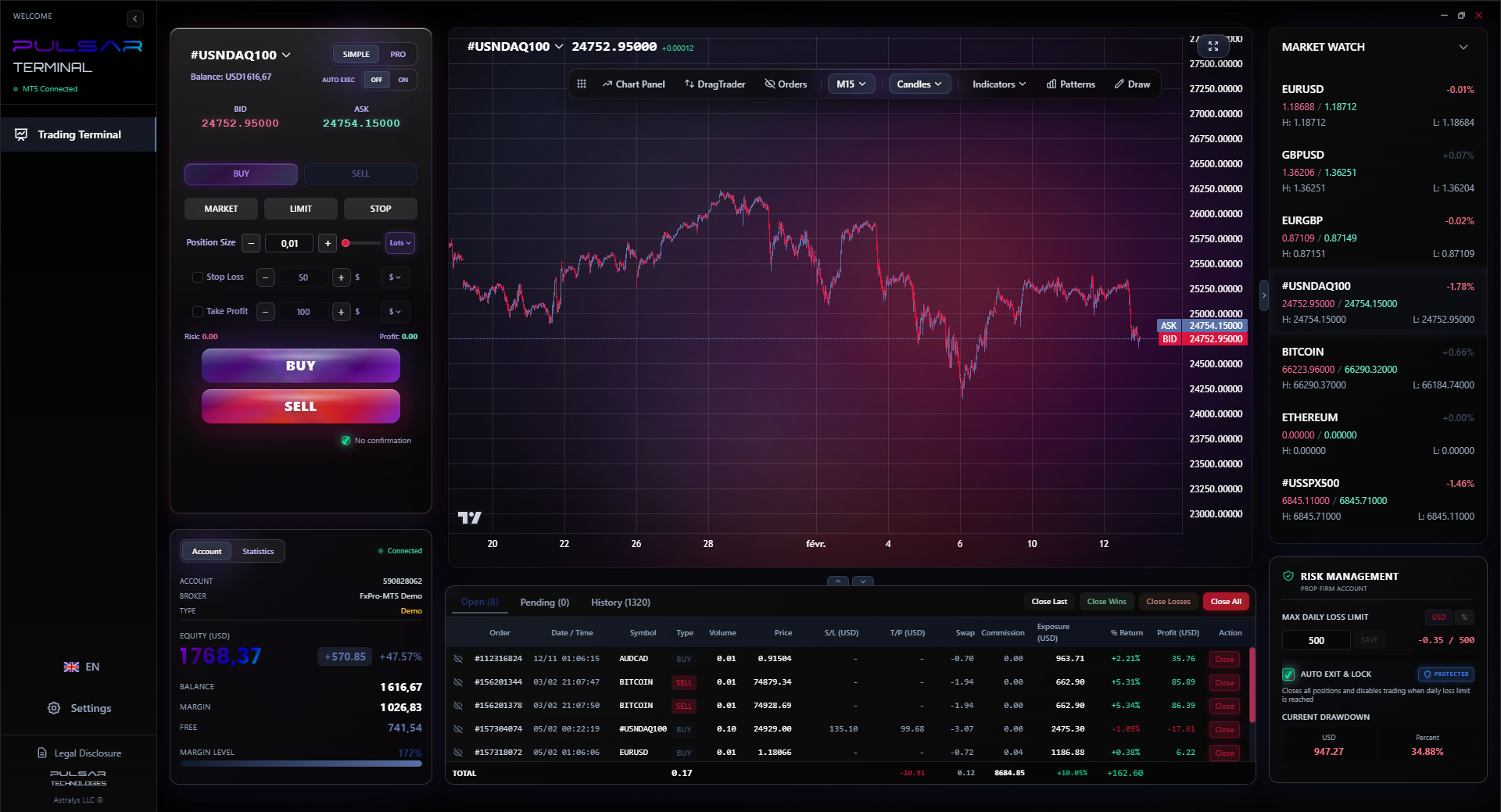
Managing multiple trades and setting advanced stops around volatile news events is stressful; Pulsar Terminal's drag-and-drop order tools and multi-TP/SL with partial closure features let you manage your entire risk plan in seconds directly on your MT5 chart.
Pulsar Terminal
The all-in-one MT5 companion: drag-and-drop orders, multi-TP/SL, trailing stop, grid trading, Volume Profile, and prop firm protection. Used by 1,000+ traders daily.
“News trading often reveals a lack of patience. The market will always be there after the announcement. Your capital might not be.”
Let's talk about the mistakes I see every new trader make, and that I've made myself.
Pitfall 1: Trading the Rumor, Getting Killed on the Fact. The market often 'prices in' an expected rate hike days in advance. When the hike actually happens, the price can reverse because 'buy the rumor, sell the fact.' Don't just trade the headline; understand the market's expectation.
Pitfall 2: Ignoring Revisions. Last month's NFP number is often revised this month. Sometimes the revision to the previous number is more important than the new one! Always check the revised previous figure.
Pitfall 3: Chasing the Spike. You see USD/ZAR rocket 200 pips. FOMO kicks in, and you buy at the top. Then it reverses 180 pips. You're now holding a massive bag. News spikes are often followed by retracements. If you missed the initial move, you missed it. Wait for the next setup.
Pitfall 4: Underestimating Confluence. A US CPI print (high impact) happens at the same time as a medium-impact EU event. The volatility compounds. Check the entire calendar for your pair's constituent currencies.
The biggest lesson? News trading often reveals a lack of patience. The market will always be there after the announcement. Your capital might not be if you gamble it on a binary outcome.
💡 Winston's Tip
The best trade after a news explosion is often no trade at all. Let the dust settle. The charts will be lying to you for the first 30 minutes.
“You control the news; you don't let it control you and your margin call level.”
Here’s a simplified version of my weekly routine regarding news.
Sunday Evening: Open my economic calendar for the week. I circle every High-impact event for USD, ZAR, EUR, and GBP. I mark them in my trading journal.
Monday Morning: I plan my trades for the first half of the week, aware that US CPI might be on Wednesday, for example. I will not open any USD pairs on Tuesday that I'm not willing to close before Wednesday's data.
Daily, Before Session Start: I check the calendar for the day. Is there SARB MPC today? If yes, my plan is simple: no new ZAR trades until after the announcement, and I'll likely close any existing ones an hour prior.
During a News Event I'm Avoiding: I am not watching the charts. Seriously. I close the platform. The psychological pull to 'just take a quick trade' is too strong. I walk away.
After the News (30-60 mins later): I assess the damage or opportunity. Has a key level broken? Has the MACD indicator or RSI indicator settled into a new, clear signal on the 15-minute or 1-hour chart? This is when I start my analysis again, with new, relevant price data.
This discipline turns news from a terrifying gamble into a scheduled event you manage. You control the news; you don't let it control you and your margin call level.
FAQ
Q1What is the single most important news event for USD/ZAR?
Hands down, the South African Reserve Bank (SARB) interest rate decision. It's the direct lever on the Rand's yield and directly impacts inflation and capital flows. The US Non-Farm Payrolls is a very close second due to its massive impact on the US Dollar side of the pair.
Q2Should I use a wider stop-loss before news?
Only if you fully understand the implied volatility and have the account size to support it. A wider stop means a smaller position size to maintain the same risk in Rands. Often, it's safer to just close the position. A stop that is 'wide enough' for news volatility might represent a loss so large it ruins your risk management for the month.
Q3Can I make money trading the news as a beginner?
I'm going to be brutally honest: probably not. You're competing against institutional algorithms with direct news feeds and microsecond execution. The spreads, slippage, and emotional chaos are a minefield. Focus on learning to trade the quieter, more predictable periods first. Survival is the first goal.
Q4What time of day is most volatile for news in SAST?
The late afternoon, from about 15:00 to 17:00 SAST. This is when most major US data (like NFP at 15:30) is released, overlapping with the end of the European session. It's also when SARB announcements typically happen. This is peak volatility hour.
Q5Do all currency pairs react the same to US news?
No. USD pairs (like EUR/USD, GBP/USD) react most directly. Pairs like USD/JPY also react strongly as a 'safe-haven' flow. For a pair like EUR/GBP, US news is less directly impactful unless it causes a huge global risk-on/risk-off move. Always consider the currencies in your pair.
Q6Is it illegal to trade forex around news events in South Africa?
No, it's perfectly legal if you're using an FSCA-licensed broker. However, the regulator's use limits (30:1 for retail) are specifically designed to protect you from the extreme volatility news events cause. Trading high-impact news with excessive use is a fast track to blowing up your account, even if it's legal.
Prof. Winston's Lesson
Key Takeaways:
- ✓Always know the time of High-impact news for your currency pairs.
- ✓The SARB decision is the #1 driver of USD/ZAR short-term moves.
- ✓Close positions or widen stops drastically before major news.
- ✓Never chase a news spike. Let volatility settle first.
- ✓Use an economic calendar daily. It's non-negotiable.
How useful was this article?
Click a star to rate
Weekly Trading Insights
Free weekly analysis & strategies. No spam.
About the Author
David van der Merwe
Emerging Markets Trader
Johannesburg-based trader with 11 years in emerging market currencies. Specializes in ZAR pairs, FSCA-regulated trading, and South African market analysis.
Comments
Risk Disclaimer
Trading financial instruments carries significant risk and may not be suitable for all investors. Past performance does not guarantee future results. This content is for educational purposes only and should not be considered investment advice. Always conduct your own research before trading.
You Might Also Like

Cara Trading Forex Sukses: 7 Prinsip dari Trader Profesional
Cara trading forex sukses dengan 7 prinsip trader pro: manajemen modal, disiplin, journal trading, backtest. Data nyata, bukan janji profit palsu.
Jam Trading Forex Terbaik untuk Trader Indonesia: Panduan Lengkap dengan Tabel Waktu
Panduan jam trading forex untuk trader Indonesia. Tabel 4 sesi dunia, jam emas 20:00-00:00, sesi mana yang harus dihindari. Data akurat + tips dari trader berpengalaman.
Top 5 Sàn Forex Uy Tín Nhất 2026: Review Jujur dari Trader Indonesia
Top 5 sàn forex uy tín 2026 untuk trader Indonesia. Review jujur: spread, deposit, withdraw, dukungan lokal. Exness, XM, IC Markets & lebih.
Get Pulsar Terminal
All these calculators are built into Pulsar Terminal with real-time data from your MT5 account. One-click position sizing, automatic risk management, and instant calculations.
Get Pulsar Terminal