


I blew a $50,000 funded account in 2023.

James Mitchell
Senior Trading Analyst
☕ 11 min read
What you'll learn:
I blew a $50,000 funded account in 2023. Not with one bad trade, but by ignoring a simple rule about maximum daily loss. One afternoon, down $1,200 and feeling stubborn, I chased. An hour later, I was down $2,500 - tripping the firm's daily loss limit. Account closed. Game over. That $289 evaluation fee? Gone. That experience taught me more about the reality of US prop firms, often called 'blue sky prop firms' due to state securities laws, than any win ever did. Let's talk about what these firms really are, the changing rules, and how to not make my mistakes.
First off, let's clear something up. You won't find a company registered as 'Blue Sky Prop Trading LLC.' The term comes from 'Blue Sky Laws,' which are state-level securities regulations in the US. They're designed to protect investors from fraudulent schemes - to sell them nothing but 'blue sky.' So when traders talk about a blue sky prop firm, they're usually referring to a US-based proprietary trading firm that has to navigate this patchwork of state laws on top of federal rules.
These firms aren't brokers. You're not depositing your life savings with them. You pay a fee - sometimes called an evaluation or challenge fee - to prove you can trade their capital responsibly. If you pass, you get a funded account. Your profits are split, usually 80/90 in your favor, and your losses are theirs... up to a point. That's the theory, anyway.
The structure is clever. Because they're offering a 'service' (the evaluation) and trading their own capital, they often sidestep direct registration with heavyweights like the SEC or CFTC. But, and this is a big 'but,' the regulatory winds are shifting. In early 2024, the SEC adopted new rules that could force more of these firms to register as 'dealers.' That means more oversight, capital requirements, and exams. The full effect is still rolling out, but the era of the wild west for prop firms is closing.

Warning: Don't assume a prop firm is unregulated. While the firm itself might not be a registered broker-dealer, the actual broker executing your trades almost certainly is (think FINRA, NFA). Always check who the executing broker is. I made the mistake of not doing this early on and ended up with terrible execution during news events.
My first foray into this world was with a firm that seemed legit. I passed a $50k challenge for a $289 fee. The thrill was real. But I learned the hard way that the real regulation often comes from the firm's own rulebook - their drawdown limits, daily loss rules, and consistency requirements. Those are the 'blue sky laws' you'll deal with every single day.
Let's talk numbers, because the marketing gloss can be deceptive. The average fee for an evaluation is around $4,270. That's a serious chunk of change. Some firms offer lower entry points - I've seen $29 for a tiny $5k account - but the scaling is tougher. Others use a subscription model, like $115 a month for a $10k account.
The Profit Split Illusion
They all advertise 80%, 90%, even 100% profit splits. It sounds amazing. But here's the catch you need to understand: that split is on net profits. It's after all your losses, fees, and commissions. I once made $8,000 in gross profits on a $100k account over a quarter. Sounds good, right? But my losing trades totaled $5,200. My net profit was $2,800. My 80% split was $2,240. For three months of work and stress. It was a humbling reality check.
The Stat That Keeps Me Up at Night
This is the most important number in this article: only about 7% of traders who buy a challenge ever receive a payout. Let that sink in. 93 out of 100 people who put money down walk away with nothing. And for the 7% who do get paid? The average payout is roughly 4% of the account size. So that $100,000 funded account you're dreaming about? The average successful trader withdraws about $4,000 from it. This isn't to discourage you, but to ground you. This is a high-stakes skill test, not a lottery ticket.

Example: Let's say you pass a $100k account challenge with a $500 fee. You trade for a month and make a 5% return ($5,000). Your profit split is 80%. You get $4,000. Minus your initial $500 fee, your net is $3,500. A great return on investment! But remember, you're in the 7% club. The other 93 people who paid $500 that month made $0 and lost their fee.
The key is to view the evaluation fee as the cost of education. If you pass and get funded, great. If you fail, you should have learned something valuable about your position size calculator, your psychology, and your strategy. I failed two challenges before my first pass. Each failure was a $300 lesson in patience and risk management.

💡 Winston's Tip
View your evaluation fee as tuition, not a ticket. If you fail, the lesson in discipline should be worth the cost. If you can't articulate what you learned, you wasted your money.
“Your first job is to avoid hitting the daily loss limit. The profits are a distant second.”
The regulatory landscape isn't static. If you're trading with a US prop firm in 2025 or beyond, you need to know about the seismic shifts happening. This directly affects a blue sky prop firm's operations and, by extension, your trading environment.
In February 2024, the SEC adopted new rules (3a5-4 and 3a44-2) that significantly broaden the definition of a 'dealer.' The goal? To get more proprietary trading firms under formal regulatory oversight. These rules have a 12-month compliance clock, meaning they're coming into full force through 2025. If a firm is deemed a 'dealer,' it must register with the SEC and FINRA, maintain strict net capital, and submit to regular examinations.
What does this mean for you, the trader?
- More Firm Closures: Between 2023-2024, about 80-100 prop firms shut down due to tighter rules. This trend will likely continue. The 'get-rich-quick' schemes and poorly capitalized operations will get weeded out. Always check a firm's longevity.
- Potential for Tighter use: Regulators love to cap use to 'protect' traders. While prop firms often offer up to 1:100, don't be surprised if this gets trimmed back across the board. Your scalping strategy that relies on high use might need adjustment.
- Increased Transparency (The Good Part): Registered firms have to disclose more. This could mean clearer rules on payouts, fewer hidden fees, and more strong conflict-of-interest policies. It's a potential win for the serious trader.
There was a brief moment of relief in February 2025 when the SEC withdrew an appeal on related Treasury dealer rules, but the main 2024 rules are still marching forward. The takeaway? The firms that survive will be more professional, more compliant, and likely more strict. Your margin for error in their challenges might get smaller, not larger.

Pro Tip: When choosing a firm in this environment, prioritize those that are transparent about their executing broker (like IC Markets or Pepperstone) and have been in business for several years. A firm's ability to navigate these new 'blue sky' and federal rules is a huge indicator of its stability.
I've given money to firms that later vanished. I've dealt with payout delays. Here's the checklist I use now, born from painful experience.
1. The Rulebook is Your Bible. Before you pay a dime, download and read every rule. Focus on:
- Maximum Daily Loss: Is it based on initial balance or trailing? My $50k blow-up was because I misread this. A 5% max daily loss on initial balance ($2,500) is very different from 5% on current equity.
- Overall Drawdown: Usually 8-12%. Know if it's static (from starting balance) or trailing (from your highest equity point). Trailing is tougher.
- Profit Target: For the challenge and for payouts. Is it realistic?
- Consistency Rules: Some firms forbid making 90% of your profit on one trade. Understand these quirks.
2. Look Under the Hood: The Broker. The prop firm provides capital, but a real broker executes trades. Ask: Who is the broker? Are they regulated (e.g., by the NFA or CFTC)? What are the typical spreads on the EUR/USD or XAU/USD? Slippage during news? I now only use firms that partner with brokers I know and trust, like those in our XM review or Exness review.
3. Payout Track Record. Search the firm's name + 'payout delay' or 'withdrawal problem.' Don't just look at the shiny testimonials. Go to forums, Reddit, and trustpilot. A firm with a history of slow payouts is a firm to avoid.
4. Scaling Plan. What happens if you're successful? How do you grow from $50k to $200k? Is it automatic? Based on profits? Clear, generous scaling plans show a firm wants you to succeed long-term.
5. Realistic Pass Rates. If a firm claims a 50% pass rate, be skeptical. The industry average is 5-10%. Firms like Apex might hit 15-20% on first attempts, which is on the high end. An honest firm is better than a 'easy' one that shuts down later.
My biggest mistake was being seduced by a high profit split and ignoring a convoluted, punitive drawdown rule. I passed the challenge but couldn't live with the rules in the funded stage. Total waste of time and money.
💡 Winston's Tip
The best tool for a prop firm trader isn't a fancy indicator; it's a daily loss counter. Know your number for the day down to the penny, and stop the moment you hit it. No exceptions.
“The 'blue sky' in Blue Sky Laws is about preventing fraud. Your due diligence is the first line of defense.”
Trading a prop firm account is fundamentally different from trading your own. Your strategy might work in a personal account but fail miserably under prop firm constraints. You have to adapt.
Risk Management is Non-Negotiable. This is the whole game. Your first job is to avoid hitting the daily loss limit or max drawdown. I now use a hard rule: I never risk more than 0.5% of the account's initial balance on any single trade. On a $100k account, that's $500. This seems tiny, but it keeps me in the game. Use a position size calculator religiously. The goal isn't to get rich on one trade; it's to survive and compound small wins.
Embrace Smaller, Consistent Wins. Prop firm rules often punish 'hero or zero' trading. They want consistency. This is where swing trading with clear risk/reward setups can shine over hyper-aggressive scalping. My most successful funded period came from aiming for 2-3% growth per month, not 2-3% per day.
Tools Are Your Best Friend. You need to automate protection. This is where technology saves you from yourself. Setting a firm-wide stop loss for the day, or using a trailing stop to lock in profits while protecting against a reversal, is crucial. Doing this manually while in a trade is emotional and error-prone.
Psychology of Trading 'Their' Money. It feels different, even though you're the one on the hook for the loss of the evaluation fee. There's pressure to perform, which leads to overtrading. My trick? Once funded, I mentally treat 80% of the account as untouchable 'firm capital.' I only 'see' the 20% that represents my potential profit share. It shrinks the psychological size of the account and makes my 0.5% risk rule feel more appropriate.
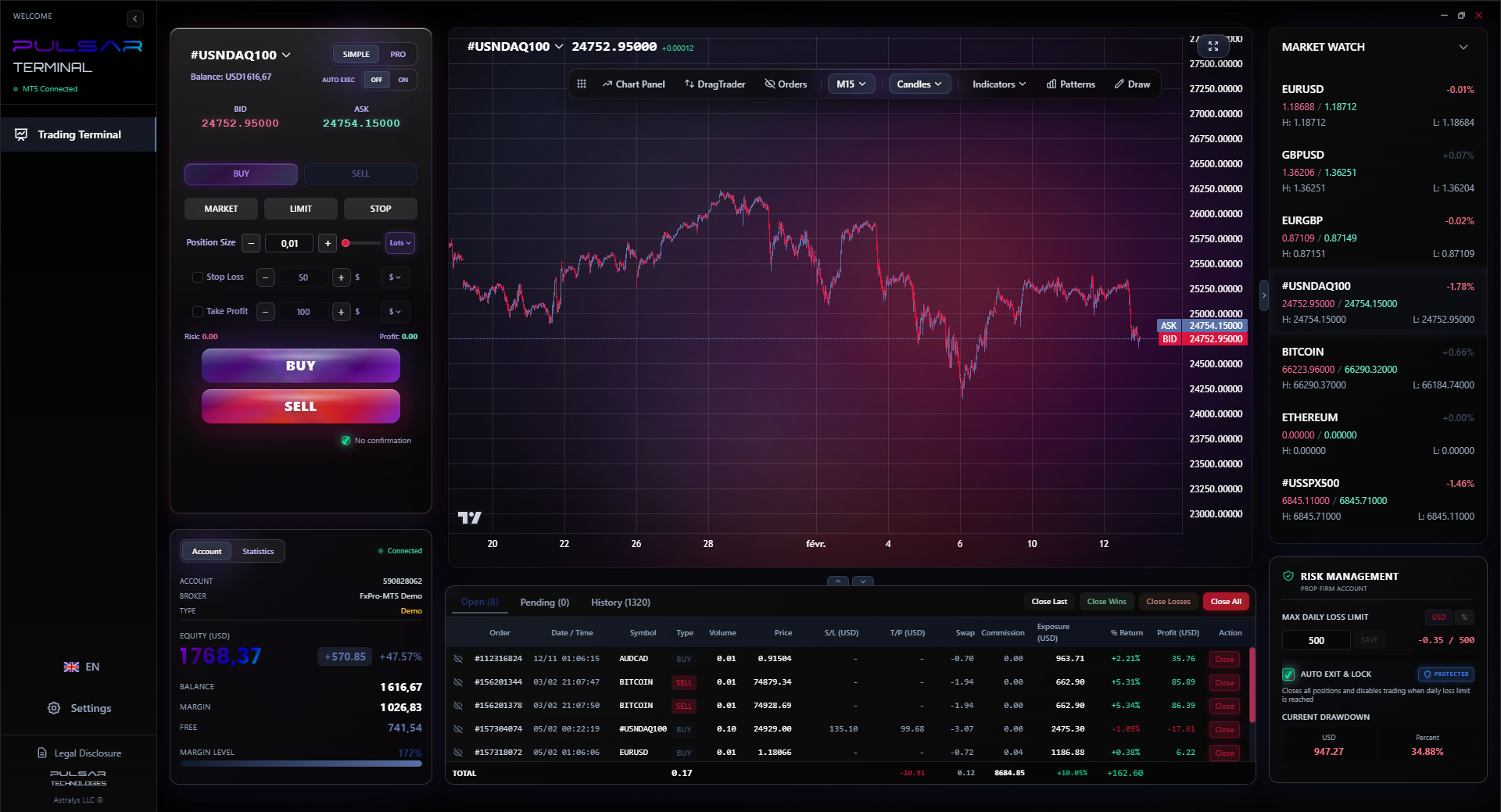
Managing a prop firm's daily loss limit is a constant mental battle, which is why I use Pulsar Terminal to set a hard equity-based stop for the entire day, automating the most important rule.
Pulsar Terminal
The all-in-one MT5 companion: drag-and-drop orders, multi-TP/SL, trailing stop, grid trading, Volume Profile, and prop firm protection. Used by 1,000+ traders daily.
So where is this all headed? The 'blue sky prop firm' model is maturing rapidly. The gold rush days are over.
I expect we'll see a continued consolidation. The 2,000+ firms globally will shrink. The ones that remain will be larger, more regulated, and will operate more like professional trading shops. Fees might standardize or even increase to cover compliance costs. The 1:100 use on forex? I'd bet it gets scaled back toward 1:30 or 1:50 to align with retail broker rules in many jurisdictions.
This is actually good news for serious traders. It means:
- Less Scam Risk: The fly-by-night operations will be regulated out of existence.
- More Reliable Payouts: Stable, regulated firms have a reputation to uphold.
- A Level Playing Field: Everyone will be working under clearer, more consistent rules.
The barrier to entry will be higher, but the path for successful traders will be more legitimate. The focus will shift even more intensely toward risk management and consistent strategy over gambling. The firms that thrive will be those that provide real value - education, technology, and fair scaling - not just a leveraged account with a fancy dashboard.
For you, the trader, it means the time to build a disciplined, rule-based approach is now. The future belongs to the systematic trader who respects drawdown limits, not the cowboy. Start treating your personal account like a prop firm challenge. Impose your own daily loss limit. Track your consistency. If you can't be profitable with your own strict rules, you won't survive in the evolving world of the blue sky prop firm.
FAQ
Q1Is a blue sky prop firm legal in the United States?
Yes, the common prop firm model is legal. They operate as service businesses offering evaluations for a fee and trade their own capital. This typically lets them avoid direct SEC/CFTC registration. However, they must comply with state 'Blue Sky Laws' (business registration, consumer protection) and the brokers they use are federally regulated. New 2024 SEC rules are bringing more firms under formal oversight.
Q2What is the average payout from a prop firm?
The statistic is brutal. Only about 7% of challenge purchasers ever get a payout. For those who do, the average payout is roughly 4% of the funded account size. So, a $100,000 account yields an average withdrawal of $4,000. This highlights that success is about consistent, small withdrawals, not hitting a home run.
Q3What's the most important rule to check in a prop firm's terms?
The Maximum Daily Loss rule. You must know if it's calculated from your initial balance or your current equity. A 5% daily loss on a $50k initial balance is $2,500. If it's on equity, and you're up $5,000, your buffer is larger. Misunderstanding this is the fastest way to blow an account, as I learned the hard way.
Q4Are prop firms shutting down?
Yes, a consolidation is happening. Between 2023-2024, an estimated 80-100 firms closed due to tighter regulations and market conditions. This trend is likely to continue as new SEC rules take effect in 2025. Always choose a firm with a multi-year track record and transparency about their executing broker.
Q5Can I use any trading strategy with a prop firm?
Not exactly. You must adapt your strategy to their rulebook. Strategies that cause large drawdowns or rely on extremely high use often fail. Consistency rules may forbid making most of your profit in one trade. Successful prop traders focus heavily on risk management, often using smaller position sizes and tools like trailing stops to protect profits and stay within limits.
Q6What's the difference between a prop firm and a broker like XM or IC Markets?
A broker (like IC Markets) holds your deposit, executes your trades, and makes money from spreads/commissions. You keep 100% of your profit but also absorb 100% of your loss. A prop firm charges you a fee for a chance to trade their capital. They keep a share of your profits (e.g., 20%) but cover the losses (until you hit their risk limits). You're trading with much larger capital but under strict constraints.
Prof. Winston's Lesson
Key Takeaways:
- ✓The 7% payout rate is the industry's dirty secret.
- ✓Maximum Daily Loss rules blow up more accounts than bad trades.
- ✓New 2025 SEC rules mean fewer, more regulated firms.
- ✓Adapt your strategy for consistency, not home runs.
How useful was this article?
Click a star to rate
Weekly Trading Insights
Free weekly analysis & strategies. No spam.
About the Author
James Mitchell
Senior Trading Analyst
Based in New York with over 9 years of trading experience. Focuses on major USD pairs, prop firm challenges, and the US regulatory landscape.
Comments
Risk Disclaimer
Trading financial instruments carries significant risk and may not be suitable for all investors. Past performance does not guarantee future results. This content is for educational purposes only and should not be considered investment advice. Always conduct your own research before trading.
You Might Also Like

Cara Trading Forex Sukses: 7 Prinsip dari Trader Profesional
Cara trading forex sukses dengan 7 prinsip trader pro: manajemen modal, disiplin, journal trading, backtest. Data nyata, bukan janji profit palsu.
Jam Trading Forex Terbaik untuk Trader Indonesia: Panduan Lengkap dengan Tabel Waktu
Panduan jam trading forex untuk trader Indonesia. Tabel 4 sesi dunia, jam emas 20:00-00:00, sesi mana yang harus dihindari. Data akurat + tips dari trader berpengalaman.
Top 5 Sàn Forex Uy Tín Nhất 2026: Review Jujur dari Trader Indonesia
Top 5 sàn forex uy tín 2026 untuk trader Indonesia. Review jujur: spread, deposit, withdraw, dukungan lokal. Exness, XM, IC Markets & lebih.
Get Pulsar Terminal
All these calculators are built into Pulsar Terminal with real-time data from your MT5 account. One-click position sizing, automatic risk management, and instant calculations.
Get Pulsar Terminal