


Let's be clear: most people calling BTC forex trading an 'opportunity' are trying to sell you something.

Olumide Adeyemi
West African Trading Pioneer ·  Nigeria
☕ 10 min read
What you'll learn:
- 1What Exactly Are You Trading? It's Not Just Bitcoin
- 2Why This Appeals to the Nigerian Trader (And The Trap)
- 3The Real Costs: Spreads, Swaps, and Slippage
- 4A Strategy That Doesn't Get You Killed
- 5Picking a Broker: The Nigerian Minefield
- 6Mindset: How to Sit Through a 20% Drop
- 7Your Action Plan: First 90 Days

Let's be clear: most people calling BTC forex trading an 'opportunity' are trying to sell you something. I've lost money believing that hype. Trading Bitcoin against the dollar or naira isn't a magic shortcut; it's a high-voltage wire where one wrong move can fry your capital. But, if you understand the unique chaos of our Nigerian context - the CBN's stance, the wild spreads, the broker shenanigans - you can find an edge. This guide isn't about getting rich. It's about not getting wiped out while you learn.
When we talk about BTC forex trading here, we're not talking about buying Bitcoin on Binance and holding it. That's investing. We're talking about trading the price movements of Bitcoin against fiat currencies, like the US Dollar (BTC/USD) or even synthetic pairs like BTC/NGN, through a forex or CFD broker. You're speculating on the exchange rate.
The key difference? You never own the Bitcoin. You own a contract for difference (CFD). This is critical. It means you can go short (bet the price will fall) as easily as going long. It also means you're exposed to broker-specific risks like overnight financing charges (swap fees) and potential platform issues during extreme volatility. I learned this the hard way during a 2022 crash. I was long BTC/USD, the price tanked, and my broker's platform froze for 90 seconds. By the time it came back, my stop-loss had been skipped, and I was hit with a much larger loss. The broker's excuse? 'Exceptional market conditions.' My lesson? The instrument itself is only half the battle; the broker's reliability is the other.

Warning: Trading BTC as a CFD means you're trusting the broker to honor the price feed and your trades. During the 2021 bull run, I saw spreads on BTC/USD widen to over $500 with some offshore brokers popular in Nigeria. That's a $50 cost just to enter a 0.1 lot trade. Always check the typical and maximum spread.

💡 Winston's Tip
The spread isn't a fee, it's a toll. If the bridge toll costs more than the goods you're carrying, find another route. Always know the toll before you cross.
The attraction is obvious, and I felt it too. First, it's a dollar-denominated asset. With the naira's volatility, holding positions in USD or a USD-paired asset feels like a sanctuary. Second, the volatility promises quick moves. A 10% daily swing in Bitcoin isn't unusual, while a major forex pair like EUR/USD might move 1%. The potential for fast profits is seductive.
But here's the trap, and I've fallen in: that same volatility is a capital destroyer. Nigerian traders, often starting with smaller accounts, see the big percentage moves and think, 'I only need a small piece of that.' They then use excessive use to try and capture it. A 2% move against you on a highly leveraged position doesn't just hurt; it triggers a margin call and wipes you out. I once put 30% of a $500 account into a single BTC/USD trade with 50:1 use. A 2% dip against me, and the entire account was gone in minutes. It felt less like trading and more like a digital robbery I volunteered for.
The dream of escaping naira volatility by jumping into Bitcoin volatility is like jumping from a frying pan into a bonfire. You need a completely different approach to risk.
“Trading Bitcoin against the dollar or naira isn't a magic shortcut; it's a high-voltage wire.”
Forget the advertised commission. The real cost of BTC forex trading for us in Nigeria is hidden in three places.
The Spread Monster
Spreads on BTC pairs are notoriously wide, especially with brokers targeting emerging markets. I've compiled averages from my journals over the past year.
| Broker Type | Typical BTC/USD Spread (Normal Market) | Spread During High Volatility (e.g., CPI news) |
|---|---|---|
| Int'l Regulated (e.g., IC Markets) | 15 - 25 pips | 50 - 150 pips |
| Common Offshore/MMA Brokers | 25 - 50 pips | 100 - 500+ pips |
A pip here is usually $1 for a standard lot. So a 50-pip spread is a $50 hole you start in. This murders scalping strategies.
The Silent Killer: Swap Fees
Because you're trading a CFD, you pay overnight financing. For BTC/USD, this is often triple the fee of major forex pairs. Holding a long position over a weekend can cost you 0.05% or more of your position value. It seems small, but it erodes profits on trades held for more than a day. Always check the broker's swap rate table.
Execution Slippage
This is where your planned entry or exit price isn't what you get. During fast moves, your market order might fill $100 above or below your click price. I once had a stop-loss on BTC/USD at $42,100. The price flashed down to $41,800 and my stop was filled at $41,750. That's $350 of slippage on one lot. Use limit orders whenever possible to control this.

Pro Tip: Before funding, create a demo account and watch the BTC pair for a week. Note the spread at 10 PM WAT, 2 AM WAT, and during US market open. You'll see the true cost of doing business.

After blowing up accounts with aggressive tactics, I had to rebuild. What works for me now in BTC forex trading is a hybrid approach. I treat it like a volatile commodity, not a currency pair.
1. Timeframe is Everything: Forget the 5-minute chart. The noise is insane. I now use the 4-hour chart for direction and the 1-hour chart for entry. This filters out 80% of the meaningless chop that whipsaws tight stops.
2. Use Volatility-Based Position Sizing: This was a game-changer. Instead of risking a fixed percentage per trade, I use a position size calculator that factors in current volatility. I measure the Average True Range (ATR) over 14 periods on the 4-hour chart. My stop-loss is then set at 1.5x the ATR. This means my position size automatically shrinks when Bitcoin is going crazy and expands when it's calm. It keeps my risk constant in market terms, not just account terms.
3. Wait for the 'Quiet' Break: My most profitable BTC trades come after periods of consolidation. When the 4-hour chart shows tightening ranges (low volatility), and then price breaks above the high with increasing volume, that's my signal. The false breakouts are fewer. I entered a long trade in October 2023 after a 3-day squeeze around $28,000. The breakout took it to $30,500. My stop, based on the ATR, was wide enough to not get shaken out by the initial retest.
4. Combine Momentum with Divergence: I use the RSI indicator (set to 21 periods, not the default 14) to spot divergences on the 4-hour chart. A new low in price without a new low in RSI can signal exhaustion. I wait for this, then look for my entry pattern on the 1-hour. This isn't for quick flips; it's for capturing the next swing.
This approach is boring. It might give you 2-3 signals a month. But it's sustainable. It's about catching the meat of a move, not trying to eat the whole animal from head to tail.
💡 Winston's Tip
Your first profit in volatile markets is often luck. Your first consistent month is skill. Don't confuse the two.
“The dream of escaping naira volatility by jumping into Bitcoin volatility is like jumping from a frying pan into a bonfire.”
This is the most important decision. A bad broker will make profitable trading impossible. Based on my experience and that of my trading circle, here’s the lay of the land.
The 'MMA' or Local Agent Trap: Many so-called brokers are just marketing agents for offshore platforms. They offer insane use (200:1, 500:1) and 'easy naira deposits.' The catch? Withdrawals can be a nightmare. I know guys who waited months. The spreads are horrific, and requotes are constant. They are salespeople, not financial service providers. Avoid.
The International Route: You need a broker with a solid reputation, regulated by a tier-1 authority (like ASIC or FCA), that accepts Nigerian clients. Yes, use will be lower (often max 30:1 on crypto), but that's a feature, not a bug. It forces discipline. Brokers like Pepperstone or Exness (their global entity) have reliable platforms. Funding is the hurdle. You'll likely need a domiciliary account or to use a crypto transfer (sending USDT to the broker). It's more work upfront, but it means your profits are actually accessible.
The Prop Firm Angle: This is a growing alternative. You trade a demo account for a firm like FTMO or The5%ers. If you pass their challenge (consistent profit, drawdown limits), you get to trade a large funded account and keep most of the profits. The beauty? You're not risking your own capital in the market, only the challenge fee. The strict rules (like a 5% daily loss limit) teach incredible discipline that translates directly to managing your own BTC trades. The risk of a margin call is on them, not you.

Example: Let's say you pass a $100,000 challenge. You might be allowed to risk 1% per trade ($1,000). On a BTC/USD trade with a 100-pip stop, that's a 1-lot position. A 500-pip move in your favor (common in Bitcoin) would be a $5,000 profit on the firm's capital. That scale is impossible with a typical Nigerian starter account.

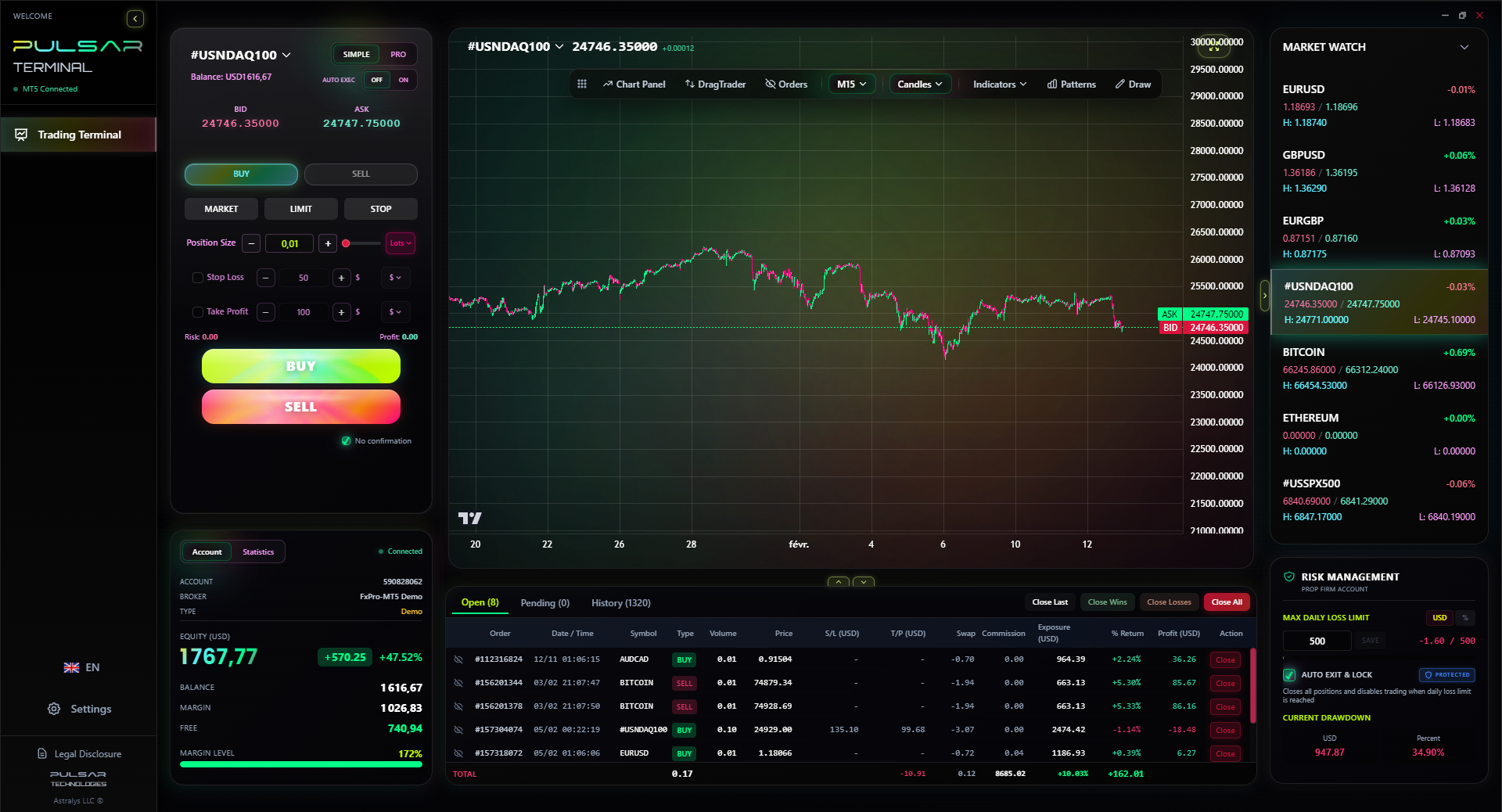
Managing multiple take-profit levels and a trailing stop on a volatile BTC/USD trade is stressful, but tools like Pulsar Terminal automate this directly on your MT5 chart.
Pulsar Terminal
The all-in-one MT5 companion: drag-and-drop orders, multi-TP/SL, trailing stop, grid trading, Volume Profile, and prop firm protection. Used by 1,000+ traders daily.
BTC forex trading is a psychological war. The charts scream at you. Here’s what I had to learn.
Detach from the Naira Value: This is huge. If you deposit 500,000 NGN, convert it to USD in your mind immediately. Track your P&L only in USD. If you watch your trade profit fluctuate in naira value with every CBN news blast, you'll make emotional decisions. I set my platform to display everything in USD.
The 'Screen Time' Rule: You cannot watch the BTC chart all day. It will break you. I schedule my analysis at specific times (London open, US open). I set my alerts and walk away. If my analysis is wrong, my stop-loss handles it. Staring at the screen leads to micromanaging, moving stops, and turning winners into losers.
Embrace Being Wrong: My most profitable year started when I accepted that 6 out of 10 trades would be losers. The goal isn't to be right. It's to have your winners be much bigger than your losers. In BTC, if you catch one or two major swings a quarter, that can cover a dozen small losses. I keep a trading journal where I review losers more than winners. Why did I take it? Was the setup truly there? This reflection is painful but necessary.
I remember holding a short position during a rally. It was going against me, but not yet at my stop. Every fiber wanted to close it. I left my house and went for a walk. By the time I came back, the price had reversed and hit my take-profit. The trade hadn't changed; my ability to sit still had.
“Your stop-loss isn't a suggestion; it's the only friend you have in a crash.”
If you're determined to try this, here's a blueprint to avoid my early mistakes.
Month 1: Education & Paper Trading
- Don't deposit any money. Open a demo account with a reputable international broker.
- Practice funding it (conceptually) via a domiciliary account or crypto transfer to understand the process.
- Trade only BTC/USD on demo. Practice the 4-hour/1-hour strategy. Use the position size calculator. Your goal is not profit, but consistency in following your rules for 20 trades.
Month 2: Micro-Live Account
- Fund a live account with the minimum possible amount. For you, this should be money you are 100% prepared to lose. Think of it as tuition.
- Trade the same strategy with real money. The psychological pressure is different. Your goal is to execute your plan under real emotional stress.
- Document every emotional impulse you have to break your rules.
Month 3: Review and Scale
- Analyze your journal. What worked? Where did you deviate?
- Only if you are consistently following your plan and are at least break-even, consider adding more capital. Not before.
- Explore other instruments to diversify. Maybe add XAU/USD (gold), which has its own volatility but different drivers than Bitcoin.
The biggest mistake is rushing from zero to hero in a week. BTC forex trading isn't a sprint; it's a marathon through a minefield. Walk slowly.
FAQ
Q1Is BTC forex trading legal in Nigeria?
Trading forex and CFDs through international brokers is in a gray area. The CBN restricts forex access for individuals, but it doesn't directly regulate offshore brokerage accounts. The legal risk is low for you as a trader, but the operational risk is high: getting your money in and out reliably is the main challenge, not police arrest.
Q2What's the minimum amount I need to start BTC forex trading?
Technically, some brokers allow you to start with $10. Practically, you need enough to survive the volatility. With a sane broker offering 10:1 use on crypto, a $500 account lets you trade micro lots (0.01) with room to breathe. Starting with less, you're one bad spread or slippage event away from a margin call. I consider $300 the absolute bare minimum for a learning account.
Q3Can I trade BTC/NGN directly?
You'll see this pair offered by some platforms, but be very careful. It's almost always a synthetic pair created by the broker, combining the BTC/USD rate with a USD/NGN rate they control. The liquidity is terrible, spreads are enormous, and it's prone to manipulation. I avoid it completely. Stick to the global benchmark: BTC/USD.
Q4Why do my BTC trades keep getting stopped out before the price reverses?
This is the number one complaint. It's usually because your stop-loss is too tight for Bitcoin's volatility. A 50-pip stop on EUR/USD is reasonable. On BTC/USD, that's noise. Use the Average True Range (ATR) indicator to set your stop. If the 4-hour ATR is 200 pips, placing a 150-pip stop is asking to be washed out. Give the trade room to breathe.
Q5Should I trade Bitcoin or Ethereum?
Start with Bitcoin. It's the benchmark, has the most liquidity (tightest spreads), and its moves often lead the rest of the crypto market. Ethereum (ETH/USD) can be even more volatile and its spreads are wider. Master one volatile asset first. Adding ETH is like learning to drive in a Ferrari and then getting a Lamborghini.
Q6How do I handle tax on profits from BTC forex trading?
Nigeria's tax laws on international trading profits are unclear. However, if you are withdrawing profits to your Nigerian bank account, the bank may ask for the source of funds. Keep careful records of all your deposits, trades, and withdrawals. Consult a local accountant familiar with forex trading. The key is documentation.
Prof. Winston's Lesson
Key Takeaways:
- ✓Use the 4-hour chart for direction; the noise below will bankrupt you.
- ✓Size your position using ATR, not a fixed percent of your account.
- ✓A 50-pip stop on BTC/USD is a wish, not a strategy.
- ✓Your broker's reliability is as important as your trading strategy.
How useful was this article?
Click a star to rate
Weekly Trading Insights
Free weekly analysis & strategies. No spam.
About the Author
Olumide Adeyemi
West African Trading Pioneer
One of Nigeria's most active forex trading educators. 8 years of experience trading from Lagos. Specializes in low-capital strategies and prop firm challenges for African traders.
Comments
Risk Disclaimer
Trading financial instruments carries significant risk and may not be suitable for all investors. Past performance does not guarantee future results. This content is for educational purposes only and should not be considered investment advice. Always conduct your own research before trading.
You Might Also Like

Cara Trading Forex Sukses: 7 Prinsip dari Trader Profesional
Cara trading forex sukses dengan 7 prinsip trader pro: manajemen modal, disiplin, journal trading, backtest. Data nyata, bukan janji profit palsu.
Jam Trading Forex Terbaik untuk Trader Indonesia: Panduan Lengkap dengan Tabel Waktu
Panduan jam trading forex untuk trader Indonesia. Tabel 4 sesi dunia, jam emas 20:00-00:00, sesi mana yang harus dihindari. Data akurat + tips dari trader berpengalaman.
Top 5 Sàn Forex Uy Tín Nhất 2026: Review Jujur dari Trader Indonesia
Top 5 sàn forex uy tín 2026 untuk trader Indonesia. Review jujur: spread, deposit, withdraw, dukungan lokal. Exness, XM, IC Markets & lebih.
Get Pulsar Terminal
All these calculators are built into Pulsar Terminal with real-time data from your MT5 account. One-click position sizing, automatic risk management, and instant calculations.
Get Pulsar Terminal