


I remember staring at the screen, my $50,000 Bulenox evaluation account down $1,250.

James Mitchell
Senior Trading Analyst
☕ 11 min read
What you'll learn:
- 1What Exactly Is Bulenox? (It's Not a Broker)
- 2The Evaluation Challenge: The Gatekeeper
- 3The Real Cost: Fees, Subscriptions, and Hidden Expenses
- 4Life in a Funded Master Account
- 5Trading Platforms & Tools: The Rithmic environment
- 6My Take: The Good, The Bad, The Ugly
- 7Who Should (and Shouldn't) Consider Bulenox
- 8Final Verdict & Is It Worth It?
I remember staring at the screen, my $50,000 Bulenox evaluation account down $1,250. It was day three. I’d broken the daily loss limit on a single, stubborn ES trade, chasing a reversal that never came. The account was instantly closed. That $175 monthly fee? Gone. It was a harsh, expensive lesson that this prop firm game isn't a shortcut. It’s a pressure cooker designed to test discipline above all else. Here’s everything I’ve learned trading with, and sometimes failing with, the Bulenox prop firm over the last year and a half.
Let's clear this up first. Bulenox isn't your broker like IC Markets or Pepperstone. You don't deposit your own trading capital with them. Instead, they're a proprietary trading firm. You pay them a fee to take an evaluation challenge. If you pass their rules, they give you a funded account (a 'Master Account') with their capital. You trade, you keep most of the profits, and they take a cut. They're based in Delaware and, like most US prop firms, they operate in a regulatory gray area. They're not registered with the SEC or CFTC as a traditional broker-dealer because you're technically trading their money as an independent contractor. This matters for taxes (they'll send you a 1099) and for understanding where your real risks lie. Your risk is your fee and your time. Their risk is the capital they allocate.
They specialize exclusively in futures. Think the E-mini S&P 500 (ES), Nasdaq (NQ), crude oil (CL), gold (GC), and Treasury bonds. If you're a forex or stock trader, this isn't your playground. This focus means their platform and rule set are built for futures volatility, which is a different beast altogether.
This is where most people fail. I did, twice, before I got it right. You buy a 'Qualification Account' for a monthly subscription. The goal? Hit a profit target without violating strict loss limits. It sounds simple. It's not.
The Hard Numbers You Must Memorize
For a standard $50,000 account, which costs $175/month (sometimes $125 with a coupon), the rules are:
- Profit Target: $2,500 (5% of the account).
- Daily Loss Limit: $1,250 (2.5%). Hit this, and your challenge is over immediately. No warning. This is what got me.
- Maximum Drawdown: $2,500 (5%). This is a trailing limit from your account's highest equity point. If your peak equity was $51,000 and you drop to $48,500, you're out.
- Minimum Trading Days: None. You can technically pass in one day if you're insane (and lucky).

Warning: The daily loss limit is a silent killer. It's not just your starting balance. If you start the day up $500, your new daily loss limit is $1,750 ($1,250 + your intraday profit). But if you give that profit back, the limit snaps back to $1,250. You must track this manually. I learned this the hard way on a volatile NQ session.
The psychology here is brutal. The pressure to make back a loss before hitting that daily limit can force terrible decisions. It's designed to weed out impatient traders. My successful pass came when I treated it like a job: tiny, consistent 2-3 ES contract scalps for $100-$300 per day, never risking more than $500 on a single trade. It was boring. It worked.

💡 Winston's Tip
The daily loss limit isn't a suggestion, it's a guillotine. Calculate it at the open, write it on a sticky note, and don't look at a chart if you get within $300 of it.
“The pressure to make back a loss before hitting that daily limit can force terrible decisions.”
Everyone looks at the profit split. I look at the cost to play. This is a business, and Bulenox's primary revenue is fees, not your trading losses.
| Account Size | Monthly Eval Fee | One-Time Master Fee | Data Feed Fee | Reset Fee |
|---|---|---|---|---|
| $25,000 | $145 | $143 | $116/month | $78 |
| $50,000 | $175 | $173 | $116/month | $78 |
| $100,000 | $215 | $213 | $116/month | $78 |
| $250,000 | $535 | $898 | $116/month | $78 |
Let's do the math on a $50k account. To pass the evaluation, let's say it takes you two months (that's being optimistic). That's $350 in subscription fees. You pass! Now you have a choice: pay a one-time activation fee of $173 for your Master Account, or keep paying the monthly fee. The one-time fee is almost always better if you plan to trade for more than a month.
Then, add the non-negotiable $116/month for the Rithmic data feed. Without it, you can't see prices. So your true upfront cost to get a live, funded $50k account is roughly $350 (eval) + $173 (activation) + $116 (first month data) = $639.

Example: If your first month's trading profit is $3,000, your take-home after the 90/10 split is $2,700. Subtract your $116 data fee, and you're at $2,584. It takes about $250 in net profit just to cover your monthly data cost. This changes your effective position size calculator math.
Resets are $78, but you get one free reset each time you renew your monthly subscription. It's a clever model that encourages you to keep paying rather than walk away after a failure.
You passed. Congrats. Now the rules change, slightly for the better. The profit target is gone. The loss limits usually remain the same ($1,250 daily, $2,500 max drawdown on a $50k). The pressure to 'make a number' is off, but the pressure to not blow up is ever-present.
The profit split is their big selling point: You keep 100% of the first $10,000 in cumulative profits. After that, it's 90% to you, 10% to Bulenox. This is genuinely good. I pulled $8,200 in my first funded period, and I kept all of it.
But here's the fine print that catches people:
- Minimum Payout: $1,000 for most accounts. You can't withdraw your first $500.
- Safety Threshold: You must leave a 'reserve' in your account. For a $50k account, it's $2,600. If your balance is $53,000, you can only withdraw up to $50,400. This buffer protects them (and you) from a single bad day wiping out the account post-payout.
- Consistency Rule: No more than 40% of your total profit can come from one single trading day. If you have $10,000 in profits, and $6,000 came from a crazy NQ scalping day, you can't withdraw until you've made more 'normal' profits. This prevents lottery-style trading.
- 10 Minimum Trading Days: Before your first payout, you need at least 10 separate trading days. This forces a rhythm.
My first withdrawal was smooth. ACH to my US bank account in about 3 business days. But the process of calculating what I could withdraw, respecting the safety threshold and consistency rule, was manual and annoying. A tool that automated this tracking would have saved me hours.
💡 Winston's Tip
Treat the evaluation fee as a sunk cost the moment you pay it. Trading to 'get your fee back' is the quickest path to breaking a rule. Trade the plan, not the P&L.
“You are not the customer. You are the product being tested.”
Bulenox forces you into the Rithmic environment. You'll use R|Trader Pro or something like Sierra Chart/Quantower with a Rithmic feed. It's professional-grade, but it's not MetaTrader. The learning curve is steep.
The good? Execution is fast. Latency is low. You're connected directly to the exchanges. The data is clean. For futures swing trading or day trading, it's superior to MT5 for raw speed.
The bad? It's clunky. Charting tools feel dated. Setting up a simple trailing stop or a multi-tiered take-profit order isn't as intuitive as on a retail platform. I missed the simplicity of my MT5 setups. I found myself manually moving stop-losses to breakeven, which is a risk if you step away.

Pro Tip: If you're used to MT5, practice on a Rithmic demo for a week before starting your Bulenox eval. The order entry panel alone will cost you money if you're fumbling during live markets. I lost $150 on a mis-clicked market order in my first week.
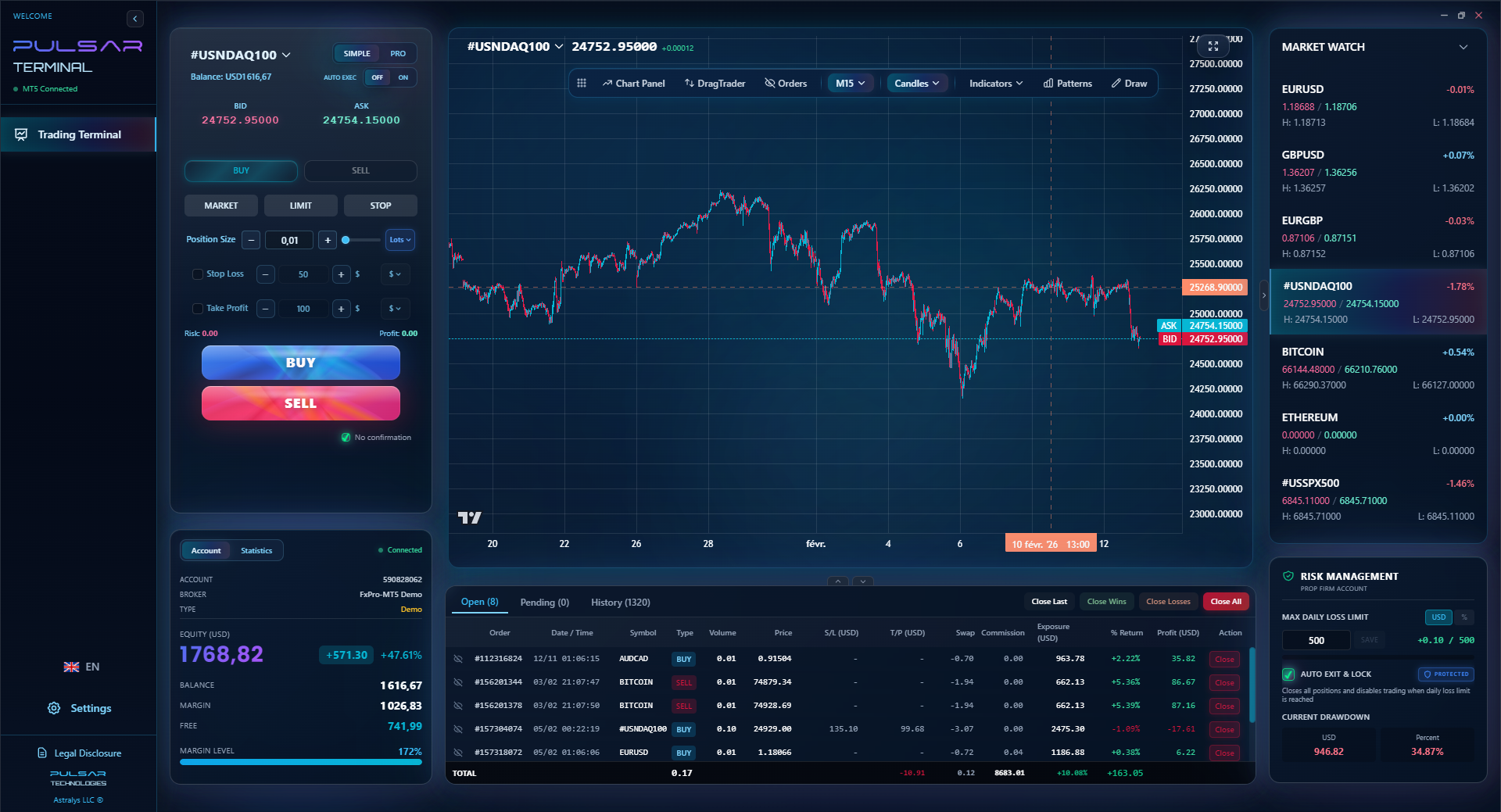
This is where third-party tools become almost essential. Having a platform that can manage complex order types, auto-move stops to breakeven, and visually track your daily loss limit against your equity in real-time is a massive advantage. It turns a clunky professional system into a streamlined trading machine and helps you avoid simple, costly errors.
Managing Bulenox's strict daily loss and trailing drawdown rules manually is a huge risk; Pulsar Terminal can display these limits in real-time on your chart and alert you before you breach them.
Pulsar Terminal
The all-in-one MT5 companion: drag-and-drop orders, multi-TP/SL, trailing stop, grid trading, Volume Profile, and prop firm protection. Used by 1,000+ traders daily.
After 18 months, here's my unfiltered assessment.
The Pros (Why I Stayed):
- 100% First $10k: This is huge. It allows for meaningful, tax-paid growth early on.
- Clear, Consistent Rules: Once you learn them, they don't change mid-game. No gotchas on payouts if you follow the guide.
- Futures-Only Focus: They understand the product. Support, while slow, knows what an ES contract is.
- No Minimum Trading Days for Eval: You can pass quickly if you're good and aggressive (though I don't recommend this).
The Cons (The Frustrations):
- The Fee Stack: The eval fee + data fee + platform fee (if you use Sierra) adds up. It feels like death by a thousand cuts. You're always paying for something.
- Rithmic or Nothing: I dislike being locked into one data/trade routing provider, even if it's a good one.
- Manual Tracking: Tracking your daily loss, max drawdown, and payout eligibility is all on you. In 2024, this feels archaic. A simple dashboard would be a game-changer.
- Reset Pricing: $78 for a reset feels punitive, especially when your subscription just lapsed.
The Ugly Truth: Bulenox, like all prop firms, makes most of its money from traders who fail the evaluation or blow their first funded account. The model is sustainable because discipline is rare. My first two fails funded someone else's payout. That's the deal. You are not the customer. You are the product being tested. Only the consistently profitable become the real customer.
💡 Winston's Tip
Your first goal in a funded account isn't a payout. It's to grow your balance past the 'safety threshold' reserve. That's your new zero. Only trade with the profits above that line.
“It made me a better trader by forcing mechanical discipline.”
Bulenox is a good fit for:
- Disciplined Futures Traders: You already have a proven, rule-based strategy for ES, NQ, CL, etc. You know what a pip in bonds is worth.
- Traders with Small Capital: You have $300-$500 for fees but not $50k for a futures account. This is use.
- US-Based Traders: The tax documentation (1099) is straightforward for US citizens.
- Traders Who Can Handle Pressure: The daily loss limit is a psychological wall.
Look elsewhere if:
- You're a forex or stock trader. Just go to a regular broker.
- You're a beginner. You will lose your fee money. Period. Practice with a simulator first.
- You hate manual admin. If tracking rules and calculating drawdowns sounds tedious, this will burn you.
- You need hand-holding. Their support is functional, not educational.
- You're looking for a 'get rich quick' scheme. This will expose that mentality and take your money.
For me, it was a bridge. It provided the capital to scale a futures scalping strategy I had proven on a small personal account. But it demanded a level of operational discipline I didn't know I lacked until I failed.
Is the Bulenox prop firm worth it? Yes, but with massive caveats.
It's worth it only if you treat it as a serious capital acquisition business. You need a business plan: 'I will spend max $XXX on fees. My strategy has a historical max drawdown under 3%. I will trade 0.5 lots max until I'm consistently past the safety threshold.'
Don't view the fee as a ticket to a casino. View it as an audition fee for a high-paying job. Most auditions fail.
How does it stack up? Compared to other futures prop firms, Bulenox is middle-of-the-pack. Their 100% first $10k is a standout perk. Their fee structure is average. Their platform lock-in is a downside. Some competitors offer more flexible platforms or different drawdown rules (like end-of-day only). You should shop around.
My final take: Bulenox is a legitimate firm that pays out as promised. But it is a harsh, efficient filter. It made me a better trader by forcing mechanical discipline. It also took $525 of my money in failed attempts before I finally listened to my own rules. The capital access is real, but the price of admission is more than money. It's your ego, your patience, and your willingness to be tested. If you have a solid edge and the mental fortitude to follow rules under fire, it can be a powerful tool. If you're still searching for an edge, save your cash. The market will be here when you're ready.
FAQ
Q1Is Bulenox regulated?
Bulenox is incorporated in Delaware, USA, but it is not regulated by the SEC or CFTC as a traditional broker. They operate as a proprietary trading firm where you trade their capital as an independent contractor. They issue 1099 tax forms for US traders.
Q2What's the catch with the 100% profit split?
The catch is it only applies to the first $10,000 of cumulative profit across your entire time with that funded account. After you've withdrawn that $10k, the split becomes 90/10. Also, you must meet all other rules (consistency, safety threshold) to withdraw it.
Q3Can I trade micro futures contracts with Bulenox?
Yes, you can trade micros (like MES, MNQ). This is a smart way to manage risk, especially when starting your evaluation. Trading one or two micro contracts helps you stay far away from that punishing daily loss limit while you find your groove.
Q4What happens if I hit the daily loss limit?
Your evaluation or funded account is terminated immediately and automatically. There is no warning. This is the most common reason for failure. You must track this limit yourself; the platform won't stop you from placing a trade that would exceed it.
Q5How often does Bulenox pay out?
You can request a payout once per week, provided you have met the minimum profit amount ($1,000 for most accounts), the 10 minimum trading days for your first payout, and the consistency/safety threshold rules. Payouts via ACH typically take 2-4 business days.
Q6Is the data feed fee mandatory?
Yes. The $116 monthly fee for the Rithmic data feed is required to get real-time price data and execute trades. You cannot trade a Bulenox account without paying for and using their designated data feed.
Q7What's the difference between the monthly fee and the one-time activation fee?
The monthly fee ($175 for a $50k eval) is for the evaluation phase. Once you pass, you upgrade to a Master Account. Here, you choose: pay a one-time activation fee (e.g., $173) to own the account forever, or keep paying the monthly fee. The one-time fee is almost always cheaper if you plan to trade for more than a month.
Prof. Winston's Lesson
Key Takeaways:
- ✓The daily loss limit is the #1 account killer.
- ✓Total upfront cost for a $50k account can exceed $600.
- ✓100% profit on first $10k is a major advantage.
- ✓Manual rule tracking is a significant operational risk.
How useful was this article?
Click a star to rate
Weekly Trading Insights
Free weekly analysis & strategies. No spam.
About the Author
James Mitchell
Senior Trading Analyst
Based in New York with over 9 years of trading experience. Focuses on major USD pairs, prop firm challenges, and the US regulatory landscape.
Comments
Risk Disclaimer
Trading financial instruments carries significant risk and may not be suitable for all investors. Past performance does not guarantee future results. This content is for educational purposes only and should not be considered investment advice. Always conduct your own research before trading.
You Might Also Like

Cara Trading Forex Sukses: 7 Prinsip dari Trader Profesional
Cara trading forex sukses dengan 7 prinsip trader pro: manajemen modal, disiplin, journal trading, backtest. Data nyata, bukan janji profit palsu.
Jam Trading Forex Terbaik untuk Trader Indonesia: Panduan Lengkap dengan Tabel Waktu
Panduan jam trading forex untuk trader Indonesia. Tabel 4 sesi dunia, jam emas 20:00-00:00, sesi mana yang harus dihindari. Data akurat + tips dari trader berpengalaman.
Top 5 Sàn Forex Uy Tín Nhất 2026: Review Jujur dari Trader Indonesia
Top 5 sàn forex uy tín 2026 untuk trader Indonesia. Review jujur: spread, deposit, withdraw, dukungan lokal. Exness, XM, IC Markets & lebih.
Get Pulsar Terminal
All these calculators are built into Pulsar Terminal with real-time data from your MT5 account. One-click position sizing, automatic risk management, and instant calculations.
Get Pulsar Terminal