


Most traders in India think complex options strategies are a shortcut to riches.

Rajesh Sharma
Senior Forex Analyst ·  India
India
☕ 12 min read
What you'll learn:
- 1What Exactly Is a Butterfly Options Strategy?
- 2Why Use This Strategy in the Indian Market?
- 3Step-by-Step: Setting Up a Nifty Butterfly Trade
- 4The #1 Reason Butterfly Traders Blow Up: Misunderstanding Risk
- 5Brokerage, Taxes & SEBI Rules: The Real Cost of Trading
- 6Practical Tips for Consistent Execution
- 7What to Do When the Market Won't Sit Still
Most traders in India think complex options strategies are a shortcut to riches. They see a butterfly spread's pretty profit/loss diagram and imagine easy money from sideways markets. I'm here to tell you that's a dangerous fantasy. The butterfly trading strategy is a precision tool, not a blunt instrument. It's about grinding out small, consistent wins in low-volatility environments while managing a dozen ways you can lose. Let's strip away the theory and look at how this strategy actually works on Nifty, with real numbers, under SEBI's tightening regulations.
Forget the textbook definitions. In practice, a butterfly is a bet that the underlying asset (like Nifty 50) will expire at a very specific price at a very specific time. It's not a bet on direction. It's a bet on stagnation.
You construct it using three strike prices, all with the same expiration date. The most common is the long call butterfly:
- Buy 1 ITM (In-The-Money) or ATM (At-The-Money) call option. (Lower strike)
- Sell 2 ATM call options. (Middle strike)
- Buy 1 OTM (Out-of-The-Money) call option. (Higher strike)
All calls. Same expiry. The sold options in the middle finance the ones you buy on the wings. Your max risk is the net premium you pay to enter the trade. Your max profit is locked in if the stock or index closes exactly at the middle strike price at expiry.

Example: Let's say Nifty is at 22,000.
- Buy 1 lot of 21,800 CE for ₹250
- Sell 2 lots of 22,000 CE for ₹150 each (₹300 total)
- Buy 1 lot of 22,200 CE for ₹70 Net Premium Paid = (250 + 70) - 300 = ₹20. This ₹20 per share (₹1,500 per standard lot) is your maximum loss. Your maximum profit occurs if Nifty expires at 22,000. The profit would be the difference between strikes (200 points) minus your net premium (20 points) = 180 points, or ₹13,500 per lot.
The strategy has a 'body' (the sold options) and 'wings' (the bought options), hence the name. There's also a put butterfly, which works on the same principle but with put options. The logic is identical: you want price to pin at the middle strike.
The real skill isn't in drawing the payoff. It's in identifying markets that are likely to go nowhere fast, and timing your entry when options are priced in a way that makes the setup cheap. This is where most retail traders mess up - they put on a butterfly when volatility is about to explode.

💡 Winston's Tip
The market's favorite trick is to hover near your middle strike all week, then sprint away in the final 90 minutes. If you're not out by 2:30 PM on expiry day, you're gambling, not trading.
The Indian equity derivatives market has a unique personality. It's retail-driven, loves weekly expiries, and can be incredibly news-sensitive. In this chaos, the butterfly offers a semblance of control.
First, it's a defined-risk play. Before you enter, you know the exact worst-case scenario. In a market where gaps up or down on opening are common, knowing your maximum loss is a psychological lifesaver. You can use a position size calculator to ensure that loss is a tiny fraction of your capital.
Second, it's capital efficient in theory. Because you're selling options to fund buying others, the margin required is often lower than for a naked short position. However, SEBI's new rules have tightened this. The 2025 mandate for 100% upfront premium payment for option buyers means you need the cash to pay for those long wings immediately. This has increased the capital commitment for strategies like butterflies.
Third, it profits from time decay (theta) and falling volatility (vega). The sold options at the middle strike decay faster than the bought options on the wings, especially in the final week before expiry. If implied volatility drops after you enter, the value of your entire position can rise.
I used this in April 2024 ahead of a major earnings week. Nifty had just had a big run-up and IV was elevated. I put on a call butterfly expecting consolidation. The earnings came in mixed, the index chopped around, and IV collapsed. I made about ₹9,200 on a ₹18,000 risk capital. Not a home run, but a solid 50% return on capital at risk in 10 days. The key was entering when volatility was high and expected to fall.

Warning: The biggest trap is using butterflies for swing trading a directional view. If you're bullish, just buy a call. A butterfly will cap your upside and likely lose money if the market trends strongly. It is purely a range-bound, low-volatility play.
“The butterfly trading strategy is a precision tool, not a blunt instrument. It's about grinding out small, consistent wins.”
Let's walk through a real setup on a platform like Zerodha or Upstox. I'm using Nifty, but the same applies to liquid stocks like Reliance or ICICI Bank.
Choosing the Strikes and Expiry
- Identify the Pin Point: Where is the market likely to get stuck? Look at major support/resistance, round numbers (like 22,000), or the current price if it's been oscillating. This is your middle strike.
- Set the Wings: The distance between strikes defines your risk/reward. A 200-point wide butterfly (e.g., 21,800/22,000/22,200) is common for Nifty. Wider wings = higher max profit but higher net premium (cost). Narrower wings = cheaper but smaller profit zone.
- Pick the Expiry: Weekly expiries are popular, but beware of gamma risk (price sensitivity) in the final days. I prefer monthly expiries, giving the market more time to stagnate. Remember, SEBI now allows weekly expiries on only one index per exchange (Nifty 50 on NSE), which has concentrated liquidity - a good thing for us.
Placing the Order
You don't place three separate orders. You place it as a strategy order or a spread order. On your broker's platform:
- Select 'NIFTY', the expiry date, and 'Call'.
- Choose the strategy builder and select 'Butterfly'.
- Input the three strike prices and quantities (1, -2, 1).
- The platform will show you the net premium (debit). This is what you pay.
Check the margin requirement. With the new upfront premium rule, you must have the cash to cover the cost of the long options immediately. The margin for the short options will be blocked separately.
The Entry Trigger
Don't just enter randomly. Wait for a confirmed range. Use technical indicators like Bollinger Band squeeze or low readings on the RSI indicator or MACD indicator hovering around zero. Enter when the market is in the middle of its recent range, not at the edge.
Here's the brutal truth: a butterfly's risk is limited, but the probability of losing that entire amount is often higher than the probability of max profit. The profit zone is a narrow pin, while loss zones are wide.
Common Fatal Mistakes:
- Over-leveraging: 'My max loss is only ₹5,000!' says the trader, who then puts on 20 contracts. A ₹100,000 loss is still a disaster. Your position size must be a fraction of your capital, even with defined risk. A 1-2% max loss per trade rule is essential.
- Ignoring Early Exit Signals: The butterfly is not a 'set and forget until expiry' trade. If the market starts trending away from your middle strike, your position loses value rapidly. You must have a plan to cut losses early, often at 1.5x to 2x your net premium paid.
- Forgetting About Gamma: In the final 2-3 days before expiry, the price sensitivity (gamma) of the short options explodes. A small move can cause massive P&L swings. Many traders see a small profit and hold for expiry, only to see a last-hour rally wipe them out. Consider exiting before the final day's madness.
- Botching the Roll: If the trade moves against you, some try to 'roll' it to a further expiry or different strikes. This often just compounds losses. It's usually better to take the small, defined loss and wait for a new setup.
I learned this the hard way in 2023. I had a beautiful 22,500 Nifty butterfly (22,400/22,500/22,600) 7 days out. Nifty was pinned at 22,510. On expiry day, it drifted to 22,490 by 2:30 PM. I was greedy, held for max profit. A sudden 30-point spike in the last 30 minutes took it to 22,520. My max profit trade turned into a 90% loss of my premium. I broke my own rule about exiting before the final hour. That ₹7,000 lesson was cheap for the humility it taught me.
Managing these multi-leg positions manually on expiry day is stressful. This is where a tool that lets you set a hard stop or automate partial exits for the entire strategy becomes useful, preventing emotional decisions.
💡 Winston's Tip
Your broker's 'theoretical' P&L is a lie. It doesn't include STT, brokerage, and GST. Deduct 15-20% from your screen profit to estimate your real, bank-account profit.
“A butterfly's risk is limited, but the probability of losing that entire amount is often higher than the probability of max profit.”
Your profit calculation is useless if you don't factor in costs. In India, they add up fast and have changed recently.
The Cost Breakdown (Per Lot, Approx.):
| Cost Component | Approximate Charge | Notes |
|---|---|---|
| Brokerage | ₹20 per executed order | Flat fee on many discount brokers. For a 4-leg butterfly, that's 4 orders = ₹80. |
| STT | 0.15% of sell-side premium | NEW (2026): Increased from 0.05%. Paid when you sell options. On a butterfly, you pay STT on the two options you sell. |
| Exchange Charges | ~₹0.01 per crore + GST | On the premium value. Small but exists. |
| GST | 18% | Applied on brokerage + exchange charges. |
| SEBI Charges | ₹10 per crore | Tiny. |
| Stamp Duty | Varies by state | Usually a small fixed amount. |
The Regulatory Game-Changers:
- Upfront Premium (2025): You need the cash to pay for long options upfront. This reduces use and increases capital needed. No more using just margin for the entire spread.
- No Calendar Spread Benefit on Expiry Day (2025): If your butterfly expires, you don't get margin relief. Full margins apply, which can tie up capital.
- Increased Contract Size (2024): Nifty lot size is larger. Your per-point value is higher, so profits and losses are magnified. A 200-point wide butterfly now controls more capital.
- ELM on Expiry Day (2024): An extra 2% Extreme Loss Margin on short options expiring that day. Another capital consideration.
These rules, from brokers like Zerodha or IC Markets, are designed to curb speculation. For the disciplined butterfly trader, they're a nuisance. For the reckless, they're a barrier. You must calculate your break-even including all costs. That ₹20 net premium trade might need a ₹25 move just to cover fees.
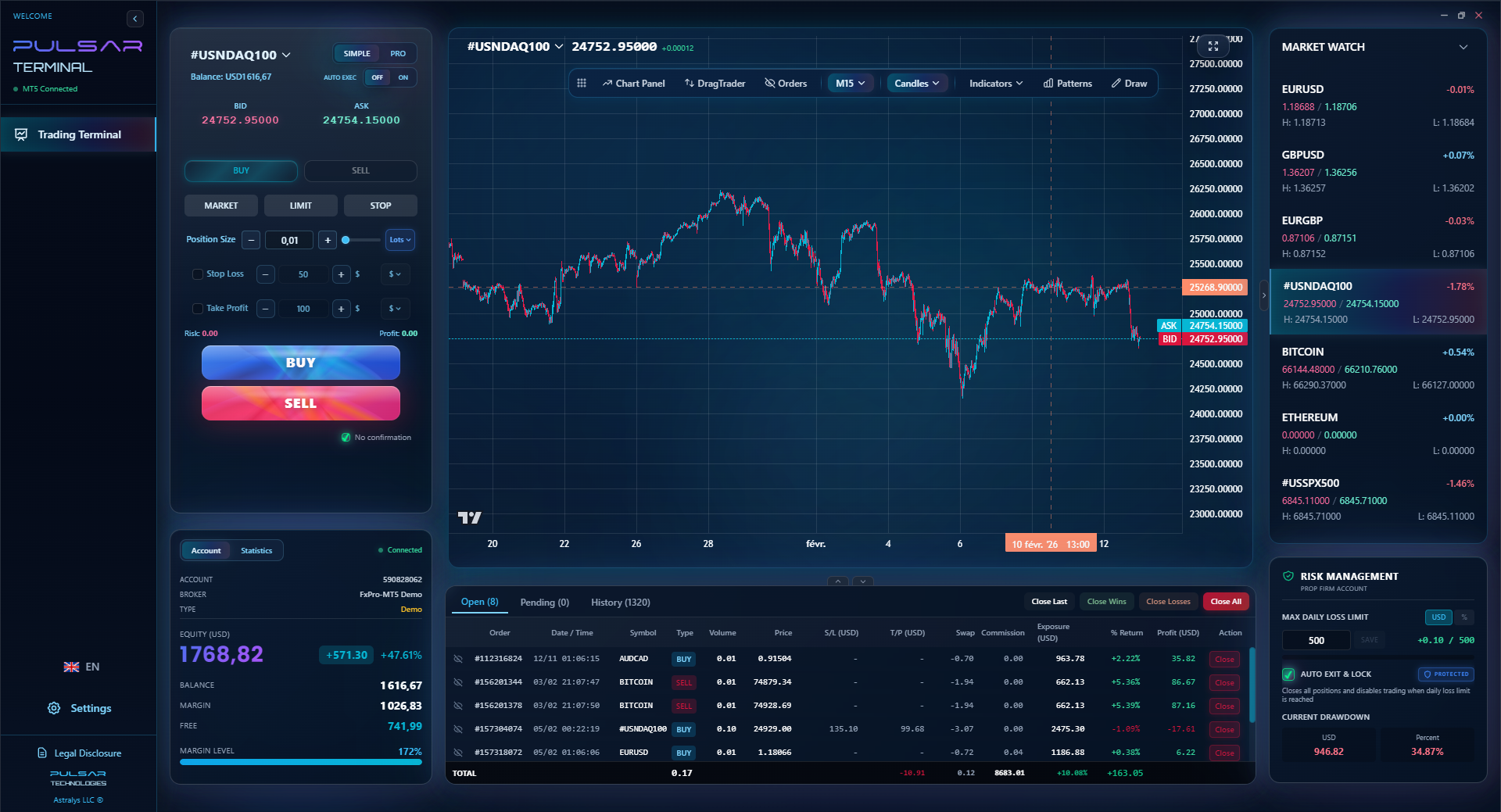
Managing the complex exit rules and stop losses for a multi-leg butterfly is stressful; Pulsar Terminal lets you set a single stop or take-profit for the entire strategy directly on your MT5 chart, automating your risk plan.
Pulsar Terminal
The all-in-one MT5 companion: drag-and-drop orders, multi-TP/SL, trailing stop, grid trading, Volume Profile, and prop firm protection. Used by 1,000+ traders daily.

Pro Tip: Paper trade this strategy for at least 3 months. Track every detail: entry rationale, strikes, expiry, premium paid, exit price, and P&L after all costs. You'll quickly see how often the market actually pins.
- Trade the Monthly, Not the Weekly: While weeklies are tempting, the gamma risk is insane. Monthly expiries give you more time for theta decay to work and reduce the impact of a single news-driven spike. The new SEBI rule limiting weekly expiries to one index helps, but monthlies are still safer.
- Use a Probability Calculator: Most broker platforms have them. Before entering, check the probability of the underlying expiring within your profit zone. If it's below 30%, the odds are stacked against you.
- Leg Into the Trade: Instead of entering the full butterfly at once, consider building it. You might sell the two middle calls first when volatility is high, then buy the wings later if the market moves. This requires skill but can improve your entry price.
- Have a Clear Exit Plan:
- Profit Target: Exit at 50-70% of max profit. Don't be greedy.
- Stop Loss: If the underlying price moves beyond a key support/resistance level away from your middle strike, exit. This is often a better signal than a fixed rupee stop.
- Time Stop: If the trade hasn't moved in your favor with 5 days to expiry, consider exiting to free up capital.
- Keep a Trading Journal: Note why you chose the strikes. Was it a technical level? An expected volatility drop? Reviewing your journal is how you learn what works in the Indian context.
Remember, this isn't a get-rich-quick scheme. It's a grind. In a good year, you might aim for a 60-70% win rate, but your average winner will be smaller than your average loser. The math only works if you keep losses very small and cut them quickly.
“In India's market, the real skill isn't in drawing the payoff diagram. It's in identifying when volatility is priced high and about to collapse.”
The butterfly strategy fails in trending or high-volatility markets. If you're constantly getting stopped out, the market is telling you something. Switch gears.
Alternative Neutral Strategies:
- Iron Condor: Similar to a butterfly but with two profit zones (above and below). You sell an OTM call spread and an OTM put spread. It profits from a wider range but has lower max profit. It's like two butterflies back-to-back.
- Calendar Spread: Buy a longer-dated option and sell a shorter-dated option at the same strike. You profit from the faster time decay of the short option. This can work when you have a mild directional bias or expect a volatility increase later.
When to Abandon Neutrality: If VIX is spiking and Nifty is making big daily moves, neutral spreads will bleed. This is the time for directional plays or, better yet, sitting in cash. Forcing a butterfly in a trending market is a surefire way to donate your capital to the market.
Sometimes, the best trade is no trade. I've had months where I didn't place a single butterfly because Nifty was in a clear, volatile uptrend. I switched to simple scalping or just watched. Preserving capital for the right setup is a skill in itself.
, the butterfly trading strategy is a specialist's tool. It requires patience, discipline, and a deep understanding of options greeks. In India's evolving regulatory landscape, it also requires adapting to higher costs and capital requirements. Master it not to become a millionaire overnight, but to add a reliable, low-stress income stream to your trading toolkit for those times when the market decides to take a nap.
FAQ
Q1Is the butterfly strategy suitable for beginners in India?
Frankly, no. It's an intermediate-to-advanced strategy. Beginners should master buying calls/puts and understanding basic spreads first. The butterfly involves multiple legs, sensitivity to time and volatility, and precise exit timing. Start with paper trading to understand its behavior without risking real money.
Q2What is the minimum capital required to trade a butterfly strategy?
There's no fixed minimum, but you need enough to cover the net premium paid for the spread plus all brokerage and taxes. With SEBI's 2025 upfront premium rule, you need the cash for the long options immediately. For a 200-point Nifty butterfly, the net premium could be ₹1,500-₹4,000 per lot. With margin for the short legs and multiple lots, a comfortable starting point is at least ₹50,000-₹1,00,000 dedicated to this strategy alone.
Q3How do I choose the best strike prices for a Nifty butterfly?
The middle strike should be at a key level where you believe Nifty will expire - often a major psychological level (like 22,000) or a strong support/resistance zone. The wing distance (e.g., 100 or 200 points) defines your risk/reward. Wider wings = higher potential profit but higher cost. Use a probability calculator on your broker's platform to see the chance of expiring within your profit zone before placing the trade.
Q4Can I lose more money than the premium I paid?
No. A long butterfly (where you pay a net premium) is a defined-risk strategy. The maximum loss is limited to the total net premium you paid to enter the trade, plus transaction costs. This is its key safety feature. However, you can lose 100% of that premium if the market moves too far away from your middle strike.
Q5How have SEBI's new rules impacted butterfly trading?
Significantly. The 100% upfront premium payment for option buyers (2025) increases the capital needed. The removal of calendar spread benefits on expiry day affects margin. The increased STT (2026) eats into profits. The larger contract sizes (2024) magnify gains and losses. Traders must now be more capital-efficient and precise, as the cost of errors and the capital commitment are both higher.
Q6Should I hold a butterfly trade until expiry?
Rarely. The risk of a last-minute price move (gamma risk) is very high. It's often better to take profits when you've achieved 50-70% of the maximum potential profit, or exit with 3-5 days remaining if the trade isn't working. Holding to expiry for max profit is greedy and exposes you to unnecessary pin risk.
Q7What is the difference between a call butterfly and a put butterfly?
The profit/loss diagram is identical. A call butterfly uses call options at three strikes. A put butterfly uses put options at three strikes. The choice often comes down to liquidity (which options are more heavily traded) and the net premium cost. For the same strikes and expiry, they should theoretically cost the same, but bid-ask spreads can create slight differences.
Prof. Winston's Lesson
Key Takeaways:
- ✓Max profit requires a perfect pin at expiry; max loss only requires the market to move.
- ✓SEBI's upfront premium rule means you need more cash, not just margin.
- ✓Exit at 50-70% of max profit. Greed turns winners into losers.
- ✓A ₹5,000 max loss on 20 lots is still a ₹100,000 disaster.
How useful was this article?
Click a star to rate
Weekly Trading Insights
Free weekly analysis & strategies. No spam.
About the Author
Rajesh Sharma
Senior Forex Analyst
Trading Indian and South Asian markets for over 10 years. Started with NSE currency derivatives before moving to international forex. Specializes in USD/INR and emerging market pairs.
Comments
Risk Disclaimer
Trading financial instruments carries significant risk and may not be suitable for all investors. Past performance does not guarantee future results. This content is for educational purposes only and should not be considered investment advice. Always conduct your own research before trading.
You Might Also Like

Cara Trading Forex Sukses: 7 Prinsip dari Trader Profesional
Cara trading forex sukses dengan 7 prinsip trader pro: manajemen modal, disiplin, journal trading, backtest. Data nyata, bukan janji profit palsu.
Jam Trading Forex Terbaik untuk Trader Indonesia: Panduan Lengkap dengan Tabel Waktu
Panduan jam trading forex untuk trader Indonesia. Tabel 4 sesi dunia, jam emas 20:00-00:00, sesi mana yang harus dihindari. Data akurat + tips dari trader berpengalaman.
Top 5 Sàn Forex Uy Tín Nhất 2026: Review Jujur dari Trader Indonesia
Top 5 sàn forex uy tín 2026 untuk trader Indonesia. Review jujur: spread, deposit, withdraw, dukungan lokal. Exness, XM, IC Markets & lebih.
Get Pulsar Terminal
All these calculators are built into Pulsar Terminal with real-time data from your MT5 account. One-click position sizing, automatic risk management, and instant calculations.
Get Pulsar Terminal