


I remember staring at my screen in late 2022, watching USD/ZAR tick up past 18.50.

David van der Merwe
Emerging Markets Trader ·  South Africa
☕ 9 min read
What you'll learn:
I remember staring at my screen in late 2022, watching USD/ZAR tick up past 18.50. My gut said 'sell the dollar, it's too high,' but my charts told a different story. I hesitated, missed the entry, and watched it run another 200 pips without me. That moment taught me that deciding to buy or sell forex isn't about gut feelings - it's about having a clear, repeatable process. For us trading in South Africa, with our unique ZAR pairs and FSCA rules, that process needs some local flavour. Let's break down how to make those decisions with confidence.
Right, let's clear this up first, because I've seen too many new traders get tripped up. When you 'buy' a currency pair, you're buying the first currency and selling the second. If you buy EUR/USD, you're betting the euro will strengthen against the dollar. Simple.
When you 'sell,' you're doing the opposite. You sell the first currency and buy the second. Selling USD/ZAR means you think the US dollar will weaken against our rand. You're going short the dollar, long the rand.
Here's the local twist that catches people: with ZAR pairs, the rand is usually the second currency (the quote currency). So USD/ZAR, EUR/ZAR, GBP/ZAR. When economic news hits that's bad for South Africa - like load-shedding warnings or political uncertainty - these pairs typically go UP. Why? Because it takes more rands to buy one dollar, euro, or pound. Selling ZAR pairs during risk-off periods is often the right move.

Example: Let's say USD/ZAR is trading at 18.7500 / 18.7520 (a 2 pip spread). If you think the rand will strengthen, you'd SELL at 18.7500. If it drops to 18.7000, you've made 500 pips. Remember, a pip for most ZAR pairs is 0.0001, but always double-check your broker's pip definition.
The first rule? Know which currency you're actually betting on. Confusion here leads to taking the exact opposite trade you intended.

💡 Winston's Tip
The market's job is to make you feel wrong. Your job is to have a plan so solid that your feelings become irrelevant.
“Deciding to buy or sell forex isn't about gut feelings - it's about having a clear, repeatable process.”
Trading EUR/USD from Cape Town is one thing. Trading USD/ZAR is another game entirely. The rand is what we call a 'risk-sensitive' or 'emerging market' currency. It doesn't always follow the textbook rules.
What Moves the Rand?
Forget just watching the US Fed. You need a local news feed. The big drivers are:
- Eskom and Load-Shedding Stages: Seriously, I've made and lost money based on the Eskom forecast. A jump to Stage 6 can send USD/ZAR spiking 50 pips in minutes.
- SARB Interest Rate Decisions: The South African Reserve Bank's MPC meetings are huge. A hawkish hold (keeping rates high) can boost the rand. I once caught a 300-pip move on USD/ZAR when the SARB surprised the market by hiking 50bps instead of 25.
- Political Climate and SA Credit Ratings: Downgrade whispers cause volatility.
- Commodity Prices: We're a resource economy. Strong platinum, gold, and coal prices often support the ZAR. You can sometimes find a correlation between XAU/USD (gold) and USD/ZAR (they can move inversely).
A Lesson in Local Liquidity
Here's a practical mistake I made so you don't have to. I tried scalping USD/ZAR during the Asian session (late night our time). The spreads from my broker, which were fine during London open, widened from 3 pips to 15 pips. I got filled on a 'buy' order at a terrible price and was immediately in the red. The liquidity just wasn't there. Trade major ZAR pairs when London or New York is open for tighter spreads and better fills.
Using a broker with a strong local presence like Exness or XM, which are popular here, can help with ZAR account funding, but always check their specific spreads on our local pairs during your trading hours.
“Trading your 'home' currency can be tempting, but the wider spreads and sensitivity to local news make it a more volatile environment.”
You need a checklist. Without one, emotion takes over. My framework has three layers: Trend, Signal, and Trigger.
1. The Trend (The Big Picture) Are we in an uptrend, downtrend, or range? Don't fight the trend. For USD/ZAR, I use the daily chart and a simple 50-period and 200-period Exponential Moving Average (EMA). If price is above both, the trend is up - look for buys on pullbacks. Below both? Look for sells on rallies. This alone keeps you on the right side of major moves.
2. The Signal (The Confluence) This is where you get your 'maybe.' I look for at least two things agreeing:
- Price Action: Is it at a key support or resistance level? A previous swing high/low?
- Indicator Confluence: My go-to is the RSI indicator showing divergence (price makes a new high, RSI doesn't) or the MACD indicator crossing its signal line. Don't use ten indicators. Master two or three.
- News Catalyst: Is there a SARB speech or US jobs data due that could be the catalyst?
3. The Trigger (The Entry) This is the 'go' moment. A signal says 'be ready to sell.' The trigger tells you 'sell NOW.' My trigger is usually a candlestick pattern on a lower time frame (like the 1-hour chart). A bearish engulfing bar at resistance after a rally? That's my trigger to execute a sell order.

Warning: Never let a 'signal' become a 'trigger' just because you're impatient. Wait for the price to confirm your hypothesis. I've blown trades by jumping in early, watching the price briefly go my way, then reverse and hit my stop-loss - only to then see my perfect trigger form. It's brutal.
“The skill isn't in predicting the market; it's in waiting for the market to show its hand.”
This is non-negotiable, especially under South African rules. The FSCA's 30:1 use cap for retail traders isn't there to spoil your fun. It's a life-saver. I used to dream of 500:1 use from offshore brokers. Thank goodness I never had easy access to it. I would have blown my account years ago.
The Golden Rule: Risk 1-2% Per Trade Not per day. Per trade. If you have a R10,000 account, your maximum risk on any single trade should be R100 to R200. This is where a position size calculator becomes your best friend.
Let's do a real example from last month. I wanted to sell EUR/ZAR at 20.1000, with a stop-loss at 20.1500. That's a 500 pip risk. My account was R15,000, and I risk 1.5% per trade (R225).
Position Size = (Account Risk in Rands) / (Risk in Pips * Pip Value) The pip value for EUR/ZAR on a standard lot (100,000 units) is roughly R10 (it fluctuates with the rate). So, R225 / (500 pips * ~R10) = 0.045 lots. I'd trade a 0.05 micro lot position. That keeps my loss limited to my plan, no matter how confident I feel.
Use Your Stops. Religiously. A stop-loss isn't a suggestion. It's an insurance policy. Setting a stop-loss 5 pips away from where you think it should be because you're scared of being 'stopped out' is a recipe for a margin call. Place it at a level that, if hit, proves your trade idea was wrong. Then walk away.
Brokers like IC Markets and Pepperstone offer good execution on stops, which is crucial for ZAR pairs that can gap on local news.
💡 Winston's Tip
A good trade is defined by its entry, stop, and target before you click 'buy' or 'sell.' If you don't know where you're getting out, you shouldn't be getting in.
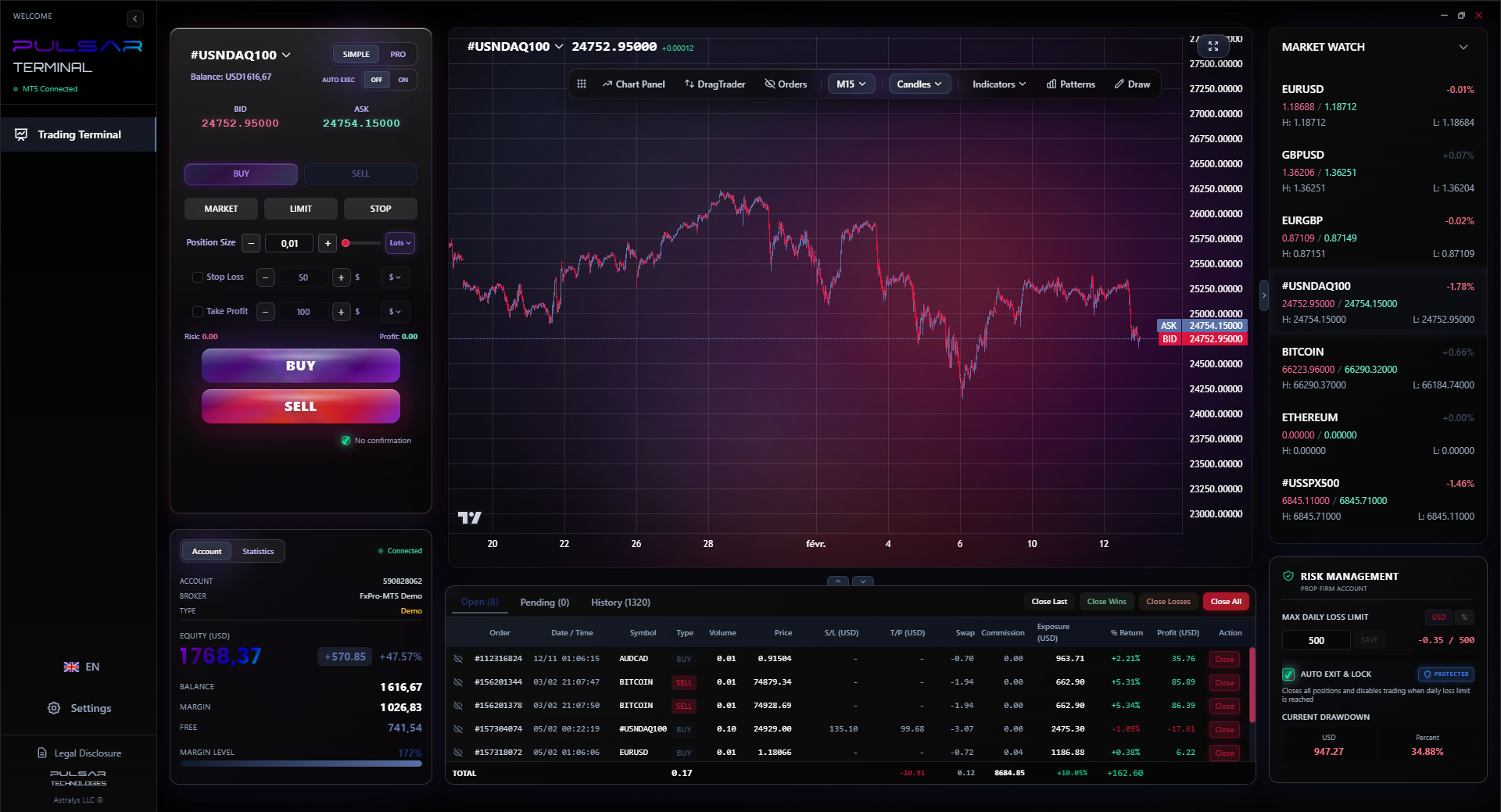
Managing multiple trades and precise stop-losses on volatile ZAR pairs is much easier with a tool like Pulsar Terminal, which lets you drag-and-drop orders and set multi-level take-profits directly on your MT5 charts.
Pulsar Terminal
The all-in-one MT5 companion: drag-and-drop orders, multi-TP/SL, trailing stop, grid trading, Volume Profile, and prop firm protection. Used by 1,000+ traders daily.
“The skill isn't in predicting the market; it's in waiting for the market to show its hand.”
Let's get honest about where we go wrong.
1. Revenge Trading After a Loss. You get stopped out on a USD/ZAR sell. You're furious. You immediately jump back in with a double-sized position to 'make it back fast.' This is how R5,000 losses become R10,000 losses in an hour. When you take a loss, shut the platform down. Go for a walk. The market will still be there tomorrow.
2. Ignoring the 'Spread' Cost. Trading USD/ZAR with a 5-pip spread? You're already down R50 on a micro lot the second you enter. You need the market to move 5 pips just to break even. This makes scalping very difficult on ZAR pairs. It's better suited for swing trading where you aim for 100+ pip moves. Always factor the spread definition into your risk calculation.
3. Over-trading During Low Volatility. The midday lull (after London open, before New York) can be deadly. Price chops around in a 20-pip range. You take two losing trades out of boredom. Wait for the market to wake up. Your patience is a weapon.
4. Letting a Winner Turn into a Loser. You're up 80 pips on a GBP/ZAR trade. Greed sets in. 'Let's go for 200!' You move your stop-loss to breakeven. The market reverses, hits your breakeven stop, and you make nothing on a great idea. Have a profit target and stick to it, or use a trailing stop to lock in profits.
“A stop-loss isn't a suggestion. It's an insurance policy placed at a level that proves your trade idea was wrong.”
Let's run through a recent trade I took, warts and all, to see the framework in action.
The Pair: USD/ZAR The Date: Early March 2024 The Context: USD had been strong globally. USD/ZAR was in a clear daily uptrend, trading above its 50 and 200 EMA. However, the SARB was meeting, and inflation data was sticky. There was talk of them staying hawkish.
My Process:
- Trend: Daily chart = Uptrend. Bias should be to BUY on dips.
- Signal: On the 4-hour chart, price pulled back to a key support zone at 18.8200 (a previous resistance-turned-support). The RSI indicator dipped near 40 (bullish in an uptrend) but didn't break into oversold. This was my 'maybe buy' signal.
- News: SARB decision the next day. Could be a catalyst.
- Trigger: I waited. Price bounced off 18.8200 and formed a bullish hammer candlestick on the 1-hour chart. That was my trigger. I entered a BUY order at 18.8350.
- Risk Management: Stop-loss placed below the support at 18.8050 (30 pip risk). My account was R20,000. Risking 1% = R200. Pip value ~R10. Position size = R200 / (30 pips * R10) = 0.66 lots. I traded 0.65 lots.
- The Outcome: The SARB held rates steady with a hawkish tone the next day. USD/ZAR rallied. I took half my position off at 19.0000 (+165 pips) and trailed a stop on the rest. The run eventually hit 19.1200 before pulling back. Final average gain: about 220 pips.
The key wasn't genius analysis. It was following the process: respecting the trend, waiting for confluence, getting a clear trigger, and sizing correctly. That's how you consistently decide to buy or sell forex.
FAQ
Q1Is forex trading legal in South Africa, and who regulates it?
Yes, it's completely legal. The main regulator is the Financial Sector Conduct Authority (FSCA). All legitimate brokers offering services to South Africans must be licensed by the FSCA. They enforce rules like the 30:1 use cap for retail clients and require client funds to be kept in segregated accounts for safety. Always check a broker's FSP number on the FSCA website before depositing.
Q2What's the best time of day to trade forex in South Africa?
The most active and liquid times are when the London and New York sessions overlap. That's from around 3:00 PM to 6:00 PM South African time. This is when you'll find the tightest spreads on major pairs like EUR/USD and decent liquidity on ZAR pairs. Avoid the middle of the night (Asian session) for ZAR pairs, as spreads can widen dramatically.
Q3How much money do I need to start trading forex in South Africa?
You can start with very little. Many FSCA-regulated brokers offer accounts with minimum deposits as low as R500 or even less. However, starting with a very small account is extremely challenging due to position sizing. Realistically, I'd suggest a minimum of R5,000 to R10,000. This allows you to risk small percentages per trade (1-2%) while still taking sensible position sizes without being wiped out by a few losses or the cost of the spread.
Q4Should I focus on ZAR pairs or major pairs like EUR/USD?
Start with the majors (EUR/USD, GBP/USD). They have much tighter spreads, more predictable liquidity, and endless free analysis available. Once you're consistently profitable there, you can explore ZAR pairs. Trading your 'home' currency can be tempting, but the wider spreads and sensitivity to local news make it a more volatile and challenging environment to learn in.
Q5What's the single most important skill for deciding to buy or sell?
Patience. The skill isn't in predicting the market; it's in waiting for the market to show its hand. Waiting for your specific setup, waiting for your trigger, waiting for the right risk/reward. Most losses come from forcing trades when the market is quiet or unclear. Being patient enough to only act when your framework gives a clear signal is what separates amateurs from professionals.
Q6How do I handle exchange control when funding my trading account?
This is crucial. Use an FSCA-licensed broker that offers ZAR-denominated accounts. You can then fund via local bank transfer (EFT) in rands, staying within your annual discretionary allowance (R1 million single, R10 million foreign investment with tax clearance). The broker handles the currency conversion. Never use unapproved channels or try to move money offshore yourself for trading - it violates SARB exchange controls and could get you into serious trouble.
Prof. Winston's Lesson
Key Takeaways:
- ✓Always identify the trend first; never fight it.
- ✓Risk a maximum of 1-2% of your capital per trade.
- ✓Wait for a clear price action trigger before entering.
- ✓Factor the spread cost into every trade, especially on ZAR pairs.
- ✓Patience is a more valuable skill than prediction.
How useful was this article?
Click a star to rate
Weekly Trading Insights
Free weekly analysis & strategies. No spam.
About the Author
David van der Merwe
Emerging Markets Trader
Johannesburg-based trader with 11 years in emerging market currencies. Specializes in ZAR pairs, FSCA-regulated trading, and South African market analysis.
Comments
Risk Disclaimer
Trading financial instruments carries significant risk and may not be suitable for all investors. Past performance does not guarantee future results. This content is for educational purposes only and should not be considered investment advice. Always conduct your own research before trading.
You Might Also Like

Cara Trading Forex Sukses: 7 Prinsip dari Trader Profesional
Cara trading forex sukses dengan 7 prinsip trader pro: manajemen modal, disiplin, journal trading, backtest. Data nyata, bukan janji profit palsu.
Jam Trading Forex Terbaik untuk Trader Indonesia: Panduan Lengkap dengan Tabel Waktu
Panduan jam trading forex untuk trader Indonesia. Tabel 4 sesi dunia, jam emas 20:00-00:00, sesi mana yang harus dihindari. Data akurat + tips dari trader berpengalaman.
Top 5 Sàn Forex Uy Tín Nhất 2026: Review Jujur dari Trader Indonesia
Top 5 sàn forex uy tín 2026 untuk trader Indonesia. Review jujur: spread, deposit, withdraw, dukungan lokal. Exness, XM, IC Markets & lebih.
Get Pulsar Terminal
All these calculators are built into Pulsar Terminal with real-time data from your MT5 account. One-click position sizing, automatic risk management, and instant calculations.
Get Pulsar Terminal