


I remember staring at my screen in 2015, watching the USD/ZAR spike to R14.45.

David van der Merwe
Emerging Markets Trader ·  South Africa
☕ 10 min read
What you'll learn:
I remember staring at my screen in 2015, watching the USD/ZAR spike to R14.45. The urge was electric. I wanted to call a friend in New York and just swap rands for dollars directly, cutting out the middleman. It felt like the smart move. That moment made me ask the same question you're asking now: can I trade forex without a broker? The short answer is no, not in the way you're thinking. But let's unpack what that really means for us trading from SA.
For retail traders like you and me, the direct answer is no, you cannot trade the forex market without a broker. The global foreign exchange market is an over-the-counter (OTC) market run by a network of banks and financial institutions. You, as an individual, don't have a seat at that table. A broker is your access pass. They provide the trading platform, the use, the connection to liquidity providers, and crucially, they handle the legal and regulatory framework that lets you place a bet on currency prices.
Think of it like trying to buy shares directly on the JSE without a stockbroker. It's just not how the system is built. The broker isn't just a website; they are a counterparty to your trade. When you click 'buy' on EUR/USD, you're not buying euros from the European Central Bank. You're entering a contract with your broker, who agrees to pay you the profit if the price moves in your favor. This is a fundamental point many new traders miss.
Trying to bypass this system usually leads to one of two places: unregulated, dangerous schemes or breaking the law. I learned this the hard way early on, chasing 'direct access' promises that were just fancy bucket shops.

💡 Winston's Tip
A broker is a tax on your ignorance. The less you know, the more you'll pay them in poor executions and hidden fees. Get smart, and they become a cheap utility.
When someone asks 'can I trade forex without a broker,' they're usually trying to avoid something: fees, regulation, or complexity. So let's look at the closest alternatives that exist.
Direct Currency Exchange
You can, of course, walk into a bank or use a service like Bidvest and exchange your rands for US dollars. This is a one-time purchase at the spot rate. It's not trading. You're now holding physical (or digital) currency, hoping its value appreciates against the rand. There's no use, no short-selling, and your profit potential is limited to the actual cash you've converted. I did this once with £2000, holding it for six months. After bank fees and the spread, I made less than if I'd just left the money in a decent savings account. It's a storage play, not an active trading strategy.
Contractual Agreements with Another Person
This is where it gets legally murky. You could theoretically make a private contract with someone overseas. You agree that if the EUR/USD rises, they pay you. This is creating an unregulated derivative contract. In South Africa, the Financial Sector Conduct Authority (FSCA) is very clear about what constitutes regulated financial services. Offering or facilitating these kinds of agreements without a license can land you in serious trouble. It also introduces massive counterparty risk - what if your friend in London just doesn't pay?

Warning: Private forex contracts are a grey area at best and illegal at worst. You have zero regulatory protection, and enforcing the contract would be a nightmare. I've seen two friendships end over handshake 'forex deals' gone wrong.
Prop Trading Firms
This is a legitimate alternative path, but it's not broker-free. Firms like FTMO or The5%ers give you capital to trade. You pass their challenge, and you get to trade a large account, splitting the profits. However, you're still trading through their chosen broker and platform. You're just not risking your own initial capital in the same way. The broker is still in the chain; you're just not directly depositing with them. It's a different risk model, not a broker-free model.
“The broker isn't just a website; they are a counterparty to your trade.”
If you try to go it alone, you're not just giving up a website. You're giving up the entire infrastructure that makes modern trading possible and (somewhat) safe.
| Function | What It Means For You |
|---|---|
| Liquidity Access | Brokers pool orders to get you prices from major banks. Alone, you get terrible rates. |
| use | Your R10,000 can control a R500,000 position. This power comes from the broker's margin system. |
| Regulatory Protection | FSCA-regulated brokers must keep client funds segregated. If they go bust, your money is (theoretically) safe. |
| Platform & Tools | MT4/5, charts, indicators, automated trading. Building this yourself is impossible. |
| Trade Execution | Your market/limit orders are routed and filled in milliseconds. |
The use point is critical. In 2018, I used a 1:500 use from a broker to make a quick R15,000 profit on a USD/ZAR move with only R3,000 of my own capital. That same move, using just my own cash in a direct exchange, would have netted me about R300. The broker provides the financial muscle.

Pro Tip: Don't see the broker as a fee-charging enemy. See them as a utility provider, like Eskom or the water board. You pay for a service you cannot realistically replicate. Your job is to choose a reliable, well-priced utility. Check out our deep dives on Exness review, IC Markets review, and XM review for SA-focused comparisons.
Let's talk numbers. The dream is to save on spreads and commissions. The reality is you'll likely lose more.
The Spread Kill: When you exchange money at a bank, the spread is huge. You might buy USD at R18.90 and sell it at R18.70 instantly - a 20-cent spread. In forex trading through a good broker, the spread on USD/ZAR might be 0.5 cents (50 pips). That's 40 times more expensive to use the bank.
Operational Nightmare: How do you short the rand if you think it's going to fall? You'd have to borrow rands, sell them, then buy them back later. This involves finding a lender, negotiating rates, and handling legal contracts. A broker lets you click 'sell' on USD/ZAR in under a second. The time and legal cost of setting up a direct short position would wipe out any potential profit on all but the largest moves.
Zero Safety Nets: No broker means no margin call warnings. You can just blow your entire stake in one go. While margin calls are painful, they are a circuit breaker that prevents a R10,000 loss from becoming a R100,000 debt if you're over-leveraged. In a private deal, your liability could be unlimited.
The biggest risk is fraud. The 'broker-less forex platforms' you might find online are almost always scams. They'll take your deposit, show you fake profits, and then vanish when you try to withdraw. At least with an FSCA-regulated entity, you have a formal channel for complaint.
💡 Winston's Tip
If you're trying to avoid a R50 commission, you're not thinking big enough. Focus on the R5,000 move, not the R50 fee. The broker's cost is the price of a ticket to the game.
“Trying to trade forex without a broker often means stepping outside the protected zone. You become an easy target.”
This is the non-negotiable part for us. The FSCA doesn't mess around. They classify forex trading with margin (which is all retail trading) as a financial product. Anybody providing that service needs a license. If you try to set up shop matching trades between people, you are providing a financial service and will need a Category 1 FSP license. The application process is long, expensive, and requires proof of capital, compliance officers, and audited processes.
For the individual trader, the regulation is your shield. It forces brokers to:
- Keep your money in separate trust accounts.
- Report their financial health.
- Have a dispute resolution process.
- Provide clear risk warnings.
Trying to trade forex without a broker often means stepping outside this protected zone. You become an easy target. I once put R5,000 into an unregulated 'direct market access' platform based in Cyprus. Withdrawing it took 3 months of daily emails and threats of legal action. I got 80% of it back, a lesson that cost me R1,000 and a lot of stress. A regulated broker has mandated timeframes for processing withdrawals.
Your best practical move is to use a reputable international broker that accepts South African clients and has a strong track record. Many of the top global brands operate here legally through their international entities. Focus on your scalping strategy or swing trading plan, not on architecting a broker-less system that will probably fail.
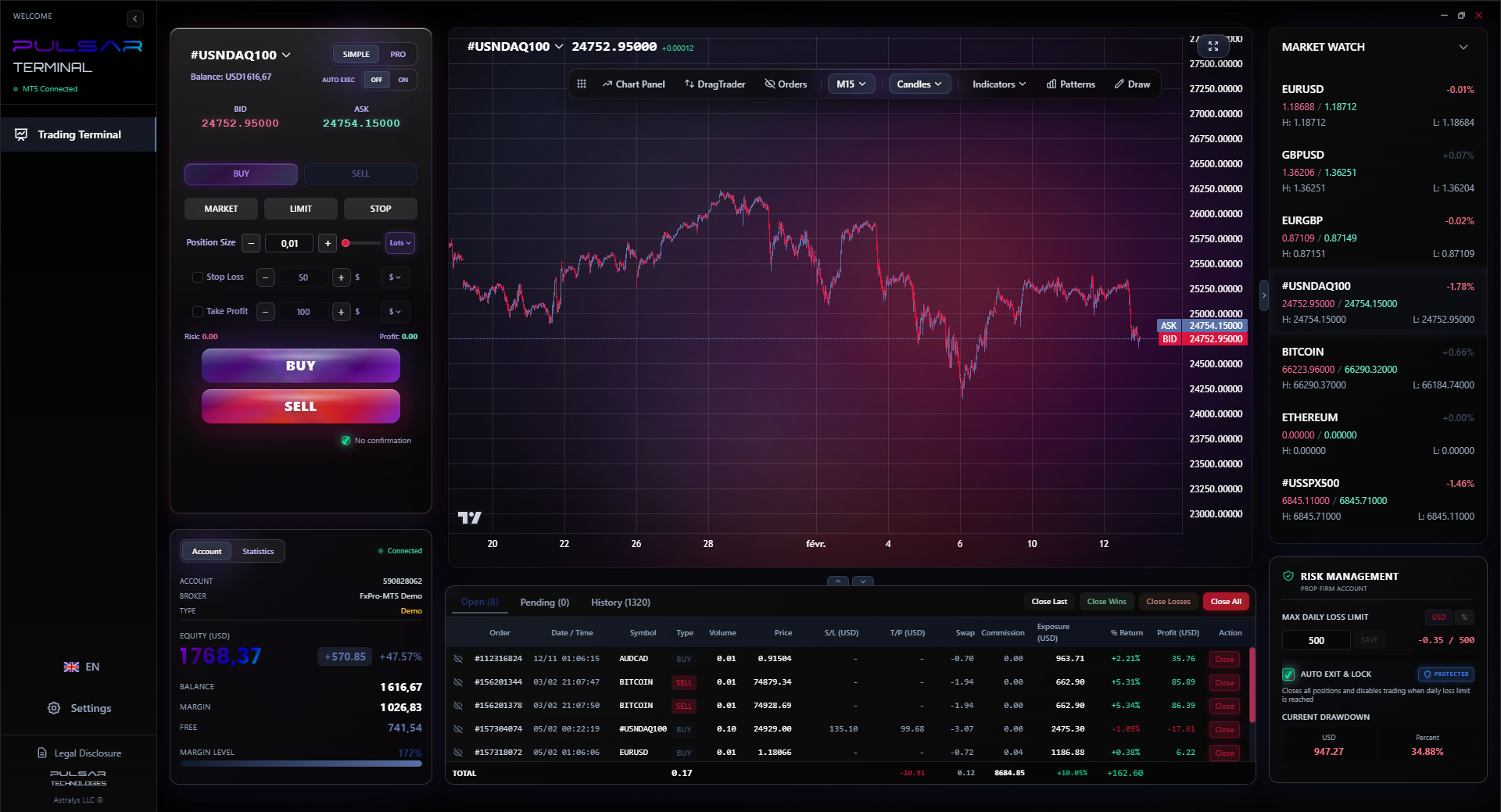
Since you'll be trading through a broker's MT5 platform, using a tool like Pulsar Terminal to manage complex orders and risk directly on your charts is how you gain a real operational edge.
Pulsar Terminal
The all-in-one MT5 companion: drag-and-drop orders, multi-TP/SL, trailing stop, grid trading, Volume Profile, and prop firm protection. Used by 1,000+ traders daily.
Accept that a broker is a necessary partner. Your energy is far better spent on selecting the right one and learning to trade well within the system.
- Choose a Regulated, Low-Cost Broker: Your goal is to minimize the broker's bite. Look for tight spreads, low commissions, and reliable execution. Don't get sucked in by bonus offers. Use our position size calculator to understand how costs affect your bottom line on every trade.
- Understand Their Cost Structure: Is the spread their main income, or do they charge a commission? How does overnight financing (swap) work? For example, trading XAU/USD guide (gold) often has different margin and swap rates than EUR/USD guide.
- Use Technology to Your Advantage: Instead of fighting the broker, use tools that work with them. This is where your edge comes from - superior analysis and disciplined execution, not structural arbitrage.
- Start Small: Open a demo account, then a small live cent account. Get used to the mechanics of placing orders, setting stops, and managing trades through a platform. See the costs in real time.
The dream of trading without a broker is usually born from a misunderstanding of what brokers do or a bad experience with a shady one. The solution isn't to eliminate them, it's to upgrade to a better one. Focus on what you can control: your strategy, your psychology, and your risk management. That's where the real money is made, not in avoiding a R7 commission.
“Your path isn't about finding a loophole. It's about finding a broker that feels like a sharp tool, not a hindrance.”
Can you trade forex without a broker? For all practical, legal, and financial purposes, the answer is a firm no. The modern retail forex market is built on the broker model. The faster you make peace with that and learn to work within it, the faster you can start focusing on the actual skill: trading.
Your path isn't about finding a loophole. It's about finding a broker that feels like a sharp tool, not a hindrance. Test a few. See whose platform clicks with you, whose costs don't eat your profits, and whose support answers your questions. That's the 'secret' - treating your broker selection with as much care as your trade selection.
I wasted months early in my career looking for backdoor routes and 'direct' methods. All it did was delay my education. The moment I accepted the framework and started seriously learning price action and risk management - using a solid broker as my vehicle - was the moment my consistency improved. Put your energy there. The broker is just the car. You still have to learn how to drive it in the rain on the N1.
FAQ
Q1Can I legally trade forex directly with a bank in South Africa?
You can exchange currency with a bank, but this is not 'trading' in the speculative sense. You cannot get margin, use, or short-selling capabilities from a retail bank like you can from a dedicated forex broker. It's a simple buy-and-hold transaction.
Q2What about peer-to-peer (P2P) forex trading platforms?
Extreme caution. Most operate in a regulatory grey area. You are taking on massive counterparty risk from the person on the other side of the trade. If they default, you have little recourse. They also rarely offer true use. It's often just a betting platform dressed up as trading.
Q3Isn't the spread how brokers make money? Can I avoid that?
Yes, the spread (and/or commissions) is their primary revenue. You cannot avoid paying for the service. However, you can minimize it by choosing an ECN/STP broker with raw spreads + a small commission. This is often cheaper overall than the wide fixed spreads of 'free' brokers.
Q4Do I need a broker if I have a lot of capital (e.g., R5 million)?
Yes, even more so. With large capital, you'd use a prime broker or a large institutional broker, but it's still a broker. They provide access to interbank liquidity, advanced execution algorithms, and dedicated support. You don't get to call Citibank directly with R5 million.
Q5Can I use a foreign broker not regulated by the FSCA?
You can, but you fall under that broker's home regulator (e.g., ASIC in Australia, CySEC in Cyprus). Your protection under South African law is limited. It's generally safer to use a broker that is either FSCA-regulated or a top-tier global brand with a strong international reputation.
Q6What's the cheapest way to trade forex then?
The cheapest way is to use a low-cost, reputable broker and trade during high-liquidity sessions (London/New York overlap) when spreads are tightest. Pair this with a solid strategy - costs matter, but they are secondary to making good trades. Always calculate your cost per pip definition before entering.
Prof. Winston's Lesson
Key Takeaways:
- ✓No direct retail forex access exists.
- ✓Brokers provide essential use & liquidity.
- ✓Private deals carry unlimited risk.
- ✓FSCA regulation is your primary shield.
- ✓Cost minimization beats cost elimination.
How useful was this article?
Click a star to rate
Weekly Trading Insights
Free weekly analysis & strategies. No spam.
About the Author
David van der Merwe
Emerging Markets Trader
Johannesburg-based trader with 11 years in emerging market currencies. Specializes in ZAR pairs, FSCA-regulated trading, and South African market analysis.
Comments
Risk Disclaimer
Trading financial instruments carries significant risk and may not be suitable for all investors. Past performance does not guarantee future results. This content is for educational purposes only and should not be considered investment advice. Always conduct your own research before trading.
You Might Also Like

Cara Trading Forex Sukses: 7 Prinsip dari Trader Profesional
Cara trading forex sukses dengan 7 prinsip trader pro: manajemen modal, disiplin, journal trading, backtest. Data nyata, bukan janji profit palsu.
Jam Trading Forex Terbaik untuk Trader Indonesia: Panduan Lengkap dengan Tabel Waktu
Panduan jam trading forex untuk trader Indonesia. Tabel 4 sesi dunia, jam emas 20:00-00:00, sesi mana yang harus dihindari. Data akurat + tips dari trader berpengalaman.
Top 5 Sàn Forex Uy Tín Nhất 2026: Review Jujur dari Trader Indonesia
Top 5 sàn forex uy tín 2026 untuk trader Indonesia. Review jujur: spread, deposit, withdraw, dukungan lokal. Exness, XM, IC Markets & lebih.
Get Pulsar Terminal
All these calculators are built into Pulsar Terminal with real-time data from your MT5 account. One-click position sizing, automatic risk management, and instant calculations.
Get Pulsar Terminal