


Here's a number that'll make you sit up: out of every 100 new retail forex traders in South Africa, maybe 10 are still actively trading after a year.

David van der Merwe
Emerging Markets Trader ·  South Africa
☕ 9 min read
What you'll learn:
Here's a number that'll make you sit up: out of every 100 new retail forex traders in South Africa, maybe 10 are still actively trading after a year. And of those, only a handful are consistently profitable. So, can you make money trading forex? The short answer is yes, absolutely. But the real question is, can you do it? It's not about getting rich quick; it's about surviving long enough to learn how to win. Let's talk about what that actually looks like for a trader in Cape Town, Joburg, or Durban right now.
First things first, trading is legal here, but it's not the wild west. The Financial Sector Conduct Authority (FSCA) runs a tight ship. You must trade with an FSCA-licensed broker - no ifs or buts. I learned this the hard way early on, wiring money to a flashy offshore outfit that promised the moon. Took me six months and a lawyer's letter to get my deposit back. Check the FSCA's public register; it's your first line of defence.
The FSCA also caps use at 30:1 for retail clients. Some guys moan about this, saying it kills their potential. I see it differently. Back in the day with 500:1, I once turned R5,000 into R25,000 in a week on a wild gold trade. Felt like a genius. The next week, I lost R30,000 on a single EUR/USD position because my stop was too tight. That 30:1 limit? It probably saved my account more times than it limited my gains. It forces you to use proper position size calculator and manage risk, which is the foundation of any real career in this game.
Then there's SARS. Oh, yes. Your trading profits are taxable income, not some magical tax-free windfall. I know a trader in Pretoria who made over R800,000 in 2023 and didn't declare a cent. SARS came knocking with penalties that wiped out nearly two years of profits. Keep careful records of every trade, every deposit, every withdrawal. They're getting smarter with data sharing from banks and brokers.

Warning: Don't even think about trying to speculate directly against the Rand by buying foreign currency through your online broker to 'bet' on ZAR moves. That's a fast track to regulatory trouble. You need a licensed bank or forex dealer for that. Your online broker is for trading currency pairs as derivatives (CFDs).
Forget the Lamborghini ads. Let's talk real ZAR. The averages are sobering, but they tell a story.
The Earnings Spectrum
Most beginners I've mentored start in the red. It's tuition. If you're scraping together R1,000 to R10,000 a month after a year, you're doing okay - you're covering costs and learning. The intermediate grind is where you see R10k to R50k monthly. That's a solid secondary income or a modest living if you're frugal. The guys pulling in R50,000 to R300,000+ a month? They've usually been at it for 5+ years, have systems, and treat it like a business. They're also the ones who survived multiple blow-ups.
I remember my first 'real' profitable month back in 2017. I netted R8,400 after all costs. I was ecstatic. Then the next month I gave back R6,200 of it. Consistency is a thousand times harder than a lucky win.
The Silent Killer: Costs
Your broker isn't a charity. They make money on the spread definition, and that's your primary cost. On EUR/USD, you might see 0.9 pips with a broker like XM on a standard account, or as low as 0.0 pips but with a commission per lot from someone like IC Markets.
Where it gets spicy for us is trading pairs with the ZAR. Want to trade USD/ZAR? Be ready for spreads starting around 5 pips. EUR/ZAR? Could be 14 pips or more. That means the market has to move significantly in your favour just for you to break even. I got caught out on this early, scalping USD/ZAR and watching my tiny profits get eaten alive by the spread. It's a terrible pair for that strategy.

Example: You buy 1 standard lot of USD/ZAR at 18.5000 with a 5-pip spread (sell price is 18.4995). Your trade starts R500 in the hole (5 pips * R10 per pip on USD/ZAR). The price needs to hit 18.5010 just for you to be up R50. That's a 10-pip move just to get a tiny profit.
Then there are overnight swap fees, and yes, some brokers will hit you with a dormancy fee if you don't trade for 30 days. Read the fine print.

💡 Winston's Tip
Your first R10,000 profit is the most dangerous money you'll ever make. It convinces you you're smarter than the market. That's when the real lesson begins.
“The 30:1 use limit probably saved my account more times than it limited my gains.”
Your broker is your partner in this. For South Africans, FSCA regulation is non-negotiable for peace of mind. You've got good options.
Local brokers like Khwezi Trade offer ZAR accounts, which is brilliant - no nasty conversion fees eating into your deposits. International giants like Pepperstone and Exness are also FSCA-regulated and offer tight spreads on majors. I've personally used accounts with both Pepperstone and IC Markets for years. Pepperstone's raw spread account on USD/ZAR is decent for the occasional ZAR trade, while I use IC Markets for the bulk of my major pair swing trading because of their razor-thin costs.
| Broker | FSCA Regulated? | Min. Deposit (approx) | Key Feature for ZAR Traders |
|---|---|---|---|
| Khwezi Trade | Yes | R500 | Proudly SA, ZAR-denominated accounts |
| Pepperstone | Yes | $200 (~R3,700) | Competitive USD/ZAR spreads (from 5 pips) |
| XM | Yes | $5 (~R90) | Very low barrier to entry for testing |
| Tickmill | Yes | $100 (~R1,850) | Low effective trading cost on majors |
As for pairs, my advice to any new trader here is simple: stick to the major pairs like EUR/USD, GBP/USD, and USD/JPY when you're learning. The spreads are tight, liquidity is massive, and you can find endless analysis on them. Once you're consistently profitable there, then maybe consider dabbling in USD/ZAR if you have a strong view. And if you're interested in non-forex volatility, learning XAU/USD guide (gold) is a fantastic complement to a forex strategy.
This is where the real answer to 'can you make money trading forex' lives. It's in your head.
Profitable trading is brutally boring. It's following your plan when you're scared and when you're greedy. It's taking a 15-pip loss and being okay with it because your system said to. The biggest mistake I see? Traders moving their stop-loss further away because they 'know' the trade will come back. That's not trading; that's hoping. I've had my share of margin call disasters from that exact move.
You need a written trading plan. What pairs do you trade? What's your entry setup? (Do you use the RSI indicator for divergence? The MACD indicator for crossovers?). Most importantly, what's your risk per trade? I never, ever risk more than 1% of my account on a single idea. If my account is R50,000, my maximum loss on any trade is R500. It sounds small, but it keeps you in the game.

Pro Tip: Track every single trade in a journal. Not just the entry and exit, but how you felt. Were you tired? Did you skip your analysis? I reviewed my journal from 2022 and found 80% of my losses happened on trades I entered after 10 PM. Now, I shut the platform down at 9. Simple fix, massive result.
Emotional control is the final boss. The market doesn't care about your rent or your ego. The sooner you accept that, the sooner you can start making logical, not emotional, decisions.
💡 Winston's Tip
Spend more time designing your exit strategy (stop-loss & take-profit) than your entry. Entries get you in, but exits determine if you eat.
“A 2-3% monthly return is fantastic and sustainable. The key is compounding that over years without the big drawdowns.”
So, let's map out a realistic first year for a dedicated beginner in South Africa with, say, R20,000 starting capital.
Months 1-3: The Demo & Education Phase Don't touch live money. Use a demo account to learn the platform, understand what a pip definition is, and test basic strategies. Paper trade like it's real. Most brokers offer unlimited demo accounts - use them.
Months 4-6: The Micro-Lot Phase Fund a live account with an amount you can afford to lose completely - maybe R5,000. Trade micro lots (0.01). Your goal isn't profit; it's to execute 100 trades according to a simple plan without blowing up. Get used to the feeling of real wins and losses. This is where you'll learn about slippage, platform quirks, and your own psychology.
Months 7-12: The Consistency Grind If you've survived and have a slightly positive or breakeven track record, you can scale up cautiously. Maybe move to mini lots (0.10) with your full R20k. Aim for a modest monthly return target - 2-3% is fantastic and sustainable. R20,000 * 2.5% = R500 per month. That's R6,000 a year. Sounds small? That's a 30% annual return. No bank offers that. The key is compounding that over years without the big drawdowns.
The path isn't linear. You'll have losing weeks, maybe losing months. The question isn't 'can you make money trading forex' in a month. It's 'can you stick to a process for a year' while the market tests you every single day.
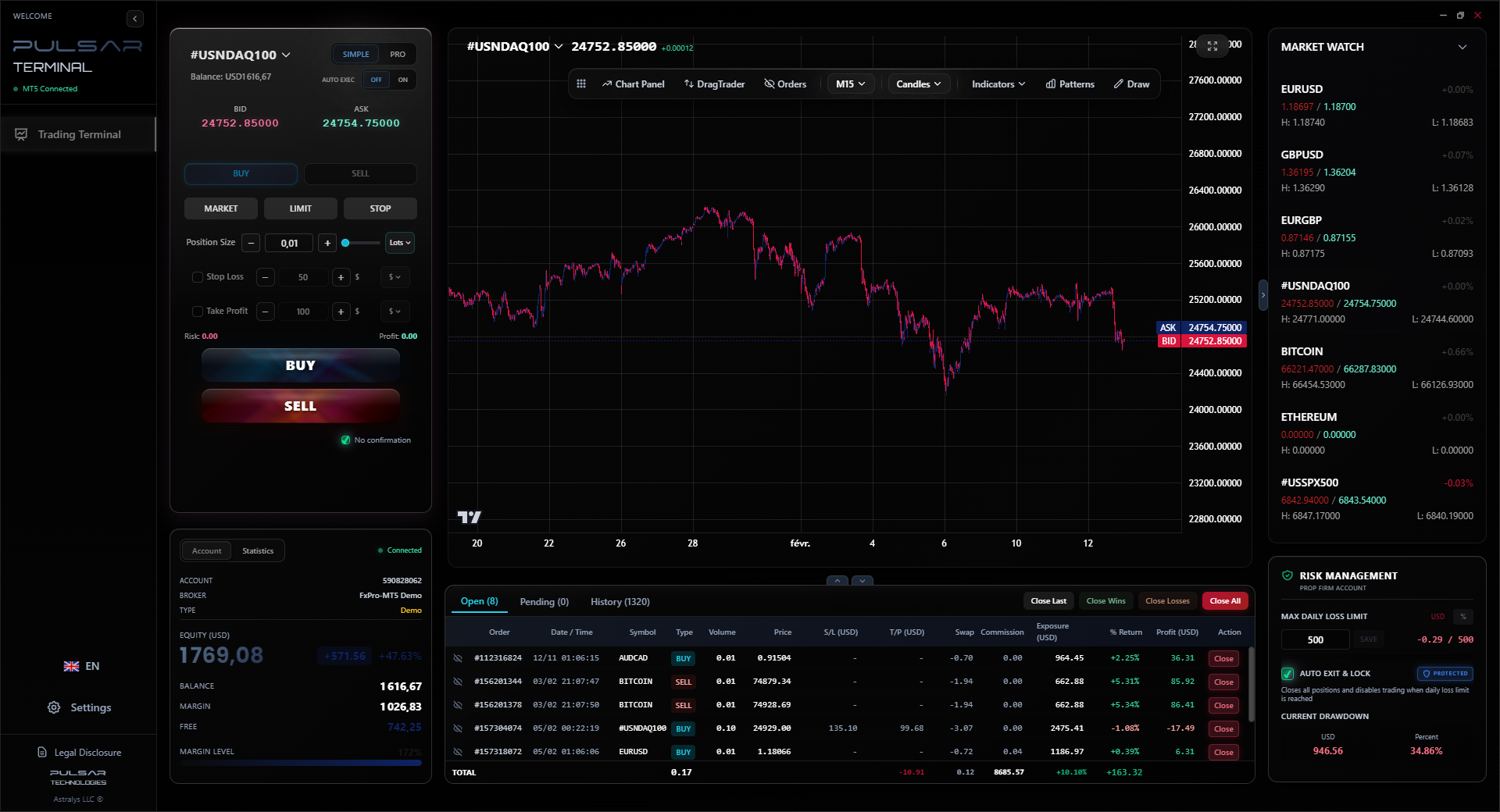
Sticking to a plan is hard, but tools like Pulsar Terminal automate key risk management rules like trailing stops and breakeven directly on your MT5 charts, removing emotion from the equation.
Pulsar Terminal
The all-in-one MT5 companion: drag-and-drop orders, multi-TP/SL, trailing stop, grid trading, Volume Profile, and prop firm protection. Used by 1,000+ traders daily.
The game is evolving. The FSCA and SARB are making moves that affect every trader.
Sending money offshore to fund your international broker account just got trickier. As of late 2025, SARB requires banks to check the tax status of the recipient before sending funds. This means if your broker isn't tax-compliant with SARS, your bank might block the transfer. It's another reason to strongly consider an FSCA-regulated broker that holds client funds locally or in recognised jurisdictions.
Enforcement is ramping up. The FSCA isn't messing around with unlicensed signal providers or educators. If someone is giving you specific trade advice for a fee, they need an FSP license. That R1 million fine they handed out in 2024 was a serious message.
Technologically, you need to be secure. Use strong passwords, enable two-factor authentication on your trading and email accounts, and be wary of 'can't lose' schemes in your WhatsApp groups. The sophistication of digital fraud is catching up with the market.
All these changes are actually good for the serious trader. They clean up the industry, protect capital, and create a more level playing field. It separates the professionals from the gamblers.
💡 Winston's Tip
If you can't explain your trade thesis in one simple sentence, you don't have a thesis. You have a hope.
FAQ
Q1Is forex trading a good way to get rich quick in South Africa?
No, it's one of the worst ways to try and get rich quick. It's an excellent way to lose money quickly if that's your approach. It's a skill-based profession that requires years of dedication to master. View it as a business, not a lottery ticket.
Q2How much money do I need to start trading forex in South Africa?
You can start with very little - some brokers like XM allow deposits from $5 (about R90). However, to trade properly with sensible risk management, a more realistic starter amount is R5,000 to R20,000. This allows you to trade micro lots and withstand normal market volatility without being wiped out by a few bad trades.
Q3Do I pay tax on my forex trading profits?
Yes. SARS views frequent forex trading profits as income from a business, taxable at your marginal income tax rate (which can be up to 45%). You must declare this income in your annual tax return. Keep detailed records of all trades, deposits, and withdrawals.
Q4Can I use my R1 million foreign investment allowance for forex trading?
Technically, you could use part of your annual discretionary allowance to fund an offshore trading account. However, given the recent SARB tightening on transfers to non-compliant entities and the high risk of loss, it's generally not advisable to use your precious offshore allowance for speculative retail forex trading. Consult a financial advisor familiar with exchange controls.
Q5What's the most common mistake new South African traders make?
Trading ZAR pairs like USD/ZAR with the same strategies and expectations as major pairs. The wide spreads make short-term trading extremely difficult. They also tend to overuse use, risking far too much of their capital on single trades, leading to quick account blow-ups.
Q6Are forex trading robots or signals worth it?
Almost universally, no. The FSCA has fined and debarred unlicensed signal providers. A robot that could reliably print money wouldn't be sold for R2,000 online. The only sustainable edge comes from your own education and discipline. Anyone promising guaranteed results is selling a fantasy.
Prof. Winston's Lesson
Key Takeaways:
- ✓FSCA regulation is non-negotiable for capital safety.
- ✓Never risk more than 1% of your account per trade.
- ✓ZAR pairs have wide spreads; avoid them for scalping.
- ✓Track every trade in a journal, including your mood.
- ✓Taxable income must be declared to SARS.
How useful was this article?
Click a star to rate
Weekly Trading Insights
Free weekly analysis & strategies. No spam.
About the Author
David van der Merwe
Emerging Markets Trader
Johannesburg-based trader with 11 years in emerging market currencies. Specializes in ZAR pairs, FSCA-regulated trading, and South African market analysis.
Comments
Risk Disclaimer
Trading financial instruments carries significant risk and may not be suitable for all investors. Past performance does not guarantee future results. This content is for educational purposes only and should not be considered investment advice. Always conduct your own research before trading.
You Might Also Like

Cara Trading Forex Sukses: 7 Prinsip dari Trader Profesional
Cara trading forex sukses dengan 7 prinsip trader pro: manajemen modal, disiplin, journal trading, backtest. Data nyata, bukan janji profit palsu.
Jam Trading Forex Terbaik untuk Trader Indonesia: Panduan Lengkap dengan Tabel Waktu
Panduan jam trading forex untuk trader Indonesia. Tabel 4 sesi dunia, jam emas 20:00-00:00, sesi mana yang harus dihindari. Data akurat + tips dari trader berpengalaman.
Top 5 Sàn Forex Uy Tín Nhất 2026: Review Jujur dari Trader Indonesia
Top 5 sàn forex uy tín 2026 untuk trader Indonesia. Review jujur: spread, deposit, withdraw, dukungan lokal. Exness, XM, IC Markets & lebih.
Get Pulsar Terminal
All these calculators are built into Pulsar Terminal with real-time data from your MT5 account. One-click position sizing, automatic risk management, and instant calculations.
Get Pulsar Terminal