


Let's be blunt: most traders think the CBN's BDC guidelines are some boring banker's problem.

Olumide Adeyemi
West African Trading Pioneer ·  Nigeria
☕ 10 min read
What you'll learn:
- 1Why Should a Forex Trader Care About BDC Rules?
- 2The New Two-Tier System: N2bn vs N500m
- 3The Rules That Actually Change Your Trading Math
- 4BDC vs. International Forex Broker: Where's the CBN?
- 5Practical Funding Strategies in the New Regime
- 6Trader-Specific Risks and Red Flags
- 7The Future: What These Guidelines Mean for Nigerian Traders
Let's be blunt: most traders think the CBN's BDC guidelines are some boring banker's problem. They're wrong. These rules are the single biggest factor shaping your trading costs, your ability to fund an account, and the real value of your Naira profits right now. I've watched these changes roll out since 2024, and I can tell you, ignoring them is like trading blind. This isn't about bureaucracy; it's about the pipeline that connects your local cash to the global markets. I'll show you exactly how the new tiered system, the 1% margin cap, and the weekly purchase limits directly affect your bottom line, and more importantly, what you should do about it.
You're probably thinking, 'I trade EUR/USD on an international broker, what's the CBN got to do with it?' Everything. Unless you're sitting on a stack of foreign currency, every Naira you deposit and every profit you withdraw passes through this environment. The BDCs are the street-level interface for retail FX access. When their rules change, your effective spread on converting Naira to USD changes. Their stability (or lack thereof) directly influences the parallel market rate, which is the real rate most of us face when moving money.
I learned this the hard way in early 2024. I had a nice win on a XAU/USD guide swing trade, pulling about $2,800. When I went to get it into Naira, the gap between the official rate and what was actually available was staggering. That 'profit' got a nasty haircut because the BDC sector was in chaos. The new CBN BDC forex guidelines are an attempt to fix that chaos, and whether they succeed or fail will hit your pocket.

Warning: Don't confuse the official CBN rate with your real conversion rate. Your trading profit is only as good as the rate you can actually get when cashing out. The BDC rules aim to narrow that gap, but the market has its own ideas.

💡 Winston's Tip
Your trading profit is calculated in dollars, but you live in Naira. The rate you get when converting is your final, real profit. Never forget the second conversion.
The core of the 2024 guidelines is a split into Tier 1 and Tier 2 BDCs. This isn't just administrative fluff; it's about consolidating power and (theoretically) improving oversight.
What Tier 1 Means (The Big Players)
Tier 1 requires a staggering N2 billion in capital and a N5 million license fee. They can operate nationwide. Think of them as potential 'FX supermarkets.' The CBN wants fewer, stronger players who can be more easily monitored. In practice, as of late 2025, only 2 outfits had gotten this license. This creates a potential bottleneck.
What Tier 2 Means (The Local Shops)
Tier 2 needs N500 million and a N2 million fee. They're confined to one state. These are your local go-to spots. There are about 80 of these licensed now. The 1km rule between branches is meant to stop street trading clusters, pushing activity into more formal offices.
For you, the trader, this consolidation means fewer but theoretically more reliable points of contact. The risk? Less competition could lead to worse rates if not strictly enforced. I used to have three BDCs within a block to price-check. Now, they'll be more spread out.

Example: The capital jump is insane. The old pre-2024 capital requirement was around N35 million for a BDC. Now it's N500m minimum. That's a 1,328% increase. They've priced out the small, fly-by-night operators, which is good for stability, but might reduce overall market liquidity.
“The CBN's BDC guidelines aren't about bureaucracy; they're about the pipeline that connects your local cash to the global markets.”
Forget the legal jargon. Here are the clauses in the CBN BDC forex guidelines that have a direct Naira-and-kobo impact on your trading life.
The 1% Margin Cap: This is the big one. BDCs must sell to you (the end-user) at no more than 1% above their own buying rate. On paper, this kills the wild margins they used to charge. If they buy at ₦1,500/$, they can't sell to you for more than ₦1,515/$. This is meant to protect you. But here's the catch: it only works if they can actually access dollars at the official/NAFEM rate. The weekly limit complicates that.
The $150,000 Weekly Purchase Limit: Each licensed BDC can only buy $150k per week from banks at the market rate. For a Tier 2 operator in a busy city, that's nothing. It can be exhausted in a day. When that happens, where do they get more dollars? They go to the secondary market, where the rate is worse, which then pressures them to bypass that 1% cap to stay in business. This rule, while aiming to control flow, can actually create scarcity that fuels the parallel market.
The $5,000 Quarterly Limit: For eligible purposes (travel, school fees). This doesn't directly hit trading, but it shapes overall dollar demand in the system. More importantly, the 75% Bank Settlement Rule does: only 25% of any FX transaction can be in cash. The rest must go through a bank. This is a killer for anonymity and a huge win for CBN tracking. Every major move you make is now digitally recorded with your BVN.
I tested this recently. I needed to fund a new account with IC Markets review. I bought $2,000. I walked out with $500 cash and the rest was a transfer to my Naira account, which I then used for a card funding. It added two days to the process. Plan for this liquidity lag.
This is a critical distinction most Nigerians miss. The CBN regulates BDCs and the domestic FX market. It does not regulate international forex brokers like Exness, Pepperstone, or XM.
- Your BDC is your currency exchange shop. They are governed by the CBN BDC forex guidelines. They sell you physical or digital dollars.
- Your Forex Broker is your trading platform. They are regulated by bodies like CySEC (Cyprus), ASIC (Australia), or the FCA (UK). They accept your deposited dollars and let you trade CFDs on EUR/USD.
The CBN's influence on your broker is indirect but powerful. They control the gate through which your Naira becomes the USD you deposit. They can make it easier or harder for brokers to offer Naira payment methods. When the CBN clamps down on BDCs and international transfers, brokers might temporarily suspend Naira deposit options, forcing you to use crypto or other roundabout methods. I've seen it happen multiple times.
So, while you're studying the MACD indicator for your next trade, keep one eye on CBN circulars. Their policy shifts can be a more powerful indicator for your financial logistics than any RSI divergence. A good broker review, like our Exness review, will always detail the current Naira funding options because that's the local pain point.
💡 Winston's Tip
In regulated chaos, the simplest rule wins. The BDC's 1% margin cap is the rule. If someone offers you a 'better deal' far from that, you're not getting a discount, you're buying risk.
“Your trading profit is only as good as the rate you can actually get when cashing out.”
Alright, enough theory. How do you actually get money to your broker now?
- BDC Route (Formal): This is the new official path. You go to a licensed Tier 1 or 2 BDC. You provide all your KYC (BVN mandatory). You buy dollars within the limits. You take a small cash portion and get the rest as a bank transfer. You then use your bank card (linked to that account) to fund your broker internationally. It's traceable, it's legal, and it's slower. Always get a receipt detailing the CBN-approved margin.
- Peer-to-Peer (P2P) & Crypto: This is the elephant in the room. When BDC limits bite, traders flock to P2P platforms. You send Naira to a local seller, they send USDT (crypto) to your wallet, and you send that to a broker that accepts crypto. It's faster, often has better rates, but carries counterparty risk (you could get scammed) and is completely outside the CBN's system. The guidelines explicitly prohibit BDCs from dealing in crypto, so this is a separate, shadow system.
- Direct Broker Naira Options: Some brokers, through third-party payment processors, offer direct Naira deposits. This is the holy grail. The broker's processor aggregates demand and handles the FX conversion in bulk. Your experience here is totally dependent on the broker's partner and current CBN liquidity. It can work seamlessly for months, then freeze up.
My strategy? I diversify. I keep a formal relationship with a good BDC for medium-sized, documented transfers. For smaller, urgent top-ups, I use a highly reputable P2P vendor I've built trust with over years. I never keep all my liquidity in one channel. And I always, always use a position size calculator so I'm not over-exposed on a single trade and forced to make rushed funding decisions.
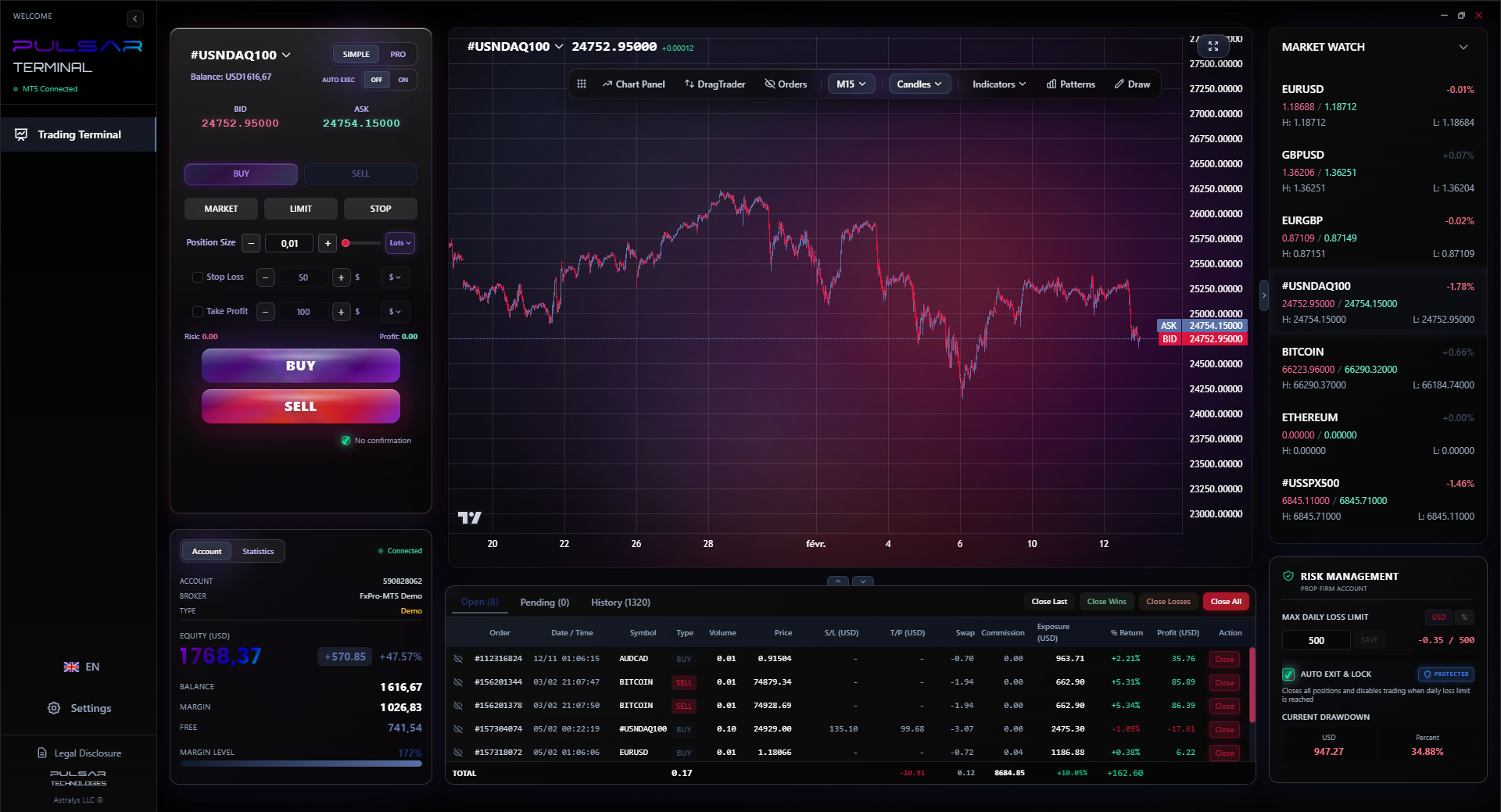
Managing multiple trades and their associated funding needs is complex, but tools like Pulsar Terminal help you execute and manage those trades efficiently on MT5, so you can focus on the market, not just the mechanics.
Pulsar Terminal
The all-in-one MT5 companion: drag-and-drop orders, multi-TP/SL, trailing stop, grid trading, Volume Profile, and prop firm protection. Used by 1,000+ traders daily.
The new environment has new pitfalls. Here’s what will blow up your account faster than a failed scalping strategy.
- Rate Volatility Risk: The gap between the BDC rate (guided by the 1% rule) and the parallel market rate is a measure of systemic stress. A widening gap means the system isn't working. If you calculate your profit based on the BDC rate but are forced to use the parallel market to exit, you could lose 10-20% instantly.
- Liquidity Freezes: That $150k weekly limit per BDC is a ticking clock. At month-ends or during high demand, they run out. Your funding plan can't be 'I'll get dollars today.' You need a buffer.
- Documentation Trail: Every BDC transaction is now linked to your BVN and bank account. The CBN is building a database of FX demand. While this fights corruption, it also means your trading volume is visible. There are unconfirmed rumors of queries for individuals with high, frequent FX purchases for 'invisible transactions' (which trading technically is).
- Prohibition Pitfalls: BDCs cannot do international outward transfers. So don't ask them to 'wire to my broker in Seychelles.' They can't. They cannot deal in crypto. Anyone offering you both is operating outside the guidelines and is a massive red flag.
I got a quiet warning from my bank manager in late 2025 after a series of BDC-to-account transfers. They just 'advised' that my pattern was 'consistent and notable.' Nothing happened, but it was a wake-up call. The visibility is real.

Pro Tip: Keep your BDC transactions for funding below the $5,000 per quarter threshold where possible. It keeps you under the radar for 'eligible transactions' and reduces documentation scrutiny. Split larger amounts across multiple quarters or use a blended approach with P2P.
💡 Winston's Tip
Liquidity is a promise until it isn't. Always have a Plan B for funding. The day you need to top up a margin call is not the day to find out your BDC is out of dollars.
“Adaptability is no longer just a trading strategy; it's a survival skill in Nigeria's FX market.”
The CBN BDC forex guidelines are a bold attempt to formalize the chaotic retail FX market. Their success hinges on one thing: making enough dollars available at the official rate to satisfy demand through the BDC channel. If they can't, the rules will be bypassed, and the parallel market will remain the true price setter.
For us traders, the long-term play is increasing formalization. The days of anonymous cash swaps are ending. Your trading will need to be more structured, with clear records. This could actually be a good thing, pushing the industry towards professionalism.
Brokers who want the Nigerian market will need to invest in strong, compliant local payment solutions. We'll likely see more partnerships between international brokers and licensed Nigerian financial technology companies.
In the meantime, your edge comes from understanding this system better than the next trader. While they're fretting over a pip definition, you're securing a reliable 1.5% conversion spread when they're paying 10%. That's a 8.5% head start on every trade you fund. That's where the real money is made in this market: not just in predicting GBP/JPY moves, but in mastering the logistics of your own capital. Adaptability is no longer just a trading strategy; it's a survival skill.
FAQ
Q1Can a BDC help me fund my international forex trading account directly?
No, not directly. BDCs are prohibited from conducting international outward transfers. Their role is to sell foreign currency to you, the end-user. You then take that currency (as cash or in your Naira account) and use it to fund your broker through the broker's accepted deposit methods (like credit/debit card or crypto transfer).
Q2What's the difference between the CBN rate, the BDC rate, and the parallel market rate?
The CBN rate is the official exchange rate set by the Central Bank. The BDC rate is what licensed BDCs sell at, which is now capped at 1% above their buying rate. The parallel market rate (aka 'black market' rate) is determined by street supply and demand, with no caps. For traders, the parallel market rate is often the real cost of acquiring dollars quickly, especially when BDC liquidity is tight.
Q3Is it illegal to use the parallel market to buy dollars for trading?
The CBN's guidelines are designed to channel all FX transactions through formal, licensed channels like banks and BDCs. Using the parallel market is not 'illegal' in a criminal sense for the buyer, but it violates CBN foreign exchange regulations. The bigger risks are financial (no recourse if scammed) and the fact you're operating outside a system the government is increasingly monitoring.
Q4How does the $5,000 quarterly limit affect me as a trader?
The $5,000 per quarter limit applies to purchases for specific 'eligible invisible transactions' like travel allowance, school fees, and medical fees. Forex trading is not an eligible transaction under these guidelines. Therefore, in theory, BDCs should not be selling you FX for trading at all. In practice, this is a gray area, and the limit pushes traders to use other channels or break larger requests into smaller, less conspicuous amounts.
Q5Will these new guidelines finally stabilize the Naira exchange rate?
As a trader, I'm skeptical of any 'final' solution. The guidelines address the distribution side (BDCs) but the core issue is supply vs. demand for dollars. If Nigeria earns more FX (from oil, exports, investment) than it spends, the rate will stabilize. The BDC rules can reduce wild spreads and speculation at the retail level, but they can't create dollars out of thin air. Watch the weekly BDC purchase limit of $150k – if that's consistently sufficient, it's a good sign. If it's constantly exhausted, pressure remains.
Q6Should I prefer a Tier 1 or Tier 2 BDC for my transactions?
For a trader, the tier matters less than their reliability and liquidity. A Tier 1 BDC, with its larger capital base, might have better access to dollars and more strong systems. However, a well-run Tier 2 operator in your area might offer more personalized service. The key is to build a relationship with one that is consistently able to fulfill your requests within the legal framework, provides proper receipts, and is transparent about their rates.
Prof. Winston's Lesson
Key Takeaways:
- ✓The 1% BDC margin cap is your benchmark for a 'good' formal rate.
- ✓BDCs have a $150k weekly purchase limit per license - liquidity isn't infinite.
- ✓Only 25% of FX from a BDC can be cash; 75% goes through your bank.
- ✓The CBN regulates BDCs, not your international forex broker.
- ✓Always have a secondary, non-BDC funding channel ready.
How useful was this article?
Click a star to rate
Weekly Trading Insights
Free weekly analysis & strategies. No spam.
About the Author
Olumide Adeyemi
West African Trading Pioneer
One of Nigeria's most active forex trading educators. 8 years of experience trading from Lagos. Specializes in low-capital strategies and prop firm challenges for African traders.
Comments
Risk Disclaimer
Trading financial instruments carries significant risk and may not be suitable for all investors. Past performance does not guarantee future results. This content is for educational purposes only and should not be considered investment advice. Always conduct your own research before trading.
You Might Also Like

Cara Trading Forex Sukses: 7 Prinsip dari Trader Profesional
Cara trading forex sukses dengan 7 prinsip trader pro: manajemen modal, disiplin, journal trading, backtest. Data nyata, bukan janji profit palsu.
Jam Trading Forex Terbaik untuk Trader Indonesia: Panduan Lengkap dengan Tabel Waktu
Panduan jam trading forex untuk trader Indonesia. Tabel 4 sesi dunia, jam emas 20:00-00:00, sesi mana yang harus dihindari. Data akurat + tips dari trader berpengalaman.
Top 5 Sàn Forex Uy Tín Nhất 2026: Review Jujur dari Trader Indonesia
Top 5 sàn forex uy tín 2026 untuk trader Indonesia. Review jujur: spread, deposit, withdraw, dukungan lokal. Exness, XM, IC Markets & lebih.
Get Pulsar Terminal
All these calculators are built into Pulsar Terminal with real-time data from your MT5 account. One-click position sizing, automatic risk management, and instant calculations.
Get Pulsar Terminal