


I was staring at my screen in June 2023 when the news hit.

Olumide Adeyemi
West African Trading Pioneer ·  Nigeria
☕ 11 min read
What you'll learn:
- 1The Official Story vs. The Street Price: Two Different Worlds
- 2How to Actually Trade Naira Volatility (It's Not What You Think)
- 3Decoding CBN Policy: Your Early Warning System
- 4Surviving the Squeeze: Risk Management When Liquidity Vanishes
- 5Your Trading Setup: From News to Execution
- 6Alternative Plays: Trading the Naira Without Touching USD/NGN
- 7The Final Word: Trading Reality, Not Hope
I was staring at my screen in June 2023 when the news hit. The CBN had finally 'unified' the exchange rate windows. The official rate, which had been artificially held around ₦460/$, was about to be set adrift. I watched the NAFEX rate on my broker's platform jump to ₦632, then ₦750, and I knew we were in for a proper storm. That moment wasn't about a single trade, it was the starting gun for a new era of Nigerian forex trading. If you're trying to make sense of the Central Bank of Nigeria's (CBN) official rate versus the street price, you're not looking at a simple chart. You're looking at a political and economic battlefield, and that's where the real opportunities (and dangers) live.
Let's get this straight from the jump. The CBN forex rate you see on the news is, for most retail traders, a fiction. It's the rate the Central Bank wants you to believe is the value of the Naira, primarily used for government transactions, some import duties, and a handful of privileged entities. For years, this rate was a heavily defended line in the sand, creating a massive gap between the official and parallel market rates. That gap was a direct measure of market stress and pent-up demand.
Then you have the real market price. This is the Nigerian Autonomous Foreign Exchange Rate (NAFEX), now often called the 'I&E Window' rate, and the parallel market rate (what your Bureau de Change guy quotes). This is where the actual forces of supply and demand play out, and it's the price that matters for your trades. When the CBN talks about 'floating' the Naira, they mean they're letting the NAFEX rate move more freely, but old habits die hard. Interventions still happen.

Warning: Never base a live trade entry or exit on the CBN's published official rate. Your broker's platform for USD/NGN or your parallel market source is your true price feed. The official rate is a lagging indicator, at best.
The key is to watch the spread between these rates. A widening gap signals mounting pressure and potential for a sharp official devaluation or a policy shift. A narrowing gap suggests some temporary stability or successful intervention. I learned this the hard way in early 2022. I saw the parallel rate hit ₦710 while the official was stuck at ₦445. The gap was screaming. I positioned for a move, but got impatient and closed too early. Two months later, the CBN did a 'gradual adjustment' that caught the market off guard. The lesson? The gap tells you when pressure is building, but the CBN decides the when of the release. Patience is a weapon.

💡 Winston's Tip
The parallel market rate isn't 'illegitimate' data. It's the purest price discovery mechanism in a distorted market. Watch it closer than the official bulletins.
“The gap between the official CBN rate and the street price isn't an error; it's the trade.”
You can't directly trade the CBN forex rate on your typical MetaTrader platform. You're trading the market-derived Naira rate, usually as USD/NGN. And brother, it can move. When liquidity is thin and news hits, 500-pip swings in a day aren't uncommon. A pip for USD/NGN is ₦0.01, so a move from ₦780 to ₦830 is a 5,000 pip move. Wrap your head around that.
Instruments and Access
Most Nigerian retail traders access this through international brokers that offer exotic pairs, or through local platforms that mirror the NAFEX rate. The liquidity isn't like EUR/USD, so expect wider spreads, especially during local market hours. I've seen spreads balloon to 50-60 pips during a CBN governor speech. You need a broker with solid execution for this. I've had decent fills with IC Markets on USD/ZAR (a correlated pair), but for direct Naira exposure, you need to do your homework on who offers reliable pricing.
The Strategy Mindset
Forget fancy indicators. This market is driven by headlines, fuel queues, and central bank whispers. Your core tools are:
- News Flow: Announcements on dollar allocations, changes to the 'eligible transactions' list for the official window, and statements from the CBN governor.
- Parallel Market Tracking: Have a reliable source for the black-market rate. When it diverges sharply from NAFEX, something's about to give.
- Simple Price Action: Support and resistance on the USD/NGN chart are everything. A breakout above a key round number (like ₦800, ₦900) can lead to a sustained run as panic sets in.
I made one of my cleanest trades in November 2023. USD/NGN had been consolidating around ₦780-₦810 for weeks after a big run-up. The CBN made a confident statement about 'clearing the FX backlog.' The price dipped to ₦775. I saw the parallel market was still at ₦1,150. The gap was insane. I went long at ₦778, thinking the 'solution' was overstated. I set a tight stop at ₦770 and used a position size calculator to keep my risk at 1%. Two days later, a report came out about the backlog being larger than stated. Price ripped to ₦830. I took half off at ₦815 and let the rest run with a trailing stop. That trade worked because I trusted the market reality over the official narrative.
“You're not betting against Nigeria. You're trading a financial instrument that reflects a complex set of economic conditions.”
The CBN doesn't just set a rate, it sets the rules of the game. Their policies are the ultimate market-moving events. You need to understand the jargon.
- FX Unification: This is the big one. It means collapsing the multiple exchange rates (official, NAFEX, etc.) into a single, market-driven window. The June 2023 move was a step towards this. When they announce 'further steps towards unification,' it usually means they'll let the official rate weaken (NAFEX appreciates in value). This is generally bullish for USD/NGN (Naira weakens).
- Open Market Operations (OMO) & CRR: How the CBN soaks up or injects Naira liquidity. High OMO rates can attract 'hot money' and temporarily support the Naira. Watch for primary market auction results.
- RT200 & Naira4Dollar: These are rebate schemes to encourage dollar inflows through exports and remittances. Their success (or failure) directly impacts dollar supply.
- Eligible Transactions: The list of what you can use the official window for. When this list shrinks, demand is pushed to the parallel market, widening the gap.
My biggest mistake was ignoring the operational details. In 2021, the CBN stopped selling FX to BDCs. I saw it as a political headline. I didn't connect the dots: that meant all that retail demand was now funneled into the parallel market alone. The parallel rate exploded, and the gap to the official rate became a chasm. I missed a huge trend because I didn't think about the mechanics of the policy. Now, I have a simple checklist for any CBN announcement: 1) Does it increase or decrease USD supply? 2) Does it increase or decrease NGN liquidity? 3) Which market (official or parallel) does it affect most? The answers tell you the direction.
“You're not betting against Nigeria. You're trading a financial instrument that reflects a complex set of economic conditions.”
Trading a currency with a history of controls requires a different risk mindset. The worst thing that can happen isn't just a stop-loss hit, it's the market ceasing to function for your exit.
1. Position Size is Your Lifeline. You must trade smaller. The volatility demands it. If you normally risk 1% on EUR/USD, consider 0.5% on USD/NGN. The swings are larger and more erratic. I cannot stress this enough. Use a position size calculator religiously and then maybe halve the result.
2. Expect Gap Risk Overnight and Over Weekends. The CBN loves to make major announcements after market close or on a Friday. You can go to bed with a profitable position and wake up to a price gap right through your stop-loss, turning a winner into a max loss. I got gap-hunted in July 2023. I was short USD/NGN at ₦830, stop at ₦850. A weekend policy shift caused Monday's open at ₦890. My stop was executed at the worst possible price. Lesson learned: ahead of major policy meetings or periods of high stress, reduce your position or exit entirely before the close.
3. Have a 'Black Swan' Plan. What if the CBN reintroduces capital controls? What if your broker suddenly restricts trading on the pair? Your plan should include knowing which correlated asset you could use as a hedge (like USD/ZAR or even XAU/USD as a general hedge against currency devaluation).

Pro Tip: Never add to a losing position in this market. Averaging down on USD/NGN during a Naira collapse is a surefire way to get a margin call. The trend, driven by fundamental scarcity, can go much further than you think.
💡 Winston's Tip
When the CBN announces a 'bold new reform', wait 72 hours. See if the market price believes it. Let the other guys be the heroes who test the waters.
“Averaging down on USD/NGN during a Naira collapse is a surefire way to get a margin call.”
Here's my daily routine for trading the Naira environment. It's less about charts and more about information synthesis.
Step 1: Morning Recon (Before 9 AM WAT)
- Check the closing NAFEX rate from the FMDQ website (the official source).
- Check 2-3 reliable parallel market rates on Twitter or from contacts.
- Calculate the gap. Is it expanding or contracting?
- Scan headlines from CBN, Finance Ministry, and major local business papers.
Step 2: Broker Platform Check
- Open your chart. Does the price align with the NAFEX close? If not, why? Sometimes your broker's quote is based on offshore NDFs (Non-Deliverable Forwards), which can differ.
- Check liquidity. Look at the spread. A suddenly widening spread with low volume is a red flag.
Step 3: Execution and Management
- Entries are best on confirmation of a policy impact. Don't front-run CBN announcements; they are unpredictable.
- Use wide stops. A 200-pip stop in EUR/USD is huge. In USD/NGN, it can be wiped out by a single volatile hour. Consider 500-800 pip stops for swing trades.
- Have multiple profit targets. Take partial profits at logical resistance levels (round numbers, previous highs). The market can reverse on rumor just as fast as it moves on news.
I find that a pure swing trading approach works better than scalping here. You're trading the broader policy failure or success, not minute-to-minute order flow. The MACD indicator on a 4H or Daily chart can help confirm the momentum of a major move, but the fundamental driver is always king.
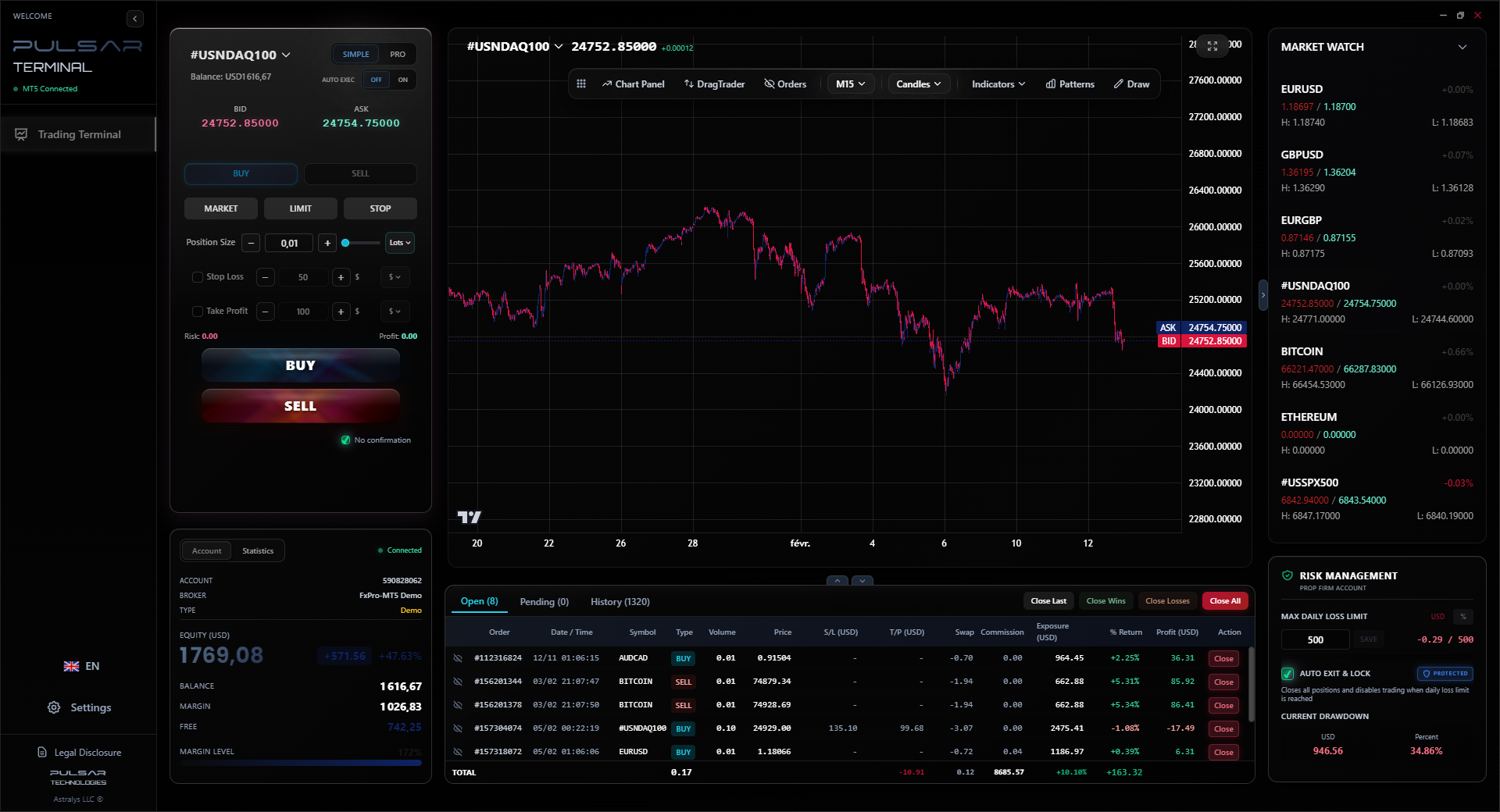
Managing multiple profit targets and wide stops on volatile pairs like USD/NGN is clunky in MT5, but Pulsar Terminal lets you set them all with a single drag-and-drop order.
Pulsar Terminal
The all-in-one MT5 companion: drag-and-drop orders, multi-TP/SL, trailing stop, grid trading, Volume Profile, and prop firm protection. Used by 1,000+ traders daily.
“Averaging down on USD/NGN during a Naira collapse is a surefire way to get a margin call.”
Maybe you don't have access to USD/NGN, or the volatility is too rich for your blood. You can still trade the Nigerian story through other instruments. This is about trading the macro consequence of CBN forex rate mismanagement.
1. Nigerian Stocks (NGSEINDEX): A collapsing Naira is terrible for import-dependent companies but can be great for exporters (like some agro-allied firms). More broadly, hyper-inflation and currency instability crush corporate earnings and foreign investment. A sustained Naira crisis often leads to a bear market in Nigerian equities. You can short the index via CFDs if your broker offers it.
2. International Stocks with Nigeria Exposure: Look at multinationals with major Nigerian operations (e.g., Nestlé Nigeria, MTN). Their dollar-denominated earnings get a translation boost when converted to Naira, but their operational costs (if imported) skyrocket. It's a mixed bag, but the stock price action often reflects the currency stress.
3. The Crypto Backdoor: For many Nigerians, cryptocurrency (especially stablecoins like USDT) has become a de facto parallel foreign exchange market. The premium on the price of USDT in Naira versus the official dollar rate is a real-time sentiment indicator. A rising premium signals increased desperation for dollar alternatives. I don't trade crypto directly from this angle, but I watch the premium as a fear gauge.
4. Correlated Forex Pairs: The South African Rand (USD/ZAR) and other emerging market currencies often move in sympathy with broader risk-off sentiment that also hits the Naira. It's not a perfect correlation, but during 'EM sell-off' periods, they can move together. Trading USD/ZAR on a platform like Pepperstone gives you exposure to EM volatility with much deeper liquidity and tighter spreads than USD/NGN.
“Your edge comes from understanding the pressures the CBN is under, not predicting their next move perfectly.”
Trading around the CBN forex rate is a exercise in cynicism. You must trade the reality on the ground, not the promise in the press release. The market will always find the true price, and the CBN's efforts often just dictate the speed and chaos of that discovery process.
Your edge doesn't come from predicting the CBN's next move perfectly. It comes from understanding the pressures they are under (dollar scarcity, inflation, political pressure) and positioning for the market's eventual resolution. The Naira's trend has been painfully clear for years. Short, sharp rallies on temporary dollar inflows or policy hype are selling opportunities, not new bull markets.
Remember, you're not betting against Nigeria. You're trading a specific financial instrument that reflects a complex set of economic conditions. Detach your patriotism from your portfolio. My most profitable trades have been on the 'wrong' side of the Naira's value, but they were the right side of the market truth. Keep your position size small, your stops wide, and your focus on the gap between the official story and the street price. That gap is where the money is made, and lost.

Example: Let's say the CBN official rate is ₦1,300/$, NAFEX is ₦1,450, and the parallel market is ₦1,600. The story isn't the individual numbers. The story is the progression: Official → NAFEX → Parallel. Each step shows increasing pressure and scarcity. A trade isn't about picking one number; it's about betting whether that pressure will force the NAFEX rate to move towards ₦1,600, or if a new policy will temporarily squash it back towards ₦1,300.
FAQ
Q1Can I directly trade the official CBN forex rate?
No. Retail traders cannot trade the official CBN rate. You trade the market-driven rate, typically the USD/NGN pair based on the NAFEX (I&E Window) or parallel market pricing, which is available through certain international brokers or local trading platforms.
Q2What moves the USD/NGN exchange rate?
Primarily the balance of dollar supply and demand in Nigeria. Key drivers are: CBN policy announcements (unification, OMO rates), crude oil prices (Nigeria's main dollar earner), levels of foreign reserves, parallel market premiums, and political stability. It's a fundamentals-driven market.
Q3Why is there such a big gap between the official and black-market rates?
The gap exists due to dollar scarcity. The CBN cannot meet all the legitimate demand for dollars at its official rate, so it rations. This unmet demand floods into the parallel market, pushing the price higher there. The gap is a barometer of market stress and the effectiveness of CBN policy.
Q4Is trading USD/NGN riskier than trading major pairs like EUR/USD?
Yes, significantly. USD/NGN has lower liquidity, much wider spreads, and is prone to extreme volatility and gap risk due to sudden policy changes. Risk management must be stricter, with smaller position sizes and wider stop-losses.
Q5What's the best time to trade USD/NGN?
The most active periods overlap with Nigerian business hours (8 AM - 5 PM WAT) and when London is open, as this is when liquidity from local and international banks is highest. Avoid holding significant positions over weekends due to high gap risk from potential policy announcements.
Q6How can I hedge against Naira devaluation?
If you hold Naira assets, consider assets priced in foreign currency. For traders, besides USD/NGN, you can look at correlated EM pairs (USD/ZAR), commodities like gold (XAU/USD), or international stocks. Cryptocurrency stablecoins are also used by many Nigerians as a practical, though risky, hedge.
Q7Where can I find reliable data on Naira rates?
For the official NAFEX rate, check the FMDQ website. For parallel market rates, follow reputable financial journalists and FX traders on Nigerian Twitter (X). Your broker's USD/NGN chart provides the tradable rate, but always cross-reference with these sources for context.
Prof. Winston's Lesson
Key Takeaways:
- ✓The parallel market rate is your true leading indicator.
- ✓Trade 0.5% risk on USD/NGN, not your usual 1%.
- ✓Policy creates volatility gaps; never hold full positions over key weekends.
- ✓A 500-pip stop in USD/NGN is conservative, not excessive.
How useful was this article?
Click a star to rate
Weekly Trading Insights
Free weekly analysis & strategies. No spam.
About the Author
Olumide Adeyemi
West African Trading Pioneer
One of Nigeria's most active forex trading educators. 8 years of experience trading from Lagos. Specializes in low-capital strategies and prop firm challenges for African traders.
Comments
Risk Disclaimer
Trading financial instruments carries significant risk and may not be suitable for all investors. Past performance does not guarantee future results. This content is for educational purposes only and should not be considered investment advice. Always conduct your own research before trading.
You Might Also Like

Cara Trading Forex Sukses: 7 Prinsip dari Trader Profesional
Cara trading forex sukses dengan 7 prinsip trader pro: manajemen modal, disiplin, journal trading, backtest. Data nyata, bukan janji profit palsu.
Jam Trading Forex Terbaik untuk Trader Indonesia: Panduan Lengkap dengan Tabel Waktu
Panduan jam trading forex untuk trader Indonesia. Tabel 4 sesi dunia, jam emas 20:00-00:00, sesi mana yang harus dihindari. Data akurat + tips dari trader berpengalaman.
Top 5 Sàn Forex Uy Tín Nhất 2026: Review Jujur dari Trader Indonesia
Top 5 sàn forex uy tín 2026 untuk trader Indonesia. Review jujur: spread, deposit, withdraw, dukungan lokal. Exness, XM, IC Markets & lebih.
Get Pulsar Terminal
All these calculators are built into Pulsar Terminal with real-time data from your MT5 account. One-click position sizing, automatic risk management, and instant calculations.
Get Pulsar Terminal