


Most traders think a drawdown is just a loss limit.

James Mitchell
Senior Trading Analyst
☕ 11 min read
What you'll learn:
- 1Drawdown Basics: What You're Actually Signing Up For
- 2Daily Drawdown (EOD): The "Flexible" Approach
- 3Intraday Drawdown: The Real-Time Assassin
- 4Side-by-Side Comparison: The Real Impact
- 5How Prop Firms Enforce This (The Hidden Costs)
- 6My Strategy Adjustments: What Actually Works
- 7The Broker Connection: Why Platform Matters
- 8Surviving the New Era of Prop Trading
Most traders think a drawdown is just a loss limit. They're wrong, and that mistake costs them thousands in blown accounts. The single biggest trap in prop firm challenges isn't your strategy; it's misunderstanding the type of drawdown you're up against. I learned this the hard way, blowing a $50k challenge in under an hour because I confused the rules. Let's set the record straight on comparing daily and intraday drawdown in prop trading firms, so you don't make my expensive error.
Before we get into the daily vs. intraday fight, you need to know what a drawdown even is in a prop firm context. It's not just a "stop loss" for your account. It's a risk parameter the firm uses to protect its capital from you.
Think of it as a fence. Your job is to trade inside it. Step outside, even once, and you're done. Game over. Account terminated.
There are three main types you'll see, and firms mix and match them:
- Maximum/Overall Drawdown: This is your total loss limit for the entire challenge or funded account. It's often a fixed percentage of your starting balance (like 10%) or a "trailing" limit that locks in profits. If your account balance hits this line, you fail.
- Daily Drawdown: Your loss limit for a single trading day. This is where the critical split happens.
- Intraday Drawdown: Often confused with daily loss, but it's a different beast entirely. We'll break that down next.
The percentages matter. Most firms set daily limits between 3% and 5% of your starting balance. The overall max drawdown is usually 5% to 10%. For a $100,000 account, a 5% daily loss limit means you can lose $5,000 in a day. Sounds like a lot, right? It disappears faster than you think if you're not using a proper position size calculator.

Warning: Never assume the drawdown is based on your current balance. Most times, it's based on your initial balance or your highest equity peak. A $5,000 loss is a $5,000 loss, whether your account is at $100,000 or $105,000. Read the rules. Twice.

💡 Winston's Tip
A drawdown rule isn't a target. It's a cliff edge. Your goal isn't to see how close you can get; it's to build a fortress so far from it that a market tsunami can't reach you.
This is the more trader-friendly version, and it's usually labeled as End-of-Day (EOD) Drawdown. Here's how it works: The firm only checks your account balance after the trading session closes. They look at your settled balance, with all positions closed.
What does this mean for you? You can have open trades that are deep in the red during the day, and as long as you manage to close them above the daily loss limit by the session close, you haven't violated the rule.
Let me give you a real example from my journal. I was trading a $50,000 account with a 5% daily EOD drawdown ($2,500 limit). I entered a short on EUR/USD that immediately went against me. My floating loss hit -$1,800. I was sweating. Under intraday rules, I'd have been dangerously close to a violation. But because it was EOD, I had time. I held, the pair reversed, and I closed the trade at a $300 profit by the New York close. My end-of-day balance was up, so no rule breach.
The Pros:
- Allows you to ride out intraday volatility.
- Less psychological pressure during trading hours.
- Aligns better with swing trading styles where you might hold a trade for a few days.
The Cons:
- You still can't let your closed P&L for the day exceed the limit.
- Requires discipline to not let a floating loss spiral into an unrecoverable EOD loss.
- If you're in a different timezone, know exactly when their "day" ends. It's usually 5 PM EST.
“Intraday drawdown doesn't care about your peak profit; it only cares about your lowest equity point.”
This is the rule that ended my first serious challenge. Intraday drawdown monitors your real-time equity. Equity = Balance + Floating P/L. It's calculated every second.
If your equity dips below the threshold - even for a millisecond - your account is liquidated. There's no waiting for the close. There's no recovery. It's instant death.
Here's my painful lesson. I funded a challenge with a firm known for tight rules (similar to models used by some brokers like FTMO). $100k account, 5% max loss, but it was an intraday rule. I was up $3,000 for the day. I entered three quick scalping trades on the NASDAQ index. All three went against me simultaneously during a news spike. My floating loss ballooned to -$4,800. My equity dropped from $103,000 to $98,200.
Boom. Account failed. I was below the 5% max loss from my starting balance of $100k. The fact that I had been up $3,000 minutes before meant nothing. The intraday rule doesn't care about your peak; it only cares about your lowest equity point.

Pro Tip: With intraday drawdown, your allowable loss shrinks as you make profit. If you start at $100k with a 5% ($5k) limit and make $2k, your equity is $102k. Your loss limit is still measured from the initial $100k, so you now have only $3k of buffer ($102k - $99k) before you breach the rule. Winning increases your risk of breaking the rule. It's counterintuitive and brutal.
This rule favors extremely disciplined, low-risk-per-trade strategies. It's designed to catch over-leveraging instantly.
Let's make this crystal clear with a table. Assume a $50,000 account with a 4% daily/intraday loss limit ($2,000).
| Scenario | Intraday Drawdown Rule | End-of-Day (EOD) Drawdown Rule |
|---|---|---|
| You have a single trade open, floating -$1,500. | VIOLATION. Equity is $48,500 (< $50k - $2k). Account is likely closed. | NO VIOLATION. The loss is not realized. You have until the session close to recover. |
| You start the day up $1,000, then a trade goes to floating -$2,500. | VIOLATION. Equity dropped to $48,500. The earlier profit is irrelevant. | NO VIOLATION. Your net closed P&L for the day is still -$1,500 (if you closed both trades), which is within the $2k limit. |
| You hit your $2,000 limit at 10 AM with closed trades. | Your day is over. Cannot trade anymore. | Your day is over. Cannot trade anymore. (This part is usually the same). |
| Best Suited For | Scalpers, algorithmic traders, very strict risk managers. | Swing traders, those who use wider stops, traders who need breathing room. |
The psychological difference is night and day. Intraday feels like walking a tightrope over a pit of spikes. EOD feels like walking a wide plank over a pool - still dangerous, but you have a chance to swim if you fall.
When choosing a firm, this is your first filter. Your trading style must match their drawdown type. A swing trading approach with a 50-pip stop loss is suicide under intraday rules.
💡 Winston's Tip
Intraday drawdown turns profits into risk. The more you make, the less room you have to breathe before hitting the fixed loss limit from your starting point. Plan for success to be constricting.
“Choosing a firm with the wrong drawdown type for your style is like trying to run a marathon in flip-flops.”
You might wonder how they track this. It's all automated. Their systems monitor your equity tick-by-tick. There's no human oversight giving you a warning. It's a cold, hard algorithm.
This has direct implications for your costs. Firms with stricter intraday rules often have slightly lower challenge fees or better profit splits to attract traders who can handle the heat. But that's a trap for the unwary.
The real cost is in your strategy's compatibility. If you trade a volatile instrument like XAU/USD (gold), the spreads and sudden swings can easily trigger an intraday violation on a momentary spike, even if your trade idea was correct. You need a broker with rock-solid execution and tight spreads, like IC Markets or Pepperstone, to minimize this slippage risk.
Also, watch for the "trailing" element. Many overall max drawdowns are trailing. If you reach a $105,000 equity peak on a $100k account with a 10% trailing max drawdown, your new floor is $95,000 ($105k - 10%). It locks in profits but also raises the floor you can't fall below. Combine a trailing max drawdown with an intraday daily rule, and you have the most restrictive environment possible.

Example: Account: $100k. Trailing Max Drawdown: 10%. You profit to $110k. Your new "drawdown line" is $99k ($110k - 10%). If your equity now hits $98,999, you fail. Your daily intraday limit is still calculated from the initial $100k, but your overall failure point has moved up. It's a two-layer trap.
After blowing that intraday account, I had to rebuild my entire approach. Here’s what I changed, and it’s the only reason I’ve stayed funded.
For Intraday Drawdown Firms:
- Micro Position Sizes: I risk no more than 0.25% of the account per trade. With a 4% daily limit, that gives me 16 trades before I'm out. It forces quality over quantity.
- Aggressive Breakeven Stops: The moment a trade goes 1:0.5 in my favor, I move my stop to breakeven. This protects my equity from ever dipping back below my entry point. Doing this manually is stressful; now I use tools that automate it.
- Avoid High-Volatility Sessions: I don't trade the first 30 minutes of London or New York open under intraday rules. The spread widening alone can kill you.
- Constant Equity Monitoring: I have my equity displayed prominently next to my chart. I know my exact danger zone at all times.
For EOD Drawdown Firms:
- Larger, Fewer Trades: I can use 0.5%-0.75% risk per trade, aiming for higher reward-to-risk ratios (3:1+).
- Can Weather Storms: I can hold a valid swing trade through intraday retracements without panic.
- Focus on Daily Close: My stress point is 4:55 PM EST, not every tick during the day.
The core tool for both? A ruthless position size calculator. I don't guess. I calculate every single entry.
“The real cost of a prop firm challenge isn't the fee; it's the strategy overhaul required to survive their drawdown rules.”
This isn't just about prop firm rules. The broker and platform they assign you can be the difference between surviving a drawdown rule and getting slaughtered by it.
If your prop firm's broker has frequent requotes, slow execution, or wide spreads, a momentary market spike can cause your equity to flash below the intraday limit before you can even react. It's a technical failure that costs you your account. I have a strong preference for firms that use reputable, tight-spread brokers like those offered through Exness or XM for their raw pricing models.
Platform choice is also key. Most firms use MT4/MT5. You need to be able to see your equity clearly and manage orders quickly. Basic MT5 is clunky for this. This is where external tools that integrate with MT5 become non-negotiable for serious prop traders. The ability to set multi-tier take-profits, automate trailing stops, and visually see your risk on the chart isn't a luxury anymore; it's essential armor against these drawdown rules.
Think about it: if your intraday equity is dancing near the cliff edge, manually dragging a stop-loss is slow and emotional. Automated trade management executes your pre-defined rules without hesitation. It turns a psychological battle into a mechanical process. After my early failures, I refused to trade a funded account without this layer of protection. It's that important.
💡 Winston's Tip
Your first trade after a winning streak is the most dangerous. Your psychology says 'play with the house's money.' The intraday drawdown rule says 'your buffer just got smaller.' Size down.
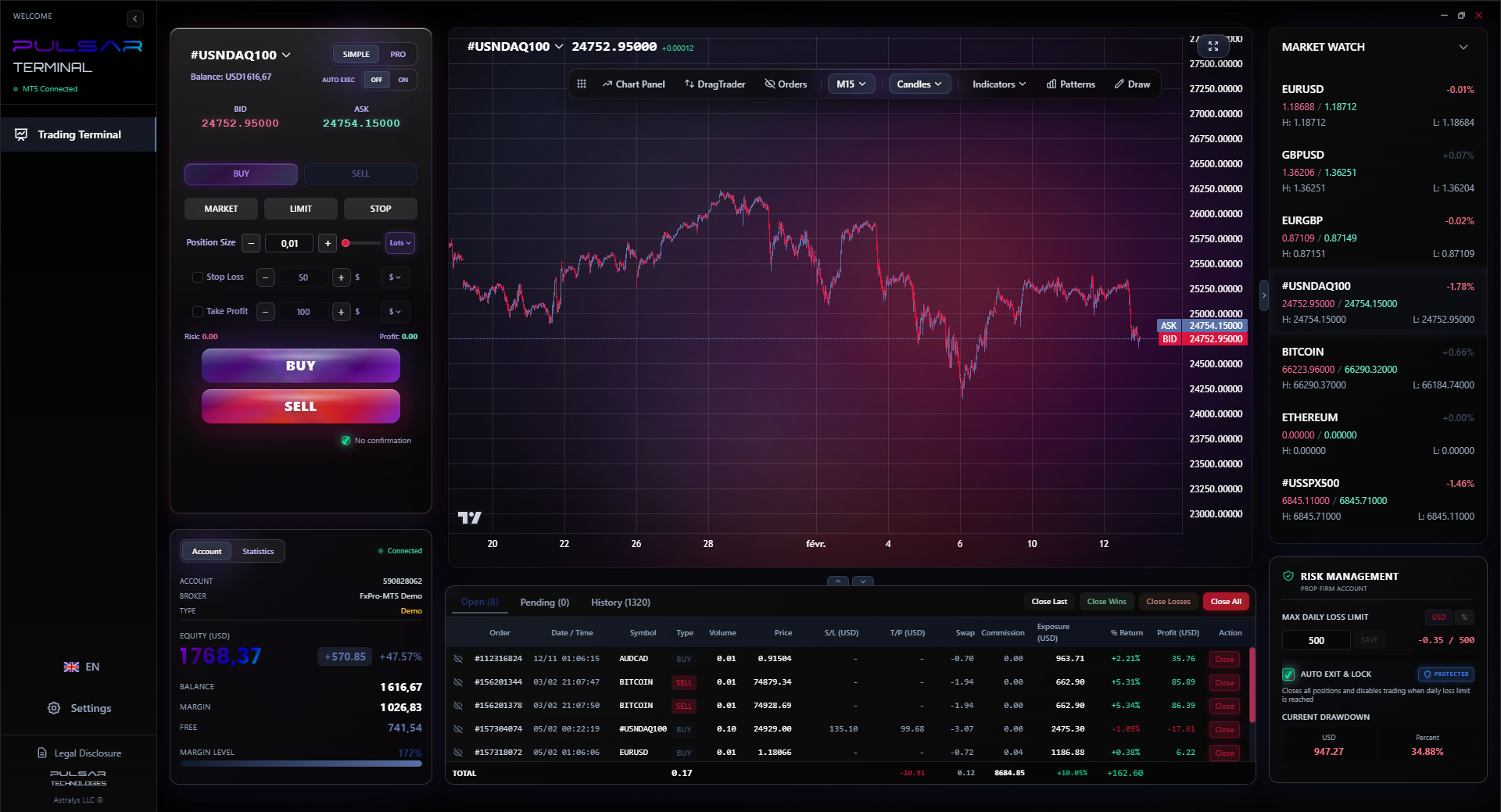
Managing intraday equity in real-time to avoid drawdown breaches is a constant battle, which is why I rely on Pulsar Terminal's automated trade management to lock in breakeven and trail stops without hesitation.
Pulsar Terminal
The all-in-one MT5 companion: drag-and-drop orders, multi-TP/SL, trailing stop, grid trading, Volume Profile, and prop firm protection. Used by 1,000+ traders daily.
The prop landscape has changed. The wave of firm closures in 2024-2025 weeded out the shady shops that were just selling dreams. The survivors are more serious, and their rules are stricter. Understanding drawdown isn't enough anymore; you have to build your entire operation around it.
Your checklist before buying a challenge:
- Identify the Drawdown Type: Is it Daily (EOD) or Intraday? Never assume.
- Calculate Real Numbers: 5% of $100k is $5,000. How many trades of your typical size is that? Do the math now.
- Check the Broker: Who is the liquidity provider? What are the typical spreads on your chosen instrument? Test it on a demo if possible.
- Plan Your Defense: Will you use automated trade management? How will you monitor equity? What's your hard stop for the day?
Comparing daily and intraday drawdown in prop trading firms is the fundamental analysis. It's more important than your entry signal. Get this wrong, and you're just donating your challenge fee. Get it right, and you've built the foundation for a funded career. I had to lose real money to learn that. You don't have to.
FAQ
Q1Which is better, daily or intraday drawdown?
Neither is universally "better." Daily (EOD) drawdown is better for most retail traders, especially swing traders, as it allows for intraday volatility. Intraday drawdown is stricter and favors scalpers or algorithmic traders with tiny, controlled risk per trade. Choose based on which one fits your natural trading style.
Q2If I have a daily drawdown limit, can I lose that amount every day?
Technically, yes, but it's a terrible plan. Remember, you also have an overall maximum drawdown (e.g., 10%). If you lose 4% daily, you'll hit your 10% max loss in just 3 days. The daily limit is a per-session guardrail, not a daily target.
Q3Can a momentary spike in spread cause an intraday drawdown violation?
Absolutely. This is a major risk. If the market gaps or spreads widen dramatically on a news event, your floating loss can instantly plunge your equity below the limit. This is why trading around high-impact news is extremely dangerous under intraday rules and why broker quality matters.
Q4Do profits increase my daily drawdown limit?
Almost never. The limit is almost always a percentage of your initial balance or starting equity for the day. If you start a $100k account with a 5% ($5k) limit and make $10k, your daily limit is still $5k from the initial $100k. Your equity buffer is larger, but the rule's threshold hasn't moved.
Q5What happens if I violate a drawdown rule?
In the vast majority of prop firms, it results in immediate and automatic account termination for that challenge or funded account. There is typically no warning, no second chance. The account is closed, and any profits are forfeited.
Q6How can I protect myself from an intraday drawdown violation?
Use extremely small position sizes (0.1%-0.25% risk), set aggressive breakeven stops, avoid volatile market opens, and consider using trade management software that can automatically move stops to breakeven or trail them to protect your equity in real-time.
Q7Are prop firm drawdown rules regulated?
Generally, no. These are contractual rules set by the private firm. The regulatory focus (e.g., SEC, FINRA) is on capital adequacy and how client funds are handled, not on the specific profit/drawdown terms of a trader challenge. This is why reading and understanding the firm's Terms of Service is entirely your responsibility.
Prof. Winston's Lesson
Key Takeaways:
- ✓EOD drawdown checks your balance at the close; intraday monitors equity in real-time.
- ✓A 5% daily limit on a $100k account is a $5,000 loss allowance, not a target.
- ✓Intraday rules reduce your loss buffer as you profit, increasing risk.
- ✓Always calculate position size based on the drawdown's reference point (initial vs. current balance).
How useful was this article?
Click a star to rate
Weekly Trading Insights
Free weekly analysis & strategies. No spam.
About the Author
James Mitchell
Senior Trading Analyst
Based in New York with over 9 years of trading experience. Focuses on major USD pairs, prop firm challenges, and the US regulatory landscape.
Comments
Risk Disclaimer
Trading financial instruments carries significant risk and may not be suitable for all investors. Past performance does not guarantee future results. This content is for educational purposes only and should not be considered investment advice. Always conduct your own research before trading.
You Might Also Like

Cara Trading Forex Sukses: 7 Prinsip dari Trader Profesional
Cara trading forex sukses dengan 7 prinsip trader pro: manajemen modal, disiplin, journal trading, backtest. Data nyata, bukan janji profit palsu.
Jam Trading Forex Terbaik untuk Trader Indonesia: Panduan Lengkap dengan Tabel Waktu
Panduan jam trading forex untuk trader Indonesia. Tabel 4 sesi dunia, jam emas 20:00-00:00, sesi mana yang harus dihindari. Data akurat + tips dari trader berpengalaman.
Top 5 Sàn Forex Uy Tín Nhất 2026: Review Jujur dari Trader Indonesia
Top 5 sàn forex uy tín 2026 untuk trader Indonesia. Review jujur: spread, deposit, withdraw, dukungan lokal. Exness, XM, IC Markets & lebih.
Get Pulsar Terminal
All these calculators are built into Pulsar Terminal with real-time data from your MT5 account. One-click position sizing, automatic risk management, and instant calculations.
Get Pulsar Terminal