


I remember staring at my screen in late 2023, watching a small, consistent trade on USD/ZAR close for a R420 profit.

David van der Merwe
Emerging Markets Trader ·  South Africa
☕ 11 min read
What you'll learn:
- 1What 'Compound Interest Forex' Really Means (And What It Doesn't)
- 2The Math Behind the Magic (No Calculator Needed)
- 3Building Your South African Compounding Plan
- 4Pairs, Platforms, and Practicalities for ZAR Traders
- 5The Psychology of Compounding: Your Biggest Hurdle
- 6Common Pitfalls (And How I Stepped in Them So You Don't Have To)
- 7Getting Started Today: Your Action Plan

I remember staring at my screen in late 2023, watching a small, consistent trade on USD/ZAR close for a R420 profit. Nothing spectacular. But instead of withdrawing it for a nice dinner, I left it in the account. That decision, repeated over months, turned a R10,000 starting capital into something that actually changed my financial picture. That's the quiet power of compound interest forex in action. It's not a magic product or a secret signal - it's a brutally simple mathematical principle applied to your trading profits. And in the South African market, where rand volatility can be both a curse and an opportunity, understanding how to use compounding correctly is what separates the dreamers from the builders.
Let's cut through the noise first. You'll see Instagram gurus promising 'compound interest forex accounts' that'll make you rich overnight. That's nonsense. In our context, compound interest forex simply means reinvesting your trading profits back into your trading capital, so future profits are calculated on a larger base. It's a strategy, not a product. The 'interest' is your own generated profit.
The power is in the snowball effect. Say you start with R15,000. You aim for a modest 3% return per month (ambitious, but let's use it). Month one, you make R450. If you add that to your capital, month two you're aiming for 3% of R15,450, which is R463.50. Small difference, right? But fast forward. By month 12, your target profit is on a capital of over R21,000. That monthly profit is now around R640. The growth accelerates because you're earning 'profit on your profits'.

Warning: This works both ways. Compound losses will destroy an account even faster. If you lose 3% per month, you don't just go to zero slowly. The decreasing capital base means each loss hurts more in percentage terms. That's why risk management isn't just a good idea here; it's the entire foundation. A single bad month can undo months of careful compounding. I learned this the hard way in 2022, letting a 10% drawdown slide because I was 'sure' the market would turn. It didn't. I wiped out three months of compounded gains in a week. My mistake? I focused on the compounding math for profits but ignored it for losses.
The local angle? Trading with a FSCA-regulated broker is non-negotiable. You're playing a long game. You need to know your Rands are safe, segregated, and that you have recourse if something goes wrong. Offshore 'bucket shops' promising insane use might turbocharge gains temporarily, but they'll vanish with your compounded capital when you need to withdraw.

💡 Winston's Tip
Forget the 1% risk rule for a moment. When compounding, your first rule is the 'Drawdown Reset.' After any month where you finish below your starting equity for that period, cut your next month's position size in half. Rebuild the foundation slowly.
“Compound interest forex isn't a magic product; it's a brutally simple mathematical principle applied to your trading profits.”
You don't need to be a mathematician, but you must respect the numbers. The core formula is simple: Future Value = Present Value x (1 + Rate)^Time.
Let's translate that to a real ZAR example. You deposit R20,000 with a broker like Pepperstone. Your goal isn't 100% a month; it's consistency. Let's say you average a net 2% monthly return after all costs (spreads, possible commissions).
The Realistic Projection
| Month | Starting Capital (ZAR) | 2% Profit (ZAR) | Ending Capital (ZAR) |
|---|---|---|---|
| 1 | R 20,000.00 | R 400.00 | R 20,400.00 |
| 6 | R 22,523.25 | R 450.47 | R 22,973.72 |
| 12 | R 25,364.84 | R 507.30 | R 25,872.14 |
See? After a year, you're making R507 in a month, not R400. The extra R107 is your money working for you. Now, here's the critical part almost everyone misses: Your 'Rate' is your average net return per period. This is NOT your win rate on trades. It's your account equity growth, after every single cost and loss is accounted for.

Example: If you make ten trades, win seven, but your winners are small and your losers are huge, your net return could be negative. You can't compound a negative. This is why a solid scalping strategy or swing trading plan with a positive risk-reward ratio is more important than any compounding spreadsheet.
The Rule of 72
This is a trader's best friend. Divide 72 by your average monthly percentage return to estimate how many months it will take to double your money. At 2% per month: 72 / 2 = 36 months, or 3 years. At 3% per month: 24 months. This instantly shows why chasing 10% returns is a dangerous game - the risk required usually leads to a blow-up long before month 7 (72/10 = 7.2).
“You cannot multiply zero. If your trading strategy doesn't consistently generate net profits, compounding just amplifies your losses.”
This is where we get practical. A plan without local context is just theory.
Step 1: Set Your Compounding Parameters.
- Starting Capital: Use only risk capital. That R10,000 you were saving for a holiday? Not it. I started my last compounding run with R12,500 - money I was truly okay with losing.
- Profit Target Per Period: Be brutally conservative. Aim for 1-2% per month on your total equity. Yes, it sounds boring. A 2% monthly target is a 26.8% annual return if compounded. That smashes any fixed deposit. My most successful compounding year ever was 2023, where I netted 31%. I did it by hitting lots of 0.8% and 1.2% months, not chasing 10% moonshots.
- Reinvestment Rate: Will you compound 100% of profits? 50%? I use a hybrid. I compound 100% until I hit a milestone (e.g., R25,000), then I withdraw 20% of profits each month as a 'salary'. This keeps me motivated and connected to real money.
Step 2: The Non-Negotiables (The Boring Stuff).
- Risk Per Trade: This is your lifeline. Never, ever risk more than 1% of your current account equity on a single trade. As your account compounds from R20k to R30k, your position size increases accordingly. Use a position size calculator for every single trade. This automates the compounding process for you.
- Broker Choice: You need a reliable, FSCA-regulated broker with tight spreads on the pairs you trade. Every pip saved on the spread is a pip added to your compounding rate. For us, watching USD/ZAR or EUR/ZAR, spreads matter a lot.
- Record Everything: Not just wins and losses. Track your net return each month. That's your true compounding rate.

Pro Tip: Open a separate, specific trading account for your compounding experiment. Mentally wall it off. Don't dip into it for other trades. Seeing that single equity curve grow is powerful psychological reinforcement.

“You cannot multiply zero. If your trading strategy doesn't consistently generate net profits, compounding just amplifies your losses.”
Your instrument choice and tools directly impact your ability to compound.
Trading the Rand: USD/ZAR is the obvious playground. It's volatile, liquid, and you understand the fundamental drivers (SARB rates, Eskom, politics). But that volatility is a double-edged sword. A sudden spike can hit your stop-loss and set back your compounding cycle. Many successful compounders I know focus on major pairs like EUR/USD for their consistency and lower spreads, then maybe allocate a smaller portion to ZAR pairs for opportunistic trades. XAU/USD (Gold) can also be a good diversifier in a compounding portfolio, often moving independently of currencies.
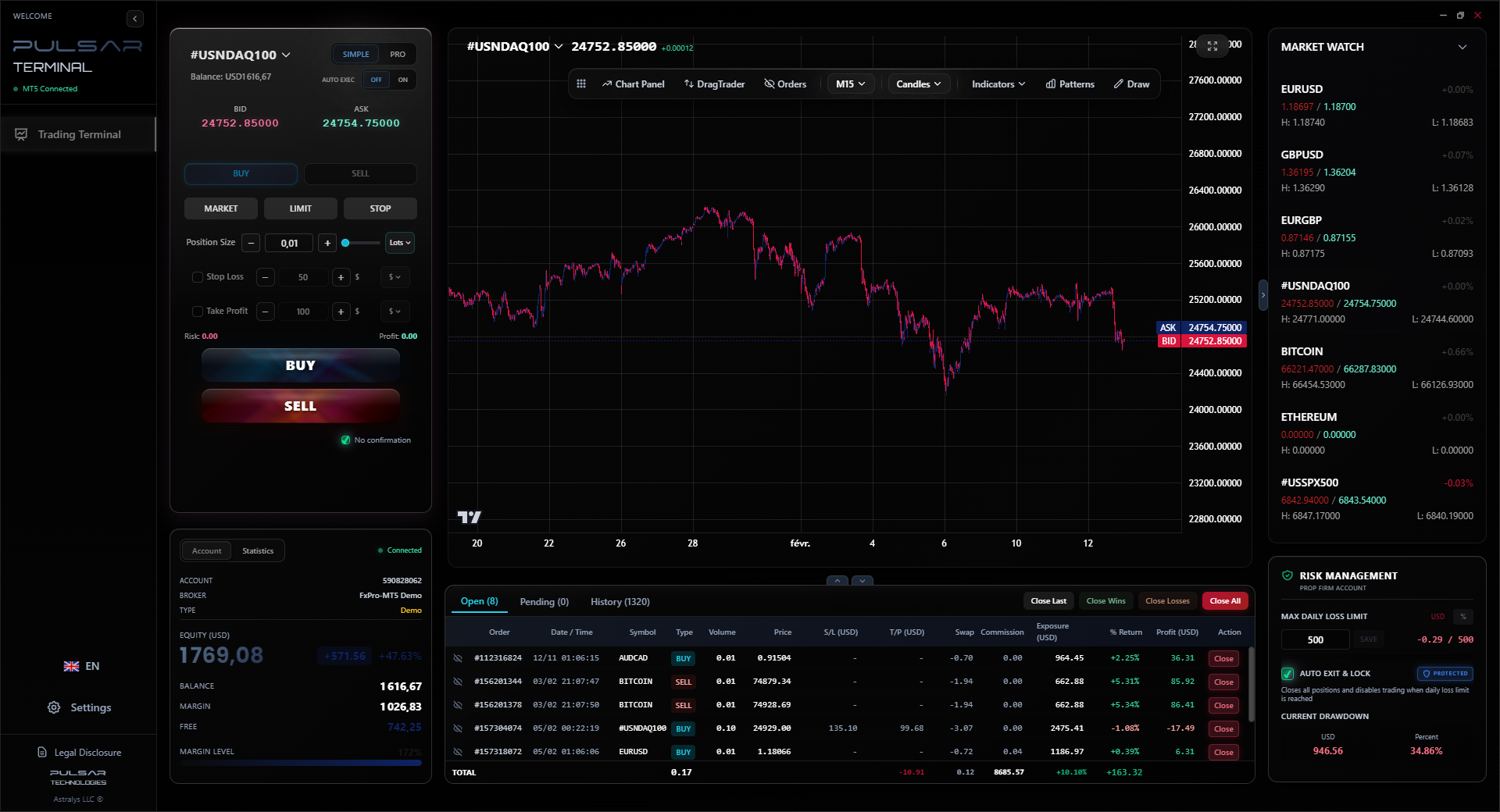
Platforms for the Long Haul: You'll be in this for months or years. You need a stable platform. MT4 or MT5 are the standards for a reason. Their charting tools let you backtest your strategy, and their stability is proven. This is where a tool like Pulsar Terminal, which integrates directly with MT5, can be a serious upgrade. Managing dozens of trades as your account grows can get messy.
Costs That Kill Compounding:
- Spreads: A 3-pip spread on USD/ZAR means you're down R30 on a standard lot before you even start. On a R20k account aiming for 2% (R400), that's 7.5% of your target profit gone immediately. Look for brokers with raw spreads.
- Swap Fees: If you hold positions overnight, these can add up. They can be positive or negative. Check your broker's swap sheet. In a compounding strategy, a consistently negative swap on a pair you trade often is a silent leak.
- Withdrawal Fees: If your broker charges R200 to withdraw your hard-earned compounded profits, that's a direct tax on your success. Factor this in when choosing a broker like XM or others - check their local bank transfer fees.
💡 Winston's Tip
The most powerful number in your compounding journey isn't your target return. It's your 'Survival Rate' - the percentage of months you end in profit, regardless of size. Aim for a 70%+ survival rate over a 10% monthly target. Survival compounds. Hype doesn't.
“The 'It's Too Slow' impulse wrecks more compounding accounts than any bad trade. The process IS the result.”
The math is easy. The psychology is everything. Compounding is profoundly boring until it isn't. You'll face two huge mental traps.
Trap 1: The 'It's Too Slow' Impulse. After month three, making R600 feels insignificant. You'll see a USD/ZAR setup and think, "If I just double my lot size this once, I'll get a month ahead." This is the siren song that wrecks more compounding accounts than any bad trade. I have a note taped to my monitor: "The process IS the result." You're not trading for the R600; you're trading to execute the system that generates the R600, then the R618, then the R636. The moment you try to skip steps, you break the machine.
Trap 2: The 'It's My Money' Fallacy. When your account grows from R15,000 to R18,000, that R3,000 feels like a profit you can play with more loosely. It's not. It's now core capital. This is where your fixed 1% risk rule is sacred. Your position size should have crept up slightly with your equity, but your risk percentage must stay locked. Letting a winning streak inflate your risk tolerance is the fast track to a margin call.
How to Stay Sane: Set milestone rewards. When I crossed R25,000, I took my wife out for a fancy dinner with R500 of the profits. It made the abstract number real. Also, log out. Check your charts for setups, manage your trades, then close the platform. Staring at a slowly rising equity curve daily will drive you mad. Trust the weekly or monthly review instead.
Automation is your psychological ally. Using tools that help manage trades - like setting multiple take-profit levels or automating a trailing stop - removes emotional decisions from the process. When a tool handles the exit based on your pre-set rules, you're free to focus on finding the next high-probability entry, which is all you should be doing.
Sticking to your compounding rules requires iron discipline, and tools like Pulsar Terminal automate key parts of your trade management—like setting multiple take-profit levels and trailing stops—directly on your MT5 charts, removing emotion from the equation.
Pulsar Terminal
The all-in-one MT5 companion: drag-and-drop orders, multi-TP/SL, trailing stop, grid trading, Volume Profile, and prop firm protection. Used by 1,000+ traders daily.
“The 'It's Too Slow' impulse wrecks more compounding accounts than any bad trade. The process IS the result.”
Let me save you some money and heartache.
Pitfall 1: Compounding Without a Positive Edge. This is the cardinal sin. You cannot multiply zero. If your trading strategy doesn't consistently generate net profits over time, compounding just amplifies your losses. Before you think about compounding, spend months proving your strategy in a demo, then a small live account. Your edge is your everything. Is it based on RSI indicator divergences? MACD crossovers on a specific timeframe? Nail it down first.
Pitfall 2: Ignoring Drawdowns. In 2021, I had a sweet run: 8 green months in a row. My account was compounding nicely. Then came a 4-week drawdown of 8%. Because I was compounding, that 8% was a larger ZAR amount than any previous monthly profit. It felt devastating and I overtraded to recover, making it worse. The lesson? A drawdown is part of the journey. Your compounding plan must include a 'drawdown protocol' - like reducing position size by half after a 5% equity drop until you recover. Protect the capital base at all costs.
Pitfall 3: Changing Strategies Mid-Stream. You're compounding at 1.5% a month with a steady trend-following method. Then you hear about a killer new scalping technique. You switch. Your account, now tuned to one volatility profile and risk rhythm, gets whiplash. Stick to one proven strategy for the entire compounding cycle. The consistency of the input (your strategy) is what allows the compounding output to be predictable.
Pitfall 4: Not Accounting for All Costs. Your spreadsheet says you made a 2.5% return. Did you subtract spreads, commission, and bank fees for depositing your Rands? That 2.5% might be 2.1%. Over years, that difference is massive. Know your true, net return.

“In the volatile South African market, a disciplined compounding approach isn't just smart - it's essential for survival.”
Enough theory. Here's what you do this week.
- Audit Your Strategy: Are you consistently profitable over at least 3-6 months? Not just winning trades, but net positive in Rands? If not, stop. Go back to demo. This is the most important step.
- Define Your Numbers: Write them down.
- Starting Capital: ________ (e.g., R 8,000)
- Monthly Profit Target: ________ % (e.g., 1.5%)
- Risk Per Trade: ________ % of equity (MAX 1%)
- Milestone for First Profit Withdrawal: ________ (e.g., R 12,000)
- Open a Dedicated Account: Fund your new, separate account with your chosen FSCA-regulated broker. Start small. R5,000 is a perfectly fine beginning.
- Trade the Plan, Not the P&L: For the first month, ignore the final profit number. Focus only on executing every trade with perfect risk management. Did you use your position size calculator? Did you stick to your 1% risk? That's your success metric.
- Review and Compound: At the month's end, calculate your net return. Add 100% of that profit to your 'Starting Capital' for next month. Update your position sizing. Repeat.
Compound interest forex isn't a get-rich-quick scheme. It's a get-rich-slowly, get-rich-surely discipline. It turns trading from a casino into a business where you are the CEO, the risk manager, and the reinvesting shareholder. In the volatile South African market, that kind of disciplined approach isn't just smart - it's essential for survival and growth. Now, go build your snowball.
FAQ
Q1Is compound interest forex a real investment product I can buy?
No, absolutely not. It's a strategy, not a product. Any company or individual selling you a 'compound interest forex account' as a packaged investment is likely running a scam. True compounding is something you do yourself by reinvesting your own trading profits.
Q2What's a realistic monthly return to target for compounding in South Africa?
Aim for 1% to 2% net return per month on your total equity. This might sound low, but compounded over a year, 2% per month turns R10,000 into over R12,600. A 3% monthly target is very aggressive and often requires risk levels that make sustained compounding unlikely. Start conservative.
Q3Can I use compounding with a prop firm challenge?
Be very careful. Prop firm challenges have strict drawdown limits, often based on your starting balance or highest equity. Compounding increases your equity, which can actually work against you if the drawdown limit is static. For example, if your limit is 5% of the starting balance and you grow your account 10%, a 4% loss from the new peak might still breach the original 5% limit. Always read the rules closely.
Q4How do I calculate my new position size as my account compounds?
You must use a position size calculator for every trade. Your risk in Rands should always be a fixed percentage (e.g., 1%) of your current live equity. As your equity grows from R20,000 to R20,400, the Rand amount you risk per trade increases slightly (from R200 to R204). This automatic scaling is the engine of compounding.
Q5Should I trade ZAR pairs or major pairs for a compounding strategy?
A mix is wise, but lean on majors for core compounding. Pairs like EUR/USD typically have much lower spreads and smoother trends, making it easier to achieve consistent small gains. Use USD/ZAR or EUR/ZAR for opportunistic trades with a smaller portion of your capital. The high spread and volatility of ZAR pairs can eat into your consistent returns.
Q6When should I withdraw profits from a compounding account?
There's no right answer, but have a plan. A good method is to compound 100% of profits until you hit a specific capital milestone (e.g., double your starting capital). After that, you might withdraw 20-30% of monthly profits as a 'performance fee' and compound the rest. This keeps you motivated and tangibly rewards your discipline.
Q7What's the biggest mistake new compounders make?
Increasing risk after a few winning months. They see their account grow and think, "I can risk 2% now to speed things up." This violates the core principle. A single 2% loss after a string of 1% wins destroys multiple periods of progress. The risk percentage must stay constant, forever.
Prof. Winston's Lesson
Key Takeaways:
- ✓Your risk per trade must be a percentage of current equity, never a fixed Rand amount.
- ✓Target 1-2% monthly net return; 3% is the danger zone for most.
- ✓A 70% monthly 'Survival Rate' is more valuable than a 10% return target.
- ✓Use a separate, dedicated trading account for your compounding experiment.
How useful was this article?
Click a star to rate
Weekly Trading Insights
Free weekly analysis & strategies. No spam.
About the Author
David van der Merwe
Emerging Markets Trader
Johannesburg-based trader with 11 years in emerging market currencies. Specializes in ZAR pairs, FSCA-regulated trading, and South African market analysis.
Comments
Risk Disclaimer
Trading financial instruments carries significant risk and may not be suitable for all investors. Past performance does not guarantee future results. This content is for educational purposes only and should not be considered investment advice. Always conduct your own research before trading.
You Might Also Like

Cara Trading Forex Sukses: 7 Prinsip dari Trader Profesional
Cara trading forex sukses dengan 7 prinsip trader pro: manajemen modal, disiplin, journal trading, backtest. Data nyata, bukan janji profit palsu.
Jam Trading Forex Terbaik untuk Trader Indonesia: Panduan Lengkap dengan Tabel Waktu
Panduan jam trading forex untuk trader Indonesia. Tabel 4 sesi dunia, jam emas 20:00-00:00, sesi mana yang harus dihindari. Data akurat + tips dari trader berpengalaman.
Top 5 Sàn Forex Uy Tín Nhất 2026: Review Jujur dari Trader Indonesia
Top 5 sàn forex uy tín 2026 untuk trader Indonesia. Review jujur: spread, deposit, withdraw, dukungan lokal. Exness, XM, IC Markets & lebih.
Get Pulsar Terminal
All these calculators are built into Pulsar Terminal with real-time data from your MT5 account. One-click position sizing, automatic risk management, and instant calculations.
Get Pulsar Terminal