


I was staring at the USD/ZAR chart on a Tuesday morning in late 2025, my finger hovering over the sell button.

David van der Merwe
Emerging Markets Trader ·  South Africa
☕ 11 min read
What you'll learn:
- 1What Confluence Actually Means (It's Not Magic)
- 2Building Your Confluence Checklist: A Practical Framework
- 3Trading It in South Africa: Costs, Brokers & The FSCA Reality
- 4Real Trade Examples & The Mistakes I Made
- 5Beyond Indicators: Advanced Confluence with Pure Price
- 6Putting It All Together: Your South African Trading Plan
I was staring at the USD/ZAR chart on a Tuesday morning in late 2025, my finger hovering over the sell button. Price was nudging R18.85, a level that had capped rallies three times before. My RSI was screaming overbought at 78. But I'd been burned before by a single indicator. That day, I waited. An hour later, a clear bearish engulfing candle printed right on that resistance, and the MACD histogram started rolling over. Three separate signals, one price. That's confluence. I sold, placed my stop above the high, and didn't look back for 150 pips. That's the power of not putting all your faith in one idea.
Forget the fancy definitions. In plain English, confluence in forex means getting a second, third, or fourth opinion before you put your money on the line. It's the trading equivalent of not buying a used bakkie just because the paint looks good. You check the engine, you kick the tyres, you take it for a test drive.
In practice, it's the alignment of two or more independent techniques pointing to the same trade idea. The key word is independent. Using two indicators that both calculate the average price (like a 50-period and a 200-period SMA) isn't real confluence. That's just getting the same answer twice. Real confluence mixes different types of analysis.
Think of it this way: a support level tells you where price might bounce. An oversold RSI tells you when momentum is exhausted. A bullish candlestick pattern tells you how the battle between buyers and sellers is shifting. When all three line up at the same spot on your chart, you've got a case. The probability isn't guaranteed, but it's significantly better than a coin flip. This is the core skill that separates consistent traders from gamblers. It forces patience and filters out the noise, which in a volatile market like the ZAR pairs, is absolutely critical.

Warning: Confluence doesn't mean "add more indicators until your chart looks like a Christmas tree." More signals from the same source (like five different moving averages) add complexity, not clarity. You're looking for quality confirmations, not quantity.

💡 Winston's Tip
A level is only 'key' if price has visibly reacted to it at least twice before. Once is an accident, twice is a coincidence, three times is a level you can trade.
“Confluence is the trading equivalent of not buying a used bakkie just because the paint looks good.”
You need a system, or you'll just chase every little blip on the chart. Here’s a simple, effective framework I teach my students. Treat it like a pre-flight checklist. You need at least two, preferably three, items checked before you take off.
The Core Pillars of Confluence
- Market Structure & Key Levels: This is your foundation. Is price approaching a clear support or resistance zone? This could be a horizontal level, a trendline, or a round number (like R19.00 for USD/ZAR). In South Africa, paying attention to local market opens (9am SAST) and liquidity sessions is part of this. A level that has been tested multiple times is stronger than a new one.
- Price Action Confirmation: What are the candles doing at that level? Look for reversal patterns like pin bars, engulfing candles, or inside bars. A massive bullish candle breaking through resistance is a different signal than a small doji sitting on resistance. Price action is the purest read of auction market sentiment.
Adding Confidence with Tools
- Momentum/Oscillator Alignment: This is where tools like the RSI indicator or MACD indicator come in. Is the RSI showing divergence at your key level? Is the MACD crossing its signal line? These shouldn't lead your decision, but they can confirm the momentum shift your price action is suggesting.
- Fibonacci Confluence: If a key level aligns with a Fibonacci retracement level (like the 61.8% or 78.6%), it adds weight. For example, if USD/ZAR pulls back to the 61.8% retracement of its last major swing and that level is also previous support, you have a stronger case.
Here’s a simple table for a buy signal example:
| Confluence Element | What to Look For | Why It Matters |
|---|---|---|
| Key Level | Price at a major historical support zone. | Defines the risk/reward. Your stop goes below it. |
| Price Action | Bullish engulfing or pin bar forming at that support. | Shows buyers are actively stepping in. |
| Momentum | RSI shows bullish divergence (higher low on RSI, lower low on price). | Signals selling pressure is waning. |

Pro Tip: Write your confluence criteria down on a sticky note next to your screen. For example: "Need: 1) Key S/R, 2) PA Pattern, 3) RSI/MACD agree." It stops you from making emotional exceptions.
“Your job is to wait for that 1 perfect setup out of 10 potential ones. The market rewards patience far more than activity.”
Understanding confluence is one thing. Executing it profitably in the South African market is another. You have to factor in the real costs and work with a legitimate broker. Let's get blunt about the numbers.
The Financial Sector Conduct Authority (FSCA) is your first line of defence. Always verify your broker's FSP number on the FSCA website. A regulated broker must keep client funds in segregated accounts - your money isn't theirs to play with. This is non-negotiable. The recent removal from the FATF grey list (Oct 2025) is a positive sign, but you still need to do your homework.
Your trading costs eat directly into the profits your beautiful confluence setup provides. Here’s the breakdown for a typical 1 standard lot (100,000 units) trade on EUR/USD or USD/ZAR:
- Spreads: This is the main cost for most. On majors like EUR/USD, top-tier brokers offer raw spreads from 0.0 pips, but you pay a commission. Spread-only accounts might have averages of 0.8-1.3 pips. For USD/ZAR, expect variable spreads that can widen during local news or low liquidity. A 5-pip spread on ZAR pairs is not uncommon.
- Commissions: Often $3-$7 per lot, per side. So a round turn (open and close) might cost $6-$14. On a scalping strategy with many trades, this adds up fast.
- Swap/Overnight Fees: If you hold a position past 10pm SAST (MetaTrader rollover), you pay or receive interest. For a swing trading approach, you must calculate this. Holding a ZAR-based pair can have significant swap rates.
Broker Context: I've used several. For raw spreads and low commissions, I've found brokers like Tickmill (FSCA regulated) excellent. Their Raw account had EUR/USD spreads at 0.1 pips with a $4 commission. For beginners or those wanting ZAR accounts, Exness (also FSCA regulated) is a solid choice with a low minimum deposit. Their Standard account has no commission but wider spreads. The choice depends on your style: high volume scalpers need low all-in costs, while swing traders can tolerate slightly wider spreads.

Example: A bad confluence trade on USD/ZAR. I entered a buy on a pin bar at support, but ignored the wide 7-pip spread. Price needed to move 7 pips just for me to break even. It ticked up 5 pips and reversed. I lost not because my analysis was wrong, but because I didn't account for the cost of doing business. Always use a position size calculator that includes spread.
💡 Winston's Tip
If you have to squint or convince yourself that an indicator 'sort of' agrees, it doesn't count. Confluence should be obvious, not arguable.
“I lost 2% of my account because I forced a trade that only had one-and-a-half confirmations. The market fined me for it immediately.”
Let's get into the messy details with real numbers. This is where theory meets the hard Rand.
Example 1: The Good (USD/ZAR Short - Oct 2025)
- Setup: Price approached a strong resistance zone at R18.82-18.85 (previous swing high, psychological level).
- Price Action: A bearish engulfing candle formed after a small rally into the zone.
- Momentum: The 4-hour RSI showed clear bearish divergence (price made a higher high, RSI made a lower high).
- My Action: Sold at R18.83. Stop loss placed at R18.95 (just above the resistance zone). Take profit set at R18.50 (near next support).
- Result: Risk: 120 pips (R18.95 - R18.83). Reward: 330 pips (R18.83 - R18.50). Risk/Reward ~ 1:2.75. Trade hit take profit over 3 days. Confluence worked: Structure, PA, and Momentum.
Example 2: The Bad (My Expensive Lesson on EUR/USD) I got cocky. I saw the EUR/USD guide hitting a trendline. The MACD was curling up. I bought. What did I miss? The overall daily trend was still bearish (I was trading against the major trend). The "confluence" was weak - just a trendline and one indicator. Price tapped the trendline, stalled for two candles, and then plummeted. I lost 2% of my account because I forced a trade that only had one-and-a-half confirmations, not two or three. I violated my own rules. The market fined me for it immediately.
The Local Mistake: Trading USD/ZAR around the SA budget speech without adjusting position size. Even with confluence, news volatility can blow through any technical level. I had a perfect setup on the 1-hour chart in February 2024. Entered, and then the finance minister started speaking. A 50-pip move against me in 90 seconds triggered my stop. Lesson? On high-impact local news days, either don't trade ZAR pairs, or reduce your size so the margin call risk is minimal. Confluence isn't a forcefield against fundamental shocks.
“I lost 2% of my account because I forced a trade that only had one-and-a-half confirmations. The market fined me for it immediately.”
As you mature as a trader, you'll start to see confluence within price action itself. This is high-level stuff, and it's incredibly powerful because it's based on what price is actually doing, not a derived calculation.
Order Block Confluence: This is a concept from institutional order flow. An "order block" is a candle (or series of candles) that represents a strong imbalance where large orders were filled. A bullish order block is a strong down candle that is later reclaimed by price. The confluence happens when price returns to the edge of this old block and shows a reversal pattern. So your confluence is: 1) Key Order Block Level, 2) Price Action Reversal Signal (like a pin bar) at that exact level.
Liquidity Confluence: Smart money often aims for stops. A common setup is a "liquidity grab." Price may make a sharp, brief move above a obvious resistance level (taking out all the buy stops) before reversing sharply downward. The confluence here is: 1) A clear resistance level, 2) A false break (wick) above it, 3) A strong close back below the level. This three-part price action story is a confluence of structure, manipulation, and rejection.
Volume Profile Confluence: This is where a tool like the Volume Profile can be a game-changer (though I promised not to use that term). It shows you where most trading activity happened over a period. A key horizontal support level that also aligns with the
Pro Tip: To see these advanced confluences clearly, you need a clean chart. Strip off most of your indicators for a week. Just draw your levels and watch the candles. You'll start to see the story price is telling. Tools that help you visualize these areas, like certain MT5 add-ons, can give you an edge by automating the drawing of key zones.
💡 Winston's Tip
Your best confluence trades will feel boring to enter. The excitement comes from the profit, not the entry.
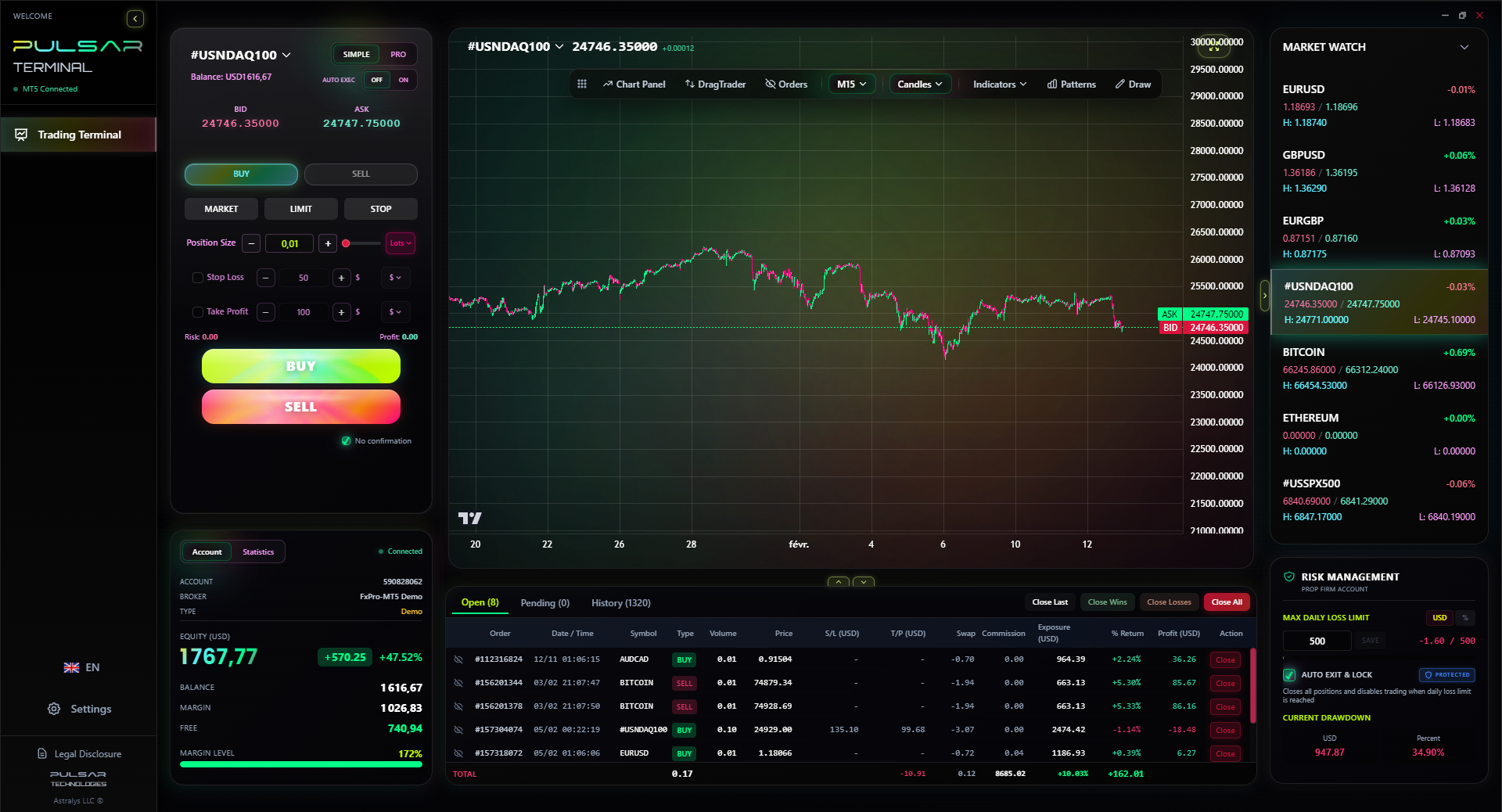
Identifying advanced confluences like order blocks and liquidity zones requires clean, precise charting, which is where a tool like Pulsar Terminal's suite of drawing tools and pattern recognition can save you hours of manual work on your MT5 charts.
Pulsar Terminal
The all-in-one MT5 companion: drag-and-drop orders, multi-TP/SL, trailing stop, grid trading, Volume Profile, and prop firm protection. Used by 1,000+ traders daily.
“Confluence increases the probability of success on any single trade. It's about stacking the odds in your favour over a large series of trades.”
Knowledge is useless without application. Here’s how to build this into your daily routine.
Step 1: The Daily Scan (15 mins) Open your 3-5 preferred pairs (e.g., EUR/USD, USD/ZAR, XAU/USD guide). On the daily and 4-hour charts, mark the obvious support and resistance levels. Note the overall trend. Don't look for trades here, just map the battlefield.
Step 2: The Confluence Hunt (Your Trading Session) Now, drop to your preferred trading timeframe (1-hour or 4-hour are good for most). Look for price approaching your pre-drawn levels. Ask the checklist questions:
- Is this a clear level from my map? (Structure)
- What is the candle doing here? (Price Action)
- Does the RSI/MACD support this? (Momentum) If you get 2-3 yeses, move to planning.
Step 3: The Risk Drill Before you even think about the buy button, calculate:
- Entry: Precise price.
- Stop Loss: Must be beyond the level that invalidates your confluence idea. If buying at support, your stop goes below the support zone.
- Take Profit: Aim for a minimum 1:1.5 risk-to-reward. The next resistance zone is a good target.
- Position Size: Use your position size calculator. For a R50,000 account risking 1% (R500), with a 50-pip stop on USD/ZAR, your position size is calculated as: Risk (R500) / (Stop in Pips * Pip Value). Get this wrong, and nothing else matters.
Final, Blunt Advice: You will see 10 potential setups for every 1 that meets your strict confluence criteria. Your job is to wait for that 1. The market will reward patience far more than it will reward activity. For the South African trader, this means sometimes sitting out during thin liquidity or around local news, even if a level "looks" good. Preserve your capital. The perfect confluence trade will come next week, next month. Be there, with money in your account, ready to take it.
FAQ
Q1What is a simple example of confluence in forex?
A simple example: The USD/ZAR price hits a strong support level that has held twice before. At the exact same level, the RSI indicator drops into oversold territory (below 30) and a bullish hammer candlestick forms. The support level (structure), the oversold RSI (momentum), and the hammer (price action) all agree a bounce is likely. That's confluence.
Q2How many confirming factors do I need for true confluence?
You need at least two, but aim for three independent factors. Two is the minimum to call it confluence (e.g., a key level and a candlestick pattern). Three significantly increases your odds (adding momentum divergence or a Fibonacci level). More than three from different analysis types is great, but don't force it - clarity is more important than complexity.
Q3Does confluence guarantee a winning trade?
Absolutely not. Nothing guarantees a win in trading. Confluence increases the probability of success on any single trade. It's about stacking the odds in your favour over a large series of trades. A good confluence setup might have a 60-65% win rate, which, combined with solid risk management, leads to long-term profitability. It's about being consistently less wrong.
Q4What's the biggest mistake traders make with confluence?
They see one strong signal (like a perfect pin bar) and then go hunting for any other indicator that vaguely agrees to justify the trade. That's backwards and desperate. Real confluence requires the signals to appear naturally and clearly at the same point. The other big mistake is ignoring the cost (spread) which can turn a technically good confluence setup into a losing trade if the market doesn't move enough.
Q5Are FSCA-regulated brokers safe for trading with this strategy?
FSCA regulation is the baseline for safety in South Africa. It means the broker must follow strict rules, including segregating client funds. This protects your capital from the broker going bankrupt. However, it does not protect you from market losses due to your own trading decisions. Always verify the FSP number on the FSCA website and choose a broker with a track record, like those we've discussed.
Q6Can I use confluence for scalping the ZAR pairs?
Yes, but it's harder. Timeframes are compressed, so your confluence must be on a lower timeframe (like 5 or 15-minute charts). You need to account for wider spreads on ZAR pairs, which can be 5+ pips. Your confluence needs to signal a move large enough to cover the spread and still make a profit. It's a higher-pressure environment better suited to experienced traders.
Q7What's one tool that can help find confluence faster?
A trading platform or add-on that allows you to easily visualize multiple elements helps. For example, being able to quickly draw Fibonacci retracements over multiple swings, or having Volume Profile areas plotted automatically, saves time. The key is finding a tool that presents information cleanly without cluttering your chart, letting you focus on the alignment of signals.
Prof. Winston's Lesson
Key Takeaways:
- ✓Require at least 2 independent confirmations before any trade.
- ✓Always calculate position size *after* defining your stop loss.
- ✓A 5-pip spread on ZAR pairs can kill a good scalping setup.
- ✓FSCA regulation is your minimum safety standard, not a performance guarantee.
How useful was this article?
Click a star to rate
Weekly Trading Insights
Free weekly analysis & strategies. No spam.
About the Author
David van der Merwe
Emerging Markets Trader
Johannesburg-based trader with 11 years in emerging market currencies. Specializes in ZAR pairs, FSCA-regulated trading, and South African market analysis.
Comments
Risk Disclaimer
Trading financial instruments carries significant risk and may not be suitable for all investors. Past performance does not guarantee future results. This content is for educational purposes only and should not be considered investment advice. Always conduct your own research before trading.
You Might Also Like

Cara Trading Forex Sukses: 7 Prinsip dari Trader Profesional
Cara trading forex sukses dengan 7 prinsip trader pro: manajemen modal, disiplin, journal trading, backtest. Data nyata, bukan janji profit palsu.
Jam Trading Forex Terbaik untuk Trader Indonesia: Panduan Lengkap dengan Tabel Waktu
Panduan jam trading forex untuk trader Indonesia. Tabel 4 sesi dunia, jam emas 20:00-00:00, sesi mana yang harus dihindari. Data akurat + tips dari trader berpengalaman.
Top 5 Sàn Forex Uy Tín Nhất 2026: Review Jujur dari Trader Indonesia
Top 5 sàn forex uy tín 2026 untuk trader Indonesia. Review jujur: spread, deposit, withdraw, dukungan lokal. Exness, XM, IC Markets & lebih.
Get Pulsar Terminal
All these calculators are built into Pulsar Terminal with real-time data from your MT5 account. One-click position sizing, automatic risk management, and instant calculations.
Get Pulsar Terminal