


Most traders I meet think consolidation is just boring market noise, a time to check out.

David van der Merwe
Emerging Markets Trader ·  South Africa
☕ 11 min read
What you'll learn:
- 1What Consolidation Really Is (It's Not Just a Flat Line)
- 2Why Markets Consolidate: The South African Angle
- 3How to Spot Consolidation Patterns (The Right Way)
- 4Trading Strategies for the Chop
- 5The Biggest Risks & How to Avoid Them
- 6Tools & Indicators That Actually Help
- 7Putting It All Together: A South African Trader's Plan
Most traders I meet think consolidation is just boring market noise, a time to check out. They're wrong, and that's why they lose money. Consolidation in forex isn't a pause in the action; it's the action. It's where retail accounts get ground down by whipsaws and false breakouts while the smart money accumulates positions. I've blown up an account trading breakouts from what I thought was a clean range, only to get slapped back inside. Let's set the record straight on how to read these phases, especially with our volatile ZAR pairs.
In simple terms, consolidation in forex is a period where the price moves sideways within a defined range after a strong trend. The bulls and bears are in a temporary stalemate. Think of it like a tug-of-war where neither side can pull the rope more than a few feet.
But here's the critical part most miss: consolidation isn't always a perfect rectangle. It can be a triangle, a wedge, or a flag. These are all consolidation patterns, just with different shapes and implications. The common thread is reduced volatility and a contraction in price movement.
For us in South Africa, watching USD/ZAR or EUR/ZAR, these phases are crucial. Our market can trend violently, then consolidate for days as local banks, miners, and international flows reassess. Trading during these times without a plan is a sure way to donate your capital to more patient players.

Warning: A common mistake is calling every little wiggle 'consolidation.' A genuine consolidation phase should be on a higher time frame (like the 1-hour or 4-hour chart) and follow a clear, sustained move. Don't get caught in the noise on a 5-minute chart.
Understanding the 'why' helps you anticipate the 'when.' Markets consolidate for specific reasons, and some are hyper-relevant to our local context.
Awaiting Macro Data
This is a big one. Before major data releases - like SA CPI figures, SARB interest rate decisions, or US Non-Farm Payrolls - the market often goes quiet. Traders aren't willing to commit big capital until they see the numbers. I've seen USD/ZAR get stuck in a 30-pip range for hours before a SARB announcement, only to explode 150 pips minutes later.
Profit-Taking and Position Squaring
After a big run, the smart money takes profits. If USD/ZAR rallies 500 pips in a week, banks and large funds will sell into that strength to lock in gains. This selling pressure meets any remaining buying, creating equilibrium. This is where retail traders often get caught buying the top, thinking the trend will continue forever.
Liquidity and Local Flows
In our time zone, especially during the Johannesburg session, liquidity can thin out compared to the London overlap. This can lead to choppy, range-bound price action on major pairs. Also, large corporate flows (like a mining company converting USD profits to ZAR) can create temporary support or resistance zones, pinning the price.
The key takeaway? Consolidation isn't random. It's a sign the market is digesting information, rebalancing, and preparing for the next major move. Your job is to figure out which way it's likely to break. For that, you need the right tools, which is why I rely on the Volume Profile indicator to see where the real trading activity is clustered during these quiet periods.

💡 Winston's Tip
The market spends more time consolidating than trending. If you only know how to trade trends, you'll be sitting on your hands most of the time. Learn to read the ranges.
“Consolidation in forex isn't a pause in the action; it's the action.”
You can't trade it if you can't see it. Here’s how I identify genuine consolidation, separating it from just messy price action.
First, switch to a higher time frame. The daily and 4-hour charts are your best friends. Look for a clear, prior trend. Then, you want to see price bouncing between two more-or-less horizontal levels. The touches should be clear rejections, not just price grazing a level.
Common Patterns You'll See:
| Pattern | What It Looks Like | What It Often Means |
|---|---|---|
| Rectangle/Range | Price oscillates between parallel support & resistance. | Pure equilibrium. Breakout direction is less predictable. |
| Triangle (Symmetrical) | Lower highs and higher lows, converging. | Compression. A volatility coil ready to spring. |
| Pennant/Flag | Small consolidation after a sharp move, sloping slightly against the trend. | Usually a continuation pattern. A brief pause before the trend resumes. |
I made a classic error early on. Back in 2019, EUR/USD was in a beautiful 80-pip range on the 4-hour chart. I got clever, selling the top and buying the bottom. It worked twice, netting me maybe 40 pips total. On the third attempt, price sliced through the top, didn't look back, and took out my poorly placed stop loss for a 50-pip loss. I gave back all my profits and more because I didn't respect that a breakout was coming. Tools like the MACD indicator can help gauge momentum fading during the range, but they're not a crystal ball.

Pro Tip: Draw your range lines on the closing prices of candles, not the wicks. Wicks show where price visited, but closes show where price settled. The body of the candle is where the real battle was won or lost.
You have two main choices during consolidation: trade the range or prepare for the breakout. Both can work, but they require completely different mindsets and risk management.
Fading the Range (The Mean Reversion Play)
This is the classic 'buy low, sell high' inside the channel. You buy near identified support and sell near resistance. The goal is small, consistent profits.
How I do it:
- Confirm a clear, multi-touch range on the H1 or H4 chart.
- Wait for price to reach the support or resistance zone.
- Look for a confirming reversal candle (like a pin bar or engulfing pattern).
- Enter with a tight stop loss just beyond the range boundary.
- Take profit near the opposite boundary.
The risk? The breakout that kills your trade. You must be disciplined and accept that this strategy has a lower win rate but aims for a positive risk-reward. Never add to a losing range trade. I use a position size calculator religiously here, as getting whipsawed can quickly amplify losses.
Preparing for the Breakout (The Momentum Play)
This is where I prefer to position myself. Instead of trying to scalp the range, I wait for the market to decide its direction and then join the move.
My breakout checklist:
- Volume: A real breakout should come with a spike in volume. A limp move on low volume is often a fakeout.
- Closing Power: Price needs to close convincingly outside the range, not just spike.
- Retest: Often, price will break out, then come back to retest the old range boundary (now turned support/resistance). This is a lower-risk entry.
For example, if I'm watching a EUR/USD range and price breaks above on strong volume, I might wait for a pullback to the former resistance. If it holds as new support, that's my entry signal. This patience has saved me from countless fakeouts.
Warning: The most tempting - and most dangerous - trade is the 'breakout fade.' You see a breakout and immediately bet it will fail. This is fighting the market's momentum and is a great way to have a series of small wins followed by one catastrophic loss.
💡 Winston's Tip
A narrow range (a tight consolidation) precedes a big move. A wide range often leads to more range-bound action. The tighter the coil, the stronger the spring.
“The most tempting - and most dangerous - trade is the 'breakout fade.'”
This is where most traders, including a younger version of me, blow up. Consolidation looks safe, but it's a minefield.
1. The False Breakout (The Fakeout): This is the #1 account killer. Price pushes beyond the range, you jump in, and it immediately reverses, stopping you out. I've been caught so many times. The fix? Don't buy the break. Buy the successful retest. Let the market prove the breakout is real by holding the new level.
2. Overtrading: Because moves are small, you're tempted to trade more frequently to 'make something happen.' This increases costs (spreads and commissions eat into tiny profits) and emotional fatigue. With a broker like Exness or Tickmill offering tight spreads, the cost is lower, but it's still a factor.
3. Ignoring the Higher Time Frame Trend: The most powerful breakouts often resume the trend that preceded the consolidation. If the market was in a strong uptrend before the range, the odds favor an upside breakout. Trading every range as a 50/50 coin flip ignores this context.
4. Poor Stop Placement: Placing your stop loss too tight inside the range guarantees you'll be stopped out by normal market noise. Place it beyond the range, accepting that the loss will be larger if you're wrong. This means trading a smaller position size. If you're constantly getting stopped out and then watching the trade go your way, your stop is in the wrong place.
A personal horror story: I was trading GBP/JPY during a tight consolidation. I placed my stop loss 5 pips inside the range, thinking I was being 'smart' and tight. Price dipped, took out my stop, and then rallied 70 pips exactly as I'd predicted. I lost R800 on the trade and missed a R3,000 gain. That was a R3,800 lesson in respecting market structure.
Indicators can add context, but they won't give you a magic signal. Here’s what I use to filter my decisions during consolidation.
Bollinger Bands: These are fantastic for visualizing consolidation. When the bands contract or 'squeeze,' it signals low volatility and often precedes a significant move. The breakout direction isn't signaled by the bands themselves, but the squeeze tells you to pay attention.
Average True Range (ATR): This indicator measures volatility. A declining ATR confirms that the market is indeed consolidating and volatility is dropping. You can also use it to set your stop losses dynamically - placing them at 1.5x the current ATR beyond the range, for instance.
Volume: As mentioned, this is key. Low volume during the range confirms the stalemate. A significant volume spike on a breakout attempt adds credibility. Most MT4/MT5 volume indicators are tick volume, not true forex volume, but it's still useful for comparison.
The Most Important Tool? Horizontal Lines. Seriously. Drawing clear support and resistance lines is 80% of the battle. Don't clutter your chart. A clean chart with a few key levels and maybe one indicator is far more powerful than a screen that looks like a spaceship dashboard.
I combine these with classic price action. For instance, if price is at the top of a range and forms a bearish engulfing candle while the RSI indicator is showing divergence (making a lower high while price makes a higher high), that's a much stronger signal to sell the range top than any one tool alone.
💡 Winston's Tip
Your first loss in a consolidation trade is usually your smallest. Adding to a losing position because 'the range should hold' is how a R500 mistake becomes a R5,000 margin call.
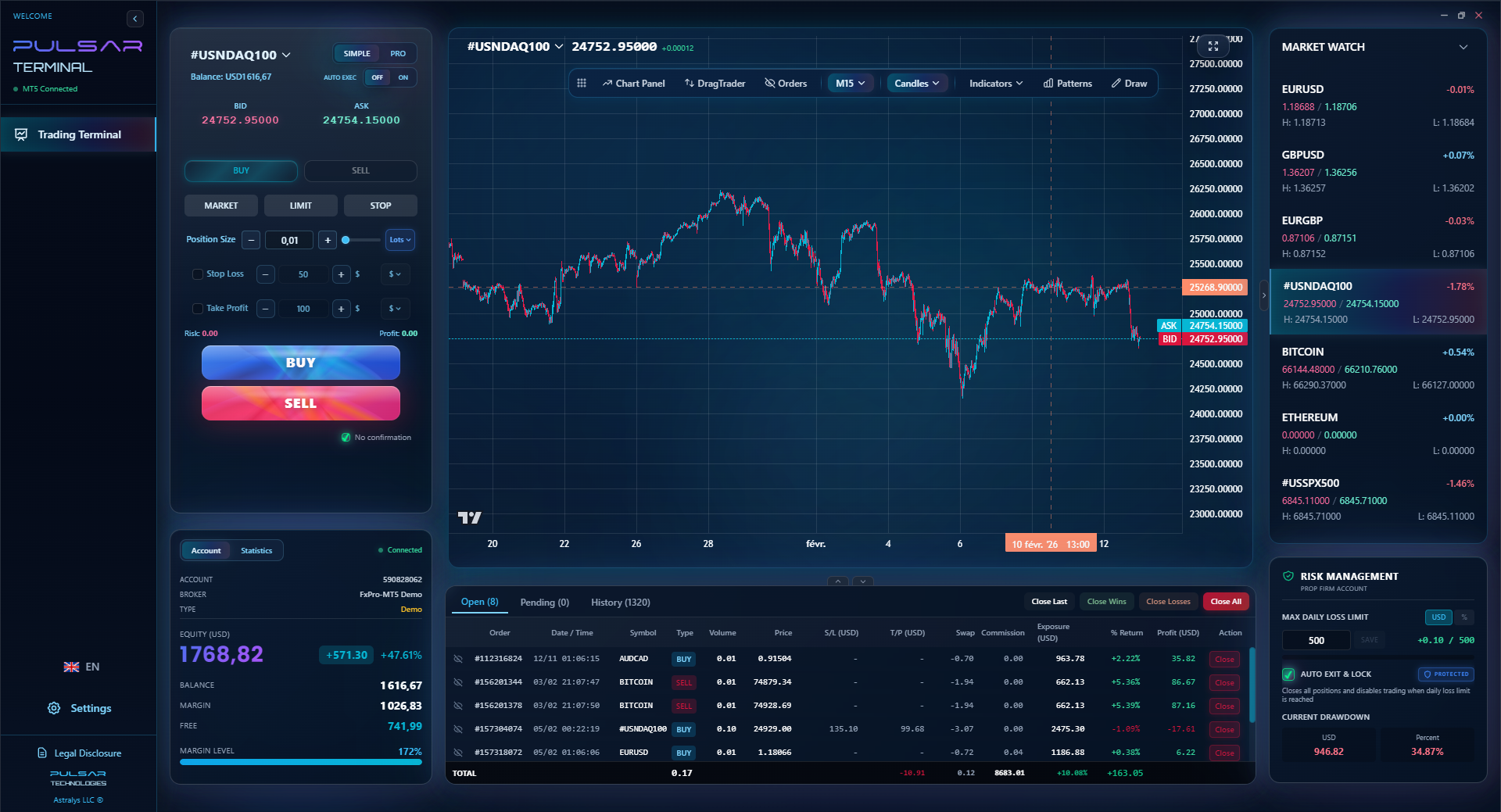
Managing multiple breakout and range trade scenarios is complex, but Pulsar Terminal lets you set multi-level take-profits and trailing stops directly on your MT5 chart, automating the plan you built during consolidation.
Pulsar Terminal
The all-in-one MT5 companion: drag-and-drop orders, multi-TP/SL, trailing stop, grid trading, Volume Profile, and prop firm protection. Used by 1,000+ traders daily.
“Sometimes the best trade is no trade. Preserving capital for high-probability setups is the hallmark of a professional.”
Let's build a practical plan for trading consolidation with our local market in mind.
Step 1: The Scan. Start your day on the Daily chart. Are any major ZAR pairs (USD/ZAR, EUR/ZAR) in a clear consolidation pattern after a trend? Note the key support and resistance levels.
Step 2: The Context. Check the economic calendar. Is there SARB speech, local CPI, or a major US event due? If yes, the market is likely consolidating ahead of that news. Your strategy should shift to preparing for a breakout, not fading the range.
Step 3: The Setup. Drop to the H4 chart. Refine your range levels. If you're considering a range trade, wait for price to reach the extreme with a reversal candle. If you're a breakout trader, set alerts at the range boundaries and wait.
Step 4: The Execution & Management.
- For a Range Trade: Enter, set stop loss beyond the range, set take profit near the opposite boundary. Do not move your stop loss into the range. If you get stopped out, the trade is over.
- For a Breakout Trade: Wait for a close outside the range. Consider waiting for a retest. Enter, place stop loss on the other side of the range. Your profit target can be measured by projecting the height of the range in the direction of the breakout.
Step 5: The Review. After the trade, win or lose, go back. Did the range hold? Was the breakout real? What was the volume like? This feedback loop is how you improve.
Remember, sometimes the best trade is no trade. If the consolidation is too messy, the range too narrow, or the news risk too high, just watch. Preserving capital for high-probability setups is the hallmark of a professional. This discipline is exactly what prop firms look for, and managing that daily risk limit is where tools that automate protection are useful.
FAQ
Q1Is forex trading legal in South Africa during market consolidation phases?
Yes, absolutely. Forex trading is legal for South African residents as long as you use a broker authorized by the Financial Sector Conduct Authority (FSCA). The legality doesn't change based on market conditions like consolidation. Always verify your broker's FSCA license number.
Q2What's a good ZAR pair to practice spotting consolidation?
USD/ZAR is your best textbook. It often has strong, clear trends followed by pronounced consolidation periods as the market absorbs local and global drivers. The ranges can be wider (100+ pips) making them easier to identify than on a pair like EUR/USD which might have tighter, noisier ranges.
Q3How do I know if a breakout from consolidation is real or a fakeout?
Look for three confirmations: 1) A strong closing candle outside the range (not just a wick). 2) An increase in trading volume on the breakout move. 3) A successful retest of the breakout level (the old range boundary now acts as support/resistance). If you get all three, the odds are much higher it's a real move.
Q4Should I use higher use during consolidation since the price isn't moving much?
This is a dangerous thought. No, you should not. In fact, you might consider using lower use. Consolidation often ends in volatile breakouts that can quickly move against you. High use during this low-volatility period can give a false sense of security, leading to oversized positions that get wrecked on the breakout. Stick to your normal risk parameters (e.g., risking 1-2% of your account per trade).
Q5What's the difference between consolidation and a market just being slow?
Consolidation has structure; it's price moving between defined, testable levels. A slow market is just low volatility with no clear direction or boundaries. Consolidation is a pattern you can trade. A slow, choppy market with no levels is often best avoided.
Q6Can I use a scalping strategy during consolidation?
You can, but it's tricky. A scalping strategy aims for very small profits on short time frames. During consolidation, spreads can become a larger percentage of your target profit, especially on exotic ZAR pairs. It requires a broker with extremely tight spreads and fast execution. It's often more suited to very experienced traders.
Prof. Winston's Lesson
Key Takeaways:
- ✓Trade the retest, not the initial breakout.
- ✓Always place stops BEYOND the range, not inside it.
- ✓Use the ATR indicator to gauge true volatility contraction.
- ✓On USD/ZAR, 100-pip ranges are common consolidation zones.
How useful was this article?
Click a star to rate
Weekly Trading Insights
Free weekly analysis & strategies. No spam.
About the Author
David van der Merwe
Emerging Markets Trader
Johannesburg-based trader with 11 years in emerging market currencies. Specializes in ZAR pairs, FSCA-regulated trading, and South African market analysis.
Comments
Risk Disclaimer
Trading financial instruments carries significant risk and may not be suitable for all investors. Past performance does not guarantee future results. This content is for educational purposes only and should not be considered investment advice. Always conduct your own research before trading.
You Might Also Like

Cara Trading Forex Sukses: 7 Prinsip dari Trader Profesional
Cara trading forex sukses dengan 7 prinsip trader pro: manajemen modal, disiplin, journal trading, backtest. Data nyata, bukan janji profit palsu.
Jam Trading Forex Terbaik untuk Trader Indonesia: Panduan Lengkap dengan Tabel Waktu
Panduan jam trading forex untuk trader Indonesia. Tabel 4 sesi dunia, jam emas 20:00-00:00, sesi mana yang harus dihindari. Data akurat + tips dari trader berpengalaman.
Top 5 Sàn Forex Uy Tín Nhất 2026: Review Jujur dari Trader Indonesia
Top 5 sàn forex uy tín 2026 untuk trader Indonesia. Review jujur: spread, deposit, withdraw, dukungan lokal. Exness, XM, IC Markets & lebih.
Get Pulsar Terminal
All these calculators are built into Pulsar Terminal with real-time data from your MT5 account. One-click position sizing, automatic risk management, and instant calculations.
Get Pulsar Terminal