


Ever looked at a trade, thought 'that's a small move, I'll just use a bigger position,' and then watched in horror as your P&L swung wildly? I have.

David van der Merwe
Emerging Markets Trader ·  South Africa
☕ 12 min read
What you'll learn:
- 1What Contract Size Actually Means (And Why It's Not Just a Number)
- 2The South African Rand in the Equation: Calculating Your Real Risk
- 3FSCA Rules & use: The 30:1 Reality Check
- 4Choosing Your Lot Size: A Strategy for Every Account
- 5The Hidden Tax: How Spreads & Commissions Eat Into Your Contract
- 6Mistakes I've Made (So You Don't Have To)
- 7Your South African Contract Size Checklist
Ever looked at a trade, thought 'that's a small move, I'll just use a bigger position,' and then watched in horror as your P&L swung wildly? I have. More than once. That gut-punch feeling is usually a contract size problem. In South Africa, with our unique FSCA rules and the Rand's volatility, getting your contract size forex calculation wrong isn't just a mistake, it's a fast track to a margin call. This isn't about complex theory. It's about the simple, brutal arithmetic that separates those who survive from those who get wiped out. Let's talk about how to stay in the game.
When we talk about contract size in forex, we're talking about the fundamental unit of your trade. It's the amount of the base currency you're buying or selling in a single transaction. Think of it as the building block. Every single calculation for your profit, loss, and required margin starts here.
Most brokers don't make you type in '100,000 units.' Instead, they use 'lots.' A standard lot is the default contract size of 100,000 units of the base currency. So, if you buy 1 standard lot of EUR/USD, you're effectively buying €100,000. That's a massive commitment, which is why most of us don't trade standard lots with our own capital. That's where fractional lots come in.
Here’s the breakdown you'll see on your MT4 or MT5 platform:
| Lot Type | Contract Size (Units) | What It Means for EUR/USD |
|---|---|---|
| Standard Lot | 100,000 | Buying €100,000 |
| Mini Lot | 10,000 | Buying €10,000 |
| Micro Lot | 1,000 | Buying €1,000 |
| Nano Lot | 100 | Buying €100 |
The nano lot (0.001 lots on your platform) is a lifesaver for proper risk management, especially when you're starting out or testing a new strategy. I learned this the hard way early on. I was trading GBP/USD with mini lots (0.1), thinking I was being conservative. The pair moved 120 pips against me on a news event. At 0.1 lots, that was a $120 loss. On a R15,000 account, that was nearly 12% gone in minutes. If I'd used a micro lot (0.01), the loss would have been R180, a much more manageable 1.2%. That trade was a cheap lesson in the raw power of contract size.

Warning: Don't let the small numbers on a micro or nano lot fool you. When you apply the 30:1 use allowed by the FSCA for retail traders, you're still controlling a significant amount of currency. A 1 micro lot trade (€1,000) with 30:1 use only requires about €33.33 in margin, but your profit and loss are calculated on the full €1,000 move. That's the use trap.

💡 Winston's Tip
Your first job is capital preservation, not appreciation. A contract size that risks more than 2% of your account on a single idea is a speculation, not a trade. Treat it as such.
This is where theory meets the tarmac. For us trading from South Africa, there's an extra layer: our account is likely in ZAR, but we're trading pairs like EUR/USD or GBP/JPY. Your profit/loss in dollars needs to be converted back to Rand, and that rate matters.
Let's walk through a real calculation. Say you're using a broker like XM or Exness, your account is in ZAR, and you want to buy GBP/USD.
The Trade:
- Pair: GBP/USD
- Entry Price: 1.2600
- Contract Size: 0.05 lots (which is 5,000 units of GBP, because 0.05 * 100,000 = 5,000)
- Stop-Loss: 50 pips away at 1.2550
- Current USD/ZAR Rate: R18.50
Step 1: Calculate the Risk in USD. The formula is: (Contract Size in Units) x (Pip Movement) x (Pip Value in Quote Currency). For GBP/USD, the pip value for a standard lot is usually $10. So for our 0.05 lot: Pip Value = 0.05 * $10 = $0.50 per pip. Risk in USD = 50 pips * $0.50 = $25.
Step 2: Convert to ZAR. Risk in ZAR = $25 * R18.50 = R462.50.
Now, ask yourself: Is a R462.50 potential loss acceptable for this single trade on your account? If your account is R10,000, that's a 4.6% risk. Most disciplined traders risk 1-2% per trade. So on a R10k account, your risk should be R100-R200. To hit a R150 risk with this setup, you'd need to trade a contract size of about 0.016 lots. This is why using a position size calculator is non-negotiable. It does this math instantly, saving you from costly errors.

Example: I once took a swing trade on XAU/USD (gold) and forgot to factor in a widening spread during the Asian session on my stop-loss. I calculated my risk based on a 35-pip spread, but it gapped to 55 pips on execution. My intended 1.5% risk became a 2.4% loss instantly. The contract size was correct for my calculation, but my assumption about market conditions was wrong. Always assume the worst-case spread.
“The 30:1 use limit has probably saved more South African trading accounts than any strategy ever could.”
This is the most important section for any South African trader. Our regulator, the Financial Sector Conduct Authority (FSCA), isn't playing games. To protect retail traders, they've capped use at 30:1 for major currency pairs. This came into effect a few years back, aligning us with other strict jurisdictions.
What does 30:1 actually mean? It means for every R1 you have in margin, you can control R30 worth of currency. Let's use the GBP/USD example again.
You want to buy 0.1 lots (10,000 units) of GBP/USD at 1.2600.
- Value of Position in USD: 10,000 GBP * 1.2600 = $12,600.
- Required Margin at 30:1: $12,600 / 30 = $420.
- In ZAR (at R18.50): About R7,770 in margin required.
That R7,770 is not a fee, it's collateral your broker holds. But your profit and loss are calculated on the full $12,600 move. This is the double-edged sword. A 1% move in the pair (126 pips) is a $126 profit or loss, which on your R7,770 margin is a 16.2% return or loss on your committed capital. That's volatile.
The Professional Client Loophole (And Why You Should Be Wary)
You might see brokers like IC Markets or Pepperstone offering higher use to 'professional' clients. To qualify, you typically need a large portfolio (over R7 million in liquid assets) and significant trading experience. Most of us don't fit that bill. Honestly, even if you could qualify, I'd caution against it. Higher use amplifies mistakes. The 30:1 limit has probably saved more South African trading accounts than any strategy ever could. I treat it as a forced discipline tool.
The FSCA also mandates client fund segregation, so your money is held separately from the broker's operating funds. Always verify your broker's FSP number on the FSCA website. It's your first line of defense.
Your contract size should be a direct function of your account size and your risk tolerance, not your greed or your 'conviction' in a trade. Here’s a pragmatic approach.
For the Starter Account (Under R5,000): You live in the world of micro and nano lots. Your goal is to learn, not to get rich quick. A R5,000 account risking 2% per trade is R100. To keep your risk per trade in that zone with sensible stop-losses (30-50 pips), you'll almost always be trading 0.01 (micro) or 0.001 (nano) lots. This lets you practice real trading psychology without the emotional gut-punch of large losses. A broker with a low minimum deposit like XM is useful here.
For the Growing Account (R5,000 - R50,000): You can start mixing in mini lots (0.1) on your higher-probability setups, but micro lots should still be your bread and butter. This is where a clear scalping strategy or swing trading plan dictates your size. Scalpers with tight stops might use slightly larger lot sizes for a smaller target. Swing traders with wider stops must use smaller lots. I keep a simple rule: If my calculated position size is above 0.15 lots, I double-check my stop-loss distance. Usually, I've placed my stop too tight, trying to justify a bigger position.
For Larger Accounts (R50,000+): Standard lots (1.0) become a tool in the box, but only for your absolute best, high-conviction, low-use setups. I might use a 0.2 or 0.3 lot size on a core position, but I'll almost never go to a full 1.0 lot with my own capital. The psychological weight is different. The noise of a 5-pip fluctuation becomes meaningful money, and that can make you jumpy.

Pro Tip: Open a demo account and practice trading with your intended live capital and lot sizes for a full month. Note the emotional difference when a 0.1 lot trade goes against you by 50 pips (a Rxxx loss) versus a 0.01 lot trade. If you can't handle the demo drawdown emotionally, you will definitely fail with real money. Scale down.
💡 Winston's Tip
The market doesn't know what lot size you're trading. Your psychology does. If you're sweating over a 10-pip move, your position is too large. Scale down until you can think clearly.
“If my calculated position size feels too big, I don't adjust the lot size. I adjust my stop-loss or walk away from the trade.”
Contract size multiplies everything, including your costs. This is a silent killer for high-frequency strategies. Let's break down the two main cost models you'll see with South African brokers.
1. The Spread-Only Model (e.g., Plus500, AvaTrade): You see one price to buy, a slightly higher price to sell. The difference is the spread. If the EUR/USD spread is 1.2 pips, you start your trade 1.2 pips in the red.
- Cost on a 0.1 lot trade: 1.2 pips * $1 (pip value for 0.1 lot) = $1.20 cost to open.
- In ZAR: $1.20 * R18.50 = R22.20.
The trade needs to move 1.2 pips just for you to break even. On a scalping strategy aiming for 5-10 pips, that's a huge chunk of your potential profit gone.
2. The Raw Spread + Commission Model (e.g., Tickmill, FP Markets): The spread might be razor thin, say 0.1 pips on EUR/USD, but you pay a commission per lot.
- Commission: Often $3-$5 per standard lot, per side (round turn = $6-$10).
- Cost on a 0.1 lot trade:
- Spread: 0.1 pips * $1 = $0.10
- Commission (one side): $3 * 0.1 = $0.30
- Total to open: $0.40
- In ZAR: About R7.40.
In this case, your break-even point is only 0.4 pips. For active traders, this model is almost always cheaper. But you must factor that commission into your risk calculation. A tool that can help you manage these precise entries and exits with attached commissions is useful. Managing multiple trades with partial closures becomes a complex math problem without the right tools.
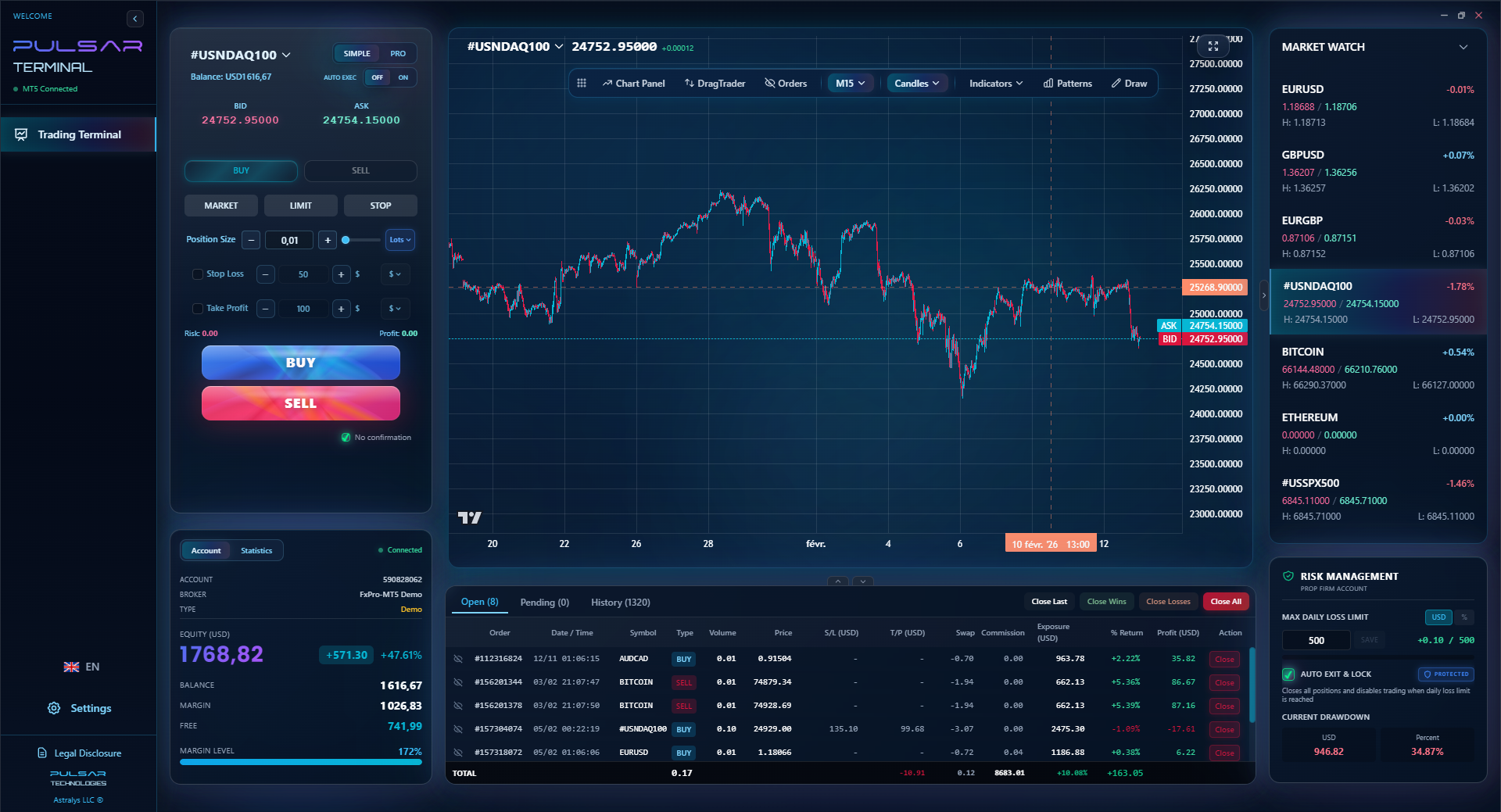
Manually calculating risk for multiple trades and partial closes is error-prone; Pulsar Terminal automates this with drag-and-drop orders and multi-TP/SL management directly on your MT5 chart.
Pulsar Terminal
The all-in-one MT5 companion: drag-and-drop orders, multi-TP/SL, trailing stop, grid trading, Volume Profile, and prop firm protection. Used by 1,000+ traders daily.
This is the confessional. I've broken every sensible rule about contract size, and my account balance has the scars to prove it.
Mistake 1: Scaling Into a Losing Position. This is the big one. EUR/USD was dropping, and I was convinced it was a fakeout. I bought 0.05 lots at 1.0850. It dropped to 1.0820. 'It's even better value now,' I thought, and bought another 0.1 lots. It dropped to 1.0790. My ego was locked in. I threw a 'Hail Mary' and bought 0.2 lots. My average price was now 1.0810 with 0.35 lots total. The pair kept falling to 1.0750. I wasn't down 60 pips on a single trade, I was down 60 pips on a position 7 times larger than my initial plan. The loss was catastrophic. I violated my max risk per trade and my max risk per day in one go. The lesson? Define your total position size before you enter. If you want to scale in, pre-define the levels and the lot size at each level, and stick to it like your life depends on it.
Mistake 2: Ignoring Volatility Around SA Data. Trading USD/ZAR around a SARB interest rate announcement or budget speech is a different beast. The spread can widen from 30 pips to over 150 pips in seconds. I once had a stop-loss on USD/ZAR that I thought was a safe 80 pips away. The news hit, the spread blew out, and my stop was executed 120 pips from my entry. My contract size was for an 80-pip risk, but I took a 120-pip loss. The market didn't care about my calculation. Now, I either close positions before major local news or I use such a tiny contract size that the worst-case slippage won't matter.
Mistake 3: Confusing 'Lot Size' with 'Risk'. Early on, I'd think, 'I'll just trade 0.01 lots, it's tiny, no risk.' Then I'd put the stop-loss 200 pips away because I didn't want to be stopped out. That 0.01 lot trade with a 200-pip stop had the same dollar risk as a 0.04 lot trade with a 50-pip stop. The lot size was small, but the risk was enormous because of the massive stop. The contract size is only one variable. The stop-loss distance is the multiplier. You need to manage both. Using the RSI indicator or MACD indicator for entry is one thing, but having a strict, arithmetic-based exit plan is what saves you.
💡 Winston's Tip
Always calculate your maximum possible loss (stop-loss + worst-case slippage) before you enter. If that number makes you uncomfortable, your contract size is wrong, no matter how good the setup looks.
“A contract size that risks more than 2% of your account is a speculation, not a trade. Treat it as such.”
Before you click 'buy' or 'sell,' run down this list. Print it out. Stick it on your monitor.
- What is my account balance in ZAR? (e.g., R23,500)
- What is my maximum risk per trade? (1-2% is standard. 1% of R23,500 = R235)
- What is my stop-loss in pips? (Be honest. Don't place it where you hope it won't get hit. Place it where the trade idea is invalidated.)
- What is the current USD/ZAR rate? (e.g., R18.42) This converts your dollar risk back to Rand.
- Use a Calculator: Plug the numbers into a position size calculator. Input your account balance, risk %, stop-loss in pips, and pair. It will spit out the correct lot size.
- Check the Margin: Does the required margin for that lot size leave you enough 'dry powder' for other opportunities or to withstand a drawdown? If one trade uses 50% of your margin, you're over-leveraged.
- Adjust: If the calculator says 0.07 lots, but that feels too big or too small, do not adjust the lot size. Adjust your stop-loss distance or accept that this trade doesn't fit your risk parameters. Walk away.
Finally, remember that your contract size is your control dial. In the noisy, emotional world of trading, it's one of the few things that is purely mathematical and within your control. Master it, and you've built the foundation for everything else. Ignore it, and you're just gambling with a fancy charting package.
FAQ
Q1What is a standard contract size in forex?
A standard contract size is 100,000 units of the base currency. This is traded as 1.0 'standard lot.' For example, 1 standard lot of GBP/USD means you are buying or selling £100,000. Most retail traders use fractions of this: mini lots (0.1 lots = 10,000 units), micro lots (0.01 lots = 1,000 units), or nano lots (0.001 lots = 100 units).
Q2How does FSCA regulation affect the contract size I can trade?
The FSCA doesn't limit contract size directly, but its 30:1 use cap for retail traders severely limits the effective position size you can take. With less use, you need to post more margin for the same trade size. This naturally encourages smaller, more manageable contract sizes (micro and mini lots) unless you have a very large account. It's a safety feature.
Q3How do I calculate the value of a pip for my contract size?
First, know the standard pip value. For pairs where USD is the quote currency (e.g., EUR/USD, GBP/USD), the pip value for 1 standard lot is $10. For a 0.1 lot, it's $1. For a 0.01 lot, it's $0.10. Then, multiply that pip value by the number of pips the market moves. Remember to convert to ZAR using the current USD/ZAR rate for your final P&L in Rands.
Q4Is it better to trade micro lots in South Africa?
For the vast majority of traders, especially those starting or with accounts under R50,000, yes. Micro lots (0.01) give you precise control over your risk. They allow you to use sensible stop-losses of 30-80 pips while keeping your risk per trade between 0.5% and 2% of your account. They are the essential tool for proper risk management.
Q5My broker offers 'flexible' contract sizes. What does that mean?
It means you can type in any lot size you want, like 0.037 or 1.25, instead of being restricted to set increments (0.01, 0.1, 1.0). This is a great feature for advanced position sizing. It lets you tailor your contract size forex calculation down to the exact unit to hit your precise risk target, which is a hallmark of professional trading.
Q6How do swap rates affect different contract sizes?
Swap rates (overnight financing charges) are applied per lot per night. A larger contract size means a larger absolute swap charge. If you're holding a 0.5 lot position overnight, you'll pay 5 times the swap of a 0.1 lot position. For long-term swing trading positions, this can significantly eat into profits or add to losses, so you must factor it into your strategy.
Q7Can I change my contract size after opening a trade?
Not directly. You cannot modify an open trade's contract size. However, you can partially close the position (close 0.03 lots of a 0.05 lot trade, for example) to effectively reduce your size. Alternatively, you can add to the position (scale in), but this creates a new trade with its own entry price and should be part of a pre-defined plan, not an emotional reaction.
Prof. Winston's Lesson
Key Takeaways:
- ✓Risk a maximum of 1-2% of capital per trade.
- ✓Use micro lots (0.01) for precise risk control.
- ✓Factor USD/ZAR conversion into all P&L.
- ✓FSCA's 30:1 use is a protective discipline tool.
- ✓Your stop-loss distance multiplies your contract size risk.
How useful was this article?
Click a star to rate
Weekly Trading Insights
Free weekly analysis & strategies. No spam.
About the Author
David van der Merwe
Emerging Markets Trader
Johannesburg-based trader with 11 years in emerging market currencies. Specializes in ZAR pairs, FSCA-regulated trading, and South African market analysis.
Comments
Risk Disclaimer
Trading financial instruments carries significant risk and may not be suitable for all investors. Past performance does not guarantee future results. This content is for educational purposes only and should not be considered investment advice. Always conduct your own research before trading.
You Might Also Like

Cara Trading Forex Sukses: 7 Prinsip dari Trader Profesional
Cara trading forex sukses dengan 7 prinsip trader pro: manajemen modal, disiplin, journal trading, backtest. Data nyata, bukan janji profit palsu.
Jam Trading Forex Terbaik untuk Trader Indonesia: Panduan Lengkap dengan Tabel Waktu
Panduan jam trading forex untuk trader Indonesia. Tabel 4 sesi dunia, jam emas 20:00-00:00, sesi mana yang harus dihindari. Data akurat + tips dari trader berpengalaman.
Top 5 Sàn Forex Uy Tín Nhất 2026: Review Jujur dari Trader Indonesia
Top 5 sàn forex uy tín 2026 untuk trader Indonesia. Review jujur: spread, deposit, withdraw, dukungan lokal. Exness, XM, IC Markets & lebih.
Get Pulsar Terminal
All these calculators are built into Pulsar Terminal with real-time data from your MT5 account. One-click position sizing, automatic risk management, and instant calculations.
Get Pulsar Terminal