


Here's a statistic that should make you pause: across major brokers offering copy trading, between 63% and 89% of retail traders lose money.

Olumide Adeyemi
West African Trading Pioneer ·  Nigeria
☕ 10 min read
What you'll learn:
- 1What Copy Trading Really Is (And Isn't)
- 2The Nigerian Regulatory Minefield
- 3The Real Costs & Fees That Eat Your Profit
- 4How to Vet a 'Master Trader' (The Due Diligence Checklist)
- 5Platforms & Brokers for Nigerian Traders
- 6The Psychology: Why Most Copy Traders Blow Up
- 7A Better Alternative: Learn to Manage Risk Yourself
Here's a statistic that should make you pause: across major brokers offering copy trading, between 63% and 89% of retail traders lose money. In Nigeria, where over 90% of forex traders are under 35, copy trading looks like a shortcut to wealth. I'm here to tell you it's more often a shortcut to a margin call. Having traded for over a decade and managed funds, I've seen the mechanics from both sides. This isn't about theory. It's about why most people who copy trade forex end up funding the lifestyles of the 'gurus' they follow.
Copy trading is an automated system that links your trading account to another trader's. When they open a trade, your account opens an identical one, proportional to your balance. It's sold as passive income, but that's a dangerous fantasy. It's passive delegation, not passive income. You're still 100% liable for the losses.
In Nigeria, the appeal is obvious. With banks limiting international card transactions and the CBN's complex rules around forex access, finding a straightforward path feels impossible. Copy trading promises a way around the learning curve. The problem? You're outsourcing your most critical job: risk management.
I made this mistake early on. I followed a 'master trader' on a platform in 2015 because his 3-month performance was up 120%. I allocated $2,000. He was a scalper. Within two weeks, a series of five losing trades hit, and my account was down 35%. I hadn't checked his maximum historical drawdown, his average trade duration, or his risk-per-trade. I just saw the green number and clicked 'copy.' That $700 lesson taught me that you must understand a strategy intimately before you let it run your money.

Warning: The term 'master trader' is a marketing title, not a regulatory certification. Anyone with a winning streak can be promoted to 'master' status by a broker looking to attract copiers.

💡 Winston's Tip
A 'master trader' with a 50% drawdown needs a 100% return just to break even. Don't confuse volatility with skill.
Let's be clear about the rules, because this is where many Nigerian traders get into trouble before they even place a trade.
Forex and copy trading are legal for individuals in Nigeria. However, the retail forex market is poorly regulated by the SEC and CBN. This creates a grey area. The CBN prohibits using official foreign exchange windows (like the I&E window) to fund speculative trading accounts. So, how you fund your broker account matters. Using your bank card for an international broker deposit might be flagged or blocked, as many banks have limited these transactions.
The Tax Reality
This isn't optional. You are subject to a 10% capital gains tax on all gross trading profits. You must submit this to the Federal Inland Revenue Service (FIRS) within 90 days after December 31st. If you copy trade and make a profit, that income is taxable. Most copy traders never factor this in, which turns a 15% annual return into a 5% return after taxes and fees.
Broker Licensing Confusion
There's conflicting info. Some say brokers need CBN licensing; others say Nigerian traders must only use CBN-licensed brokers. In practice, most successful Nigerian traders I know use reputable offshore brokers like IC Markets or Pepperstone because of better execution and lower costs. The key is ensuring that broker is regulated elsewhere (like ASIC in Australia or CySEC in Europe) for your own protection. Your primary relationship is with the broker hosting the copy trade, not with a Nigerian authority.

Pro Tip: Before depositing, do a small withdrawal test. If you can't easily get your money back out through a method like a local bank transfer or crypto, consider it a major red flag. Your broker's withdrawal policy is more important than any 'master trader's' stats.
“Copy trading promises a way around the learning curve. The problem? You're outsourcing your most critical job: risk management.”
They don't advertise this part loudly. Copy trading has a layered fee structure that can turn a winning strategy into a loser for you.
First, you have the broker's costs. This is the spread and possibly a commission. On a standard account, spreads on major pairs like EUR/USD might start around 1.4 pips. On a raw ECN account, like those from IC Markets, you might get spreads from 0.0 pips but pay a commission of $6 per standard lot. Every copied trade inherits this cost.
Second, and most critical, is the 'master trader's' performance fee. This is a cut of the profits you make. It can range from 10% to a staggering 50%. Let's do the math with a real example from my own tracking.
📊 Example: You copy a trader with a 50% performance fee. You invest NGN 500,000.
- Month 1: The strategy makes a 10% profit. Your gain: NGN 50,000.
- The 'master' takes 50% of that profit: NGN 25,000.
- Your net profit before other costs: NGN 25,000.
- Now account for spreads, slippage, and the 10% capital gains tax on the gross NGN 50,000 (NGN 5,000).
- Your real take-home could be less than NGN 20,000 - a 4% return, not 10%.
If the strategy loses 10% next month, you bear the full NGN 50,000 loss. The 'master' loses nothing; they only share profits. Their incentive is to swing for the fences with high risk, because they get half the upside and none of the downside. This misalignment is the core reason copy trade forex fails for most followers. You need a strong position size calculator to understand your true risk, but in copy trading, you surrender that control.
You wouldn't hand your car keys to a stranger. Don't hand your trading capital to one. If you decide to copy trade, do this homework first. I look for these five things, minimum.
- Track Record Length: Ignore anything under 18 months. A 3-month 100% return is noise, not skill. You need to see performance across different market conditions - ranging, trending, volatile.
- Maximum Drawdown (Max DD): This is the largest peak-to-trough drop in their equity curve. It's the most important number. If their Max DD is 40%, you must be prepared to watch your account lose 40% before (hopefully) recovering. Can you stomach that? Most can't, and they quit at the bottom.
- Average Risk-Per-Trade: This tells you their discipline. If they regularly risk 5% of their capital per trade, they are a gambler, not a trader. I look for strategies that risk 1-2% max. You can often infer this from their stop-loss distances and lot sizes relative to their account balance.
- Strategy Transparency: Do they describe their method? Is it based on a scalping strategy or swing trading fundamentals? Avoid 'black box' traders who won't explain their edge.
- Live vs. Demo Performance: Ensure you're looking at a live, real-money track record, not a demo simulation. Demo trading lacks psychological pressure.
I once found a trader with a 24-month record, 35% total return, but a Max DD of only 8%. That's a conservative, risk-managed approach. That's far more valuable long-term than a trader up 200% with a 60% DD. The latter will blow up; it's just a matter of time.
💡 Winston's Tip
If you wouldn't understand the trade if you placed it yourself, you have no business copying it. Blind faith is a liability, not an asset.
“Their incentive is to swing for the fences with high risk, because they get half the upside and none of the downside.”
Your choice of broker dictates your copy trading experience. You need one that offers reliable connectivity, accepts Nigerian clients, and has sensible deposit/withdrawal options. Here’s a breakdown of common options.
| Broker | Copy Trading Feature | Key Consideration for Nigerians |
|---|---|---|
| Exness | Social Trading via Exness Copy Trading | Popular locally, but research their specific Exness review for Naira deposit details. |
| IC Markets | cTrader Copy, Myfxbook AutoTrade | Top-tier execution with raw spreads. A favorite for serious copy traders. Check the IC Markets review. |
| XM | XM CopyTrading | Low minimum deposit, but spreads are typically higher on standard accounts. |
| AvaTrade | DupliTrade, AvaSocial | Requires a $2,000 minimum for DupliTrade. A higher barrier to entry. |
| Pepperstone | MetaTrader Signals, DupliTrade | Excellent all-round broker with multiple copy options. |
Your biggest practical hurdle will be funding. Given bank restrictions, many traders now use cryptocurrency (like USDT) to deposit and withdraw. Most international brokers accept crypto. It's fast and bypasses the traditional banking bottlenecks. Just be aware of crypto's own price volatility during the transfer window.
Warning: Avoid brokers that only offer proprietary copy trading with their own in-house 'gurus.' You want a broker that provides access to third-party platforms like Myfxbook or Signal Start, where you can see thousands of independent strategies to analyze.
The technology works. The math is clear. So why do the vast majority fail? It's 100% psychological.
You start copying during a winning streak. Equity curve goes up and to the right. You feel like a genius. You increase your allocation. Then, the inevitable drawdown hits. The strategy loses 15%. This is normal - even the best have drawdowns. But you haven't internalized the risk. You see your hard-earned Naira evaporating. Panic sets in.
You do the worst possible thing: you stop copying at the bottom of the drawdown. You lock in the loss. A week later, the strategy resumes its upward climb, but you're no longer in it. This cycle of 'buy high, sell low' is repeated endlessly. You're not paying for bad trades; you're paying for bad behavior.
The other fatal error is over-diversification. You think, "I'll copy 10 traders to spread risk." What you actually do is aggregate correlation risk. If all 10 are trading EUR/USD or Gold (XAU/USD guide), a single market move can trigger losses across all of them simultaneously. You've built a fragile house of cards.
The solution is to treat copy trading like hiring a fund manager. You do due diligence, you allocate a set percentage of your capital you can afford to lose completely, and you commit to a minimum evaluation period (e.g., 50-100 trades). You don't watch it daily. You review it monthly. This emotional detachment is the only way it can work, and frankly, most people are incapable of it.
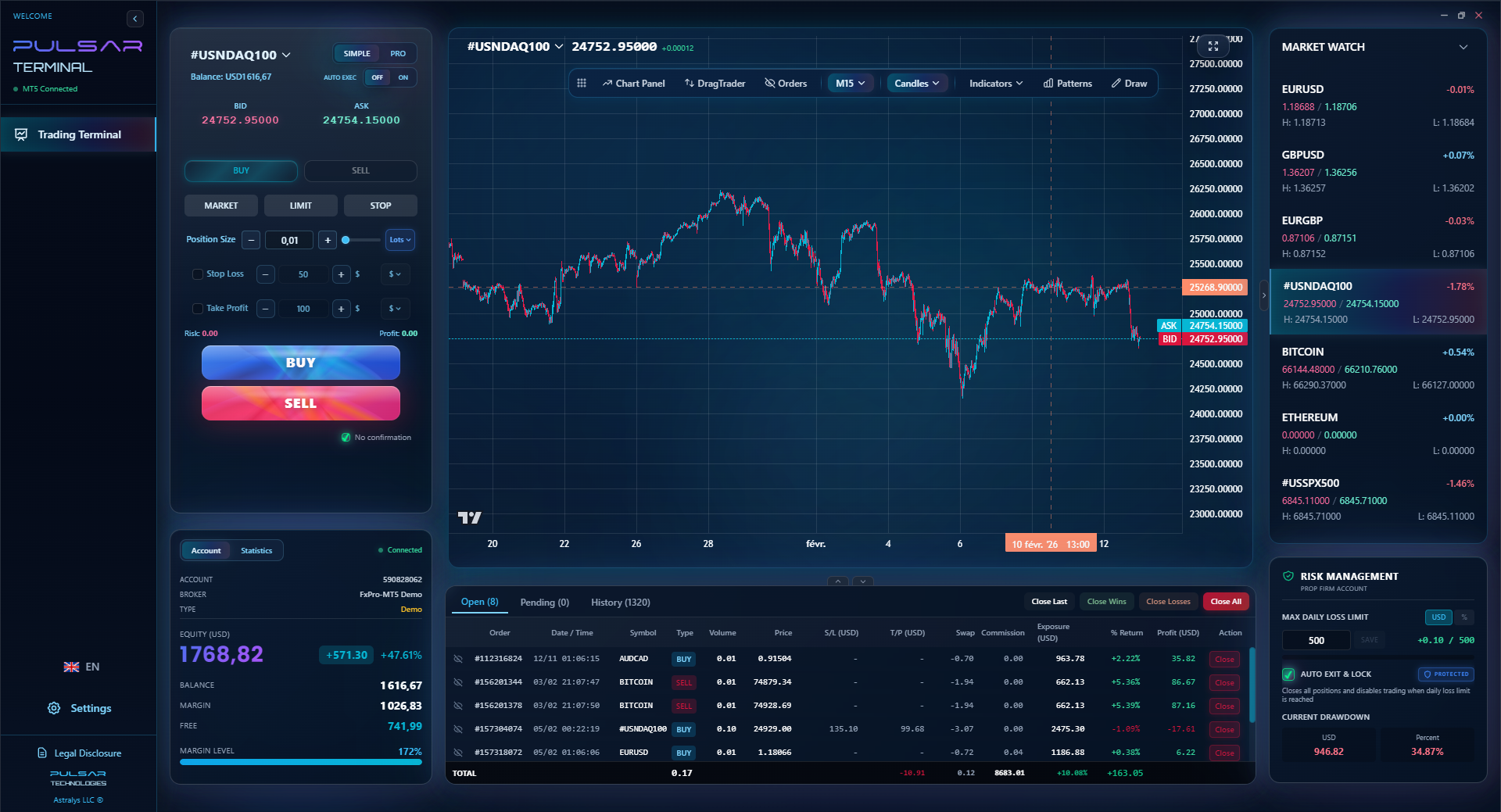
Managing the emotional stress of copy trading drawdowns is easier when you have precise tools to monitor risk and set automatic safeguards, which is exactly what Pulsar Terminal builds into MT5.
Pulsar Terminal
The all-in-one MT5 companion: drag-and-drop orders, multi-TP/SL, trailing stop, grid trading, Volume Profile, and prop firm protection. Used by 1,000+ traders daily.
“You're not paying for bad trades; you're paying for bad behavior.”
This is my frank advice after 12 years: the time and money you'll spend chasing the right 'master trader' is better invested in learning to manage your own trades. You will never have control until you understand the mechanics.
Start small. Open a demo account, then a live account with $100. Learn what a pip definition really means in Naira terms. Feel the impact of the spread definition on your entries and exits. Use a simple strategy based on one or two indicators like the RSI indicator or MACD indicator. The goal isn't to get rich from $100. The goal is to learn the process without catastrophic risk.
Focus relentlessly on position sizing. This is the master skill. It's the difference between a 10% drawdown that you can recover from and a 50% drawdown that ends your trading career. A proper position size calculator is your most important tool.
When you understand risk, you can look at any 'master trader's' profile and immediately see the flaws. You'll know that a 40% drawdown is unsustainable. You'll see that their profit factor is too low. You become an informed investor, not a hopeful follower. This self-reliance is the only true 'edge' in this market. Copy trading can be a tool in your arsenal, but it must never be your entire strategy. Your capital is your responsibility - never outsource that completely.
FAQ
Q1Is copy trading forex legal in Nigeria?
Yes, for individual retail traders, both forex trading and copy trading are legal activities. However, the market is considered poorly regulated. The critical legal point is that you cannot use official CBN foreign exchange windows (like the I&E window) to fund your trading account for speculation. Most traders use alternative methods like cryptocurrency transfers to fund offshore broker accounts.
Q2How much tax do I pay on copy trading profits in Nigeria?
You are required to pay a 10% capital gains tax on your gross trading profits to the Federal Inland Revenue Service (FIRS). This must be filed and paid within 90 days after the end of the calendar year (December 31st). Remember, this is on gross profits before the 'master trader's' fees are deducted, which significantly impacts your net return.
Q3What is the minimum amount needed to start copy trading?
It varies by broker. Some brokers like XM allow you to start with $100 or less. Others, like AvaTrade for their DupliTrade service, require a minimum of $2,000. In Nigeria, given the risks, I advise never to start with money you cannot afford to lose completely. Treat any initial amount as tuition for learning.
Q4Can I lose more money than I deposit in copy trading?
With reputable brokers offering CFDs on forex, you generally cannot lose more than your account balance due to negative balance protection (a regulatory feature in many jurisdictions). However, if your broker does not offer this protection, in extreme market volatility (like a 'flash crash'), it is theoretically possible, though rare. Your main risk is losing your entire deposited capital.
Q5What's the difference between a 'master trader's' profit and my actual profit?
Your profit is their profit, minus their performance fee (10-50%), minus your broker's spreads/commissions on every trade, minus any slippage, and minus the 10% Nigerian capital gains tax. The 'master's' displayed profit rarely accounts for all these costs on your specific account. A strategy showing a 15% annual return might net you only 3-5% after all costs.
Q6Which broker is best for copy trading in Nigeria?
There's no single 'best.' It depends on your needs. For low-cost, direct copy trading, IC Markets with cTrader Copy is excellent. For social trading features, Exness is popular locally. The most important factors are: 1) Reliable deposit/withdrawal methods for Nigerians (often crypto), 2) A transparent platform where you can analyze the 'master's' full statistics, and 3) Strong international regulation (like ASIC).
Prof. Winston's Lesson
Key Takeaways:
- ✓Vet track records for at least 18 months of live data.
- ✓Maximum Drawdown is more important than total return.
- ✓Assume a 50% performance fee halves all advertised profits.
- ✓Factor in the 10% Nigerian capital gains tax on gross gains.
How useful was this article?
Click a star to rate
Weekly Trading Insights
Free weekly analysis & strategies. No spam.
About the Author
Olumide Adeyemi
West African Trading Pioneer
One of Nigeria's most active forex trading educators. 8 years of experience trading from Lagos. Specializes in low-capital strategies and prop firm challenges for African traders.
Comments
Risk Disclaimer
Trading financial instruments carries significant risk and may not be suitable for all investors. Past performance does not guarantee future results. This content is for educational purposes only and should not be considered investment advice. Always conduct your own research before trading.
You Might Also Like

Cara Trading Forex Sukses: 7 Prinsip dari Trader Profesional
Cara trading forex sukses dengan 7 prinsip trader pro: manajemen modal, disiplin, journal trading, backtest. Data nyata, bukan janji profit palsu.
Jam Trading Forex Terbaik untuk Trader Indonesia: Panduan Lengkap dengan Tabel Waktu
Panduan jam trading forex untuk trader Indonesia. Tabel 4 sesi dunia, jam emas 20:00-00:00, sesi mana yang harus dihindari. Data akurat + tips dari trader berpengalaman.
Top 5 Sàn Forex Uy Tín Nhất 2026: Review Jujur dari Trader Indonesia
Top 5 sàn forex uy tín 2026 untuk trader Indonesia. Review jujur: spread, deposit, withdraw, dukungan lokal. Exness, XM, IC Markets & lebih.
Get Pulsar Terminal
All these calculators are built into Pulsar Terminal with real-time data from your MT5 account. One-click position sizing, automatic risk management, and instant calculations.
Get Pulsar Terminal