


I was convinced the rand was going to keep weakening against the dollar in late 2023.

David van der Merwe
Emerging Markets Trader ·  South Africa
☕ 9 min read
What you'll learn:
- 1What the Hell is a COT Report, Anyway?
- 2How to Read the Thing: It's Not Rocket Science
- 3The R40,000 Lesson: USD/ZAR and Complacency
- 4Fitting the COT Report Into Your Actual Trading
- 5The Ugly Truth: Where the COT Report Lets You Down
- 6Practical Steps for South African Traders
- 7Is It Worth Your Time? My Blunt Take

I was convinced the rand was going to keep weakening against the dollar in late 2023. USD/ZAR was at R18.50, everyone on the news was talking about load-shedding and politics, and I went all in. I didn't check the Commitments of Traders (COT) report. A month later, I was staring at a R40,000 loss as the pair reversed hard to R18.00. The COT data had been screaming for weeks that the 'smart money' was quietly getting out of long USD positions. I learned the hard way that in forex, ignoring what the biggest players are doing is a fantastic way to lose your shirt.
Right, let's cut through the jargon. The Commitments of Traders (COT) report is a weekly snapshot of who's betting what in the US futures markets. It's published every Friday by the Commodity Futures Trading Commission (CFTC).
While we trade spot forex, the big institutional moves often happen in the futures market first. This report shows us the positions of three key groups:
1. Commercial Traders: These are the 'smart money.' Think massive corporations, banks, and hedgers. A South African mining company hedging its future dollar revenue from platinum sales would be here. They're not speculating for fun; they're managing real-world business risk. When they take a huge position, they usually know something.
2. Non-Commercial Traders: These are the large speculators. Big hedge funds, commodity trading advisors (CTAs), and other institutional funds. They're in it to make money from price moves. They have resources we can only dream of.
3. Non-Reportable Positions: This is us. The small retail traders. We're the 'dumb money' in this equation, and the report lumps all our small positions together. It's humbling, but it's the truth.

Warning: The COT report is not a timing tool. It won't tell you to buy at 1.0850 on Tuesday. It's a sentiment gauge. It shows you if the market is extremely one-sided, which often precedes a reversal. Using it for a scalping strategy is pointless. It's for the bigger picture.
The key takeaway? If the Commercials are heavily short EUR/USD and the Non-Commercials are heavily long, there's a conflict. History shows betting against the Commercials is usually a bad idea.
“The COT report shows you if the market is extremely one-sided, which often precedes a reversal.”
The raw report looks like a spreadsheet nightmare. You don't need to read it directly. Use free sites like Tradingster or CFTC.gov that visualize the data. You're looking for two main things:
1. Net Positions: This is the number of long contracts minus short contracts for each group. A rising net long position for Non-Commercials means funds are getting bullish.
2. The COT Index & Sentiment Extremes: This is more useful. It's an oscillator that shows where current net positioning falls within the last 52-week (or longer) range. A reading above 90% means net longs are at extreme highs relative to the past year. A reading below 10% means net shorts are at extreme lows.
My Go-To Setup
I wait for the COT Index for Non-Commercials to hit above 90 or below 10. This is an extreme. Then, I look for a technical signal on the chart - a break of a key trendline, a bearish MACD indicator divergence on the weekly chart, or a rejection at a major resistance level. The COT tells me the fuel for a reversal is there; the chart tells me when the match might be lit.

Example: Let's say Non-Commercial net longs in GBP/USD hit a COT Index of 93. That's extreme bullishness. The pair is at 1.2800. I'm not selling yet. I wait. If price then fails to break 1.2850 and forms a weekly shooting star candle, that's when I start looking for a short entry with a tight stop above that high. The COT set the stage; price action gave me the cue.

💡 Winston's Tip
A COT extreme is like a weather warning for a storm. It doesn't tell you which tree will fall, or when. It just tells you to get ready and stay indoors until it passes.
“I learned the hard way that in forex, ignoring what the biggest players are doing is a fantastic way to lose your shirt.”
Let me walk you through my disaster trade so you don't repeat it. It was October 2023. USD/ZAR had rallied from R17.80 to R18.80. The narrative was perfect for a South African: persistent load-shedding, political uncertainty, a weak commodity outlook. I was long from R18.30, adding to my position like an idiot.
I was chart-focused, using my usual RSI indicator and support/resistance levels. I didn't look at the COT report for weeks. Why would I? The trend was my friend.
When I finally looked after the crash, the story was clear. The Commercials (smart money) had been reducing their net short position in USD/ZAR futures for a month. Their selling pressure was fading. Meanwhile, the Non-Commercials (large speculators like funds) had built a massive net long position that was in the 95th percentile - an extreme. The market was packed with bullish speculators with no one left to buy.
A major US inflation print came in softer than expected, the dollar weakened globally, and USD/ZAR got annihilated. The crowded long trade evaporated. My stop was at R18.70, and it got taken out viciously. A R40,000 lesson: always check if the room is getting too crowded. The COT report shows you the occupancy level.

Pro Tip: For South African traders, don't just look at COT data for USD/ZAR. Watch the data for plain old USD index (DXY) futures. The dollar's global strength is the primary driver for ZAR pairs. If Commercials are turning net short the dollar index, it doesn't matter what Eskom is doing - the rand will likely catch a bid.
“I learned the hard way that in forex, ignoring what the biggest players are doing is a fantastic way to lose your shirt.”
You can't trade off this report alone. It's a background filter, a context provider. Here’s how I use it now in my swing trading approach.
Step 1: The Weekly Scan. Every Saturday morning, with my coffee, I check the COT extremes for the majors: EUR, GBP, JPY, AUD, and the Dollar Index. I note any that are above 90 or below 10 on the COT Index. That's my watchlist.
Step 2: Chart Analysis. I then go to the weekly and daily charts of those pairs. I am not looking to fade the trend immediately. I'm looking for the first sign of weakness in the trend. Is momentum stalling? Is there a divergence? Is price hitting a multi-year trendline?
Step 3: Patience & Entry. This is the hard part. I wait for a clear price-based entry signal. For a potential short after a bullish extreme, I might wait for a daily close below a 20-period EMA that's been supporting the move. I then use my position size calculator to ensure my risk is tiny - usually 0.5% of my capital on these high-conviction, counter-trend setups. The stop is always placed beyond the recent swing high/low.
What It Does For You: It stops you from adding to a position at the worst possible time. When EUR/USD is ripping higher and everyone is bullish, a COT extreme can be the voice in your ear saying, "Don't chase. Wait for a better price, or prepare for a reversal." It gives you the discipline to be a contrarian when it matters.
💡 Winston's Tip
If you find yourself on the same side of a trade as the 'Non-Reportable' crowd (the retail mob), and against the Commercials, it's time to seriously question your thesis. You're likely the exit liquidity.

“It adds a layer of macro-awareness that separates the informed from the reactive.”
It's not a holy grail. I've lost money following it blindly too.
Lag is a Killer: The report is released Friday, showing data from the previous Tuesday. That's a 3-day lag. In a fast market, the extreme can already be unwinding by the time you see it. You're looking at a photo from last week, not a live feed.
It Doesn't Measure Conviction: A net long position of 100,000 contracts could be held by 10 funds or 100 funds. The report doesn't tell you if one massive player is about to exit, which could tank the price regardless of the net number.
It's US-Centric: The CFTC only covers US futures exchanges. A huge amount of forex trading happens elsewhere, especially in London and Asia. You're only seeing one piece of the global puzzle.
It Can Stay Extreme... Forever: Markets can remain irrational longer than you can remain solvent. A COT extreme at 95 can go to 97, then 99. If you short every time it hits 90, you'll get run over in a strong trend. This is why you must wait for price confirmation. The report identifies a dangerous cliff; price action tells you when the market is actually walking off it.
My second-biggest COT mistake? Shorting gold (XAU/USD) in early 2024 when Non-Commercial net longs were extreme. I got my price signal, entered, and then central bank buying (not reported in the COT) drove it even higher. I took a 1.5% loss. The lesson: other forces can override the futures positioning, especially in a crisis asset like gold. Always have a stop.
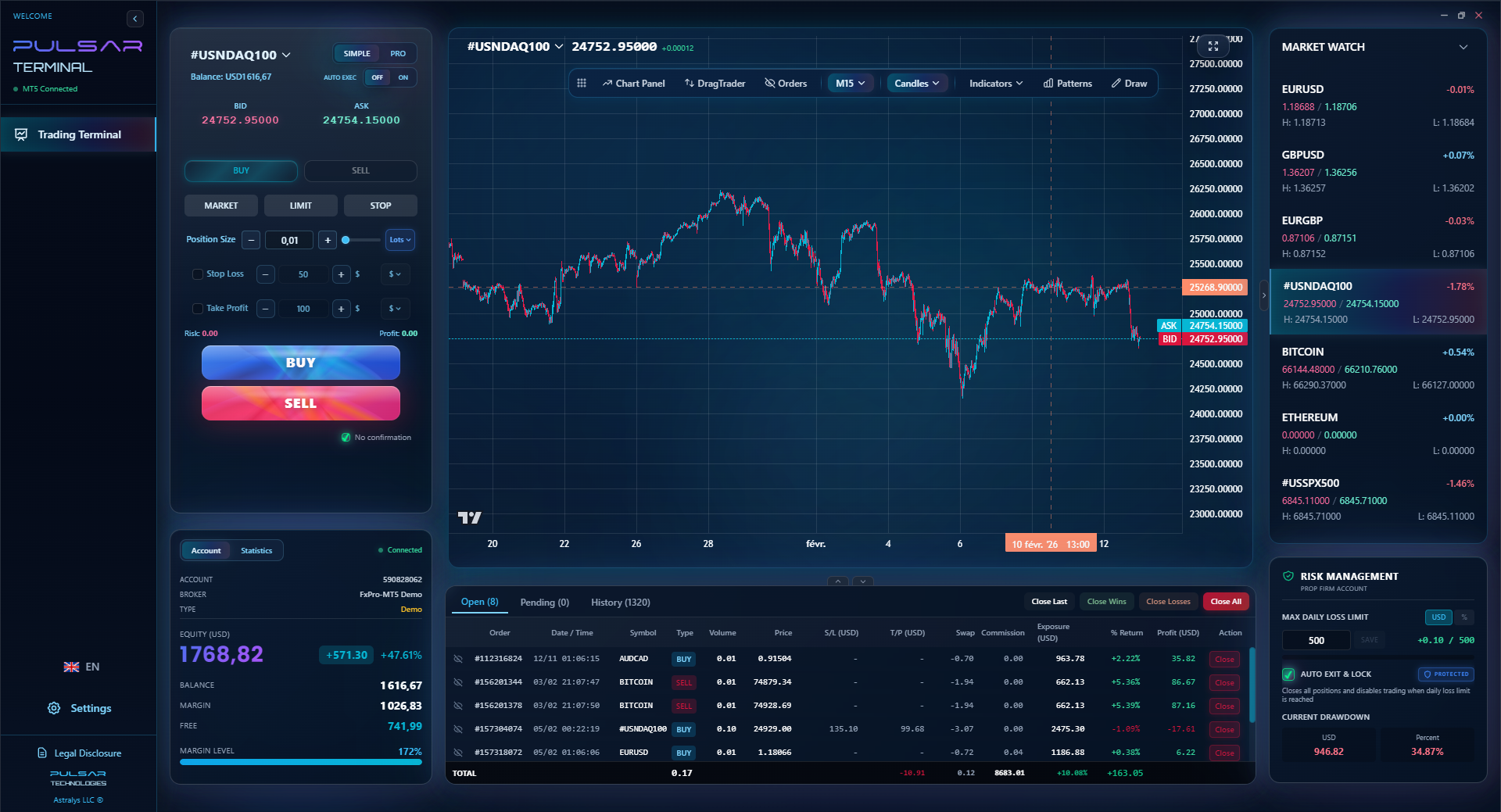
When trading based on COT extremes and waiting for price confirmations, managing multiple orders and partial closures is key, which is where a tool like Pulsar Terminal for MT5 excels.
Pulsar Terminal
The all-in-one MT5 companion: drag-and-drop orders, multi-TP/SL, trailing stop, grid trading, Volume Profile, and prop firm protection. Used by 1,000+ traders daily.
“It adds a layer of macro-awareness that separates the informed from the reactive.”
Alright, how do you actually do this from SA?
1. Where to Get the Data (It's Free):
- Tradingster.com: My favourite. Clean, simple charts for the COT Index and net positions. No fluff.
- CFTC.gov: The official source. Go to "Market Reports," then "Commitments of Traders." It's the raw data if you want it.
- Finviz.com: Has a basic COT section that's good for a quick glance.
2. Broker Considerations: You need a broker that gives you access to the underlying instruments. Most international brokers available to South Africans like IC Markets review, Pepperstone review, or Exness review are fine. The key is low spreads and reliable execution, especially if you're trading based on this slower, swing-style approach. You don't want your edge eaten by costs.
3. Your New Weekly Routine:
- Saturday: Review COT extremes. Update watchlist.
- Sunday: Analyse watchlist charts on higher timeframes. Plan potential levels.
- Monday-Friday: Trade your plan. The COT work is done; now it's about price action and risk management. Never let a COT extreme make you override a clear margin call or stop-loss rule.
The goal is to make this a 20-minute weekly habit, not a daily obsession. It's about building a broader, smarter context for your trades, so you're not just reacting to the last candle on the screen.
“The COT report won't make you rich quick. It might save you from being poor quick.”
For a new trader obsessed with 5-minute charts? No. You have more important things to learn, like not blowing up your account with poor position size calculator use.
For an experienced trader who's plateauing, who keeps getting caught in major reversals, and who trades on the daily or weekly timeframe? Absolutely. It's a crucial piece of the puzzle.
The COT report won't make you rich quick. It might save you from being poor quick. It adds a layer of macro-awareness that separates the informed from the reactive. After my R40,000 lesson, it's a non-negotiable part of my weekly review. It reminds me who the real players are in the market - and that I'm not one of them. My job is to follow their footprints, not try to make my own.
FAQ
Q1How often is the COT report released?
It's published weekly, every Friday at 15:30 US Eastern Time (that's 21:30 South African Standard Time, 22:30 when we're on daylight saving). The data reflects positions as of the previous Tuesday.
Q2Can I use the COT report for crypto trading?
Not directly. The CFTC report only covers regulated US futures markets. While there are Bitcoin and Ethereum futures on the CME, the crypto market is dominated by unregulated spot exchanges, so the COT data only shows a fraction of the total market activity. It's less reliable for crypto.
Q3What's the difference between the 'Legacy' and 'Disaggregated' reports?
The Legacy report is the old format with just Commercial, Non-Commercial, and Non-Reportable. The Disaggregated report breaks it down further (e.g., separating Producer/Merchant/Processor/User from Swap Dealers). For most forex traders starting out, the Legacy report is simpler and perfectly adequate. Don't overcomplicate it.
Q4As a South African, should I focus on USD/ZAR COT data?
Yes, but don't stop there. USD/ZAR futures volume is lower than majors like EUR or GBP. The COT signal can be noisier. Always cross-reference with the COT data for the US Dollar Index (DXY). A extreme positioning in the dollar itself will flow through to all dollar pairs, including ZAR.
Q5The report shows an extreme, but the trend keeps going. What am I doing wrong?
You're probably trying to pick the exact top or bottom. An extreme means the trend is mature and vulnerable, not that it's over. You must wait for a confirmed reversal in price action - a break of a key trendline, a lower high, etc. The COT gives you the warning; price gives you the permission to act.
Q6Is there a similar report for the JSE or South African markets?
No, not publicly available in the same detailed, weekly format. The COT is a unique product of the US CFTC. For South African equity or index analysis, you have to rely on other sentiment indicators like put/call ratios or market breadth data, which are less straightforward.
Prof. Winston's Lesson
Key Takeaways:
- ✓The COT report is a weekly sentiment snapshot, not a timing tool.
- ✓Commercial traders ('Smart Money') are often on the right side of major turns.
- ✓Always wait for price confirmation after identifying a COT extreme.
- ✓A 3-day data lag means you're never seeing the current picture.
How useful was this article?
Click a star to rate
Weekly Trading Insights
Free weekly analysis & strategies. No spam.
About the Author
David van der Merwe
Emerging Markets Trader
Johannesburg-based trader with 11 years in emerging market currencies. Specializes in ZAR pairs, FSCA-regulated trading, and South African market analysis.
Comments
Risk Disclaimer
Trading financial instruments carries significant risk and may not be suitable for all investors. Past performance does not guarantee future results. This content is for educational purposes only and should not be considered investment advice. Always conduct your own research before trading.
You Might Also Like

Cara Trading Forex Sukses: 7 Prinsip dari Trader Profesional
Cara trading forex sukses dengan 7 prinsip trader pro: manajemen modal, disiplin, journal trading, backtest. Data nyata, bukan janji profit palsu.
Jam Trading Forex Terbaik untuk Trader Indonesia: Panduan Lengkap dengan Tabel Waktu
Panduan jam trading forex untuk trader Indonesia. Tabel 4 sesi dunia, jam emas 20:00-00:00, sesi mana yang harus dihindari. Data akurat + tips dari trader berpengalaman.
Top 5 Sàn Forex Uy Tín Nhất 2026: Review Jujur dari Trader Indonesia
Top 5 sàn forex uy tín 2026 untuk trader Indonesia. Review jujur: spread, deposit, withdraw, dukungan lokal. Exness, XM, IC Markets & lebih.
Get Pulsar Terminal
All these calculators are built into Pulsar Terminal with real-time data from your MT5 account. One-click position sizing, automatic risk management, and instant calculations.
Get Pulsar Terminal