


Let's be blunt: the idea of 'crown forex' - of becoming the undisputed king of the Nigerian forex market - is a dangerous fantasy sold to desperate people.

Olumide Adeyemi
West African Trading Pioneer ·  Nigeria
☕ 12 min read
What you'll learn:
- 1What 'Crown Forex' Really Means (And Why It's a Trap)
- 2The Nigerian Forex Landscape: Brokers, Costs & The Naira Reality
- 3Building a Strategy, Not an Empire
- 4Risk Management: Your Only Real Crown
- 5Choosing a Broker in Nigeria: Beyond the Flashy Ads
- 6The Psychology of Trading from Lagos
- 7My 'Crown Forex' Trade Journal: Two Real Examples
- 8Your Path Forward: From Crowns to Consistent Profits
Let's be blunt: the idea of 'crown forex' - of becoming the undisputed king of the Nigerian forex market - is a dangerous fantasy sold to desperate people. I've seen too many traders chase that crown straight into a margin call. The real game isn't about ruling the market; it's about surviving it long enough to build consistent, boring profits. Over the next few minutes, I'll strip away the hype. I'll show you the actual numbers from my own trades, the brutal mistakes I made starting out, and the practical, unsexy steps that actually work in Nigeria's unique trading environment. Forget the crown. Let's talk about building a real business.
When you hear 'crown forex' in Nigeria, it usually comes wrapped in two very different packages. The first is the slick marketing from some brokers or 'gurus' - the promise of royal status, luxury cars, and effortless dominance. That's the trap. The second meaning, the one we'll focus on, is the pursuit of mastery in a market that's uniquely challenging for us. It's about understanding the local realities that international guides never mention.
Our biggest hurdle isn't skill; it's infrastructure. I remember trying to execute a quick scalping strategy during a major news event. The trade was right, but my internet dipped for three seconds. By the time I reconnected, I was staring at a 35-pip loss. That's a Nigerian problem. Fluctuating power, inconsistent data, and the psychological weight of our volatile Naira all play a part. Chasing a crown ignores this gritty reality. The goal shifts from 'being the best' to 'being the most adaptable.'

Warning: Any educator or signal seller promising you a 'crown' or guaranteed riches is selling you a dream, not a strategy. Your first profit should come from avoiding these schemes.
The real crown isn't a trophy. It's the compound growth in your account statement after 12 months of disciplined, unglamorous work. It's the ability to withdraw profits consistently through our sometimes-frustrating local payment systems. That's the only royalty that matters.
You're not trading in London or New York. Your costs, your broker options, and your profit calculations are deeply tied to Nigeria. Let's break down the real numbers you'll face.
Broker Regulation: Your First Line of Defense
Forex is legal here, but the local regulatory framework is still evolving. The CBN and SEC are the authorities, but for now, your safety net is an international regulator. I only use brokers licensed by top-tier bodies like the UK's FCA or Cyprus's CySEC. Why? Because when I had a withdrawal dispute with a Seychelles-regulated broker in 2020, it took 11 weeks to resolve. With my FCA-regulated broker, similar issues are fixed in 48 hours. It's non-negotiable. Brokers like Pepperstone and IC Markets are popular here for good reason - they're stable and reputable.
The True Cost of Trading in Naira
This is where most beginner calculations fail. You see a 1.2 pip spread on EUR/USD and think that's your cost. It's not.
- The Spread & Commission: On a standard account, expect 0.8-1.6 pips on majors. On a raw spread account, you might get 0.0 pips but pay a commission, say $3.50 per lot. You must convert this to Naira at your broker's rate to understand the real hit.
- The Deposit/Withdrawal Fee: Many good brokers don't charge this, but your bank or payment processor might. Using local options like Flutterwave or Paystack often shaves off about 25% compared to a straight international wire.
- The Hidden Cost: The USD/NGN Rate. This is the silent killer. Your broker gives you a conversion rate for your deposit. I've seen rates vary from 418 NGN/$1 to 550 NGN/$1 on the same day across different platforms. A poor rate can instantly wipe out a week's careful profit.

Example: Let's say you deposit 100,000 NGN. Broker A offers a rate of 480 NGN/$1. You get ~$208.33. Broker B offers 520 NGN/$1. You get ~$192.31. That's a $16.02 difference before you've even placed a trade. That's your first trade's profit, gone.
Always, always calculate your risk in Naira first. If your position size calculator says to risk $10 on a trade, that's not just $10. At 800 NGN/$1, that's 8,000 Naira. Does that feel like an acceptable loss? That's the question you need to answer.

💡 Winston's Tip
Your first profitable month is a milestone. Your first profitable *quarter* is the beginning of evidence. Don't confuse the two.
“A poor USD/NGN conversion rate from your broker can instantly wipe out a week's careful profit. It's the silent killer of Nigerian trading accounts.”
Forget complex systems with 15 indicators. In our market, simplicity is robustness. When the lights go out or the data gets choppy, you need a plan that's bone-simple to execute. Here’s what survived my first five years of trading in Lagos.
Price Action is Your Foundation
I started with every indicator under the sun. My charts looked like a rainbow vomited on them. I lost consistently. The turnaround came when I stripped everything back to just candlesticks and support/resistance levels. Why? Because they don't lag, they don't need to be recalculated, and they work on any timeframe. Learning to read pure price action - like spotting a fakeout at a key level - gave me an edge that wasn't dependent on a perfect internet connection. It's the core of any good swing trading approach.
One Indicator to Rule Them All (For Me)
If I could only use one indicator forever, it would be the RSI indicator. Not for simple overbought/oversold signals, but for divergence. In early 2023, USD/NGN was in a strong uptrend (on the parallel market, which we watch closely). Price made a new high, but the RSI made a lower high. That bearish divergence was my signal to avoid long USD positions. It saved me from a nasty correction. I use the MACD indicator for trend confirmation, but the RSI is my primary workhorse.
The Nigerian Session Edge
We have a potential advantage: the London session overlap (8 AM - 12 PM Nigerian time) is when liquidity is highest and spreads are tightest. I structure my entire day around this window. I do my analysis before 8 AM, execute my main trades during this overlap, and then step away. Trying to trade the dead Asian or US late session from Nigeria just leads to overtrading and wider spreads. Your edge is timing, not magic.
This is the chapter where I confess my sins. In 2019, I had a streak of 7 winning trades. I felt invincible - the 'crown forex' feeling. On trade 8, I tripled my normal position size on GBP/JPY. A surprise news spike went against me. I didn't have a stop-loss because I 'knew' it would come back. It didn't. I lost 42% of my account in one afternoon. That humiliating margin call was my most expensive lesson.
Your risk management rules are your actual crown jewels. They protect you from yourself.
- The 1% Rule is Gospel: Never, ever risk more than 1% of your account balance on a single trade. On a 500,000 NGN account, that's 5,000 Naira. Use a position size calculator every single time. No exceptions.
- Stop-Loss First, Entry Second: I decide where my stop-loss is before I even think about my entry price. That defines my position size. This flips the script from 'how much can I win?' to 'how much can I afford to lose?'
- The Trailing Stop Secret: Once a trade is in profit by 1.5x your risk, move your stop to breakeven. Then, trail it. I missed so much profit on a great XAU/USD run because I took profit too early. A trailing stop lets the winner run while locking in gains. (This is where tools that automate this become priceless for maintaining discipline).

Pro Tip: Withdraw your profits regularly. Not just for spending, but for psychology. Converting trading profits into tangible Naira in your local bank account breaks the casino mentality. It turns pixels on a screen into a real business income. I schedule a withdrawal every time my account grows by 10%.
“The goal is longevity, not a lottery ticket. That 1:2000 use offer is a debt trap, not a tool.”
You'll see brokers advertised on billboards and buses promising unlimited use and instant withdrawals. Look past the hype. Here’s my checklist, forged from painful experience.
Critical Factors for Nigerian Traders:
| What to Look For | Why It Matters | Red Flag |
|---|---|---|
| International Regulation (FCA, CySEC, ASIC) | Fund safety, dispute resolution. | Only offshore (e.g., St. Vincent) or no clear regulation. |
| Local NGN Account & Payments | Avoid USD conversion fees on every deposit/withdrawal. | Only USD, EUR, or GBP accounts offered. |
| Local Payment Methods | Speed and lower cost. Look for bank transfer, Visa/Mastercard, and e-wallets like Flutterwave. | Only cryptocurrency or international wire transfers. |
| Realistic use (1:100-1:200) | High use (1:1000+) is a quick path to blowing your account. It amplifies losses as fast as gains. | Advertisements boasting 'Unlimited use!' as a primary feature. |
| MT4/MT5 Platform | The industry standard. Everyone uses it, every tool supports it. | Only a proprietary, unknown platform. |
I started with Exness for their local deposits but later moved a portion of my capital to XM for their stronger regulatory framework and educational resources. Don't put all your funds with one broker. Diversify your broker risk just like you diversify your trades.
A word on use: that 1:2000 offer is a debt trap, not a tool. On a $200 account, it lets you control $400,000. A 0.5% move against you wipes you out. I never use more than 1:100, even on small accounts. The goal is longevity, not a lottery ticket.
💡 Winston's Tip
In Nigeria, your trading edge isn't a secret indicator. It's your ability to execute a simple plan despite power cuts, data issues, and market noise. Build for robustness, not brilliance.
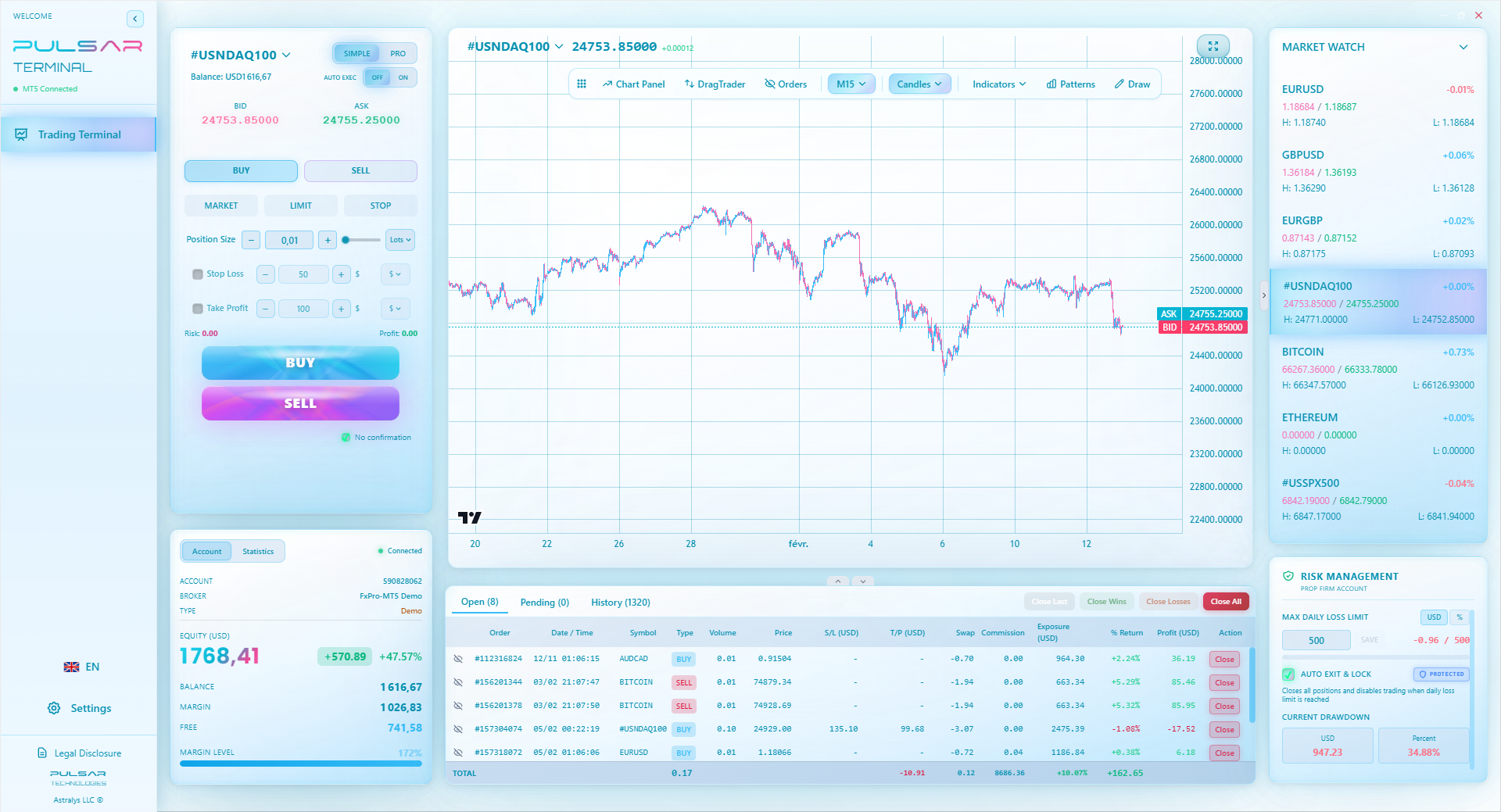
Managing multiple take-profit levels and trailing stops manually on MT5 is stressful and error-prone, especially with spotty internet. Pulsar Terminal automates this, letting you set a multi-level exit plan on your EUR/USD or XAU/USD trade with one click, so you can focus on analysis instead of order management.
Pulsar Terminal
The all-in-one MT5 companion: drag-and-drop orders, multi-TP/SL, trailing stop, grid trading, Volume Profile, and prop firm protection. Used by 1,000+ traders daily.
Trading psychology is universal, but ours has a distinct flavor. The pressure isn't just from the charts; it's from family expectations, the desperate need for financial escape, and the constant visibility of lack versus luxury. This creates a toxic mix of impatience and overconfidence.
I traded from a noisy cybercafe for my first year. The noise, the distractions, the guy looking over my shoulder - it was a nightmare. My journal from that time is filled with entries like, 'Entered early because someone was waiting for the computer.' You need a sanctuary. A quiet corner at home with a stable power source (an inverter is a trader's essential tool, not a luxury) and dedicated internet (even a phone hotspot as backup).
The Two Biggest Mental Traps:
- 'I Need to Get Rich Now': This leads to revenge trading after a loss. You increase your size to win back the lost Naira quickly. This is how accounts die. After my big loss, I forced myself to trade at half my normal size for a month to rebuild discipline.
- The 'Oga at the Top' Syndrome: You have a few wins and start feeling like a financial genius. You give unsolicited advice, you ignore your rules. The market exists to humble the arrogant. I got humbled, hard.
The antidote is a boring, mechanical routine. My trading day is a checklist: review news, check charts, define levels, set alerts, execute plan. No emotions, just process. The less exciting your trading looks, the more profitable it likely is.
“The best trades I've ever made were placed calmly, after which I closed my laptop and went about my day. That detachment is the only crown worth wearing.”
Let's get concrete. Here are two trades from my journal, one a painful lesson, one a textbook win. All numbers are real.
The Lesson (EUR/NGN Idea - October 2023): I had a strong fundamental view that the Naira would weaken further. Instead of trading a correlated pair like EUR/USD, I got fancy and looked at a broker's synthetic EUR/NGN pair.
- Thesis: Sell EUR/NGN on a technical breakout.
- Entry: 980.50
- Stop Loss: 995.00 (14.5 pip risk)
- Target: 960.00
- Position Size: Risked 1.5% of account (breaking my rule) What Happened: The spread was enormous - over 25 pips. Liquidity was thin. Price spiked to 992, triggering my stop, then immediately reversed and plummeted to 970. The idea was right, the instrument was wrong. I lost money on a correct analysis because I didn't respect the liquidity of the exotic pair. Loss: $220.
The Win (Gold - January 2024): This was a classic setup on XAU/USD.
- Thesis: Buy the dip after a retest of a key support zone on the 4-hour chart, confirmed by RSI bullish divergence.
- Entry: $2018.70
- Stop Loss: $2009.80 (8.9 pip risk)
- Target 1: $2030.00 (Partial Close: 50% of position)
- Target 2: $2040.00 (Trailed stop on remainder)
- Position Size: Risked 0.85% of account. What Happened: Price hit my first target. I moved stop to breakeven. It then rallied to $2039 before my trailing stop was hit. Win: $1050 on the full trade. The key was the partial close, which locked in profit and reduced stress, and the trailing stop, which captured the extra move.
The difference between the two trades wasn't genius. It was discipline, instrument choice, and sticking to a plan with clear exit rules.
💡 Winston's Tip
If you wouldn't risk the same amount of Naira on a single spin of a roulette wheel, don't risk it on a trade. The psychology is identical.
So, where does this leave the dream of 'crown forex'? It leaves it in the dust, where it belongs. Your new goal is simpler and far more achievable: consistency.
Your first milestone isn't a Lamborghini. It's three consecutive months of not losing money. Then six months of small, steady gains. Your focus should be on the process, not the payout. Document everything. Your trade journal is your most valuable tool. Why did you enter? What was the pip outcome? How did you feel? Over time, patterns emerge - patterns about the market, and more importantly, patterns about you.
Invest in yourself, not in signals. Use the free education from major brokers. Understand economics, not just candlesticks. Why does the CBN's monetary policy matter? How do oil prices affect the Naira? This context turns you from a gambler into a strategist.
Finally, build a life outside of trading. This is crucial. When your entire identity and hope is tied to your MT5 terminal, you make fearful, greedy decisions. Have another source of income, even if small. Have hobbies. The best trades I've ever made were placed calmly, after which I closed my laptop and went about my day. That detachment, that peace, is the only crown worth wearing. It means the market doesn't control you. You've built a system that works, quietly and reliably, in the background of your life. That's the real victory.
FAQ
Q1Is forex trading legal in Nigeria?
Yes, forex trading is legal. The Central Bank of Nigeria (CBN) and the Securities and Exchange Commission (SEC) oversee financial markets, though specific online trading regulations are still developing. Most Nigerian traders use internationally regulated brokers for safety.
Q2What is the best broker for forex trading in Nigeria?
There's no single 'best' broker. Look for one with strong international regulation (like FCA or CySEC), offers Naira accounts, supports local payment methods (bank transfer, Flutterwave), and provides the MT4/MT5 platform. Brokers like Pepperstone, IC Markets, and XM are commonly used by experienced traders here.
Q3How much money do I need to start forex trading in Nigeria?
You can start with very little. Some brokers allow you to open an account with 0 NGN. However, to trade practically and apply proper risk management, I'd recommend a minimum of 50,000 - 100,000 NGN. This allows you to risk small amounts (like 500-1000 Naira per trade) without being wiped out by a single loss or high transaction costs.
Q4How do I deposit and withdraw money with a forex broker in Nigeria?
Use the broker's local payment options to save costs. The best methods are direct local bank transfers (NGN), debit/credit cards (Verve, Mastercard, Visa), and local e-wallets or payment processors like Flutterwave, Paystack, or Opay. These are faster and cheaper than international wire transfers.
Q5What is the biggest mistake new Nigerian forex traders make?
Using excessive use. Brokers offer up to 1:2000, which is a trap. It magnifies losses instantly. New traders see it as a way to get rich quick with little capital, but it's the fastest way to lose everything. Never use more than 1:100 use, especially when starting.
Q6Can I trade forex successfully with my phone in Nigeria?
You can, but I don't recommend it as your primary method. Phone screens are small, making chart analysis difficult, and connections can be less stable. Use your phone for monitoring trades or alerts, but do your main analysis and order placement on a computer with a reliable internet connection.
Q7How do I avoid forex scams in Nigeria?
Avoid any person or company that: 1) Promises guaranteed profits or daily returns. 2) Asks for direct payment to a personal account. 3) Has no verifiable regulatory license. 4) Pressures you to deposit more money to 'unlock' profits. Only use well-known, internationally regulated brokers and invest in your own education, not 'secret signals'.
Prof. Winston's Lesson
Key Takeaways:
- ✓Risk a maximum of 1% per trade, calculated in Naira first.
- ✓Choose brokers with international regulation & local Naira payments.
- ✓Your edge is executing a simple plan during the London overlap.
- ✓Never use use above 1:100, no matter what the broker offers.
- ✓Withdraw profits regularly to make the business feel real.
How useful was this article?
Click a star to rate
Weekly Trading Insights
Free weekly analysis & strategies. No spam.
About the Author
Olumide Adeyemi
West African Trading Pioneer
One of Nigeria's most active forex trading educators. 8 years of experience trading from Lagos. Specializes in low-capital strategies and prop firm challenges for African traders.
Comments
Risk Disclaimer
Trading financial instruments carries significant risk and may not be suitable for all investors. Past performance does not guarantee future results. This content is for educational purposes only and should not be considered investment advice. Always conduct your own research before trading.
You Might Also Like

Cara Trading Forex Sukses: 7 Prinsip dari Trader Profesional
Cara trading forex sukses dengan 7 prinsip trader pro: manajemen modal, disiplin, journal trading, backtest. Data nyata, bukan janji profit palsu.
Jam Trading Forex Terbaik untuk Trader Indonesia: Panduan Lengkap dengan Tabel Waktu
Panduan jam trading forex untuk trader Indonesia. Tabel 4 sesi dunia, jam emas 20:00-00:00, sesi mana yang harus dihindari. Data akurat + tips dari trader berpengalaman.
Top 5 Sàn Forex Uy Tín Nhất 2026: Review Jujur dari Trader Indonesia
Top 5 sàn forex uy tín 2026 untuk trader Indonesia. Review jujur: spread, deposit, withdraw, dukungan lokal. Exness, XM, IC Markets & lebih.
Get Pulsar Terminal
All these calculators are built into Pulsar Terminal with real-time data from your MT5 account. One-click position sizing, automatic risk management, and instant calculations.
Get Pulsar Terminal