


Here's a hard truth: over 90% of retail traders lose money trading crude oil.

Rajesh Sharma
Senior Forex Analyst ·  India
India
☕ 10 min read
What you'll learn:
Here's a hard truth: over 90% of retail traders lose money trading crude oil. It's not because the market is rigged, but because their strategy is built on sand. In India, where we trade rupee-denominated barrels on the MCX, the volatility can wipe out a month's salary in minutes if you're not careful. I've seen it happen. This guide isn't about finding a magical indicator. It's about building a strong, evidence-based crude oil trading strategy that accounts for India's unique market structure, our import-driven price swings, and the psychological traps that sink most accounts.
You can't trade what you don't understand, and in India, crude oil is a story of dependence. We import over 85% of what we consume. That means the price you see on your MCX terminal isn't just about global supply and demand, it's about the USD/INR exchange rate, geopolitical tensions on shipping routes, and the government's tax policies. It's a local price with global drivers.
The benchmark you're trading on MCX is typically linked to West Texas Intermediate (WTI) or Brent, but settled in rupees. A lot size of 100 barrels means every ₹1 move is ₹100 in your P&L. That's exciting, but also dangerous. The mini contract (10 barrels) is a godsend for retail traders starting out; it lets you manage risk without needing a massive bankroll. Remember, this is a cash-settled futures market. You're not taking delivery of 100 barrels of oil in Mumbai. You're speculating on the price movement, which is settled in cash when the contract expires.

Warning: Don't confuse MCX Crude Oil with international CFDs. The liquidity, spreads, and trading hours are completely different. Trading the MCX contract means you're playing in a pool dominated by local speculators and hedgers, which creates its own patterns.
Trading hours are key. MCX crude trades from 5:00 PM to 11:30/55 PM IST. This overlaps with the European afternoon and US morning session, which is when the big moves often happen. If you're only trading 9 AM to 5 PM, you're missing the main event.
“In India, where we trade rupee-denominated barrels on the MCX, the volatility can wipe out a month's salary in minutes if you're not careful.”
Forget the 10 indicators on your chart. For a volatile asset like crude, simplicity wins. My entire crude oil trading strategy is built on three layers: structure, momentum, and confirmation.
Reading the Market Structure
Is the market trending or ranging? On a daily chart, draw the obvious swing highs and lows. In a strong uptrend, you'll see a series of higher highs and higher lows. In a downtrend, it's lower highs and lower lows. Everything else is a range. This seems basic, but most losses come from trying to buy in a clear downtrend because the RSI is 'oversold.' I've done it. In April 2023, I kept trying to catch the falling knife as crude dropped from ₹7,400 to ₹6,200. I lost about ₹35,000 before I stepped back and just admitted the trend was down.
The Momentum Gauge
This is where I use one indicator: the MACD indicator. Not for crossovers, but for divergence. When price makes a new high but the MACD histogram fails to make a new high (bearish divergence), it's a warning the uptrend is tired. The opposite is true for bullish divergence at lows. It's a filter, not a signal.
The Entry Signal: Supply and Demand Zones
I look for areas where price has previously reversed sharply. A 'demand zone' is a candle with a long wick to the downside followed by a strong move up. A 'supply zone' is the opposite. I mark these zones on my chart. When price returns to these zones in line with the broader trend, that's my potential entry area. For example, if we're in an uptrend and price pulls back into a former demand zone, I'm looking for a buy setup.

Example: Let's say crude is at ₹6,500/barrel. You're trading one standard lot (100 barrels). A 50-pip (₹50) stop-loss means your risk on that single trade is ₹5,000 (100 barrels * ₹50). If your account is ₹100,000, that's a 5% risk. That's manageable. A 200-pip move against you would be a ₹20,000 loss, or 20% of your account. That's a disaster. Always use a position size calculator.
“Greed kills more accounts than bad analysis.”
This is where your crude oil trading strategy lives or dies. Oil moves fast. You can be right on direction but get stopped out by noise if your position is too big.
-
The 1% Rule: Never risk more than 1% of your total trading capital on a single trade. For a ₹200,000 account, that's ₹2,000 max risk. With a standard lot (tick value ₹100), that means your stop-loss can only be 20 ticks (₹20) away from entry. That's tight. This rule often forces you to trade the mini contract, which is smarter anyway.
-
Stop-Loss Placement: Your stop goes below a recent swing low (for longs) or above a recent swing high (for shorts). Not based on a random rupee amount. If that logical stop-loss point represents more than 1% risk, you don't take the trade. It's that simple.
-
Profit-Taking: I use a 1:2 risk-to-reward ratio as a minimum. If I risk ₹1,000, I want a target that makes ₹2,000. I'll often take 50% off at the first target and trail the rest. Greed kills more accounts than bad analysis. I learned this the hard way in 2020. I had a short from ₹4,800 that ran down to ₹4,200. I didn't take profit, thinking it would crash to ₹3,500. It reversed violently to ₹4,700, turning a ₹60,000 profit into a ₹10,000 loss. I broke my own rule and paid for it.
Broker choice matters here. A broker with reliable order execution is critical. Slippage on a volatile crude oil move can blow past your stop. I've had good experiences with the stability of platforms from brokers like IC Markets for analysis, but for MCX, you need a solid SEBI-registered domestic broker.

💡 Winston's Tip
The market's job is to make you feel wrong. If a trade immediately goes against you and hits your stop, you did your job perfectly. The only failure is not having a stop.
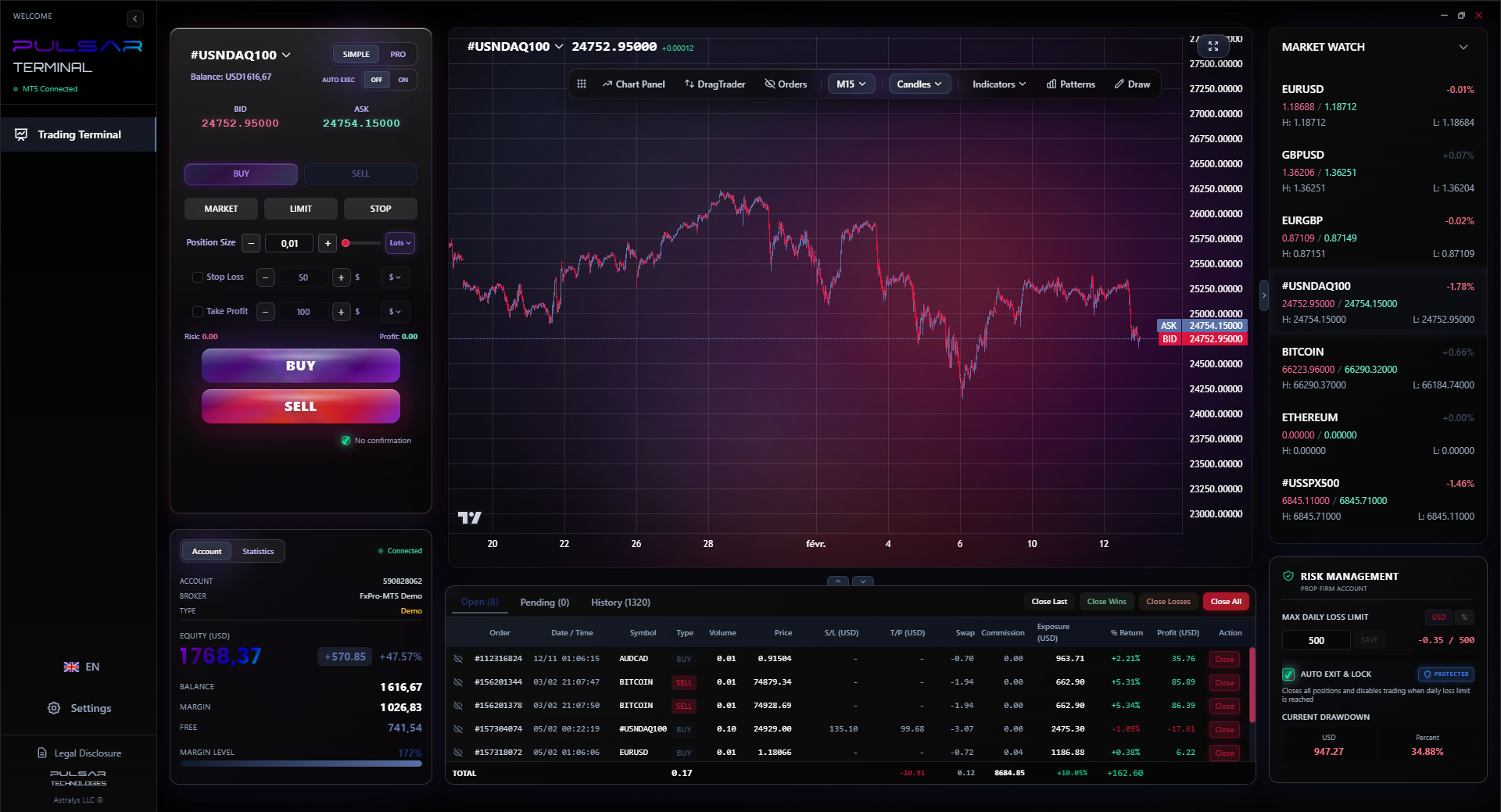
Managing multiple profit targets and trailing stops on volatile crude oil trades is complex, but tools like Pulsar Terminal automate these orders directly on your MT5 platform.
Pulsar Terminal
The all-in-one MT5 companion: drag-and-drop orders, multi-TP/SL, trailing stop, grid trading, Volume Profile, and prop firm protection. Used by 1,000+ traders daily.
“Greed kills more accounts than bad analysis.”
Technical analysis gives you the 'when,' but fundamentals give you the 'why.' For an Indian trader, these are the headlines that move our MCX price:
- OPEC+ Meetings: Any decision to cut or increase production sends shockwaves. The anticipation alone causes volatility.
- US Crude Inventories (EIA Data): Released weekly, this is the big one. A larger-than-expected build (more oil in storage) is bearish. A larger-than-expected draw is bullish. The price often moves 100-200 rupees in seconds.
- USD/INR Exchange Rate: Since our contract is in rupees but the commodity is dollar-priced globally, a weakening rupee (USD/INR going up) makes imported oil more expensive, pushing MCX crude up, and vice-versa.
- Geopolitics: Trouble in the Middle East (straits of Hormuz), sanctions on major producers like Russia, or decisions from the US Strategic Petroleum Reserve.
- Indian Demand Data: Industrial production numbers, festival season demand forecasts. Our domestic demand story can sometimes decouple us briefly from global trends.
You don't need to be an economist. Just have an economic calendar open. Don't hold a big position into a major news event unless you're intentionally gambling. It's not trading; it's a coin flip.
“A 5% monthly return compounds to over 79% per year. Focus on survival, not lottery tickets.”
Let's get tactical. Here are two ways to apply this crude oil trading strategy on the MCX.
The Daily Chart Swing Trade
This is for people with day jobs. You analyze in the evening, place trades, and manage them over days or weeks.
- Timeframe: Daily Chart.
- Identify Trend: Use market structure (HH/HL or LH/LL).
- Wait for Pullback: Let price come back to a key support (in uptrend) or resistance (in downtrend). This could be a moving average or a prior demand/supply zone.
- Look for Reversal Candles: A bullish pin bar or engulfing candle at support in an uptrend is your signal.
- Enter: Place a buy order above the high of that reversal candle.
- Stop-Loss: Below the recent swing low.
- Target: Aim for at least the previous swing high (1:2 R/R or better).
The Intraday Momentum Trade
This is for active traders during market hours (6 PM - 11 PM IST).
- Timeframe: 15-minute or 30-minute chart.
- Context: Know the daily trend direction. Only trade intraday pullbacks in the direction of the daily trend. It's higher probability.
- Trigger: I use a break of a minor consolidation. For example, in a daily uptrend, if price consolidates for a few 15-minute candles, a break above that consolidation's high is my long entry.
- Stop-Loss: Just below the consolidation low.
- Exit: Be quick. Take 50% profit at a 1:1 risk-reward and trail the rest with a breakeven stop. Intraday noise can reverse gains fast.

Pro Tip: The first 30 and last 30 minutes of the MCX crude session are often the most volatile and unpredictable. Consider sitting them out until you see a clear direction. Let the market settle.
Whether you're swing trading or considering more active styles like scalping, the core principles of trend alignment and tight risk management remain the same.
“A 5% monthly return compounds to over 79% per year. Focus on survival, not lottery tickets.”
Your biggest enemy is in the mirror. After 12 years, I can tell you the mental mistakes are universal.
- Revenge Trading: You take a loss. Anger and embarrassment kick in. You jump right back in with a bigger position to 'make it back.' This is the fastest path to a margin call. After a loss, shut down the platform. Walk away.
- Moving Your Stop-Loss: You're in a trade, it goes against you. Instead of accepting the loss, you move your stop further away, thinking 'it'll come back.' It usually doesn't. You've just broken your risk management plan and turned a small, planned loss into a catastrophic one.
- Overtrading: Boredom is not a trading signal. Just because the market is open doesn't mean you need to be in a trade. Wait for your setup. Sometimes the best trade is no trade.
- Confirmation Bias: You're bullish, so you only read bullish news and ignore bearish charts. You hang on to losing longs, hoping for a miracle. The market doesn't care about your opinion.
I keep a trading journal. Every entry, exit, reason, and emotional state. Reviewing it weekly is brutally honest. You see your patterns of stupidity repeated. Then you can fix them.
💡 Winston's Tip
Your first loss is often your smallest loss. The instinct to 'average down' in a losing crude oil trade is the siren song that sinks the ship. Respect your initial stop.
“Your biggest enemy is in the mirror. The mental mistakes are universal.”
Here's how to implement this crude oil trading strategy, step by step.
- Education First: Paper trade for at least two months. Use a demo account that simulates MCX conditions. Don't touch real money until you have three consecutive profitable weeks on demo. This tests your discipline.
- Choose Your Broker: Open an account with a SEBI-registered broker that offers MCX trading. Compare brokerage, platform stability, and margin requirements. Start with the Crude Oil Mini contract.
- Capital: Never trade with money you can't afford to lose. Your trading capital should be separate from your emergency fund, savings, or household money.
- Start Small: With your real account, start with position sizes so small that a loss doesn't bother you emotionally. You're trading to learn the real-money feel, not to get rich quick.
- Focus on One Instrument: Master crude oil. Don't jump to natural gas, gold (XAU/USD guide), or forex (EUR/USD guide) until you have consistency.
- Review and Adapt: The market changes. Your journal will tell you what's working and what's not. A strategy is a framework, not a prison.
Finally, manage your expectations. Aim for consistent, small gains. A 3-5% return per month is phenomenal and will compound dramatically over time. Chasing 50% months is what gets people wiped out. Trading is a marathon of survival, not a sprint to riches.
FAQ
Q1What is the best time to trade crude oil on MCX?
The most active and volatile periods are between 7:00 PM and 11:00 PM IST, as this overlaps with the European and early US sessions. The first 30 minutes after open (5:00 PM) can be erratic. Avoid trading during major news releases like the US EIA inventory data unless you're experienced with the volatility.
Q2Should I trade the standard lot or the mini contract?
For almost all retail traders, start with the mini contract (10 barrels). The tick value is ₹10, making risk management far easier. The standard lot (100 barrels, tick value ₹100) requires a much larger account to safely adhere to the 1% risk rule. Move to the standard lot only when your account size and consistent profitability justify it.
Q3How does the USD/INR rate affect MCX Crude Oil prices?
Directly. Global oil is priced in USD. If the rupee weakens (USD/INR goes up), it takes more rupees to buy the same dollar-priced barrel, so MCX crude price tends to rise, all else being equal. A strengthening rupee (USD/INR down) can suppress MCX prices even if global oil is flat or rising slightly.
Q4What is a realistic monthly return from trading crude oil?
If you're consistently making 3-5% per month on your trading capital, you are in the top tier of retail traders. Anyone promising or expecting more is likely taking unsustainable risks. Focus on risk-adjusted returns and protecting your capital. A 5% monthly return compounds to over 79% per year.
Q5Can I use this strategy for international WTI or Brent CFDs?
The core price action and risk management principles are universal. However, execution differs. International CFD brokers like Pepperstone or Exness offer different contract sizes, use, and have 24-hour trading. The spread definition and liquidity during Asian hours can also vary. Always practice a strategy in the specific market you intend to trade.
Q6How do I handle overnight positions in crude oil?
Hold overnight positions only if they are in significant profit and you have a stop-loss at breakeven or better. Crude oil is prone to overnight gaps due to global news. Ensure you have the required margin for NRML positions and understand that the gap risk is real. Most retail traders should square off intraday positions (MIS) to avoid this risk entirely.
Prof. Winston's Lesson
Key Takeaways:
- ✓Risk max 1% per trade on MCX Crude.
- ✓Start with the Mini contract (10 barrels).
- ✓Trade pullbacks in the direction of the daily trend.
- ✓Never hold a large position into EIA data.
How useful was this article?
Click a star to rate
Weekly Trading Insights
Free weekly analysis & strategies. No spam.
About the Author
Rajesh Sharma
Senior Forex Analyst
Trading Indian and South Asian markets for over 10 years. Started with NSE currency derivatives before moving to international forex. Specializes in USD/INR and emerging market pairs.
Comments
Risk Disclaimer
Trading financial instruments carries significant risk and may not be suitable for all investors. Past performance does not guarantee future results. This content is for educational purposes only and should not be considered investment advice. Always conduct your own research before trading.
You Might Also Like

Cara Trading Forex Sukses: 7 Prinsip dari Trader Profesional
Cara trading forex sukses dengan 7 prinsip trader pro: manajemen modal, disiplin, journal trading, backtest. Data nyata, bukan janji profit palsu.
Jam Trading Forex Terbaik untuk Trader Indonesia: Panduan Lengkap dengan Tabel Waktu
Panduan jam trading forex untuk trader Indonesia. Tabel 4 sesi dunia, jam emas 20:00-00:00, sesi mana yang harus dihindari. Data akurat + tips dari trader berpengalaman.
Top 5 Sàn Forex Uy Tín Nhất 2026: Review Jujur dari Trader Indonesia
Top 5 sàn forex uy tín 2026 untuk trader Indonesia. Review jujur: spread, deposit, withdraw, dukungan lokal. Exness, XM, IC Markets & lebih.
Get Pulsar Terminal
All these calculators are built into Pulsar Terminal with real-time data from your MT5 account. One-click position sizing, automatic risk management, and instant calculations.
Get Pulsar Terminal