


Here's a statistic that might surprise you: over 70% of traders who try to use harmonic patterns give up within six months.

David van der Merwe
Emerging Markets Trader ·  South Africa
☕ 10 min read
What you'll learn:
- 1What Exactly is the Cypher Pattern? (And Why It's Different)
- 2Spotting the Cypher on South African Charts: USD/ZAR & EUR/USD
- 3My Trading Rules: Entry, Stop Loss, and Taking Profit
- 4The Mistakes I Made (So You Don't Have To)
- 5Boosting Confidence: Combining the Cypher with Other Tools
- 6Trading the Cypher in South Africa: Brokers, Costs & Sessions
- 7Final Thoughts: Is the Cypher Pattern Right for You?
Here's a statistic that might surprise you: over 70% of traders who try to use harmonic patterns give up within six months. They find the rules confusing, the setups rare, and the results inconsistent. I was almost one of them. The cypher pattern forex setup changed that for me. It's not your typical harmonic - it breaks some of the old rules and, when traded right on pairs like USD/ZAR, it can be brutally effective. This guide isn't about theory. It's about how I learned to spot it, trade it, and, more importantly, not blow up my account with it in the South African market.
Most harmonic patterns you read about - the Gartley, the Bat, the Crab - follow a strict set of Fibonacci ratios. The cypher pattern is the rebel of the family. It emerged from market behavior rather than pure Fibonacci theory, and its defining feature is an aggressive, extended C point.
Think of it as a five-point structure (X-A, A-B, B-C, C-D) that looks for a reversal at point D. The magic, and the confusion, lies in the ratios. While a Bat pattern might require a precise 0.886 retracement, the cypher is more flexible and often more extreme.
Here’s the core structure that makes a valid cypher pattern:
- Leg X-A: Any strong impulse move.
- Leg A-B: This retraces between 38.2% and 61.8% of X-A. Pretty standard so far.
- Leg B-C: This is where it diverges. This leg extends beyond point A. It should be between 113.0% and 141.4% of the X-A leg.
- Leg C-D: The final leg. This is the potential reversal zone (PRZ). It's a deep retracement of the entire X-C move, typically between 78.6% and 88.6%.
The pattern is complete when price reaches this C-D zone. That’s your signal to look for a reversal back in the direction of the initial X-A move.

Warning: The extended B-C leg is what catches most people off guard. You'll think the trend is continuing strongly, only for it to reverse sharply at the 78.6% level. This is why confirmation is non-negotiable.
You can't just slap a Fibonacci tool on any chart and hope. The cypher pattern forex setup needs volatility and clear swings. In South Africa, we have two fantastic testing grounds.
The Volatility Playground: USD/ZAR
This is where I've caught my biggest cypher wins. The pair's inherent volatility creates those deep, exaggerated swings that form perfect cypher legs. You need a broker with tight spreads here, as the moves can be fast. I primarily use IC Markets review for ZAR pairs because their raw spreads keep costs predictable during these volatile setups.
Look for it during London/New York overlap (3-7 PM SAST). A sharp rally (X-A), a pullback (A-B), then an even sharper extension beyond the high (B-C). When it finally starts pulling back from that extreme, draw your Fib from X to C. If it hits that 78.6-88.6% zone, get ready.
The Liquid Gauge: EUR/USD
For practicing the structure, nothing beats the majors. EUR/USD offers cleaner, less erratic price action. It's where I learned to identify the pattern without the noise of emerging market currency spikes. The patterns form more slowly, giving you time to measure and confirm. My guide on EUR/USD guide covers the fundamentals that often drive these large swings.

Example: In early 2024, USD/ZAR formed a near-textbook bearish cypher on the 4-hour chart. X-A was a drop from R18.90 to R18.45. A-B retraced to R18.75 (approx. 61.8%). B-C extended down to R18.30 (beyond point A). The C-D leg then rallied all the way back to the 78.6% Fib of the entire X-C move, around R18.82. That was the reversal zone. Price rejected it and fell over 300 pips.

💡 Winston's Tip
The market's memory is at whole numbers. A cypher's PRZ at a level like $1.1000 or R19.00 is ten times more potent than one at a random Fibonacci level alone.
“The cypher pattern is the rebel of the harmonic family, born from market behavior, not just textbook theory.”
This is where I lost money before I developed a system. Seeing the pattern is one thing. Trading it profitably is another.
1. The Entry (The Patience Game): Never, ever enter the moment price touches the PRZ (the 78.6-88.6% zone). You must wait for price action confirmation. I use a simple two-step process:
- Step 1: Price reaches the PRZ.
- Step 2: I wait for a bullish or bearish rejection candle to close within the zone. A pin bar, an engulfing candle, or even a strong reversal candle with high volume works. My entry is on a break of that confirmation candle's high (for bullish cypher) or low (for bearish cypher).
2. The Stop Loss (The Non-Negotiable): Your stop loss must be placed beyond point X of the entire pattern. If price breaks beyond that origin point, the pattern's structure is invalidated. There's no argument here. This stop is usually 1.5 to 2 times your anticipated reward, which is why position sizing is critical. I always run my trades through a position size calculator before entering.
3. Taking Profit (The Realistic Approach): Beginners aim for the moon. I aim for logical levels. My primary profit target (TP1) is at the 38.2% retracement of the C-D leg. TP2 is at 61.8%. Sometimes, if momentum is strong, I'll trail the rest. I rarely hold for a full retracement to point C. This is a swing trading mindset, not a home-run swing.
Here’s a real trade from my journal: EUR/USD, 1-Hour Chart, Bearish Cypher.
- Point D/PRZ identified at 1.0885 (78.6% Fib).
- A bearish engulfing candle closed at 1.0880.
- Entered short on break of candle low: 1.0878.
- Stop Loss above point X: 1.0925 (47 pips risk).
- TP1 at 38.2% of C-D: 1.0840 (38 pips profit).
- Moved stop to breakeven at TP1. Price hit TP2 (61.8%) the next day. Net win: +58 pips on half the position. Not explosive, but consistent.
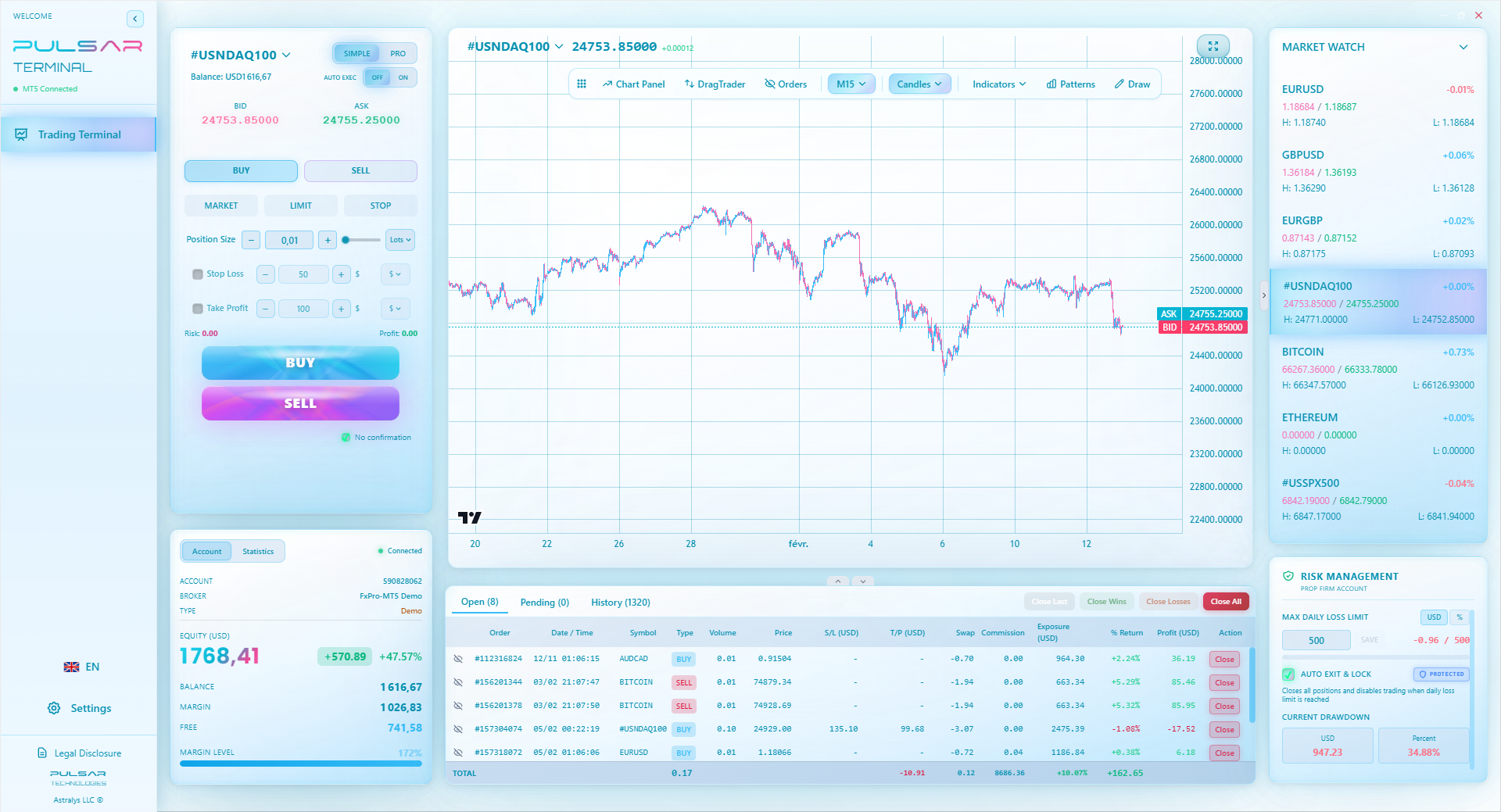
Managing multiple profit targets and a breakeven stop on a cypher trade is manual and stressful, but tools like Pulsar Terminal automate these orders directly on your MT5 chart.
Pulsar Terminal
The all-in-one MT5 companion: drag-and-drop orders, multi-TP/SL, trailing stop, grid trading, Volume Profile, and prop firm protection. Used by 1,000+ traders daily.
I have a folder of losing trades labeled 'Cypher School Fees.' Let's talk about them.
Mistake 1: Ignoring the B-C Extension Rule. Early on, I'd see a deep retracement and call it a cypher. If the B-C leg doesn't extend beyond point A (between 113% and 141.4% of X-A), it's not a cypher. It might be a different harmonic. Trading a fake cypher is a sure way to get stopped out.
Mistake 2: Trading Against the Higher Timeframe Trend. This was a costly one. I caught a perfect-looking bullish cypher on the 1-hour USD/ZAR chart. What I ignored was that on the daily chart, price was crashing through a major support level in a strong bearish trend. I bought the 'pattern,' but the trend steamrolled it. The pattern failed. Now, I only trade cypher patterns that are in alignment with the daily or 4-hour trend. A bullish cypher in a broader uptrend? High probability. The same pattern in a downtrend? I'll pass.
Mistake 3: No Confirmation, Just Hope. I entered at the PRZ because the ratio was 'pretty.' Price tapped 78.6% and I jumped in. It then proceeded to slice through 88.6%, 100%, and my stop loss. The pattern was technically valid, but there was no buying or selling pressure at the PRZ. Now, I wait for the candle close. No confirmation, no trade. It saves me from at least two bad trades a month.
These mistakes are often tied to poor risk management, which can lead to a dreaded margin call. A solid pattern is useless without solid discipline.
💡 Winston's Tip
If you can't immediately see the X-A leg - the initial, strongest impulse - walk away. A weak foundation makes for a fragile pattern.
“A perfectly traded 50-pip win from a cypher is infinitely better than a poorly managed 200-pip loss from chasing a trend.”
A cypher pattern in isolation is good. A cypher pattern supported by other indicators or market context is great. I don't use many, but these two have saved me countless times.
The RSI Divergence Check: While price is making that extended high at point C (in a bearish cypher), I watch the RSI indicator. If I see clear bearish divergence - price makes a higher high, but RSI makes a lower high - my conviction for the impending reversal at point D skyrockets. It tells me momentum is waning even as price pushes higher.
The MACD Momentum Signal: As price enters the PRZ (point D), I glance at the MACD indicator. I'm not looking for a complex signal. A simple crossover happening near the zero line, or the histogram showing a clear loss of momentum, acts as a secondary confirmation. It's not my entry trigger, but it tells me the engine is stalling right where I expected it to.
The Support/Resistance Overlap: This is the most powerful filter. If the cypher's PRZ (point D) coincides with a major horizontal support/resistance level, a previous swing high/low, or a key round number (like R19.00 on USD/ZAR), the setup goes to the top of my watchlist. It means multiple market forces are aligning at that single price point.

Pro Tip: Don't overcomplicate it. Use one, maybe two, confirming tools. The pattern itself is the primary signal. The tools are just there to give you the guts to pull the trigger.
The theory is universal, but the execution is local. Here’s what matters for us trading from SA.
Regulation & Safety (The FSCA Rule): Only trade with brokers licensed by the Financial Sector Conduct Authority (FSCA). This isn't a suggestion. Your funds need the protection of client money segregation and local regulatory oversight. Since 2021, use for retail traders is capped at 30:1. This is actually a good thing for pattern trading - it prevents you from overleveraging on a single setup.
Costs That Eat Profits: You're hunting for moves of 50-150 pips. If your broker's spread on USD/ZAR is 15 pips, you've already lost a chunk of your potential profit. Look for brokers known for tight spreads on major and ZAR pairs.
- Commission-based accounts can be cheaper for active traders. You might pay $5-$7 per standard lot but get spreads near 0.0 pips.
- Spread-only accounts are simpler but watch the average spread, especially during volatile SA news releases. I've found brokers like Pepperstone review and the aforementioned IC Markets offer conditions that make these trades viable. Always factor in the spread definition as a direct cost before calculating your risk/reward.
The Best Time to Hunt: Cypher patterns form on all timeframes, but for the best quality setups on pairs like EUR/USD and GBP/USD, focus on the London session (10 AM - 7 PM SAST) and the London-New York overlap (3 PM - 7 PM SAST). This is when liquidity is highest, and institutional moves create the clean, strong swings that form reliable patterns. For USD/ZAR, local market hours (9 AM - 5 PM SAST) also see good activity, but be aware of SARB announcements.
💡 Winston's Tip
Your first profit target should always be the easiest for the market to give you. Aim for the 38.2% retracement of the C-D leg. Greed turns high-probability trades into break-even scratches.
“Never enter the moment price touches the Potential Reversal Zone. You must wait for price action to confirm the market agrees with your analysis.”
The cypher pattern forex strategy isn't for everyone. It requires patience (setups aren't daily), precision in measurement, and the discipline to wait for confirmation. If you're a scalping strategy trader who needs action every hour, you'll hate it.
But if you're a swing trader who doesn't mind analyzing the charts once or twice a day, who enjoys the puzzle of market structure, and who can manage risk patiently, the cypher can be a powerful weapon. It taught me to respect Fibonacci levels in a new way and to see reversals where others just see continuation.
Start on a demo account. Practice identifying 50 cyphers on historical charts before you even think about real money. Then, paper trade it for a month. Track your success rate. The pattern works, but only if the trader does too. My biggest lesson? A perfectly traded 50-pip win from a cypher is infinitely better than a poorly managed 200-pip loss from chasing a trend. In our market, consistency is the only edge that lasts.
FAQ
Q1What is the success rate of the cypher pattern?
There's no universal number, as success depends entirely on your rules. With strict confirmation (like a reversal candle close in the PRZ) and trend alignment, my personal win rate over the last 100 trades is around 62-65%. Without rules, the rate plummets. It's not about the pattern's innate success, but how well you filter and execute it.
Q2Can I trade the cypher pattern on gold (XAU/USD)?
Absolutely. Commodities like gold often form clean harmonic patterns due to their strong trending nature. The same rules apply. Be mindful that gold's volatility means wider stops, so adjust your position size accordingly. I've written a specific guide on trading gold using technical setups in my XAU/USD guide.
Q3What's the minimum timeframe to trade the cypher?
I don't recommend going below the 1-hour chart. The pattern needs space to develop its legs properly. On lower timeframes like 15-minute or 5-minute charts, there's too much market noise, and false setups are common. My sweet spot is the 4-hour and daily charts for the highest-probability setups.
Q4How do I accurately draw the Fibonacci retracement for the pattern?
For the critical C-D leg, you must draw the Fibonacci tool from point X (the very beginning of the pattern) to point C (the extreme of the extension). The Potential Reversal Zone (PRZ) is between the 78.6% and 88.6% retracement levels of this X-C move. Most mistakes happen from drawing the Fib from A to C instead of X to C.
Q5Are there automated tools or scanners for the cypher pattern?
Some advanced trading platforms and third-party tools like Pulsar Terminal offer pattern recognition scanners. However, I strongly advise learning to identify it manually first. Automated tools can miss nuance, like whether the B-C leg truly extends beyond point A or if the PRZ aligns with key support. Use scanners as an alert system, not a crutch.
Q6As a South African, do I pay tax on profits from forex trading?
Yes. Profits from forex trading are generally considered taxable income by SARS (South African Revenue Service). It's crucial to keep detailed records of all your trades, including entries, exits, and profits/losses. Consult with a tax professional who understands trading to ensure you comply correctly. Trading through an FSCA-regulated broker also provides clear statements for tax purposes.
Prof. Winston's Lesson
Key Takeaways:
- ✓The B-C leg must extend 113-141.4% of X-A. No extension, no cypher.
- ✓Always place your stop loss beyond point X. It's the pattern's invalidation line.
- ✓Wait for a confirming candle close in the PRZ before entering.
- ✓Align cypher trades with the higher timeframe trend for a major edge.
- ✓Factor in the spread, especially on USD/ZAR, before calculating risk/reward.
How useful was this article?
Click a star to rate
Weekly Trading Insights
Free weekly analysis & strategies. No spam.
About the Author
David van der Merwe
Emerging Markets Trader
Johannesburg-based trader with 11 years in emerging market currencies. Specializes in ZAR pairs, FSCA-regulated trading, and South African market analysis.
Comments
Risk Disclaimer
Trading financial instruments carries significant risk and may not be suitable for all investors. Past performance does not guarantee future results. This content is for educational purposes only and should not be considered investment advice. Always conduct your own research before trading.
You Might Also Like

Cara Trading Forex Sukses: 7 Prinsip dari Trader Profesional
Cara trading forex sukses dengan 7 prinsip trader pro: manajemen modal, disiplin, journal trading, backtest. Data nyata, bukan janji profit palsu.
Jam Trading Forex Terbaik untuk Trader Indonesia: Panduan Lengkap dengan Tabel Waktu
Panduan jam trading forex untuk trader Indonesia. Tabel 4 sesi dunia, jam emas 20:00-00:00, sesi mana yang harus dihindari. Data akurat + tips dari trader berpengalaman.
Top 5 Sàn Forex Uy Tín Nhất 2026: Review Jujur dari Trader Indonesia
Top 5 sàn forex uy tín 2026 untuk trader Indonesia. Review jujur: spread, deposit, withdraw, dukungan lokal. Exness, XM, IC Markets & lebih.
Get Pulsar Terminal
All these calculators are built into Pulsar Terminal with real-time data from your MT5 account. One-click position sizing, automatic risk management, and instant calculations.
Get Pulsar Terminal