


Here's a number that should make you pause: over 90% of transactions on the Nigerian Stock Exchange are by domestic investors.

Olumide Adeyemi
West African Trading Pioneer ·  Nigeria
☕ 10 min read
What you'll learn:
- 1What You're Actually Buying: Ownership vs. Exchange Rate
- 2When Can You Trade? 24/5 vs. Banking Hours
- 3The Naira & Kobo: Costs, use, and the 10% Tax Man
- 4The Wild West vs. The Formal Sector: Brokers & Regulation
- 5So, Which Market is For You? A Nigerian Reality Check
- 6The Strategy & Mindset Shift You Must Make
- 7Getting Started: Your First Practical Steps in Nigeria
Here's a number that should make you pause: over 90% of transactions on the Nigerian Stock Exchange are by domestic investors. Foreign money has largely stayed away. Meanwhile, Nigerians are trading billions in forex daily on international platforms. The difference between stock and forex trading here isn't just about assets - it's about who controls the game, how you get paid, and what the taxman takes. I've lost money in both markets before figuring out which one actually works for the Nigerian trader.
This is the core difference, and if you don't get it, you'll lose. When you buy a stock on the NGX - say, Dangote Cement - you're buying a tiny piece of that company. You become a part-owner. Your profit comes from the company doing well (share price goes up) or from them sharing profits (dividends). You're betting on Nigerian corporate success.
Forex is a pure speculation game. You're not buying ownership in a country. When you trade EUR/USD or GBP/NGN, you're betting that one currency will get stronger or weaker against another. It's a direct bet on macroeconomic forces: interest rates, inflation, political stability. There's no dividend, no shareholder meeting. Just price movement.
I learned this the hard way early on. I bought United Bank for Africa (UBA) stock because I 'believed in the brand,' like it was a football team. The price went sideways for months while I watched my capital sit idle. In forex, that same capital could have been in and out of dozens of trades. Different mindset entirely.
The Local Angle: Naira Pairs
For us, a huge part of forex trading involves the Naira. Pairs like GBP/NGN or USD/NGN are massively volatile, driven by Central Bank of Nigeria (CBN) policies and black-market rates. Trading these is a direct play on Nigeria's economic health, which we understand intuitively. You won't find that kind of direct, liquid exposure on the stock exchange.
“The difference between stock and forex trading here isn't just about assets - it's about who controls the game.”
This is a practical difference that affects your job, your sleep, and your strategy.
The Nigerian Stock Exchange (NGX) operates from 10:00 AM to 2:30 PM, Monday through Friday. That's it. If you have a 9-5, you're trading on your lunch break or sneaking glances at your phone. The market closes, and nothing moves until the next day. News breaks after hours? You're stuck until morning.
The forex market is open 24 hours a day, five days a week. It starts in Sydney, moves to Tokyo, then London, and finally New York. Major sessions like the London-New York overlap (1 PM - 4 PM Nigerian time) are when things get really liquid. You can trade before work, after work, even at 2 AM if you're an insomniac like I sometimes am.

Warning: 24-hour access is a double-edged sword. It doesn't mean you should be trading 24 hours. I burned myself out in 2020 trying to catch every Asian session move. Pick a session that suits your life and master its rhythm. For most Nigerians, the London session (12 PM - 4 PM) is the sweet spot.
Liquidity is the other key difference. The forex market is the largest financial market in the world, turning over trillions daily. This means tight spreads and your orders get filled fast. The NGX, while growing, is smaller. Sometimes you'll struggle to buy or sell a large block of shares without moving the price against yourself. For active traders, this difference is everything.

💡 Winston's Tip
Your first N100,000 profit is the most expensive to earn. It pays for all your future lessons. Don't rush to withdraw it all; reinvest part of it in your trading education.
“use is dangerous power. I once used 1:500 use, made 15% in an hour, and felt like a genius. The next day, I wiped out two weeks of profits.”
Let's talk about what really matters: what it costs to play and what you get to keep. The numbers here are starkly different.
Forex Costs & use: Your main cost is the spread - the difference between the buy and sell price. On a good broker like Exness or IC Markets, you can get spreads from 0.0 pips on major pairs like EUR/USD (you pay a small commission instead). use is where it gets crazy. Because retail forex is loosely regulated here, brokers offer insane use - I've seen up to 1:3000. Exness even offers 'unlimited' use for experienced clients. This is dangerous power. I once used 1:500 use on a gold trade, made a 15% return on my account in an hour, and felt like a genius. The next day, a similar trade wiped out two weeks of profits. use amplifies everything, especially mistakes.
Stock Costs: You pay brokerage fees (a percentage of the trade), SEC fees, and NGX fees. It's less transparent than a simple spread. There's no use like in forex. You can get margin loans, but it's a formal process, not a click-of-a-button 1:500.
The 10% Rule That Nobody Talks About Enough: Here’s the critical Nigerian-specific difference. By law, you are subject to a 10% Capital Gains Tax on your gross trading profits. This applies whether you trade NGX stocks or forex with an international broker. Let me be blunt: most forex traders ignore this. They think because their broker is in Cyprus or Seychelles, the taxman can't see them. That's a risky game. The FIRS is getting smarter. If you fund your broker account from your Nigerian bank account, there's a trail.
I set aside 10% of every profitable withdrawal into a separate savings account. It’s not my money; it’s the government’s. Pretending otherwise is an expensive fantasy. When calculating if a trade is worth it, factor in that 10% right from the start. Use a position size calculator that includes your target profit after tax.
“use is dangerous power. I once used 1:500 use, made 15% in an hour, and felt like a genius. The next day, I wiped out two weeks of profits.”
How you access these markets in Nigeria is a tale of two worlds.
Stock Trading: It's formal and regulated by the Securities and Exchange Commission (SEC) Nigeria. You must use a licensed stockbroking firm. You can verify any broker on the SEC's Capital Markets Operator Search tool. Your money is held in trust, and the process feels like dealing with a bank. It's safe, but sometimes slow and bureaucratic.
Forex Trading: This is where it gets interesting. The local regulatory framework for online retail forex is... let's call it 'developing.' The CBN authorizes some OTC forex brokers, but most serious Nigerian traders use internationally regulated brokers that accept Nigerian clients. Think Exness, XM, or Pepperstone. These brokers are regulated by bodies like CySEC (Cyprus) or the FSC (Mauritius).
Why do we do this? Better technology, lower costs, and that insane use. I use Exness for its seamless local bank transfers and IC Markets for its raw spreads. But you must do your homework. You're placing your trust in a foreign entity. Check their license, their history, and how they handle withdrawals. I learned this after a sketchy 'broker' vanished with my $500 deposit in 2017. Now, I only trade with top-tier regulated firms.

Pro Tip: Your funding method is key. Use brokers that support direct Naira deposits/withdrawals via local bank transfer. It’s faster and cheaper than international card payments or crypto conversions. Exness is excellent for this. It turns a 3-day process into 10 minutes.
💡 Winston's Tip
If you wouldn't buy it in the supermarket at that price, don't buy it on the NGX. Hype is not a strategy.
“Pretending the 10% capital gains tax doesn't apply to you is an expensive fantasy.”
This isn't about which is 'better.' It's about which fits your personality, capital, and goals as a Nigerian.
Choose STOCKS if:
- You are a long-term investor. You want to buy and hold for years, collecting dividends.
- You believe in specific Nigerian companies and the economy's long-term growth.
- You have a larger capital base (thousands of dollars) and don't need use.
- You prefer a regulated, formal environment and are patient with processes.
- You're okay with trading only during NGX hours.
The 2026 FTSE Russell reclassification of Nigeria back to Frontier Market status is a big deal. It means foreign institutional money is expected to flow back in, which could boost blue-chip stocks. That's a long-term investor's tailwind.
Choose FOREX if:
- You are an active trader (scalper, day trader, swing trader).
- You have limited starting capital (you can start with $10-$50 on a cent account).
- You need flexibility to trade outside 10 AM - 2:30 PM.
- You understand global macroeconomics and want to trade the Naira's volatility.
- You can handle the psychological pressure of high use and 24-hour markets.
I trade both, but 80% of my activity is forex. Why? Liquidity, speed, and the ability to scalp for small, frequent gains that add up. My stock portfolio is for retirement; my forex account is for monthly income.
My biggest mistake was trying to trade stocks like forex - getting in and out quickly. The fees ate me alive. And trying to trade forex like a stock - 'investing' in a currency pair and holding for months through huge drawdowns. That was a painful margin call lesson.
“Pretending the 10% capital gains tax doesn't apply to you is an expensive fantasy.”
The tools and techniques that work in one market can fail miserably in the other.
Analysis Differences:
- Stocks: You need fundamental analysis. Read annual reports, understand debt ratios, follow management news. Technical analysis helps with entry timing, but the company's health is key.
- Forex: Fundamentals are about countries, not companies: interest rate decisions, inflation data (CPI), employment numbers, and political events. Technical analysis is king here because price action reflects all these global flows. I rely heavily on the RSI indicator for overbought/oversold levels and the MACD indicator for trend momentum on my forex charts.
Mindset & Risk: Stock investing is often about 'conviction.' You buy and hope you're right over months. Forex trading is about 'reaction.' You have no conviction; you follow the price. It's more disciplined and less emotional if done right.
Risk management is non-negotiable in forex because of use. A 2% stop-loss on a 1:500 leveraged trade can still wipe out your account if you over-position. In stocks, without use, a 2% move is just a 2% move. The emotional weight is completely different.

Example: Let's say you have N500,000.
- In Stocks: You buy N500,000 worth of MTN shares. A 10% drop means you lose N50,000. Your shares still exist.
- In Forex (with 1:100 use): You control N50,000,000 worth of USD/NGN. A 1% move against you is a N500,000 loss... which is 100% of your actual capital. Game over. This is why your position size is your most important decision.
💡 Winston's Tip
The spread isn't a fee, it's the first loss of every trade. Choose your broker and your pairs accordingly.
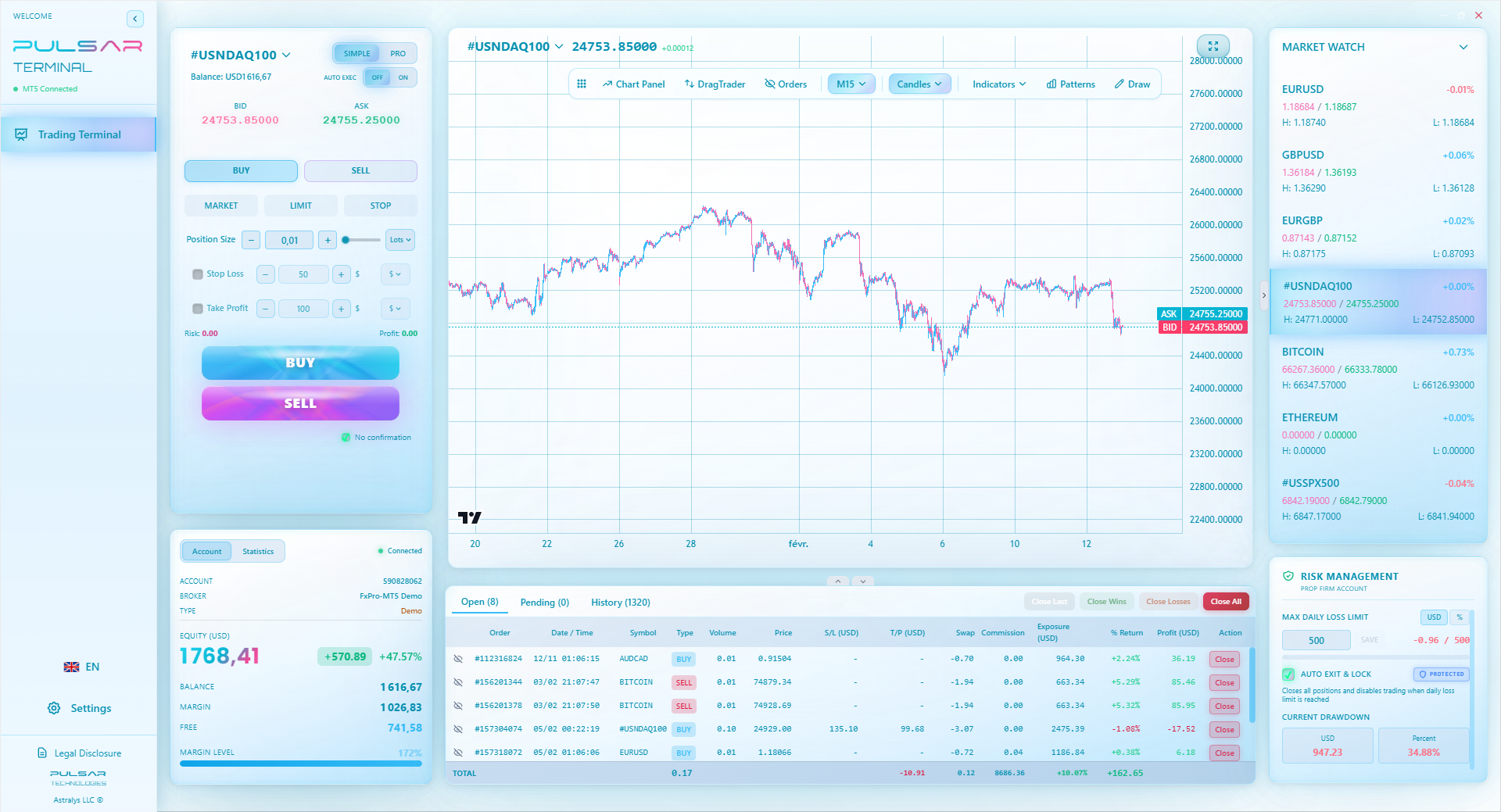
Managing multiple trades and precise stop-losses across different markets is complex, but tools like Pulsar Terminal automate this directly on your MT5 platform.
Pulsar Terminal
The all-in-one MT5 companion: drag-and-drop orders, multi-TP/SL, trailing stop, grid trading, Volume Profile, and prop firm protection. Used by 1,000+ traders daily.
“My stock portfolio is for retirement; my forex account is for monthly income.”
Enough theory. Here's what you do next.
For Stocks:
- Get a Broker: Research SEC-licensed stockbroking firms. Look for low brokerage fees and a good online/mobile platform.
- Open a CSCS Account: The Central Securities Clearing System account is like your stock holding passport. Your broker will help you set this up.
- Fund Your Account: Transfer Naira from your bank account to your broker's trust account.
- Start Small: Don't go all in. Pick one or two liquid blue-chip stocks (like the banks or Airtel Africa) for your first trades.
For Forex:
- Choose an International Broker: I recommend starting with a well-regulated broker that welcomes Nigerians, like XM or Pepperstone. Read our detailed reviews.
- Open a Demo Account: Trade with virtual money for at least 3 months. Test your strategy on pairs like EUR/USD and XAU/USD (gold).
- Start with a Live Cent Account: When you go live, use a cent account (where $1 = 100 cents). This lets you trade real money with tiny, psychological-risk amounts. I wish I had done this. My first live trade was a full $500 lot... a stressful disaster.
- Use Local Transfer to Fund: Use the broker's local deposit option. You'll get a Nigerian bank account details to transfer Naira to. It converts automatically.
- Learn One Strategy: Don't jump between 10 methods. Master one, like price action swing trading. Understand what a pip and spread mean for your bottom line.
The biggest edge you have as a Nigerian trader is understanding local dynamics. You feel the inflation, you hear the CBN news first. Use that intuition to inform your trades, but always let cold, hard price action have the final say.
FAQ
Q1Is forex trading illegal in Nigeria?
No, it's perfectly legal to trade forex with your own money. The confusion comes from the CBN cracking down on unlicensed brokerage operations and Ponzi schemes. Trading with internationally regulated brokers like Exness or XM is a standard practice for Nigerian retail traders.
Q2Which is more profitable, stocks or forex?
Profitability depends on the trader, not the market. Forex offers more frequent opportunities due to use and 24-hour markets, which can lead to faster gains (and losses). Stocks can offer steadier, long-term wealth building through dividends and appreciation. A skilled forex scalper might see more monthly percentage returns, but with significantly higher risk.
Q3Do I pay tax on forex trading profits in Nigeria?
Yes. The law states a 10% Capital Gains Tax on gross profits from all investments, including forex. While enforcement on international broker profits has been inconsistent, it's a legal liability. Smart traders set aside 10% of profits for tax obligations.
Q4Can I start forex trading with 10,000 Naira?
Absolutely. Many international brokers offer cent accounts or micro lots. With 10,000 Naira (about $6-7), you can open a cent account where you trade cents instead of dollars. It's the best way to learn real trading psychology without risking meaningful money.
Q5What's the main risk difference between the two?
The core risk in stocks is company-specific (bankruptcy, poor management) or market-wide declines. In forex, the primary risk is use. You can lose more than your initial deposit very quickly if you don't use strict stop-losses. A stock can go to zero, but it takes time. A forex account can hit zero in minutes.
Q6Should I trade Nigerian stocks or international stocks?
Start with what you know. Nigerian stocks (on the NGX) are easier to research locally, pay dividends in Naira, and you understand the companies. Some forex brokers also offer CFDs on international stocks (like Apple, Tesla), but you're then dealing with foreign exchange risk on top of stock risk. Master one arena first.
Q7Why is use so high for forex in Nigeria?
Because the local regulatory environment for online retail forex is not as strict as for securities. International brokers operating here often offer use from their offshore entities (like 1:1000 from an FSC-regulated branch). It's a marketing tool, but treat it as a danger, not a benefit. Never use maximum use.
Prof. Winston's Lesson
Key Takeaways:
- ✓use above 1:30 turns you into a gambler, not a trader.
- ✓Always calculate profit targets after the 10% capital gains tax.
- ✓Trade NGX for years, forex for hours or days.
- ✓Your funding method is as important as your broker choice.
How useful was this article?
Click a star to rate
Weekly Trading Insights
Free weekly analysis & strategies. No spam.
About the Author
Olumide Adeyemi
West African Trading Pioneer
One of Nigeria's most active forex trading educators. 8 years of experience trading from Lagos. Specializes in low-capital strategies and prop firm challenges for African traders.
Comments
Risk Disclaimer
Trading financial instruments carries significant risk and may not be suitable for all investors. Past performance does not guarantee future results. This content is for educational purposes only and should not be considered investment advice. Always conduct your own research before trading.
You Might Also Like

Cara Trading Forex Sukses: 7 Prinsip dari Trader Profesional
Cara trading forex sukses dengan 7 prinsip trader pro: manajemen modal, disiplin, journal trading, backtest. Data nyata, bukan janji profit palsu.
Jam Trading Forex Terbaik untuk Trader Indonesia: Panduan Lengkap dengan Tabel Waktu
Panduan jam trading forex untuk trader Indonesia. Tabel 4 sesi dunia, jam emas 20:00-00:00, sesi mana yang harus dihindari. Data akurat + tips dari trader berpengalaman.
Top 5 Sàn Forex Uy Tín Nhất 2026: Review Jujur dari Trader Indonesia
Top 5 sàn forex uy tín 2026 untuk trader Indonesia. Review jujur: spread, deposit, withdraw, dukungan lokal. Exness, XM, IC Markets & lebih.
Get Pulsar Terminal
All these calculators are built into Pulsar Terminal with real-time data from your MT5 account. One-click position sizing, automatic risk management, and instant calculations.
Get Pulsar Terminal