


It was March 2020, and EUR/USD was in freefall.

Olumide Adeyemi
West African Trading Pioneer ·  Nigeria
☕ 11 min read
What you'll learn:
- 1What Divergence Actually Is (And What It Isn't)
- 2The Best Tools for the Job: RSI, MACD, and Stochastic
- 3How to Set Up Your Charts for Success (Lagos Edition)
- 4A Real Trade Example: From Spotting to Cashing Out
- 5The 5 Costly Mistakes You're Probably Making
- 6Building Your Complete Divergence Trading Plan
- 7Next-Level Divergence: Triple Divergence and Confluence

It was March 2020, and EUR/USD was in freefall. My screen was a sea of red, panic was setting in, and my last sell order was looking brilliant. Then, something caught my eye. Price was making a new low, but my RSI indicator was forming a higher low. I hesitated, convinced the downtrend would continue. I ignored the classic bullish divergence forming right in front of me. The pair reversed hard, rallying over 500 pips in the next week, and I watched it all from the sidelines, nursing a missed opportunity that would have covered six months of bills. That painful lesson cost me real money, but it burned the power of divergence forex into my trading brain forever.
Let's cut through the fancy jargon. In simple terms, divergence in forex happens when the price of a currency pair is doing one thing, but your momentum indicator is telling a different story. It's a disagreement, a hidden argument between price action and momentum. The most common lie you'll hear is that divergence is a guaranteed reversal signal. It's not. It's a warning sign that the current trend is losing steam, like a car engine starting to sputter before it stalls.
There are two main types you need to know:
Regular Divergence: This is your classic reversal signal.
- Bearish Regular Divergence: Price makes a higher high, but the indicator makes a lower high. Suggests a potential move down.
- Bullish Regular Divergence: Price makes a lower low, but the indicator makes a higher low. Suggests a potential move up.
Hidden Divergence: This one tricks most new traders. It's actually a continuation signal.
- Bearish Hidden Divergence: Price makes a lower high (like in a pullback), but the indicator makes a higher high. Suggests the downtrend will continue.
- Bullish Hidden Divergence: Price makes a higher low (a pullback in an uptrend), but the indicator makes a lower low. Suggests the uptrend will resume.

Warning: Divergence alone is a terrible trade entry signal. I've blown accounts trying to trade every little blip on the RSI. You must combine it with other elements, like price action at key support/resistance levels. Think of it as the spark, not the entire bomb.
Not all indicators are created equal for spotting divergence. You want ones that measure momentum or rate of change. Here’s the breakdown from my 12 years of screen time:
1. Relative Strength Index (RSI) This is my personal workhorse, especially on the 1-hour and 4-hour charts for swing trading. Its clear overbought/oversold zones (typically 70 and 30) make divergences stand out like a sore thumb. The bullish divergence I missed on EUR/USD? That was on the RSI. It’s less noisy than some others, which is perfect when you're also monitoring your position size calculator to manage Naira risk.
2. Moving Average Convergence Divergence (MACD) The MACD is in the name for a reason. Look for divergence between price and the MACD histogram (the bars), not just the signal lines. The histogram shows the acceleration of momentum, and divergences there can be incredibly powerful. It’s often slower than RSI but can give you stronger signals on daily charts.
3. Stochastic Oscillator The Stochastic is hyper-sensitive. It’s great for spotting potential reversals early on shorter timeframes, but that sensitivity is also its curse. You’ll get many more false signals. I used it a lot in my early scalping strategy days and got whipsawed constantly. Use it with caution.
A Quick Comparison Table
| Indicator | Best For | Speed | Noise Level | My Preference |
|---|---|---|---|---|
| RSI | Swing trades, clear signals | Medium | Low | ✅ Primary Choice |
| MACD | Trend strength, daily charts | Slow | Medium | ✅ For Confirmation |
| Stochastic | Early signals, fast markets | Very Fast | High | ❌ Use Sparingly |

Pro Tip: Don't use more than two divergence indicators at once. You'll get analysis paralysis. Pick RSI as your main, use MACD to confirm, and ignore the rest. Clarity beats complexity every single time.

💡 Winston's Tip
Divergence is a symptom, not a disease. It shows momentum is sick. Your job is to diagnose if the patient (the trend) will recover or die.

“Divergence alone is a terrible trade entry signal. I've blown accounts trying to trade every little blip on the RSI.”
Your chart setup can make or break your ability to see divergence clearly. Here’s exactly how I configure my MT5 platform, trading from Lagos with sometimes-unreliable light.
Step 1: Clean Your Chart Remove every unnecessary line, indicator, and doodad. You need a clean price chart. Add a simple 50-period and 200-period Exponential Moving Average (EMA) to identify the broader trend. Divergence against the major trend is stronger.
Step 2: Add Your Indicators
- RSI: Period 14, applied to Close. Levels at 70, 50, and 30. Place this window below your main chart.
- MACD: Fast EMA 12, Slow EMA 26, Signal SMA 9. Apply to Close. Place this below the RSI.
Step 3: The Nigerian Reality Check Your internet might dip. Your power might go. Before you enter any trade based on divergence, ask: "If I lose connection for 10 minutes, will this trade survive?" If the divergence is on a 5-minute chart, probably not. Focus on 1-hour or 4-hour charts for more reliable signals that won't vanish during a brief outage. This is one reason a reliable broker like Exness or IC Markets, with solid mobile platforms, is non-negotiable here.
I learned this the hard way. I spotted a perfect divergence on GBP/JPY on a 15-min chart during a volatile session. Just as I entered, NEPA took the light (and my inverter chose that moment to beep). By the time I got back online 25 minutes later, the trade had reversed and hit my stop loss. The divergence was valid, but my timeframe wasn't resilient to Nigerian infrastructure.
Let's walk through a real divergence forex trade I took on XAU/USD (Gold) last year. This is the exact process, with numbers.
The Setup (October 2023): Gold had been in a strong downtrend for weeks. On the 4-hour chart, price made a new swing low at $1810.50. I looked at my RSI window. Instead of making a new low with price, the RSI had formed a visibly higher low. Classic bullish regular divergence.
Confirmation (The Missing Piece): I didn't buy just because of the divergence. I waited for price action confirmation. The confirmation came when price broke above a minor down-trending resistance line and then closed back above the previous swing low level (around $1825). This showed buying pressure was real.
The Trade:
- Entry: $1826.80 (market order after the close above $1825).
- Stop Loss: $1809.90 (just below the recent swing low). Risk: ~$16.90 per ounce.
- Take Profit 1: $1850 (partial close of 50% position).
- Take Profit 2: $1875 (trailed stop for the remainder).
The Result: TP1 was hit two days later. I moved my stop on the remaining position to breakeven. The rally continued, and I was stopped out on the remainder at $1878 a week after that. Total gain on the trade was about 70% of my total risked capital. Not a home run, but a solid, high-probability double. This is the power of combining divergence with concrete price action. For more on trading Gold, see our dedicated XAU/USD guide.

Example: My risk was 1% of my account ($100). My position size was calculated to risk $100 based on the distance between entry ($1826.80) and stop loss ($1809.90). That's a 169-pip risk. Using a position size calculator, that meant trading a micro lot size to keep my risk sane. Never eyeball this.
💡 Winston's Tip
If you see divergence on a 5-minute chart, look away. That's the market blinking, not talking. Wait for the 1-hour chart to speak.
“Your internet might dip. Your power might go. Before you enter any trade based on divergence, ask: 'If I lose connection for 10 minutes, will this trade survive?'”
I've made these. My students make these. Let's kill these habits now.
1. Trading Divergence on Low Timeframes (Under 1H) This is the biggest killer. On the 5 or 15-minute chart, you'll see divergence everywhere. Most of it is meaningless market noise. It will get you chopped up and spread-eaten, especially with brokers who have wider spreads. Save divergence for the higher timeframes where institutional money leaves clearer footprints.
2. Ignoring the Overall Trend A bullish divergence in a strong, established downtrend is a potential bounce, not a trend reversal signal. It's often just a pullback before the next leg down. Always trade divergence in the direction of the higher timeframe trend for better odds.
3. No Price Action Confirmation You see divergence and jump in immediately. Wrong. Divergence tells you a reversal might happen. You need a price action trigger - a bullish engulfing candle, a break of a structure, a close above a key level - to tell you it is happening. Wait for the confirmation candle to close.
4. Misreading Hidden Divergence You see price make a higher low and the RSI make a lower low. "Aha! Bearish divergence!" you shout. That's actually bullish hidden divergence, a signal for the uptrend to continue. Mixing these up will have you trading against the trend constantly.
5. Letting a Good Trade Turn Bad (Naira Attachment) You catch a perfect divergence trade on EUR/USD. It goes in your favor, then retraces. You think, "I can't take a loss in Naira terms, I'll just wait." You move your stop, hoping. The trade reverses fully and turns a winner into a loser. This emotional attachment to converting back to Naira is a silent account killer. Your stop loss is sacred. Let your winners run with a trailing stop, but never, ever move your initial stop further away.

Divergence isn't a strategy. It's a component. Here’s how to build it into a strong trading plan that works for the Nigerian market.
Step 1: The Scan (Higher Timeframe First) Start your day on the Daily and 4-Hour charts for the major pairs (EUR/USD, GBP/USD, XAU/USD). Look for clear trends and note any obvious support/resistance zones. Then, scan the 1-Hour RSI and MACD for any divergences forming near those key levels.
Step 2: The Signal & Filter Found a divergence? Filter it.
- Is it on the 1H+ chart? (If no, discard).
- Is it occurring at a clear support/resistance, trend line, or Fibonacci level? (If no, be cautious).
- Does it align with the higher timeframe trend? (For regular divergence, a counter-trend signal at support in an uptrend is gold).
Step 3: The Trigger & Entry Now, zoom to the 1-hour or 30-minute chart. Wait for your price action trigger. For a bullish divergence, this could be a strong bullish candle closing above the high of the divergence-forming candle. That's your entry signal. Place your stop loss logically below the recent swing low (for buys) or above the swing high (for sells).
Step 4: Risk Management (The Nigerian Safety Net) This is where you survive. Never risk more than 1-2% of your account on any single divergence trade. The false signals will come. Use a position size calculator religiously. Consider using a broker with strong risk management tools like Pepperstone or XM to help automate this.
Step 5: Exit Strategy Have a plan before you enter. I use a partial profit target (50% of position) at the next nearest resistance/support level. For the remaining half, I trail my stop using the Average True Range (ATR) to lock in profits as the trend develops. This way, you bank some profit and give the rest room to run.
💡 Winston's Tip
The best divergence trade you'll ever take is the one you miss because you waited for confirmation. Patience isn't passive; it's the most aggressive form of capital preservation.

“This emotional attachment to converting back to Naira is a silent account killer. Your stop loss is sacred.”
Once you're consistently spotting and trading regular divergence, you can look for stronger signals. These are rarer, but when they appear, they often lead to major moves.
Triple Divergence: This is when price makes three successive highs/lows, but the indicator makes three opposite successive highs/lows. For example, price: High 1, Higher High 2, Even Higher High 3. RSI: High A, Lower High B, Even Lower High C. This shows momentum fading dramatically over three pushes. The reversal that follows a triple divergence is often violent and sustained. I've only seen a handful of true triple divergences in 12 years, but each one was worth the wait.
Multi-Indicator Confluence: This is where the real edge lies. Don't just look for RSI divergence. Look for the same divergence signal appearing on multiple momentum indicators at the same time and price level.
Scenario: Price hits a key support level on the 4H chart.
- The RSI shows a bullish regular divergence.
- The MACD histogram also shows a bullish divergence.
- The Stochastic is showing a bullish crossover from oversold.
When two or three independent momentum tools are all screaming the same warning, the probability of a reversal skyrockets. This is the kind of high-conviction setup you can size slightly larger on (though never abandon your 1-2% risk rule!). It requires patience to wait for, but it turns trading from a guessing game into a game of probabilities. This level of chart analysis is where having advanced tools that can help you visualize these relationships quickly becomes useful.

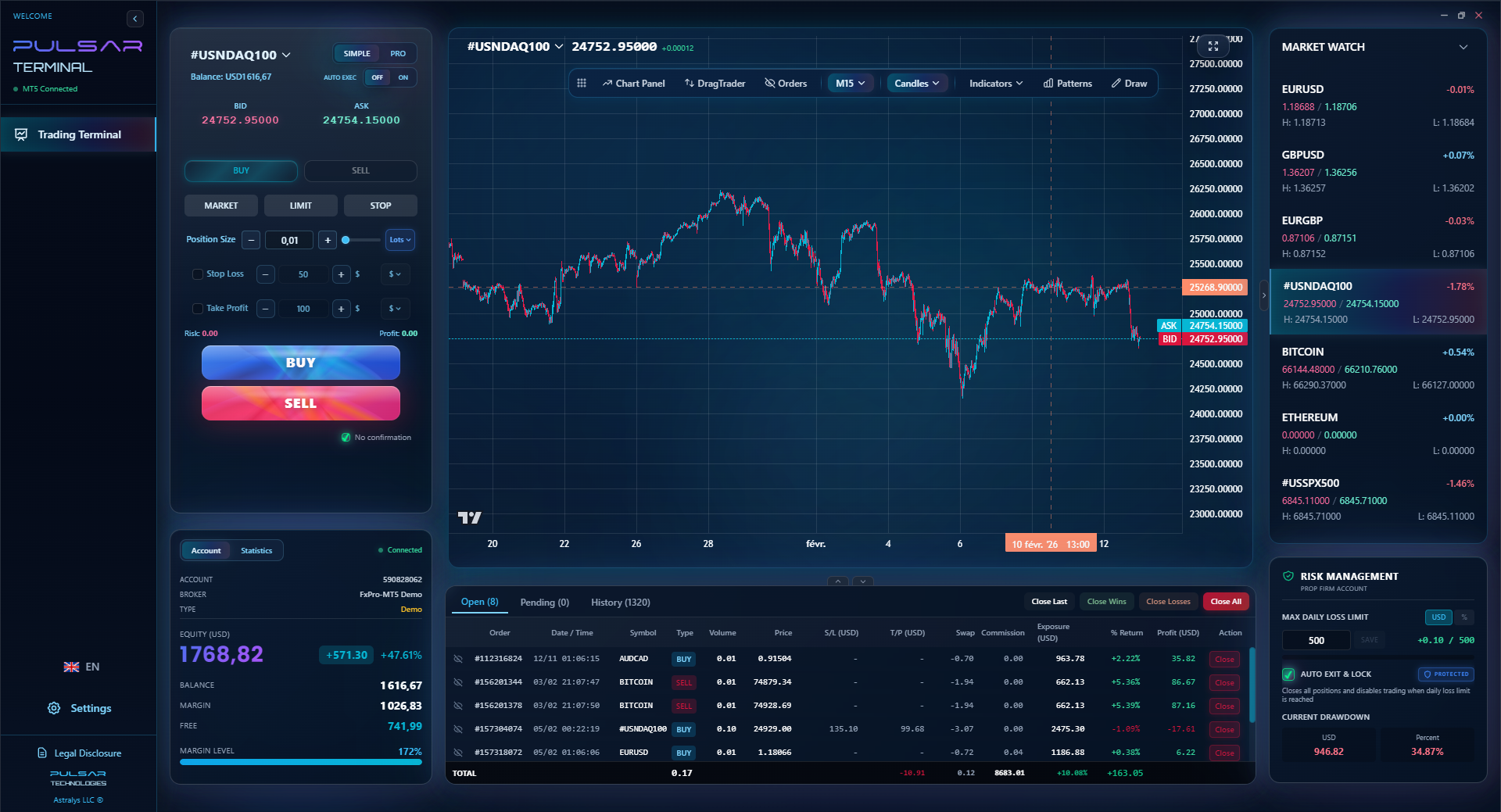
Spotting multi-indicator confluence and managing complex partial exits is far easier with a tool like Pulsar Terminal, which brings advanced order and analysis features directly into your MT5 platform.
Pulsar Terminal
The all-in-one MT5 companion: drag-and-drop orders, multi-TP/SL, trailing stop, grid trading, Volume Profile, and prop firm protection. Used by 1,000+ traders daily.
FAQ
Q1Is divergence a reliable signal on its own?
Absolutely not. It's a warning sign, not an entry ticket. Relying on divergence alone is a fast track to losing money. You must always wait for price action confirmation - like a candle close beyond a key level - before entering a trade.
Q2What is the best timeframe to trade divergence forex?
For Nigerian traders dealing with potential connectivity issues, I strongly recommend the 1-hour and 4-hour charts as your primary hunting grounds. Signals here are more reliable and less prone to noise than lower timeframes, and you won't be wiped out by a brief power outage.
Q3What's the difference between regular and hidden divergence?
This is crucial. Regular divergence signals a potential reversal of the trend. Hidden divergence signals a continuation of the trend (it often appears during pullbacks). Mixing them up means you'll constantly be betting against the market's momentum.
Q4Can I use divergence for scalping?
You can, but I don't recommend it, especially with Nigeria's internet speeds. Divergence on very low timeframes (like 1-min or 5-min) is extremely noisy and leads to many false signals and high transaction costs from the spread. It's a high-stress, low-reward approach.
Q5How do I avoid false divergence signals?
Use two filters: 1) The Trend Filter: Only act on divergence that aligns with a higher timeframe trend or occurs at a major trend reversal point. 2) The Level Filter: Only give weight to divergence that forms at a clear technical level - like previous support/resistance, a Fibonacci retracement level, or a major moving average.
Q6Which currency pairs are best for trading divergence?
Major pairs with high liquidity and lower spreads are ideal because the price action is cleaner. Focus on EUR/USD, GBP/USD, and USD/JPY. Also consider XAU/USD (Gold), which often exhibits beautiful, tradable divergence patterns due to its sentiment-driven nature.
Q7My divergence trade hit stop loss, was the signal wrong?
Not necessarily. No signal has a 100% win rate. A divergence might correctly identify weakening momentum, but the market can consolidate (move sideways) instead of reversing sharply, eventually hitting your stop. This is why risk management - using a proper stop loss and position size - is more important than being right on the signal.
Prof. Winston's Lesson
Key Takeaways:
- ✓Divergence is a warning, not an entry. Always wait for price confirmation.
- ✓Trade divergence on 1H+ charts only. Lower timeframes are noise.
- ✓Never risk more than 1-2% of your capital on a single divergence setup.
- ✓Hidden divergence means trend continuation, not reversal.
- ✓Combine RSI and MACD signals for high-probability confluence.
How useful was this article?
Click a star to rate
Weekly Trading Insights
Free weekly analysis & strategies. No spam.
About the Author
Olumide Adeyemi
West African Trading Pioneer
One of Nigeria's most active forex trading educators. 8 years of experience trading from Lagos. Specializes in low-capital strategies and prop firm challenges for African traders.
Comments
Risk Disclaimer
Trading financial instruments carries significant risk and may not be suitable for all investors. Past performance does not guarantee future results. This content is for educational purposes only and should not be considered investment advice. Always conduct your own research before trading.
You Might Also Like

Cara Trading Forex Sukses: 7 Prinsip dari Trader Profesional
Cara trading forex sukses dengan 7 prinsip trader pro: manajemen modal, disiplin, journal trading, backtest. Data nyata, bukan janji profit palsu.
Jam Trading Forex Terbaik untuk Trader Indonesia: Panduan Lengkap dengan Tabel Waktu
Panduan jam trading forex untuk trader Indonesia. Tabel 4 sesi dunia, jam emas 20:00-00:00, sesi mana yang harus dihindari. Data akurat + tips dari trader berpengalaman.
Top 5 Sàn Forex Uy Tín Nhất 2026: Review Jujur dari Trader Indonesia
Top 5 sàn forex uy tín 2026 untuk trader Indonesia. Review jujur: spread, deposit, withdraw, dukungan lokal. Exness, XM, IC Markets & lebih.
Get Pulsar Terminal
All these calculators are built into Pulsar Terminal with real-time data from your MT5 account. One-click position sizing, automatic risk management, and instant calculations.
Get Pulsar Terminal