


I blew R15,000 in three days.

David van der Merwe
Emerging Markets Trader ·  South Africa
☕ 10 min read
What you'll learn:
I blew R15,000 in three days. It was 2012, and I was convinced the USD/ZAR was going to crash through 8.50. I loaded up with max use from an offshore broker, ignoring every rule I knew. The pair didn't crash. It rallied. I got a margin call before I could even blink. That loss, paid for with my year-end bonus, taught me the first brutal lesson about whether forex traders make money: the market doesn't care about your conviction. It only cares about your capital and your discipline. Let's cut through the Instagram hype and look at the real numbers, regulations, and gritty reality of making money from forex right here in SA.
Before you even think about profits, you need to understand the legal playing field. It's confusing, and getting it wrong can cost you more than a bad trade.
Forex trading is legal in South Africa, but only through brokers licensed by the Financial Sector Conduct Authority (FSCA). This is non-negotiable. A broker like Exness or XM operating here must have that FSP number. It means they have to keep your money in a separate account from theirs – a basic but critical safety net.
Now, here's the kicker that most "gurus" don't mention. The National Treasury and the South African Reserve Bank (SARB) have a different rule book called the Exchange Control Regulations. Officially, they state that individuals are "not permitted to speculate against the Rand." Let that sink in.
What does this mean for you, practically? Trading major pairs like EUR/USD or GBP/JPY through an FSCA-regulated broker is generally accepted as being within the rules. You're using your single discretionary allowance (R1 million per year) or foreign capital allowance (R10 million) to fund an international account. However, directly punting the USD/ZAR on some unregulated platform? That's walking a very fine line. The authorities are more concerned with large-scale capital flight, but it's a risk you should know exists.
And yes, the taxman always gets his share. Every cent of profit you make is taxable income. SARS doesn't see it as gambling; they see it as a business. Keep careful records.

Warning: Using an international broker offering 1:500 use might seem tempting, but if they aren't FSCA regulated, you have zero recourse if they disappear with your money. The 30:1 use cap for retail clients exists for a reason – to stop you from blowing up your account as fast as I did.
“The market doesn't care about your conviction. It only cares about your capital and your discipline.”
Forget the Lamborghini memes. Let's talk real, achievable returns. The global statistic is brutal: between 51% and 89% of retail traders lose money trading CFDs and forex. In South Africa, it's no different. The profitable minority is small.
Realistic Earnings Tiers
- The Beginner: You're in the learning phase. If you're slightly profitable, you might see R50 to R300 on a good day. More likely, you're breaking even or taking small, controlled losses as tuition fees. Your goal isn't profit; it's survival and learning.
- The Consistent Retail Trader: This is where you want to be. You've got a solid scalping strategy or swing trading plan. You might pull R400-R1,500 on a good day, but averaged over a month, a realistic target is a 3-8% return on your trading capital. On a R100,000 account, that's R3,000 to R8,000 per month. It's a decent second income, but it's not quit-your-job money unless your capital is substantial.
- The Professional: This requires serious capital and even more serious discipline. Aiming for 5-10% monthly, professionals with accounts of R1 million+ are looking at monthly earnings in the range of R50,000 to R300,000+. This is a full-time job with immense psychological pressure.
Here's a personal example from my swing trading days. In 2020, I went long on EUR/USD at 1.0845. My analysis showed a strong support zone. I risked 1.5% of my account (R2,250 on a R150,000 account). I set a take-profit at 1.1050 and a stop-loss at 1.0770. The trade ran for two weeks and hit TP. Net profit: 205 pips. Using a standard lot size calculator, that was about $2,050, or roughly R35,000 at the time. A good trade, but it required patience and strict adherence to my plan. For every one like that, I've had three small losers.
The Silent Profit Killers: Costs
Your broker isn't a charity. They make money from the spread and sometimes commissions. That tiny difference between the buy and sell price eats into your profits every single trade.
| Cost Type | What It Is | Real-World Example (EUR/USD) |
|---|---|---|
| Spread | The primary cost. Broker's built-in fee. | XM's commission-free account: ~0.8 pips. IC Markets: as low as 0.0 pips (but pay a commission). |
| Commission | A direct fee per lot traded. | Often $3-$7 per lot, per side. On a 1-lot trade, that's $6-$14 round turn before you're even in profit. |
| Swap/Overnight | Interest for holding a position past 10pm SA time. | Can be positive or negative. If you're long a high-interest rate currency, you might earn a little. Usually, it's a small cost. |
That's why your strategy needs an edge wider than just the spread. If you're trying to scalp for 5-pip profits with a 2-pip spread, you're fighting a losing battle from the start.

💡 Winston's Tip
Your first R10,000 in profits isn't for a new watch. Re-invest it into your trading capital. Compound growth is the only magic in finance.
“A realistic target is a 3-8% return on your trading capital per month. It's a decent second income, but it's not quit-your-job money unless your capital is substantial.”
Your broker is your gateway to the market. Picking the wrong one is like trying to win a race with a flat tyre.
Stick with FSCA-regulated brokers. Full stop. Here are a few popular options with their SA-relevant details:
- XM: Hugely popular here. Minimum deposit is just $5 (about R90), which is great for starting small. Their spreads are decent on the major pairs. I've used them for micro-lot testing of new strategies.
- Tickmill: Known for razor-sharp raw spreads (0.11 pips on EUR/USD) but you pay a commission. This is better for high-volume traders where the lower spread saves you more than the commission costs.
- IC Markets: Another favorite for raw spreads. Their True ECN account is excellent for serious traders who need fast execution.
- Exness: Offers unique features like instant withdrawals, which is a big plus. They cater well to the SA market.

Pro Tip: Don't get hung up on "zero spread" marketing. Look at the effective cost: spread + commission. A "0.0 pip spread" with a $7 commission is often more expensive than a 0.8 pip spread with no commission on a standard 1-lot trade. Do the math using a position size calculator.
The FSCA use cap of 30:1 is your friend. It might feel restrictive, but it prevents you from taking on catastrophic risk. If a broker offers you 1:1000, ask yourself why they're so eager to help you lose everything quickly. Start with 10:1 or even 5:1 while you're learning. Managing your margin call level is more important than chasing oversized returns.
“Your stop-loss is not a failure; it's the cost of doing business.”
As South Africans, we have a potential insider's view on the Rand. We feel the load-shedding, follow the political drama, and see the commodity price swings. This can be an edge, but it's a double-edged sword.
The USD/ZAR is a beast. It's volatile, meaning big profit potential and big risk. The spread is usually much wider than on EUR/USD – often 50-100 pips or more. That means the price needs to move significantly just for you to break even.
I once tried to trade USD/ZAR based on a SARB interest rate announcement. I thought a hike would strengthen the Rand. I shorted USD/ZAR at 14.85. The hike happened, but the market had already "priced it in." The pair spiked to 15.20 on profit-taking and global dollar strength first, hitting my stop-loss, before eventually falling to 14.60 over the next week. I was right on the fundamentals but wrong on the market timing and emotion. Lost 2% of my account in minutes.
Common ZAR pairs like EUR/ZAR and GBP/ZAR can offer interesting opportunities, but remember the Exchange Control sentiment. Also, liquidity can dry up around SA public holidays, leading to erratic moves. My advice? Master your strategy on the major pairs like EUR/USD first, where costs are lower and liquidity is deep. Then, if you want to apply it to ZAR pairs, do so with smaller position sizes and wider stops to account for the volatility.
Payment methods are easy these days. Most brokers accept direct EFTs from major SA banks. Withdrawal times are usually 1-3 business days. If a broker makes it difficult to get your money out, that's a massive red flag.
💡 Winston's Tip
If you feel a strong urge to "revenge trade" after a loss, close the platform. Go for a walk. The market will still be there, but your money might not be if you trade angry.
“Your stop-loss is not a failure; it's the cost of doing business.”
This is where the real answer to "do forex traders make money" lives. It's not in a secret indicator. It's between your ears.
The losing majority is driven by fear and greed. They chase losses, turn small winners into losers by exiting too early, and let one bad trade ruin their week. The profitable trader has a system and follows it, mechanically, even when it's boring or scary.
Discipline over Prediction: You don't need to predict the market. You need a set of rules for when to enter, how much to risk (always use a position size calculator), and when to exit. My rule is never to risk more than 1.5% of my account on any single trade. It's boring. It prevents home runs, but it also prevents strikeouts.
Embrace Being Wrong: Your stop-loss is your best friend. It's not a failure; it's the cost of doing business. I've had streaks of 7 losing trades in a row. It happens. If your system has a positive edge over hundreds of trades, you just need to survive the drawdowns.
Journal Everything: Write down every trade. The entry, exit, pips gained/lost, the chart setup, and – crucially – your emotional state. Were you bored? Revenge trading? This log will show you your true weaknesses. I found I consistently lost money on Friday afternoons. Now, I don't trade after 2pm on a Friday. Problem solved.
Tools can help enforce this discipline. Manually moving stop-losses to breakeven or trailing a winner is stressful and prone to error.

Example: Let's say you buy GBP/USD at 1.2600, with a stop at 1.2570 (30-pip risk) and a target at 1.2660 (60-pip reward). If the price moves to 1.2630 (30 pips in your favor), a basic trailing stop or breakeven trigger would move your stop-loss to 1.2600, guaranteeing no loss on the trade. This removes emotion and locks in a safety net.
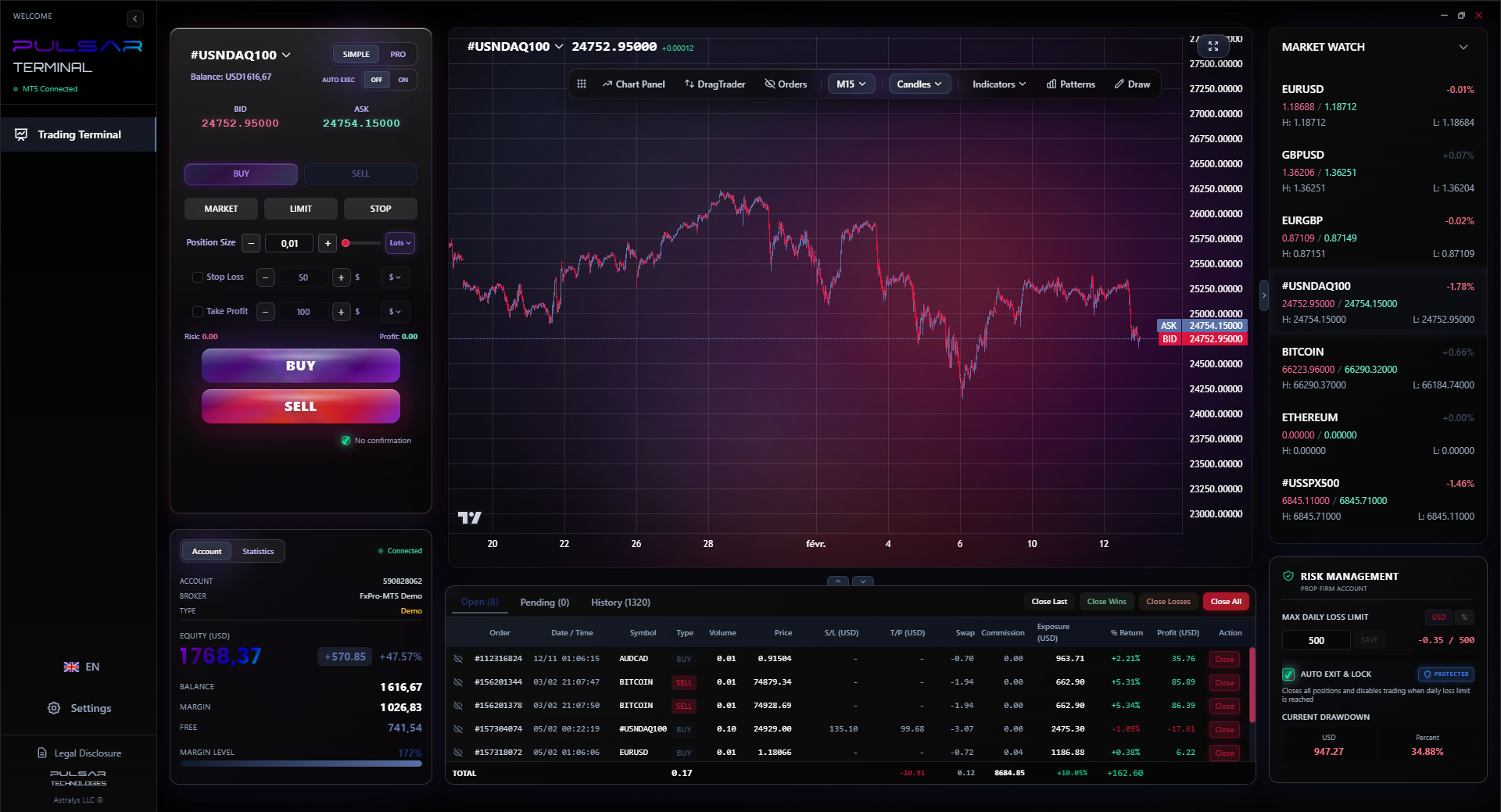
Sticking to your trading plan, especially moving stops to breakeven or trailing winners, is where most fail—Pulsar Terminal automates these rules directly on your MT5 chart, removing the emotion.
Pulsar Terminal
The all-in-one MT5 companion: drag-and-drop orders, multi-TP/SL, trailing stop, grid trading, Volume Profile, and prop firm protection. Used by 1,000+ traders daily.
“Start with a live account with the minimum possible deposit. Your goal is not to make money. Your goal is to not lose it over three months.”
So, do forex traders make money? Some do. Here's how you build a path to being one of them, step by step.
- Education with a Capital E: Not from YouTube gurus selling courses. Learn about price action, support/resistance, and maybe one or two indicators like the RSI or MACD. Understand what a spread is and how use works.
- Find a Regulated Broker: Pick one from the list above. Start with a demo account. Then, open a live account with the minimum possible deposit. For XM, that's $5. Your goal with this first deposit is not to make money. Your goal is to not lose it over three months.
- Develop a Simple Strategy: It could be: "Buy when price pulls back to the 50-day moving average on the 4-hour chart, with a stop-loss below the recent swing low. Risk 1%." Test it on demo, then on your tiny live account.
- Scale Slowly: Only add more capital to your account from your trading profits. Never add more "life money" to cover a loss. If you can grow a $100 account to $120, you're learning. If you blow the $100, the lesson was cheap.
- Treat It Like a Business: Set office hours. Have a daily loss limit (e.g., if I lose 3% in a day, I stop). Have a weekly profit target (e.g., 2%). Withdraw profits regularly to enjoy the fruits.
It's a marathon, not a sprint. The market will be here tomorrow. Your job is to make sure your account is too.
FAQ
Q1What percentage of forex traders actually make money in South Africa?
While there's no official SA-specific number, the global retail forex statistics apply here too. Estimates consistently show that a majority lose money, with figures ranging from 51% to as high as 89% of accounts being unprofitable. The profitable minority is small, which is why education, discipline, and proper risk management are non-negotiable.
Q2How much money do I need to start forex trading in South Africa?
Technically, you can start with as little as R90 (around $5) with brokers like XM. However, starting with a very small amount has a key purpose: to learn without significant financial risk. A more practical starting point for serious learning is R2,000-R5,000. This allows for meaningful position sizing while still keeping risk capital low. Remember, your first goal is preservation of capital, not profit.
Q3Is forex trading taxable in South Africa?
Yes, absolutely. The South African Revenue Service (SARS) views profits from forex trading as taxable income. You are required to declare these earnings in your annual tax return. Keep detailed records of all your trades, deposits, withdrawals, and statements. Losses can often be offset against profits, but you should consult with a tax professional familiar with trading income.
Q4Can I trade with high use like 1:500 in South Africa?
Not with an FSCA-regulated broker. Since 2021, the FSCA has capped use for retail traders at 30:1 on major forex pairs. Some international, unregulated brokers may offer 1:500 or even 1:1000, but this is extremely dangerous and offers you no regulatory protection. High use amplifies losses just as fast as profits and is a primary reason many new traders blow up their accounts.
Q5What is the best forex trading strategy for beginners?
There is no single "best" strategy, but beginners should focus on simplicity and risk management. A good start is swing trading on higher time frames (like the 4-hour or daily chart), focusing on major currency pairs like EUR/USD where spreads are low. Combine basic support/resistance levels with one or two indicators for confirmation. The core of your strategy should be a strict rule for position sizing (e.g., risking no more than 1% per trade) and using stop-losses on every single trade.
Q6Are prop firms a good way to start trading forex?
Prop (proprietary trading) firms can be a way to trade with larger capital without risking your own savings, but they come with strict challenges and rules. You typically need to pass a evaluation by hitting profit targets without breaching drawdown limits. This requires an already proven and disciplined strategy. For a complete beginner, they are often a fast track to losing the challenge fee. It's better to first prove you can be consistently profitable with your own small capital.
Prof. Winston's Lesson
Key Takeaways:
- ✓Up to 89% of retail traders lose money; be in the disciplined minority.
- ✓FSCA regulation is mandatory for broker safety in SA.
- ✓Aim for realistic 3-8% monthly returns, not get-rich-quick schemes.
- ✓Never risk more than 1.5% of your capital on a single trade.
- ✓Profits are taxable income; keep impeccable records for SARS.
How useful was this article?
Click a star to rate
Weekly Trading Insights
Free weekly analysis & strategies. No spam.
About the Author
David van der Merwe
Emerging Markets Trader
Johannesburg-based trader with 11 years in emerging market currencies. Specializes in ZAR pairs, FSCA-regulated trading, and South African market analysis.
Comments
Risk Disclaimer
Trading financial instruments carries significant risk and may not be suitable for all investors. Past performance does not guarantee future results. This content is for educational purposes only and should not be considered investment advice. Always conduct your own research before trading.
You Might Also Like

Cara Trading Forex Sukses: 7 Prinsip dari Trader Profesional
Cara trading forex sukses dengan 7 prinsip trader pro: manajemen modal, disiplin, journal trading, backtest. Data nyata, bukan janji profit palsu.
Jam Trading Forex Terbaik untuk Trader Indonesia: Panduan Lengkap dengan Tabel Waktu
Panduan jam trading forex untuk trader Indonesia. Tabel 4 sesi dunia, jam emas 20:00-00:00, sesi mana yang harus dihindari. Data akurat + tips dari trader berpengalaman.
Top 5 Sàn Forex Uy Tín Nhất 2026: Review Jujur dari Trader Indonesia
Top 5 sàn forex uy tín 2026 untuk trader Indonesia. Review jujur: spread, deposit, withdraw, dukungan lokal. Exness, XM, IC Markets & lebih.
Get Pulsar Terminal
All these calculators are built into Pulsar Terminal with real-time data from your MT5 account. One-click position sizing, automatic risk management, and instant calculations.
Get Pulsar Terminal