


Here's the biggest lie I hear from new traders in South Africa: 'SARS doesn't know about my forex profits, and my broker is offshore, so it's tax-free.' Let me be blunt.

David van der Merwe
Emerging Markets Trader ·  South Africa
☕ 11 min read
What you'll learn:
- 1How SARS Sees Your Trading: Business vs. Investment
- 2The Real Numbers: Tax Rates, Deductions, and Your Bottom Line
- 3Provisional Tax: The System That Catches Everyone Off Guard
- 4Record Keeping: Your Only Defense in a SARS Audit
- 5Offshore Brokers, Local Rules: The FSCA and Your Responsibility
- 6Legal Tax-Saving Strategies (Not Loopholes)
- 7The 5 Costly Mistakes Every South African Trader Makes
Here's the biggest lie I hear from new traders in South Africa: 'SARS doesn't know about my forex profits, and my broker is offshore, so it's tax-free.' Let me be blunt. That's a fast track to a massive tax bill, penalties, and a world of financial pain. The South African Revenue Service is smarter, more connected, and more aggressive than you think. I've seen traders get caught years later, owing hundreds of thousands in back taxes. This isn't about scaring you. It's about giving you the evidence-based, no-BS guide to trading legally and keeping what you earn. Let's set the record straight.
This is the core question that determines your entire tax bill. SARS doesn't have a special 'forex trader' category. They fit you into one of two boxes, and the difference is huge.
If you're trading frequently, using use, aiming for short-term profits, and treating it like a job, SARS will almost certainly classify you as carrying on a business. Your profits are considered ordinary revenue and get added to your other income (like your salary). You then pay income tax at the full progressive rates, which can go up to 45%. This is the reality for most active day traders and scalpers.
Now, if you buy and hold a currency pair for years as a long-term investment (which is rare in forex), SARS might see it as a capital asset. Your profit would then be a capital gain. Here's the kicker: only 40% of that gain is included in your taxable income. So, your effective tax rate maxes out at 18% (40% of the top 45% rate). Sounds great, right?
Don't get excited. I made this mistake early on. In my second year, I had a decent run with a swing trading approach on EUR/USD, holding positions for weeks. I thought, 'This is capital.' My accountant laughed. He pointed to my trade frequency (over 200 that year), my use of a scalping strategy on other pairs, and my detailed trading plan. SARS would have ripped the 'capital' argument to shreds. I paid income tax. Assume you're a business until proven otherwise.

Warning: Your intent matters less than your actions. A high volume of trades, using use from brokers like IC Markets or Pepperstone, and short holding periods are giant red flags for SARS that you're running a business.
“SARS doesn't have a special 'forex trader' category. They fit you into one of two boxes, and the difference is huge.”
Let's talk concrete numbers. Forget percentages in a vacuum. Here’s what it looks like in your bank account.
Income Tax Rates (2025 Tax Year)
If you're a sole proprietor (individual trader), your forex profits stack on top of any other income. Here are the brackets:
| Taxable Income (R) | Rate of Tax (R) |
|---|---|
| 1 – 237,100 | 18% of taxable income |
| 237,101 – 370,500 | 42,678 + 26% of amount above 237,100 |
| 370,501 – 512,800 | 77,362 + 31% of amount above 370,500 |
| 512,801 – 673,000 | 121,475 + 36% of amount above 512,800 |
| 673,001 – 857,900 | 179,147 + 39% of amount above 673,000 |
| 857,901 – 1,817,000 | 251,258 + 41% of amount above 857,900 |
| 1,817,001 and above | 644,489 + 45% of amount above 1,817,000 |
Example: Let's say you have a salary of R500,000 and make a R200,000 profit from forex trading. Your total taxable income is R700,000. Using the table, your tax would be roughly R179,147 + 39% of (R700,000 - R673,000) = R189,680. Your forex profit effectively got taxed at 39%.
What You Can Deduct (Legitimately)
This is your best weapon. You can deduct expenses wholly and exclusively incurred in generating your trading income. My rule: if you wouldn't have spent the money if you weren't trading, it's probably deductible.
- Platform & Data Fees: Broker commissions, spreads (as part of cost), market data subscriptions.
- Equipment & Software: Proportion of your computer, monitors, trading software licenses (like a Pulsar Terminal subscription), internet costs.
- Education: Trading courses, books, seminars. Yes, really.
- Home Office: A portion of your rent, electricity, and insurance if you have a dedicated trading space. You need to calculate this carefully.
- Professional Fees: Accountant and legal fees.
I keep a simple spreadsheet. Every month, I log every trade and every business-related expense, no matter how small. When tax season comes, it's a 30-minute job, not a panic-filled weekend.

Example: Your gross trading profit is R150,000. You have R15,000 in platform fees, R5,000 for a new monitor, R2,000 for internet, and R3,000 for accounting software. Your deductible expenses are R25,000. Your taxable trading profit is now R125,000. That's R25,000 you don't pay tax on.
“Assume you're a business until proven otherwise. Your intent matters less than your actions.”
This is where most traders blow up their compliance, not their accounts. As a self-employed person (which a trading business is), you are a provisional taxpayer. This means SARS doesn't want to wait until the end of the tax year for its money. You have to pay as you earn, in advance.
Here’s the painful schedule you must follow:
- First Period (End of August): You must make your first provisional tax payment. You estimate your total taxable income for the full year (March to February) and pay half of the estimated tax liability.
- Second Period (End of February): You make your second payment. You should now have a much clearer idea of your actual year-end profit. You settle the remaining estimated tax for the year.
- Third Period (Optional, but often needed): If you still owe tax after the second period, you have until end of September to pay the top-up without penalty.
The trap: You underestimate in August. Your trading takes off in the last quarter. Come February, you owe a massive lump sum you didn't budget for. I got nailed by this in 2019. I had a quiet first half, paid a small provisional amount. Then the XAU/USD guide strategy I was testing went on a tear. My February payment was five times my August payment. It wiped out my trading capital for two months.
You must file an IRP6 return for each provisional period. Then, after the tax year ends, you file your final ITR12 return. Missing a deadline triggers immediate penalties and interest. SARS is utterly unforgiving here.

Pro Tip: Use the SARS safe harbour rule. For your second period (February), you can estimate your income to be equal to your actual taxable income from the previous year. This can prevent under-estimation penalties if your current year is similar to last year.

💡 Winston's Tip
Your first profitable trade isn't a win. Your first correctly filed provisional tax return is. Treat tax admin with the same discipline as your risk management.
“Assume you're a business until proven otherwise. Your intent matters less than your actions.”
Imagine SARS sends you a letter. They want to see proof of every trade, deposit, and expense for the last three years. If your records are a mess of screenshots and broker emails, you're already guilty in their eyes.
You need a bulletproof, systematic record-keeping process. Here’s what I do, and what my accountant demands:
Mandatory Records:
- Trade Ledger: A detailed log of every single trade. Date, instrument (e.g., EUR/USD), entry price, exit price, pip movement, profit/loss in your account currency (ZAR or USD), and broker confirmation ID.
- Bank Statements: All statements for your trading account and your linked funding account. This proves deposits and withdrawals.
- Broker Statements: Monthly and annual statements from your broker (like Exness or XM). These must reconcile perfectly with your trade ledger.
- Expense Invoices: Scanned copies of every invoice for deductible expenses.
- Currency Conversion Records: If you trade in USD but report in ZAR, you must convert all profits/losses using the official SARS average exchange rate for the tax year. Keep a record of the rates you used.
I use a dedicated accounting software for small businesses. Every Monday morning, I spend 20 minutes uploading the previous week's broker statement and matching it to my trades. It's boring, but it's the price of staying in the game. A clean, organized set of records is the difference between a smooth process and a nightmare margin call from SARS.
“A common misconception: 'My broker is in Cyprus/Australia, so SARS can't touch me.' Wrong.”
A common misconception: 'My broker is in Cyprus/Australia, so SARS can't touch me.' Wrong. South Africa taxes based on residence. You pay tax on your worldwide income, full stop. It doesn't matter if your broker is on Mars.
The Financial Sector Conduct Authority (FSCA) regulates the local market for fairness. While you can use international brokers, many choose FSCA-regulated ones like Khwezi Trade for peace of mind and ZAR accounts. But the FSCA doesn't protect you from SARS.
Here's the scary part: SARS has data-sharing agreements with many countries and international financial institutions. Large offshore brokers report data. When you withdraw profits to your South African bank account, that's a flagged transaction. SARS's automated systems are looking for deposits that don't match your reported income.
I know a trader who used a well-known offshore broker for three years and never declared. He bought a car with his profits. SARS sent a query to his bank about the source of funds. He had no records, no defense. He settled for a huge sum including penalties. The broker's location was irrelevant.
Your responsibility is absolute. You must convert all foreign-currency profits to ZAR using the SARS prescribed rates and declare them. Using a local, FSCA-regulated broker with a ZAR account simply makes the accounting a bit easier, as you're already dealing in Rands.
💡 Winston's Tip
If you can't explain your P&L and expenses to a grumpy SARS auditor in under 10 minutes, your record-keeping has already failed. Simplify it now.
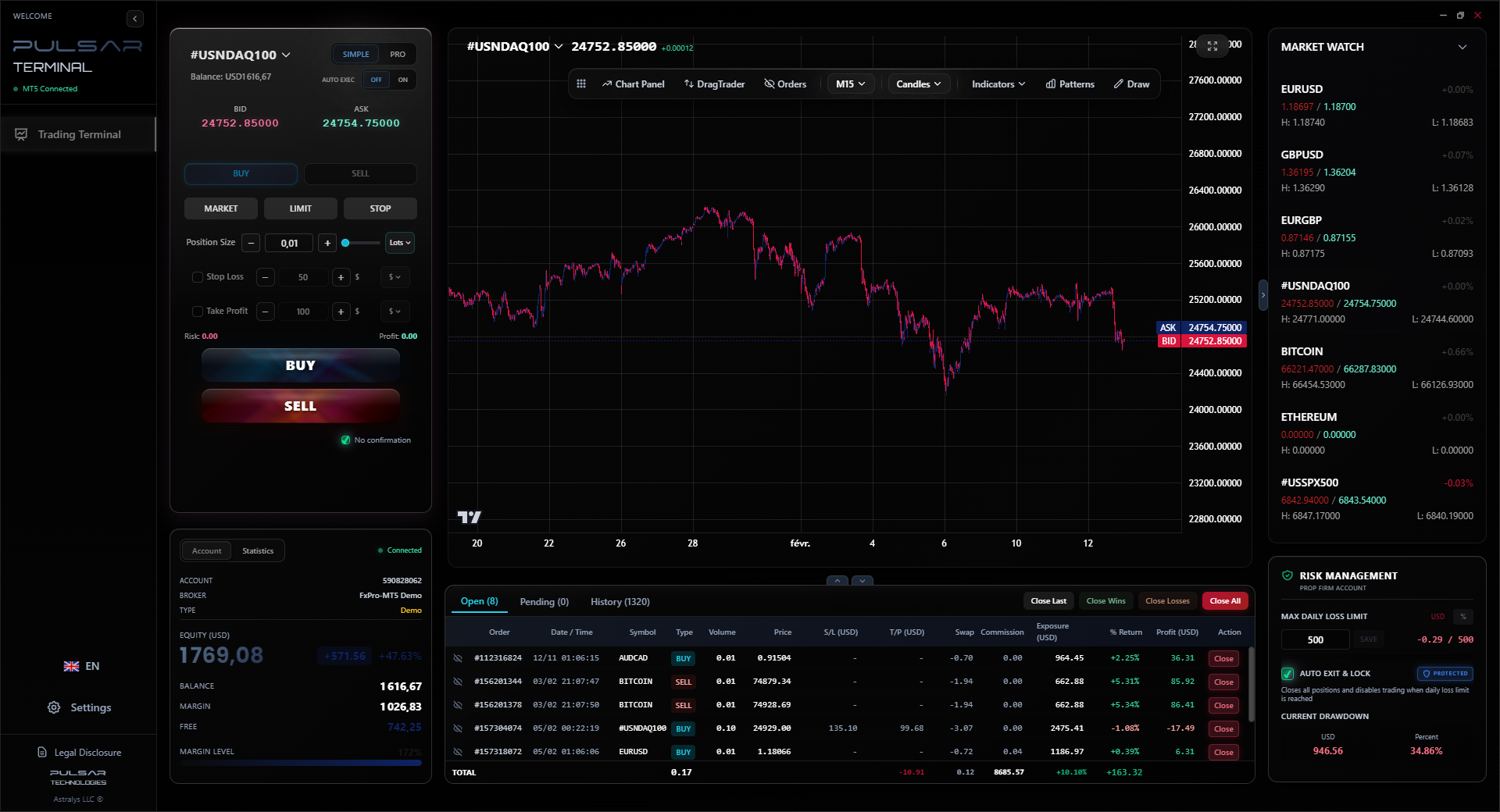
Accurate trade logging is critical for tax compliance, and Pulsar Terminal's detailed trade journal and reporting features automate this directly within your MT5 platform.
Pulsar Terminal
The all-in-one MT5 companion: drag-and-drop orders, multi-TP/SL, trailing stop, grid trading, Volume Profile, and prop firm protection. Used by 1,000+ traders daily.
“A common misconception: 'My broker is in Cyprus/Australia, so SARS can't touch me.' Wrong.”
You can't avoid tax, but you can be smart about it. These are legitimate, SARS-approved methods to reduce your liability.
1. Trade Through a Company (Pty Ltd) This is a serious step, but for consistently profitable traders, it's worth considering. Companies pay a flat tax rate of 27% (as of 2025). If your personal marginal tax rate is 41% or 45%, that's a massive saving. However, there are costs: auditing, accounting, CIPC fees. You also can't just take the money out; you pay yourself a salary or dividends, which are then taxed in your hands. It's a structure for retained earnings and growth.
2. Maximize Your Deductions (Aggressively) Don't be shy. That high-speed internet? 80% business use. A portion of your rent? Calculate it properly and claim it. A new PC primarily for trading charts? Deduct it (over three years as an asset). I even deduct the cost of financial news subscriptions. Every rand deducted is a rand you don't pay 18-45% tax on.
3. Use Retirement Annuities (RAs) and TFSAs This isn't a direct trading deduction, but it's crucial for financial planning. Contributions to an RA are tax-deductible up to 27.5% of your taxable income (max R350,000 p.a.). This lowers your taxable income today. A Tax-Free Savings Account (TFSA) allows you to invest up to R36,000 per year (lifetime limit R500,000), and all growth and withdrawals are tax-free. Use these for your long-term investment portfolio, separate from your trading capital.
The key is to plan this with a professional. A good tax practitioner who understands trading will save you multiples of their fee.
“Mixing personal and trading money is the cardinal sin. It turns a tax return into a forensic nightmare.”
After 12 years and coaching hundreds of traders, I see the same errors on repeat. Avoid these to save yourself money, time, and sanity.
1. Mixing Personal and Trading Money This is the cardinal sin. You must have a separate bank account solely for trading. All deposits to your broker come from this account. All withdrawals go back into it. This creates a clean, auditable money trail. When you pay yourself, transfer a 'salary' from the trading account to your personal account.
2. Ignoring Provisional Tax Deadlines Mark August 31 and February 28 in your calendar. Set reminders a month before. Underpayment penalties are 20% of the shortfall. It's a brutal, easily avoided tax on your laziness.
3. Poor Record Keeping Relying on broker platforms alone is risky. What if your broker changes systems or you switch brokers? You need your own independent, permanent record. Use a cloud-based spreadsheet or simple accounting software.
4. Not Using a Specialist Accountant Your family accountant who does your mom and dad's taxes probably doesn't understand forex, the business vs. capital distinction, or deductible trading expenses. Find someone who deals with traders or financial professionals. It's worth the extra cost.
5. Assuming Losses Are 'Written Off' Trading losses from your business can be deducted against other income (like your salary), reducing your overall tax bill. But you must be able to prove it was a legitimate business activity with the intent to profit. A history of well-documented trades, a business plan, and a professional setup help prove this. Haphazard gambling won't qualify.
I learned #4 the hard way. My first accountant treated my trading like a hobby. He missed thousands in legitimate deductions and gave me bad advice on provisional tax. Switching to a specialist was one of the best financial decisions I've made.
FAQ
Q1Do I pay tax if I make a loss in forex trading?
Yes, but not in the way you think. You don't pay tax on a loss, but you must still declare your trading activity to SARS if you are a provisional taxpayer. The loss can potentially be deducted from your other taxable income (like your salary), lowering your overall tax bill. However, you must prove to SARS that you are running a legitimate business with the intent to profit, not just gambling.
Q2What is the tax-free threshold for forex traders in South Africa?
There is no specific 'forex trading' tax-free threshold. Your trading profits are added to your other income (salary, rental income, etc.). The standard tax tables for individuals apply. For the 2025 tax year, the first R95,750 of your total taxable income is effectively tax-free due to the primary rebate. But your trading profits themselves are fully taxable from the first rand if they are classified as business income.
Q3How do I convert my USD forex profits to ZAR for SARS?
You must use the official SARS average exchange rate for the tax year in which the income was received (or the trade was closed). You cannot use the spot rate on the day. SARS publishes these average rates on its website. You must apply this rate to convert every individual trade's profit/loss from USD to ZAR, or use it to convert your total annual profit/loss from your broker's annual statement. Keep a record of your calculation.
Q4Can SARS find out about my trading if I use an international broker?
Almost certainly, yes. SARS has international data-sharing agreements (like the Common Reporting Standard). Also,, when you withdraw profits to your South African bank account, the bank may question the source of funds for anti-money laundering purposes. Large, regular deposits that don't match your declared employment income are a major red flag that can trigger a SARS audit.
Q5Do I need to register a company to trade forex?
No, you can trade as a sole proprietor (individual). However, if you become consistently profitable and your personal marginal tax rate exceeds 27%, registering a private company (Pty Ltd) can be tax-efficient, as companies pay a flat 27% tax rate. This comes with additional admin and costs, so it's only advisable for traders with significant, stable profits. Consult a professional first.
Q6What happens if I don't declare my forex trading income?
If SARS discovers the undeclared income (and they likely will, especially on large withdrawals), you will be liable for: 1) The full outstanding tax, 2) An understatement penalty of up to 200% of the tax owed, and 3) Interest on the overdue amount calculated from the date the tax was originally due. This can easily double or triple your original tax liability. In severe cases, it can lead to criminal prosecution for tax evasion.
Prof. Winston's Lesson
Key Takeaways:
- ✓SARS taxes forex profits as business income, not capital gains, for active traders.
- ✓Provisional tax deadlines (Aug 31, Feb 28) are non-negotiable. Miss them, pay 20% penalties.
- ✓Keep immaculate records: trade ledger, broker statements, expense invoices.
- ✓Use a specialist accountant. The cost is a deductible business expense.
- ✓Separate your trading bank account from your personal finances immediately.
How useful was this article?
Click a star to rate
Weekly Trading Insights
Free weekly analysis & strategies. No spam.
About the Author
David van der Merwe
Emerging Markets Trader
Johannesburg-based trader with 11 years in emerging market currencies. Specializes in ZAR pairs, FSCA-regulated trading, and South African market analysis.
Comments
Risk Disclaimer
Trading financial instruments carries significant risk and may not be suitable for all investors. Past performance does not guarantee future results. This content is for educational purposes only and should not be considered investment advice. Always conduct your own research before trading.
You Might Also Like

Cara Trading Forex Sukses: 7 Prinsip dari Trader Profesional
Cara trading forex sukses dengan 7 prinsip trader pro: manajemen modal, disiplin, journal trading, backtest. Data nyata, bukan janji profit palsu.
Jam Trading Forex Terbaik untuk Trader Indonesia: Panduan Lengkap dengan Tabel Waktu
Panduan jam trading forex untuk trader Indonesia. Tabel 4 sesi dunia, jam emas 20:00-00:00, sesi mana yang harus dihindari. Data akurat + tips dari trader berpengalaman.
Top 5 Sàn Forex Uy Tín Nhất 2026: Review Jujur dari Trader Indonesia
Top 5 sàn forex uy tín 2026 untuk trader Indonesia. Review jujur: spread, deposit, withdraw, dukungan lokal. Exness, XM, IC Markets & lebih.
Get Pulsar Terminal
All these calculators are built into Pulsar Terminal with real-time data from your MT5 account. One-click position sizing, automatic risk management, and instant calculations.
Get Pulsar Terminal