


I lost R8,500 in three days.

David van der Merwe
Emerging Markets Trader ·  South Africa
☕ 10 min read
What you'll learn:
- 1What Exactly Is a Forex Robot?
- 2The SA Regulatory Scene: FSCA Warnings Are No Joke
- 3The Real Costs (It's Never Just the Purchase Price)
- 4Profitability: The Brutal Truth About Win Rates and Drawdowns
- 5How to Test a Robot Safely (Without Losing Your Shirt)
- 6Better Alternatives to Buying a 'Black Box' Robot
- 7The Final Verdict for South African Traders
I lost R8,500 in three days. Not on a bad trade, but on a robot called 'Quantum Scalper Pro' I bought for R4,100. The sales page showed a backtest with a 92% win rate. My reality? It opened 47 micro-lots on EUR/USD during a major news event, ignored my stop loss settings, and got absolutely shredded when the market reversed. That loss, plus the robot cost and a month of VPS hosting, taught me a brutal lesson about the shiny promises of automation. Let's talk honestly about whether forex trading robots really work for us here in SA.
Alright, let's get the basics out the way. A forex robot, or Expert Advisor (EA), is just a piece of software that runs on a platform like MetaTrader 4 or 5. You attach it to a chart, and it's supposed to do all the heavy lifting: analyse price, spot setups, and place trades automatically based on its programmed rules.
The big sell here in SA is the 24/7 promise. You set it up, let it run on a Virtual Private Server (VPS), and theoretically it can trade the London, New York, and Asian sessions while you're sleeping or at your day job. The other big hook is removing emotion. No more revenge trading after a loss, no more getting greedy and moving your stop loss.
But here's the thing nobody tells you upfront: a robot is only as smart as the person who coded it and the strategy it's based on. It's a tool, not a magician. If the logic is flawed, it will lose money just as efficiently as it might make it. I learned that the hard way with my Quantum Scalper disaster.

Warning: A robot following a bad strategy doesn't get tired or emotional. It just executes terrible trades with perfect, relentless discipline. That can blow up an account faster than you can say 'margin call'.

💡 Winston's Tip
A robot's backtest is its CV. If it can't show consistent, realistic performance over 5+ years of historical data, including the 2020 market crash, don't hire it.
This is the most critical part for any South African. Our market is targeted hard by scammers, and the Financial Sector Conduct Authority (FSCA) is constantly putting out warnings. You need to listen to them.
Recent FSCA Red Flags
The FSCA isn't messing around. Just look at some of their recent public warnings:
- Trabot (2026): A Randburg company selling 'Forex Robots' promising 20-50% profit per month. The FSCA said they're not authorised, and clients reported ongoing losses.
- Blueway Trades (2024): Pushing an 'AI mobile robot' on WhatsApp and TikTok, with crazy promises like turning R1,700 into R120,000. Not authorised.
- 'Money Teddy' (2025): Using a WhatsApp channel called 'DrillionSignals' to sell signals and a robot without a license. That's a criminal offense.
The pattern is clear. If someone is contacting you directly on social media or WhatsApp, promising insane, guaranteed returns for a fee, run. These are almost always scams. The FSCA's message is simple: verify the provider's registration before you hand over a single cent.
Using Robots with Legit Brokers
The robot itself isn't regulated, but your broker must be. Always, and I mean always, use an FSCA-regulated broker when running any EA. This protects your funds. Most decent international brokers with a South African presence, like Pepperstone or IC Markets, are FSCA-regulated and fully support EAs on their MT4/MT5 platforms. It's your first line of defence.
“The robot was right 70% of the time, but it was still a net loser because its risk management was terrible.”
Let's break down the real rand-and-cent cost of running a robot, because the sticker price is just the beginning.
The Robot Itself:
| Type | Typical Cost (ZAR) | What You Get |
|---|---|---|
| 'Free' Robot | R0 | Usually very basic, often a marketing tool to get you into a paid group or service. Quality is suspect. |
| Basic Robot | R500 - R2,000 | A simple strategy, maybe a grid or martingale EA. Little to no ongoing support. |
| Mid-Range | R2,000 - R10,000 | More sophisticated logic, sometimes with customisation. This was my 'Quantum Scalper' zone. |
| Premium | R10,000+ | Complex algorithms, dedicated support, frequent updates. Still no guarantee of profit. |
The Hidden Costs That Get You:
- VPS Hosting: If you want true 24/7 trading, you need a Virtual Private Server. Your home PC and internet aren't reliable enough. This costs between R150 to R500+ per month, every month.
- Broker Spreads & Commissions: A scalping robot making 50 trades a day will get murdered by high spreads. You need a broker with razor-thin spreads, like those offered by IC Markets or Exness, or those commissions add up fast. Every pip in spread is money off your potential profit.
- Data Feeds: Some fancy robots need premium data feeds, which is another monthly subscription.
- The Cost of a Blow-Up: The biggest hidden cost? The robot failing and wiping out a chunk of your capital. No sales page factors that in.

Example: Let's say you buy a robot for R5,000. You run it for a year on a R200/month VPS. That's R2,400. Your total cost before a single trade is R7,400. The robot needs to make at least that much just for you to break even. That changes the profit picture dramatically.
This is where the marketing meets reality. Sellers love to flash backtests with 95% win rates. I'm here to tell you that's mostly nonsense.
A high win rate is meaningless if the losing trades are massive. Let me give you a real example from a different robot I tested (more carefully this time).
It had a 70% win rate, which sounds great. Over 100 trades, it won 70 times. But the average winning trade was R80. The average losing trade was R350. Do the math:
- Total Wins: 70 x R80 = R5,600
- Total Losses: 30 x R350 = R10,500
- Net Result: -R4,900
The robot was right most of the time, but it was still a net loser because its risk management was terrible. It didn't understand the concept of a positive risk-to-reward ratio.
The FSCA warns specifically against promises of "20 to 50% per month." Let's be real: if a strategy could reliably make even 10% per month with low risk, the big banks would have bought it for billions. Anyone selling it for a few thousand rand is lying.
Most credible, long-term profitable robots aim for much more modest returns - think 2-5% per month - but they do it with very strict risk management, like never risking more than 1% of your account per trade. They focus on the overall equity curve, not the flashy win rate. You can model this kind of careful approach with a position size calculator before you ever let a robot touch your live account.
💡 Winston's Tip
The most valuable automation isn't trade entry; it's risk management. Automating your stop losses and take profits removes 90% of emotional error.
“A high win rate is meaningless if the losing trades are massive.”
So you still want to try one? Okay, but do it like a scientist, not a gambler. Here's my process after getting burned.
Step 1: Demo, Demo, Demo
Run the robot on a demo account for at least two to three months. One good month is luck. You need to see it through different market conditions: trending, ranging, high volatility. Does it keep blowing up demo accounts? That's your answer.
Step 2: Forward Test on a Cent Account
After a successful demo run, move to a 'cent' account if your broker offers it. This is a live account where 1 USD cent = 1 unit of currency. You can risk real money (like R200) but the stakes are tiny. This tests the live execution and latency with your broker and VPS.
Step 3: Analyse the Trades, Not Just the Balance
Don't just look at the profit number. Open the trade history and ask:
- What's the average risk-to-reward? (Winners should be bigger than losers)
- Does it have a sensible stop loss on every trade?
- Does it trade during major news events? (This is often a killer)
- How large is the maximum drawdown? (If it dropped 25% on demo, it'll do it on your live cash)
Step 4: Start Live with Tiny Size
When you finally go live, use the smallest possible position size. Let it run for a full month making pennies. Prove it can behave with real money on the line. This is where a tool that manages risk automatically is gold. For instance, managing a prop firm challenge where you have a strict daily loss limit is terrifying manually, but automation can save you.

Pro Tip: The best use for a robot isn't always full automation. Sometimes, the best 'robot' is a custom indicator that pops up an alert for you. You get the automated analysis, but you keep the final execution decision. It's a hybrid approach that keeps you in the loop.
Spending R10k on a mysterious EA feels a lot like gambling. Here are smarter ways to use automation.
1. Learn to Code Your Own (Or Modify One): This is the ultimate solution. You don't need to be a genius. Platforms like MT4/5 use a language called MQL4/5, and there are tons of free tutorials. Start by modifying a simple free robot. Change its take profit level, add a trailing stop, make it wait for the MACD indicator to confirm a signal. Now you understand the logic, and you're not trusting a stranger's code.
2. Use Automation Tools for Risk Management: This is, in my opinion, the holy grail. Use tools that don't decide when to trade, but how to manage the trade once you're in. Think about automated trailing stops, breakeven functions, or scaling out of positions at multiple profit targets. This removes emotion from the hardest part: letting winners run and cutting losers.
For example, a proper swing trading strategy often requires moving your stop to breakeven after a certain move. Doing that manually for 5 trades at 3am is a pain. Automation handles it perfectly.
3. Rent, Don't Buy (Sometimes): Some reputable developers offer their EAs on a monthly subscription (R500-R1000/month). This lowers your upfront risk. If it stops working after a month, you cancel. Just make sure they're transparent and have a verifiable track record, not just pretty screenshots.
The core idea is to shift from seeking a 'set-and-forget money machine' to using technology as a powerful assistant that enforces your own trading rules and saves you time.
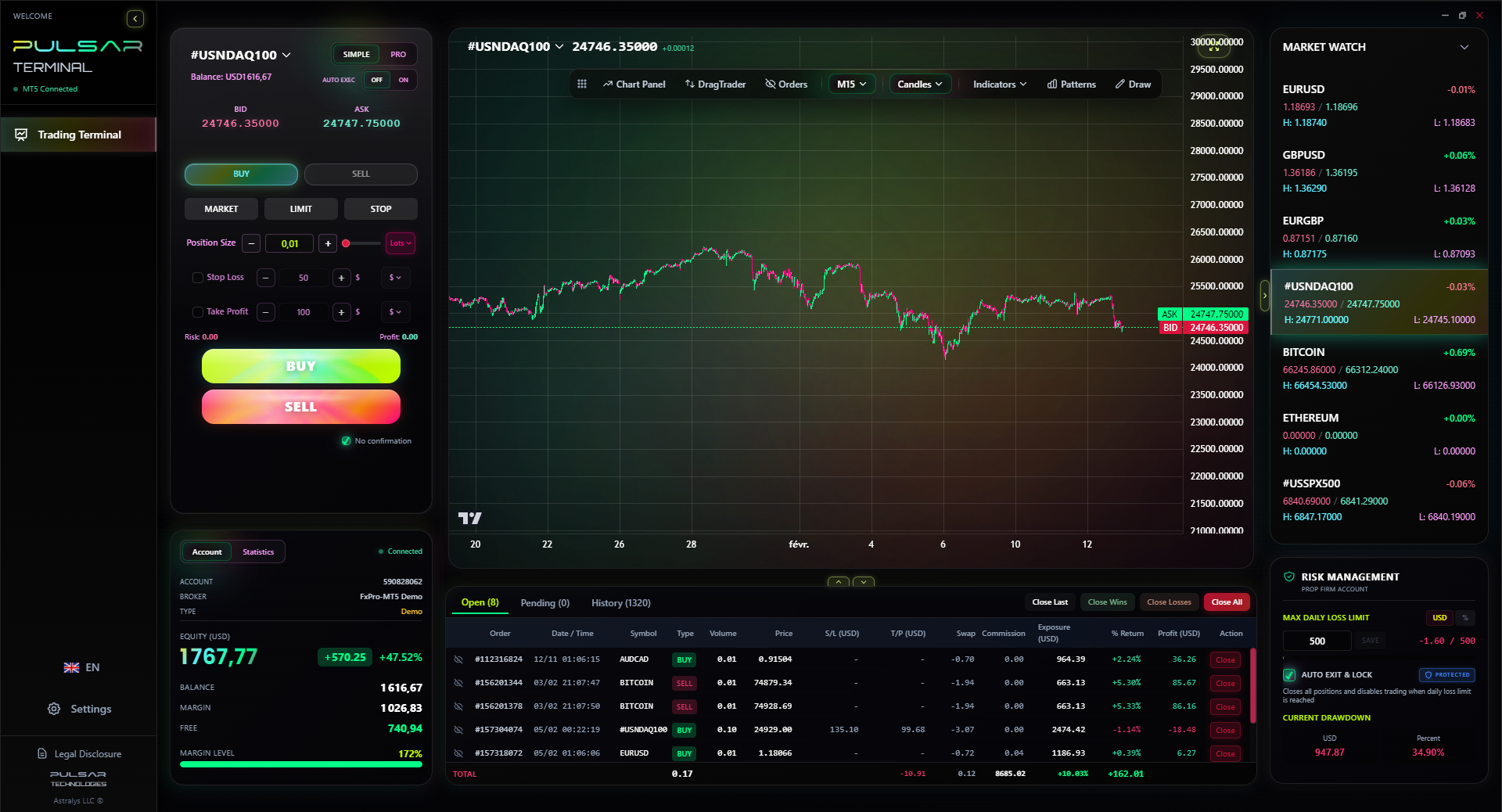
Automating complex trade management rules—like partial closures at multiple targets or moving stops to breakeven—is exactly what tools like Pulsar Terminal are built for, working directly on your MT5 platform.
Pulsar Terminal
The all-in-one MT5 companion: drag-and-drop orders, multi-TP/SL, trailing stop, grid trading, Volume Profile, and prop firm protection. Used by 1,000+ traders daily.
“The best 'robot' is still the one between your ears, educated by experience.”
So, do forex trading robots really work? The answer is frustratingly nuanced.
Yes, they can work, but not in the way most sellers advertise. They won't make you rich overnight with no effort. A profitable robot is simply a mechanical, emotionless execution of a profitable underlying strategy. The hard work is finding or creating that strategy.
For most South African traders, especially those starting out, buying a random robot is a terrible idea. The risks of scams, hidden costs, and catastrophic losses are too high. The FSCA warnings are there for a reason.
The smarter path is to:
- First, learn to trade profitably yourself. Understand support/resistance, risk management, and maybe one or two indicators like the RSI indicator.
- Then, and only then, look at automation as a way to execute and manage your proven strategy more efficiently, or to backtest new ideas.
- Always, without exception, use an FSCA-regulated broker and test everything relentlessly on demo and cent accounts first.
My R8,500 lesson was expensive, but it taught me to respect the market's complexity. No piece of software can outsmart the collective wisdom of millions of traders forever. The best 'robot' is still the one between your ears, educated by experience and disciplined by a solid plan. Use technology as a tool to serve that trader, not replace them.
FAQ
Q1Are forex trading robots legal in South Africa?
Yes, using forex robots (Expert Advisors) is legal. However, the companies or individuals selling them may be operating illegally if they are not registered as financial services providers with the FSCA. The FSCA has issued multiple warnings against unauthorized entities selling robots and promising unrealistic returns. Always verify the seller's status and only trade through an FSCA-regulated broker.
Q2What is a realistic monthly return from a forex robot?
Anything promising over 5-10% per month consistently should be viewed with extreme skepticism. The FSCA specifically warns against claims of 20-50% per month as "highly unrealistic." A well-designed, risk-averse robot in a good market environment might aim for 2-5% monthly growth. Remember, preserving capital is more important than chasing high returns. A 5% monthly gain compounded over a year is a fantastic result.
Q3Can I run a forex robot on my phone?
Technically, some broker apps allow it, but it's a terrible idea. For a robot to work properly, it needs to be running 24/7 on a stable, high-speed internet connection. Your phone goes to sleep, loses signal, and closes apps. To run a robot seriously, you must use a Virtual Private Server (VPS), which is a remote computer always online, costing around R150-R500 per month.
Q4I see a robot with a 95% win rate in backtests. Is it good?
Probably not. A win rate that high almost always means the strategy has no stop loss or uses a 'martingale' system (doubling down after losses). It will show a beautiful, smooth equity curve in backtests, but in live trading, one prolonged losing streak will wipe out your entire account. Focus on the risk-to-reward ratio and maximum drawdown, not just the win rate.
Q5What's the minimum amount I need to start with a forex robot?
You need enough to cover the robot cost, VPS fees, and still have a trading account large enough to survive drawdowns. As a rough guide, I wouldn't even consider it with less than R20,000 in risk capital. You need a buffer. If a robot costs R5,000 and needs a R200/month VPS, and you start with a R5,000 account, you're already starting 100% in the hole before the first trade. It's a losing battle.
Q6What's the difference between a forex robot and trading signals?
A robot (EA) is software that automatically opens and closes trades on your MT4/5 account. Trading signals are just alerts (e.g., "Buy GBP/USD at 1.2500") sent via SMS, Telegram, or email, and you have to manually execute the trade. Both are offered by regulated and unregulated providers. The FSCA has warned against unauthorized signal sellers like 'DrillionSignals' as well. Neither guarantees profits.
Prof. Winston's Lesson
Key Takeaways:
- ✓Verify FSCA registration for any robot seller.
- ✓Realistic monthly returns are 2-5%, not 20-50%.
- ✓Test for 3 months on demo first.
- ✓The VPS is non-negotiable for 24/7 trading.
- ✓Focus on risk-to-reward, not win rate.
How useful was this article?
Click a star to rate
Weekly Trading Insights
Free weekly analysis & strategies. No spam.
About the Author
David van der Merwe
Emerging Markets Trader
Johannesburg-based trader with 11 years in emerging market currencies. Specializes in ZAR pairs, FSCA-regulated trading, and South African market analysis.
Comments
Risk Disclaimer
Trading financial instruments carries significant risk and may not be suitable for all investors. Past performance does not guarantee future results. This content is for educational purposes only and should not be considered investment advice. Always conduct your own research before trading.
You Might Also Like

Cara Trading Forex Sukses: 7 Prinsip dari Trader Profesional
Cara trading forex sukses dengan 7 prinsip trader pro: manajemen modal, disiplin, journal trading, backtest. Data nyata, bukan janji profit palsu.
Jam Trading Forex Terbaik untuk Trader Indonesia: Panduan Lengkap dengan Tabel Waktu
Panduan jam trading forex untuk trader Indonesia. Tabel 4 sesi dunia, jam emas 20:00-00:00, sesi mana yang harus dihindari. Data akurat + tips dari trader berpengalaman.
Top 5 Sàn Forex Uy Tín Nhất 2026: Review Jujur dari Trader Indonesia
Top 5 sàn forex uy tín 2026 untuk trader Indonesia. Review jujur: spread, deposit, withdraw, dukungan lokal. Exness, XM, IC Markets & lebih.
Get Pulsar Terminal
All these calculators are built into Pulsar Terminal with real-time data from your MT5 account. One-click position sizing, automatic risk management, and instant calculations.
Get Pulsar Terminal