


Here's a statistic that should grab your attention: in the 2024/25 tax year, HMRC collected over £16.7 billion in Capital Gains Tax.

Sarah Collins
Trading Strategist ·  United Kingdom
☕ 9 min read
What you'll learn:
- 1The Short Answer? Yes, Probably.
- 2Capital Gains Tax (CGT): Your Most Likely Bill
- 3When Forex Becomes a Trade: Income Tax
- 4The Spread Betting 'Loophole': A Warning
- 5How to Calculate and Report Your Tax
- 6Choosing a Broker: FCA Regulation is Non-Negotiable
- 7Common Mistakes (And How to Avoid Them)
- 8Your Action Plan for 2026
Here's a statistic that should grab your attention: in the 2024/25 tax year, HMRC collected over £16.7 billion in Capital Gains Tax. A growing slice of that is coming from retail traders like you and me. So, do you pay tax on forex trading in the UK? The short, uncomfortable answer is almost always yes. But the how and how much depends entirely on whether HMRC sees you as a casual punter or a serious operator. I've had to explain my own trading statements to an accountant more than once, and let me tell you, getting this wrong is an expensive lesson.
Let's cut through the hopeful forum posts. If you're trading forex in the UK and making consistent profits, you almost certainly have a tax liability. The idea that it's 'tax-free gambling' is a dangerous myth that could leave you with a nasty bill and penalties.
The key isn't the instrument itself - it's your activity. HMRC uses a set of tests called the 'badges of trade' to figure out what you're up to. They look at things like: how often you trade, if you're using sophisticated analysis, if you're borrowing money (use), and frankly, if you look like you're running a business. Once I scaled up my trading volume, my accountant immediately reclassified my activity. The taxman's view shifted from 'maybe' to 'definitely'.
There are three main buckets your profits could fall into: Capital Gains Tax, Income Tax, or the rare tax-free status of spread betting. Your job is to know which one you're in before HMRC tells you.

Warning: Ignorance isn't a defence with HMRC. If you don't declare taxable profits, you're liable for the unpaid tax plus interest and potentially hefty fines. Getting your records in order isn't optional.
For most retail traders using a standard forex or CFD trading account, profits are treated as capital gains. This is the default position for HMRC if you're trading actively but not quite at a 'business' level.
The Numbers That Matter Now (2024/25 Onwards)
Forget the old rates. The government has tightened the screws. Here’s what you’re dealing with:
- Annual Exempt Amount (AEA): This is your tax-free allowance. It was slashed to £3,000 for 2024/25 and stays there. Only gains above this threshold are taxed.
- Tax Rates: This is the big change. From 30 October 2024, rates jumped.
- For basic rate taxpayers: 18% (was 10%)
- For higher/additional rate taxpayers: 24% (was 20%)
These rates apply to your total taxable gains across all assets (shares, crypto, forex) after using your AEA.
A Real Example from My Journal
Let's say in the 2025/26 tax year, you make £15,000 in net profits from forex trading (after all losses are factored in). You're a higher-rate taxpayer.
- Subtract your Annual Exempt Amount: £15,000 - £3,000 = £12,000 taxable gain.
- Apply the CGT rate: £12,000 x 24% = £2,880 in tax due.
That’s a significant chunk. It makes using your position size calculator to manage risk not just a trading necessity, but a tax-planning one too. A bad month of oversized losses can’t always be undone.

Example: If you also sold some shares for a £2,000 gain, your total gains are £17,000. After the £3,000 AEA, you pay 24% on £14,000 = £3,360 tax. It all stacks up.

💡 Winston's Tip
Your first £3,000 in annual gains is a tax-free buffer. Don't see it as a target. See it as a margin of error. A single good trade shouldn't blow through it.
“The moment your spread betting looks like a professional operation, the taxman comes knocking.”
This is where it gets serious. If HMRC decides you're not just investing capital but running a trading business, your profits get hit with Income Tax and possibly National Insurance. The thresholds are lower and the rates are higher.
How do they decide? They look for the 'badges of trade':
- Frequency & Organisation: Are you trading daily? Using a dedicated office, multiple screens, and trading journals? I had to admit my home office setup was a point against me.
- Profit-seeking Motive: This is obvious, but they look at the method. Are you applying a structured scalping strategy or just clicking buttons?
- Financing: Using high use consistently can be a flag.
If you're classified as a trader, your profits are added to your other income.
Income Tax Rates & Allowances (2024/25):
- Personal Allowance: £12,570 (0%)
- Basic Rate (20%): £12,571 to £50,270
- Higher Rate (40%): £50,271 to £125,140
- Additional Rate (45%): Above £125,140
There's also a £1,000 Trading Allowance for minor, casual trading income. But if your forex profits are your main gig, forget it.
The kicker? You can often claim more expenses as a business (software, data feeds, part of your utilities). But the higher tax rates usually mean you pay more. In one brutal year, my trading profits pushed me into the higher rate band. The combined tax and NI bill was a wake-up call to restructure everything.
This is the big one everyone talks about. Profits from financial spread betting are generally exempt from UK Capital Gains Tax and Income Tax. That's why brokers like IG and CMC Markets push it hard to UK clients.
But. And it's a massive 'but'.
This exemption only holds if HMRC views your spread betting as a speculative activity, not a trade or business. If you're trading full-time, with significant capital, using professional methods, they can and will reclassify it. The moment you look like a professional trader, the taxman comes knocking.
Also,, spread betting has its own dangers. The spread is usually wider, it's always a CFD-like product (so you can lose more than your deposit), and the psychological effect of 'tax-free' profits can make you reckless. I've seen traders blow up accounts because they treated 'tax-free' as 'risk-free'. It's not.

Pro Tip: If you're starting out and your profits are modest, spread betting can be efficient. The second you start making serious money, get professional advice. Assume the exemption won't last forever.
“A losing trade isn't just a hit to your ego. It's a potential reduction in your tax bill.”
You can't manage what you don't measure. This isn't just trading wisdom, it's tax law.
1. Keep Impeccable Records: Every trade. Entry, exit, pip value, profit/loss in GBP. Your broker's statements are a start, but HMRC expects your records. Use a spreadsheet or proper trading journal software. I log the time, instrument, and rationale for every single trade.
2. Calculate Your 'Net Gain': This is your total taxable profit for the tax year (6 April to 5 April).
- Add up all your profitable trades (in GBP).
- Add up all your losing trades.
- Your net gain = Total Profits - Total Losses.
You can use losses to offset gains. If your net position is a loss, you can carry it forward to offset future gains.
3. Use Your Allowances: Deduct your £3,000 Capital Gains Tax Annual Exempt Amount from your net gain. What's left is your taxable gain.
4. Report via Self-Assessment: If your total taxable gains are above the £3,000 AEA, or you need to register for other reasons, you must file a Self-Assessment tax return. The deadline for online submission is 31 January following the end of the tax year.
A Painful Personal Lesson: One year, I assumed my broker's annual statement was sufficient. My accountant asked for a trade-by-trade breakdown to correctly match losses against specific gains. I spent a weekend reconstructing it from my fragmented notes. Never again. Now, my journal is my bible.
💡 Winston's Tip
If you're manually moving stop-losses to breakeven, you're wasting focus and inviting emotion. Automate it. Your mental capital is for analysis, not babysitting trades.
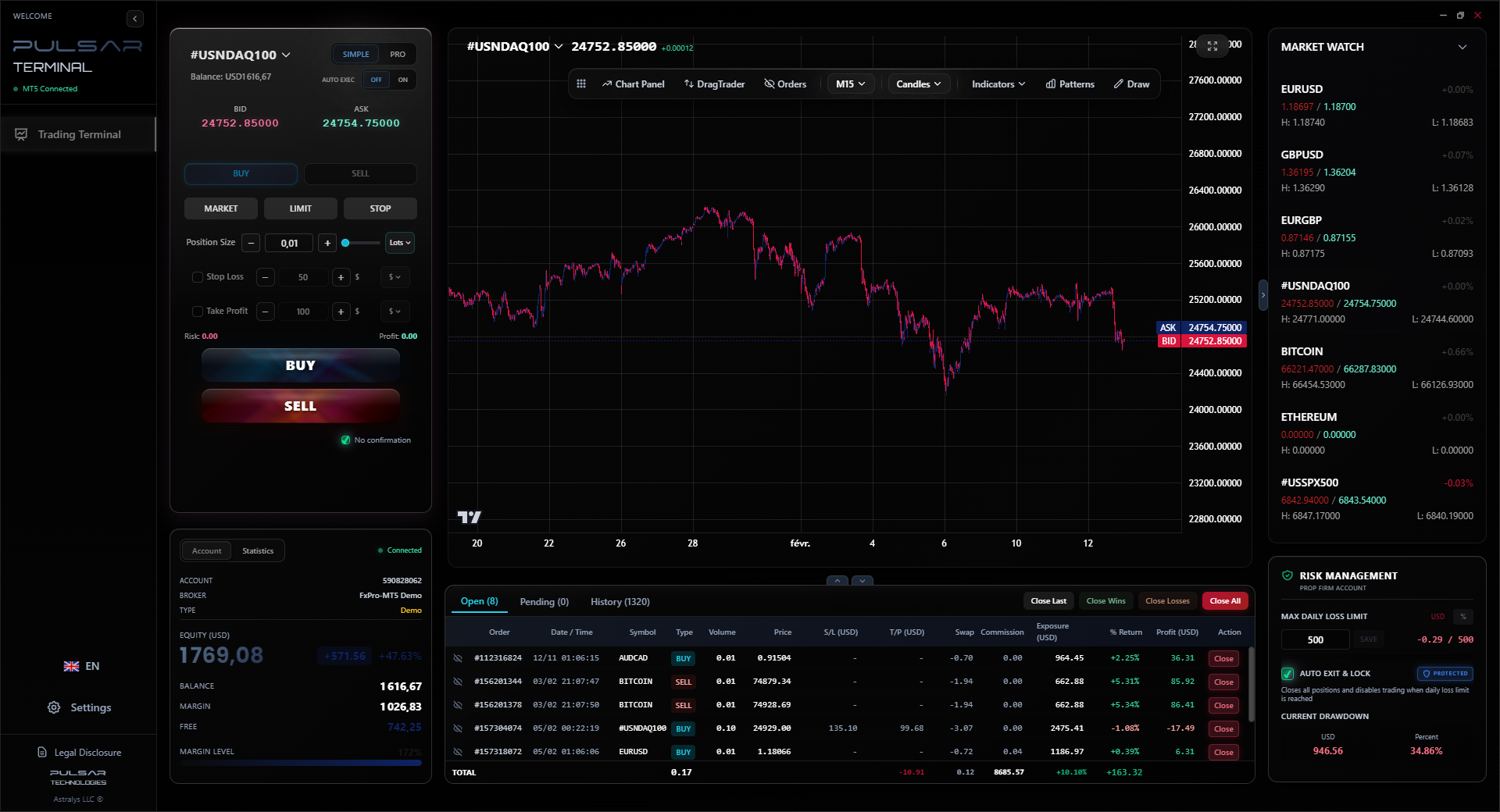
Manually calculating your net P&L from hundreds of trades for your tax return is a nightmare. Pulsar Terminal's advanced trade journal automatically logs every execution in your MT5 account, giving you a precise, exportable record HMRC will accept.
Pulsar Terminal
The all-in-one MT5 companion: drag-and-drop orders, multi-TP/SL, trailing stop, grid trading, Volume Profile, and prop firm protection. Used by 1,000+ traders daily.
If you're trading from the UK, your broker must be regulated by the Financial Conduct Authority (FCA). This isn't a suggestion, it's your first line of defence. It ensures client money segregation, provides access to the Financial Services Compensation Scheme (FSCS) up to £85,000, and guarantees fair practices.
All the major international brokers have FCA-licensed entities: Pepperstone, IC Markets, XM, etc. But you must explicitly open your account under their UK Ltd. company, not their global brand.
What FCA Regulation Means for You:
- use Caps: Retail clients are limited to 1:30 on major forex pairs. This protects you from yourself, frankly.
- Negative Balance Protection: You can't lose more than the money in your account.
- Clear Reporting: You'll get proper annual statements, which are crucial for your tax return.
Trying to dodge these rules by using an offshore broker is foolish. It complicates your tax situation, removes all protection, and is a red flag if HMRC ever asks about your trading.
“Trading profitably is hard. Keeping the profits after tax is a whole other skill.”
I've made or seen most of these. Learn from my wallet's pain.
1. Not Keeping Real-Time Records. Don't wait until January. Update your P&L spreadsheet weekly. Use a tool that connects to your broker's API if you trade frequently. The headache of a year's backlog isn't worth it.
2. Mixing Personal and Trading Money. Open a separate bank account for trading funds. It makes tracking deposits/withdrawals crystal clear for you and HMRC.
3. Ignoring Losses. A losing trade isn't just a hit to your ego. It's a potential reduction in your tax bill. You must record it accurately to offset against your gains.
4. Assuming Spread Betting is Always Tax-Free. We covered this. It's a grey area that gets darker the more successful you are.
5. Going It Alone When You Shouldn't. If your trading profits are substantial (say, over £20k net), pay for a consultation with an accountant who specialises in financial traders. The £200-£500 fee could save you thousands and years of stress. I did this after my reclassification mess, and it was the best trading-related investment I ever made.
💡 Winston's Tip
A trading journal isn't for your ego. It's your primary evidence for HMRC. If you can't explain a losing trade to the taxman, you shouldn't have taken it.
Let's get practical. Here's what you need to do, right now.
- Classify Yourself: Be brutally honest. Are you a casual investor (CGT likely) or a systematic, frequent trader (Income Tax risk)?
- Choose Your Vehicle: Understand the trade-off. Standard CFD/Forex account (clear CGT path) vs. Spread Betting (potentially tax-free, but with regulatory and reclassification risks).
- Get Your Broker Right: Only use an FCA-regulated broker. Verify their registration number on the FCA register.
- Implement a Journal: Today. Not tomorrow. Use a spreadsheet with columns for Date, Pair, Long/Short, Entry, Exit, P&L (GBP), and Notes.
- Calculate Your 2024/25 Position: Gather all statements from 6 April 2024 to 5 April 2025. Work out your net gain or loss.
- Diary a Tax Consultation: If your net gain is comfortably above the £3,000 allowance, book a meeting with a specialist accountant for July/August. This gives you plenty of time before the January deadline.
- Factor Tax into Your Strategy: If you're facing an 18% or 24% levy on profits, your risk/reward calculations need to account for it. A 10% return becomes 8.2% or 7.6% after tax. It changes what's viable.
Trading profitably is hard. Keeping the profits after tax is a whole other skill. Master both, or you're just working for the government.
FAQ
Q1Is forex trading tax-free in the UK?
No, it is generally not tax-free. Profits from standard forex/CFD trading are usually subject to Capital Gains Tax. The only common exception is spread betting, but only if HMRC views it as casual speculation, not a trading business.
Q2How much tax do I pay on forex profits?
If taxed as a capital gain, you pay 0% on the first £3,000 (Annual Exempt Amount). Above that, you pay 18% if you're a basic rate taxpayer or 24% if you're a higher/additional rate taxpayer (2025/26 rates). If taxed as income, rates start at 20% and go up to 45%.
Q3Do I need to declare forex trading on my tax return?
Yes, if your total taxable capital gains (from all sources, including forex) exceed the £3,000 Annual Exempt Amount for the tax year. You must report it via a Self-Assessment tax return.
Q4Can I offset forex losses against tax?
Yes. Losses from CFD and forex trading can be offset against other capital gains in the same tax year. If you have an overall net loss, you can carry it forward to offset against future capital gains.
Q5What's the difference between CGT and Income Tax for forex?
CGT is for 'investment' activities, with a £3,000 allowance and lower rates (18%/24%). Income Tax applies if HMRC sees your trading as a business - it has a higher personal allowance (£12,570) but much higher rates (20%-45%) and no separate CGT allowance.
Q6Are there any tax-free forex trading options?
Spread betting is the main option, as profits are currently exempt from CGT and Income Tax. However, this exemption is not guaranteed if your activity appears professional. Also, trading within an ISA or SIPP is not permitted for forex/CFDs.
Q7What records do I need to keep for HMRC?
You must keep detailed records of every trade: date, currency pair, direction (buy/sell), entry/exit price, profit/loss in GBP, and broker statements. Keep these for at least 5 years after the 31 January submission deadline for the relevant tax year.
Prof. Winston's Lesson
Key Takeaways:
- ✓Assume you owe tax on forex profits; the default is CGT.
- ✓The CGT tax-free allowance is now only £3,000 per year.
- ✓New CGT rates are 18% (basic) and 24% (higher rate).
- ✓Spread betting tax exemption is fragile for serious traders.
- ✓Impeccable trade records are your legal obligation.
How useful was this article?
Click a star to rate
Weekly Trading Insights
Free weekly analysis & strategies. No spam.
About the Author
Sarah Collins
Trading Strategist
London-based trading strategist with 12 years in financial markets. Former analyst at a City of London brokerage. Covers GBP pairs, European markets, and FCA-regulated trading.
Comments
Risk Disclaimer
Trading financial instruments carries significant risk and may not be suitable for all investors. Past performance does not guarantee future results. This content is for educational purposes only and should not be considered investment advice. Always conduct your own research before trading.
You Might Also Like

Cara Trading Forex Sukses: 7 Prinsip dari Trader Profesional
Cara trading forex sukses dengan 7 prinsip trader pro: manajemen modal, disiplin, journal trading, backtest. Data nyata, bukan janji profit palsu.
Jam Trading Forex Terbaik untuk Trader Indonesia: Panduan Lengkap dengan Tabel Waktu
Panduan jam trading forex untuk trader Indonesia. Tabel 4 sesi dunia, jam emas 20:00-00:00, sesi mana yang harus dihindari. Data akurat + tips dari trader berpengalaman.
Top 5 Sàn Forex Uy Tín Nhất 2026: Review Jujur dari Trader Indonesia
Top 5 sàn forex uy tín 2026 untuk trader Indonesia. Review jujur: spread, deposit, withdraw, dukungan lokal. Exness, XM, IC Markets & lebih.
Get Pulsar Terminal
All these calculators are built into Pulsar Terminal with real-time data from your MT5 account. One-click position sizing, automatic risk management, and instant calculations.
Get Pulsar Terminal