


You've probably seen the ads.

Olumide Adeyemi
West African Trading Pioneer ·  Nigeria
☕ 10 min read
What you'll learn:
- 1What 'Dummy Forex Trading' Really Means (And What It Doesn't)
- 2The Nigerian Trader's Mindset: Why We Blow Up Accounts
- 3Building Your Actual 'Dummy' Trading System
- 4Choosing Your Battleground: Instruments & Brokers in Nigeria
- 5Execution: Where Even 'Dummy' Traders Fail
- 6The Demo to Live Trap (And How to Cross It)
- 7Surviving the Long Game: It's a Marathon, Not a Sprint
You've probably seen the ads. The ones with the guy in a suit next to a Lamborghini, promising you'll make millions from dummy forex trading with 'zero effort.' Let me be the one to tell you: it's a lie. That version of dummy trading - where you just copy signals or follow a guru - is a fast track to blowing up your account. The real 'dummy' approach isn't about being lazy. It's about building a simple, repeatable system so mechanical a dummy could run it. This guide strips away the nonsense and shows you why 90% of Nigerian traders fail, and what the surviving 10% actually do differently.
In Nigeria, 'dummy forex trading' has been twisted into something dangerous. It's marketed as a passive income scheme where you just sit back and let signals or a robot do the work. I fell for this myself early on. I paid 150,000 Naira for a 'plug-and-play' EA in 2015, only to watch it wipe out a $500 account in three days during a news event it wasn't programmed to handle.
The real, professional meaning of a dummy-proof system is different. It's a trading plan so clear, with rules so specific, that emotion is removed. You're the dummy in this scenario - your job is to execute the plan without deviation, not to think or improvise. The system does the thinking for you.
This involves a written checklist for every trade: your entry trigger, your exact position size based on your account balance, your stop loss, and your take profit. No guesswork. When your setup appears, you trade. When it doesn't, you don't. It's boring. It's repetitive. And it's the only thing that works long-term.

Warning: Any service selling you 'dummy trading' as a set-and-forget magic box is selling you a dream. The market changes. Systems decay. There is no autopilot; there is only disciplined execution of a strong plan.
The core of a true dummy system is risk management. It's not about finding a magical entry. It's about knowing exactly how much you can lose on any single trade, and never, ever exceeding it. I strongly advise using a position size calculator for every single trade, no exceptions.

💡 Winston's Tip
If you can't explain your trade entry and exit rules in one simple sentence, your system isn't dummy-proof. Complexity is the enemy of execution.
“The real 'dummy' approach isn't about being lazy. It's about building a simple, repeatable system so mechanical a dummy could run it.”
Let's talk about the local context. The pressure is immense. With unemployment high and the Naira volatile, forex is seen as an escape hatch. This creates a desperate, get-rich-quick mentality that is absolutely toxic for trading.
The Prop Firm Trap
Prop firm challenges are huge here. The promise is simple: risk their capital, keep most of the profits. But the structure is designed for you to fail. You have a profit target and a strict daily loss limit. What does the average trader do? They see a losing trade, panic, and double down to try and get back to breakeven before the day ends. This violates every rule of sane trading and usually triggers the margin call. I've done it. I once lost 80% of a $10,000 challenge account in one afternoon trying to revenge trade after a 2% loss.
The Guru Culture
We respect authority. That's exploited by 'forex gurus' on WhatsApp and Instagram who post screenshots of winning trades (never the losers). You're led to believe success comes from following someone else's calls. It doesn't. It makes you dependent and kills your ability to learn. You're not trading; you're gambling on someone else's analysis.
The real shift happens when you stop looking for the secret signal and start building your own process. It's about controlling what you can control: your risk per trade, your emotions, and your consistency. Tools like a trailing stop or a breakeven function are vital for managing open trades without emotion, which is a key feature of professional platforms.
“You're not trading; you're gambling on someone else's analysis.”
Here's where we get practical. Your system needs three pillars: a clear trigger, rigid risk rules, and a trade management protocol.
1. The Entry Trigger: This must be objective. Not 'I feel like the price is high.' More like: "I enter a buy order when the 1-hour candle closes above the 200-period EMA, and the RSI indicator crosses above 30 from below." See the difference? One is a feeling, the other is a rule you can test.
2. The Risk Foundation: This is non-negotiable.
- Maximum Risk per Trade: Never risk more than 1-2% of your current account balance on a single trade. On a 100,000 Naira account, that's 1,000-2,000 Naira.
- Stop Loss First: Decide where your stop loss goes before you enter the trade. That defines your position size.
- Reward-to-Risk Ratio: Aim for a minimum of 1:1.5. If you're risking 50 pips, your target should be at least 75 pips away.
3. Trade Management: What do you do after entry? A true dummy system has rules for this too.

Example: Your rule could be: "Move stop loss to breakeven when price moves 1.5x your initial risk in your favor. Then, trail the stop by 50% of the recent candle's range." This locks in profit and lets winners run.
This is where most retail platforms fall short. Manually moving stops and calculating partial closures is stressful and error-prone. Having a tool that automates these rules based on your pre-set conditions removes you from the emotional decision-making loop entirely. That's the essence of dummy trading.
“You're not trading; you're gambling on someone else's analysis.”
You don't need to trade everything. In fact, you shouldn't. The 'dummy' trader masters one or two instruments.
For most Nigerians, focus is key. The EUR/USD is the most liquid pair in the world. Tight spreads, clear trends. It's where I made my first consistent profits. You can learn a lot from our dedicated EUR/USD guide. XAU/USD (Gold) is another favorite. It reacts well to technical levels and global uncertainty, but the spreads are wider, so factor that into your calculations. Check our XAU/USD guide for specifics.
Choosing a broker is critical. You need one that is accessible, has fair pricing, and won't disappear with your money.
| Broker | Key Feature for Nigerian Traders | Watch Out For |
|---|---|---|
| Exness | Popular here, local deposits/withdrawals. | Be very careful with their high-use account types. use is a tool, not a goal. |
| IC Markets | Raw spreads, great execution. A favorite for serious scalpers. | Minimum deposit might be higher for some account types. |
| XM | Lots of educational resources, welcome bonus offers. | Bonuses often come with tricky withdrawal conditions. Read the fine print. |
| Pepperstone | Strong regulation, great platform support. | Might have fewer local payment options than others. |
Do your own research. Read our full reviews for Exness, IC Markets, XM, and Pepperstone. Never deposit more than you can afford to lose, and always start with a demo account to test their platform execution and spreads.
💡 Winston's Tip
Your first 100 live trades are for data collection, not profit. If you break even after 100 trades while perfectly following your rules, you're in the top 20% of starters.
“Profits are a byproduct of consistent process, not the goal of each trade.”
You can have the world's best plan and still fail at execution. Here are the fatal flaws I see every day.
Overtrading: This is the #1 killer. Your system says wait for the setup, but you're bored. So you take a 'just okay' trade. That's not dummy trading, that's gambling. A real dummy waits for the green light, period.
Moving Stops: You place a stop loss at 50 pips. Price goes against you by 40 pips. You panic, move the stop to 80 pips because 'it might come back.' You've just broken your system and guaranteed a larger loss. Your initial stop was there for a reason.
Strategy Hopping: You try a scalping strategy on Monday, lose. On Tuesday, you switch to a swing trading method from a YouTube video. By Friday, you're trying grid trading. You never give any system time to work. Pick one. Test it for at least 50-100 trades in a demo. Then, and only then, judge it.
Ignoring the Journal: If you're not journaling, you're not trading. You're just throwing darts. Your journal isn't just 'won/lost.' It's: 'Did I follow my rules? What was the market condition? How did I feel?' This feedback loop is how you fix errors in your 'dummy' system.
My biggest execution failure was in 2018. I had a perfect short setup on GBP/USD. My risk was $100. Price went my way, then sharply reversed. Instead of hitting my stop, I added another lot 'to average down.' I turned a $100 loss into a $450 loss in minutes. I broke every dummy rule I had. The system was right; I was wrong.
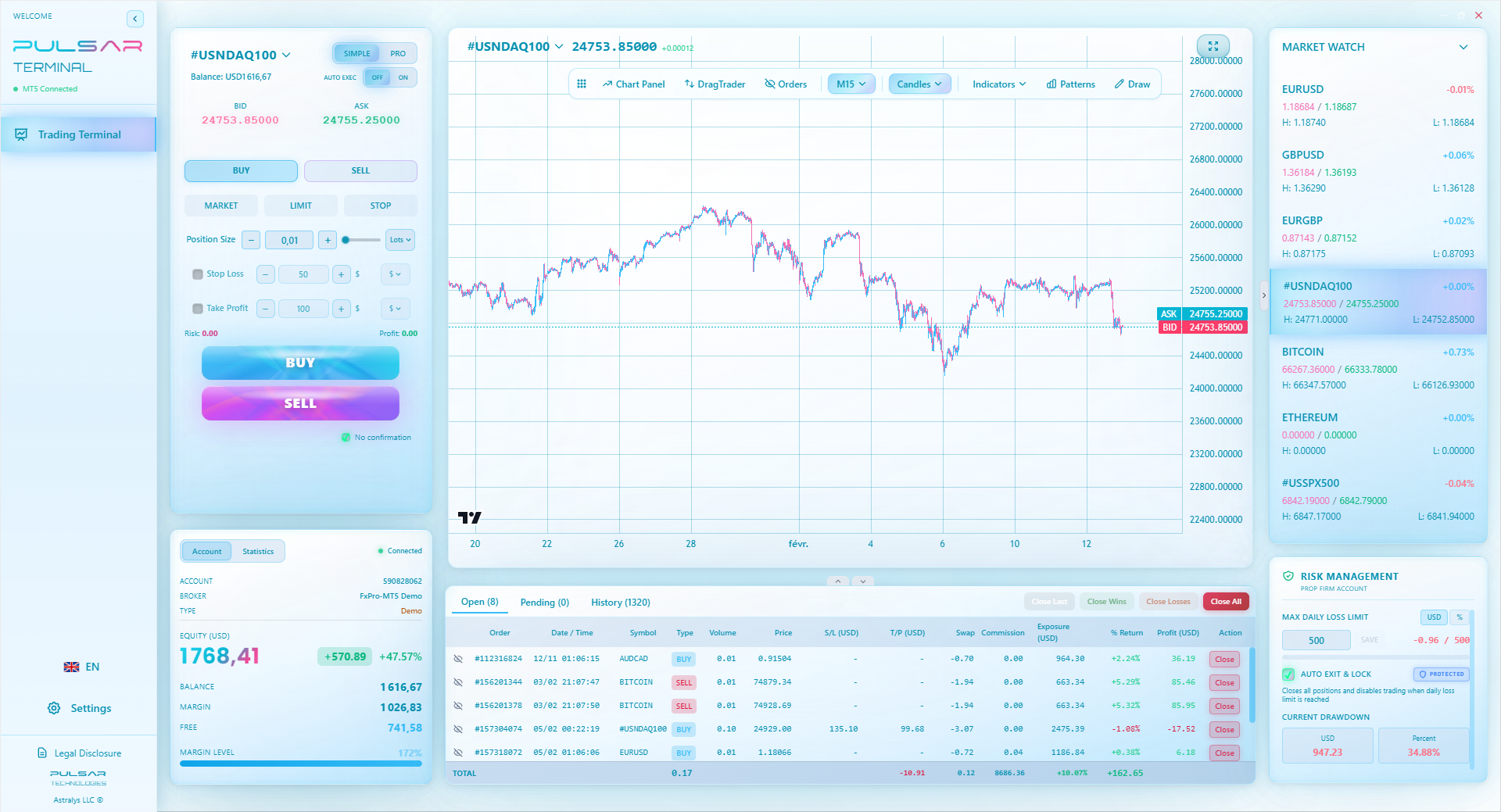
Manually moving stops and managing multiple trades under pressure is where systems break down; Pulsar Terminal automates these rules directly on your MT5 chart, turning your written plan into executed action.
Pulsar Terminal
The all-in-one MT5 companion: drag-and-drop orders, multi-TP/SL, trailing stop, grid trading, Volume Profile, and prop firm protection. Used by 1,000+ traders daily.
“Profits are a byproduct of consistent process, not the goal of each trade.”
Everyone kills it on demo. Then they go live and lose real money. Why? Because demo trading is a video game. There's no real fear, no sweaty palms when the price approaches your stop.
The psychological pressure of real money changes everything. That's why your transition plan matters.
Step 1: Demo with Real Rules. Trade your dummy system on demo for a minimum of two months. Not casually. Religiously. Pretend it's real money. If you break a rule, stop trading for the day.
Step 2: Live, but Microscopic. Your first live account should be with money you are 100% prepared to lose. I'm talking about an amount that wouldn't change your life if it vanished. For many, that's 20,000-50,000 Naira. The goal of this account is NOT to make profit. The goal is to execute your plan under real pressure for 100 trades. If you can do that, you've succeeded, even if the account is slightly down.
Step 3: Scale Slowly. Only add more capital once you have a proven, multi-month track record of following your rules on the small live account. This is the most skipped step. People get a few wins and throw their life savings at it. That's not trading; that's lottery buying.

Pro Tip: When you go live, reduce your position size by 50% from what you used in demo for the first month. The psychological weight will make your normal size feel huge. This forces even more discipline.
“The market's job is to make you feel smart right before it takes your money.”
Forex isn't a side hustle. It's a performance skill, like surgery or flying a plane. You wouldn't let a dummy perform surgery after a weekend course, right? Treat your trading with the same respect.
Your focus should shift from 'How much did I make today?' to 'Did I follow my process today?' Profits are a byproduct of consistent process, not the goal of each trade.
You will have losing weeks. Maybe losing months. Your dummy system must have the edge to survive these drawdowns. This is where your 1% risk rule saves you. If you risk 1% per trade, a horrific streak of 20 losses in a row (it happens) only loses you about 20% of your account. You're wounded, not dead. If you were risking 5% per trade, that same streak wipes you out.
Finally, never stop learning, but be careful what you learn. Study price action. Understand economic calendars. But filter everything through the lens of your system. Does this new idea fit? Can it be turned into a clear rule? If not, file it away and stick to your plan. The market's job is to make you feel smart right before it takes your money. Your dummy system's job is to ignore that feeling and just follow the rules.
💡 Winston's Tip
The market doesn't care about your rent, your dreams, or your ego. Your trading plan shouldn't either. Trade the chart, not your life.
FAQ
Q1Is dummy forex trading legal in Nigeria?
Forex trading itself is legal in Nigeria. However, there is no specific regulation called 'dummy forex trading.' The danger lies in unregulated signal sellers and 'gurus' who promise guaranteed profits. Always trade through an internationally regulated broker, and remember you are solely responsible for your trades and losses.
Q2What is the minimum amount to start dummy forex trading in Nigeria?
Technically, you can start with as little as $10 (about 15,000 Naira) with some brokers. But realistically, to properly implement a dummy system with sane risk management, I'd recommend a minimum of $100 (approx 150,000 Naira). This allows you to position size correctly without being wiped out by a single small loss or a wide spread.
Q3Can I really make money with a dummy-proof system?
Yes, but not in the way the ads say. A strong, rule-based system gives you a statistical edge over many trades. It doesn't win every trade. You might only win 40% of the time. But if your winning trades are bigger than your losing trades (a positive risk-reward ratio), you can be profitable. The 'dummy' part is about removing emotion, not removing effort in building and testing the system.
Q4What's the biggest mistake in moving from demo to live trading?
Trading with too much money, too soon. The psychological pressure is completely different. The most common mistake is using the same large position size from demo on a live account. This magnifies fear and greed, causing you to break your own rules. Start with a tiny live account whose loss wouldn't affect you emotionally.
Q5How do I handle losses in a dummy system?
You don't 'handle' them emotionally. You accept them as a cost of doing business. Your system should have a predefined stop loss for every trade. When it hits, the trade is over. No analysis, no second-guessing. A loss is just feedback that the market conditions didn't align with your setup at that moment. Review it later in your journal, but do not revenge trade.
Q6Which time frame is best for dummy trading in Nigeria?
There's no single best. It depends on your lifestyle. If you have a day job, don't try to scalp the 1-minute chart. A 1-hour or 4-hour chart for swing trading is more practical. The key is to pick one primary time frame for your setup triggers and stick to it. Consistency in your analysis timeframe is part of the dummy system.
Q7Do I need a VPN to trade forex in Nigeria?
Generally, no. Reputable international brokers accept Nigerian clients. Using a VPN to disguise your location to open an account is a red flag for brokers and can lead to your account being frozen and funds confiscated. Always be truthful about your residency during registration.
Prof. Winston's Lesson
Key Takeaways:
- ✓Risk a maximum of 1-2% of your account per trade.
- ✓A trading plan without a journal is just a wish list.
- ✓Demo success means nothing without live psychological testing.
- ✓Master one instrument and one time frame before adding more.
How useful was this article?
Click a star to rate
Weekly Trading Insights
Free weekly analysis & strategies. No spam.
About the Author
Olumide Adeyemi
West African Trading Pioneer
One of Nigeria's most active forex trading educators. 8 years of experience trading from Lagos. Specializes in low-capital strategies and prop firm challenges for African traders.
Comments
Risk Disclaimer
Trading financial instruments carries significant risk and may not be suitable for all investors. Past performance does not guarantee future results. This content is for educational purposes only and should not be considered investment advice. Always conduct your own research before trading.
You Might Also Like

Cara Trading Forex Sukses: 7 Prinsip dari Trader Profesional
Cara trading forex sukses dengan 7 prinsip trader pro: manajemen modal, disiplin, journal trading, backtest. Data nyata, bukan janji profit palsu.
Jam Trading Forex Terbaik untuk Trader Indonesia: Panduan Lengkap dengan Tabel Waktu
Panduan jam trading forex untuk trader Indonesia. Tabel 4 sesi dunia, jam emas 20:00-00:00, sesi mana yang harus dihindari. Data akurat + tips dari trader berpengalaman.
Top 5 Sàn Forex Uy Tín Nhất 2026: Review Jujur dari Trader Indonesia
Top 5 sàn forex uy tín 2026 untuk trader Indonesia. Review jujur: spread, deposit, withdraw, dukungan lokal. Exness, XM, IC Markets & lebih.
Get Pulsar Terminal
All these calculators are built into Pulsar Terminal with real-time data from your MT5 account. One-click position sizing, automatic risk management, and instant calculations.
Get Pulsar Terminal