


Everyone's looking for the easy way to trade forex.

David van der Merwe
Emerging Markets Trader ·  South Africa
☕ 10 min read
What you'll learn:
- 1Forget the Gurus, Learn the Local Rules First
- 2Picking Your Broker: Cutting Through the Marketing
- 3The "Easy" System: A 3-Step Process
- 4Managing Your Money, Not Your Emotions
- 5Tools That Actually Make It Easier
- 6Pitfalls Every South African Trader Faces (And How to Avoid Them)
- 7Putting It All Together: Your First Month Plan
Everyone's looking for the easy way to trade forex. Spoiler: it's not a secret indicator or a guru's signal service. The real 'easy' way is about cutting out the noise, understanding the local rules, and sticking to a brutally simple system. I've watched too many South African traders blow accounts chasing complexity. Let me show you the straightforward path that's kept me in the game for over a decade.
Before you even think about a chart, you need to know the playing field. Trading in South Africa isn't the wild west. The Financial Sector Conduct Authority (FSCA) calls the shots, and getting this wrong is the fastest way to turn an 'easy' start into a nightmare.
The big one? use. The FSCA caps it at 30:1 for retail traders. You'll see international brokers advertising 500:1, but if they're properly registered here, that use isn't for you. I learned this the hard way early on. I signed up with an offshore broker offering insane use, made a few lucky wins, then got absolutely hammered when a single trade moved against me. The promised 'easy money' vanished in minutes. That loss taught me more than any win.
Your money's safety is another non-negotiable. Only use brokers that segregate client funds. This means your capital is held separately from the broker's operating money. If they go under (it happens), your funds aren't part of their bankruptcy estate. Check the FSCA's public register. It takes five minutes and is the most important trade you'll ever make.

Warning: Using an unregulated international broker might give you higher use, but you have zero protection from the FSCA if things go south. You're on your own.
Also, understand what you can't do. As a South African resident, you generally can't use an online broker to speculate on the Rand (ZAR) for physical delivery. That's a SARB rule. For actual currency conversion, you use a bank. For trading USD/ZAR as a CFD? That's a different story, and it's where most of the action is.

💡 Winston's Tip
The market's job is to make you feel smart right before it takes your money. Your job is to not believe the hype.
Broker ads scream about tight spreads and instant execution. Let's translate that into what actually matters for your wallet.
The Cost Breakdown You Need
Your trading costs eat into profits. Here’s the real math on the major pairs:
| Cost Type | What It Is | Typical Range (EUR/USD) | What It Means For You |
|---|---|---|---|
| Spread | Difference between buy/sell price | 0.0 - 0.8 pips | Your immediate cost to enter a trade. Lower is better. |
| Commission | Fee per lot traded | $3 - $7 per side | Common on 'raw spread' accounts. Adds to total cost. |
| Swap | Overnight holding fee | Varies by pair & direction | Can be a cost or a credit. Check your broker's table. |
A 'zero spread' account often has a commission. You need to calculate the effective spread: Spread + Commission. For example, a 0.1 pip spread with a $3.50 commission per side might be cheaper than a 0.8 pip spread with no commission on a standard lot. Use a position size calculator to work this out before you trade.
The South African Funding Headache
Depositing and withdrawing is where local brokers shine. International brokers might have slick platforms, but if it takes a week and R500 in bank fees to get your money, you'll feel the pain.
Look for brokers that offer local ZAR deposits via EFT. It's faster and cheaper. Many top-tier international brokers with a local presence, like Pepperstone or IC Markets, have this sorted. I use a broker that offers instant EFT via PayFast for deposits. It lands in my trading account in minutes, not days, and the fees are minimal compared to an international SWIFT transfer.

Pro Tip: Always check the withdrawal policy and fees, not just the deposit. Some brokers make it easy to put money in but a bureaucratic nightmare to get it out.
“The real 'easy' way is about cutting out the noise and sticking to a brutally simple system.”
Here’s the core of it. The easy way to trade forex isn't about predicting every wiggle. It's about having a clear, repeatable process that removes emotion. I call it the 3-Step Filter.
Step 1: Find the Tide (The Trend) Don't fight the major flow. On a 4-hour or daily chart, I use a simple 50-period and 200-period Exponential Moving Average (EMA). If price is above both, the tide is up. Look for buys. If it's below both, the tide is down. Look for sells. If the averages are tangled, the market is confused. Stay out. This one filter keeps you on the right side of major moves. I once spent a week trying to short a strong uptrend in Gold (XAU/USD) because I thought it was 'overbought.' I lost 2.3% of my account before I admitted the trend was king.
Step 2: Wait for the Pullback (The Entry) Markets don't go straight up or down. They rise, pull back, then rise again. Your job is to wait for that pullback into a support (for uptrends) or resistance (for downtrends) zone. This is where you get a better price. Use previous swing highs/lows or a dynamic level like the 50-period EMA as your area.
Step 3: Set Your Lines & Walk Away (The Exit) This is the most important step. Before you click buy or sell, you must know:
- Where you get out if you're wrong (Stop Loss): Place it just beyond the support/resistance zone that defined your entry. If that level breaks, your thesis is invalid.
- Where you take profit (Take Profit): Aim for a risk-to-reward ratio of at least 1:1.5. If you're risking 50 pips, your target should be 75 pips away.
Set the orders, and then close the platform. Seriously. Overtrading and tweaking orders in real-time is the number one killer of new traders. This disciplined approach is the foundation of successful swing trading.
You can have the best system in the world, but if you bet the farm on one trade, you're finished. Risk management is the boring superpower.
The 1% Rule: Never, ever risk more than 1% of your trading account capital on a single trade. If you have a R10,000 account, your maximum risk per trade is R100. This isn't a suggestion; it's a law. It means you can be wrong 10 times in a row and still only be down 10%. You live to fight another day. I violated this rule in my second year. Convinced the EUR/USD was about to crash, I risked 5% on one trade. It went against me, and that single loss took me out of the game for three months while I rebuilt my capital.
Position Sizing is Everything: Your stop loss distance (in pips) determines your position size. Don't just guess. If your stop loss is 25 pips away on EUR/USD, and you can only risk R100, you need to calculate the exact lot size that makes a 25-pip move equal R100. Use a calculator every single time.
This strict approach prevents a margin call from sneaking up on you. It turns trading from a gambling session into a business with controlled overheads.
💡 Winston's Tip
A good trade is defined by its risk management before it's ever defined by its profit. The entry is the least important part of the plan.
“Risk management is the boring superpower that keeps you in the game.”
The right tools automate discipline and remove friction. You don't need 20 monitors; you need a few things that work.
Your Platform: MetaTrader 5 (MT5) is the standard for a reason. It's stable, almost every broker offers it, and there's a massive community. Learn how to set pending orders, attach stop losses and take profits directly to the order ticket, and use its basic drawing tools. Fancy platforms are nice, but MT5 gets the job done.
Your Indicators (Keep It Simple): I use two, maybe three. The EMAs for trend (as above). The RSI indicator to help spot potential pullback zones in a trend (looking for readings back to 40-50 in an uptrend, or 50-60 in a downtrend). That's it. I don't use the MACD indicator for entries anymore - it's a lagging confirmation tool for me now. The clutter on your chart is inversely proportional to the clarity in your mind.
Your Trading Journal: This is non-negotiable. After every trade, win or lose, write down: the pair, entry/exit prices, why you took the trade (which rule from your system), the outcome, and most importantly, how you felt. Over time, you'll see patterns. You'll notice you lose more on Friday afternoons, or when you trade before your morning coffee. This self-awareness is priceless.
We have unique challenges here. Knowing them is half the battle.
Trading USD/ZAR Like a Major Pair: It's not. USD/ZAR is an exotic pair. It's less liquid, more volatile, and has much wider spreads. A 50-pip stop loss on EUR/USD is tight; on USD/ZAR, it's nothing. The spread alone can be 80-100 pips. You need to adjust your position size accordingly and understand you're trading a different beast influenced by local politics, commodity prices, and load-shedding headlines.
Chasing "Tax-Free" Myths: Your forex profits are taxable income for SARS. Full stop. You can deduct legitimate trading expenses (platform fees, data, a portion of internet costs), but the net profit is taxable. Keep clean records from day one. The 'easy' way involves an Excel spreadsheet for your trades, not a shoebox of receipts come tax season.
Ignoring Swap Rates on Long-Term Holds: If you're holding trades for weeks, the overnight swap fees can be a significant cost or benefit. In a high-interest-rate environment like we've had, selling a high-yielding currency like the ZAR can incur heavy negative swap. Check the broker's swap table. Sometimes a good-looking trade can be eaten away by daily fees.
The Prop Firm Trap: Passing a prop firm challenge is a popular goal. It requires hyper-strict loss management, often with a maximum daily loss limit. This is where discipline is tested, and manual trading often fails under pressure.
💡 Winston's Tip
If you can't explain your trade in one simple sentence ('buying the pullback in an uptrend'), you don't understand what you're doing. Close it.
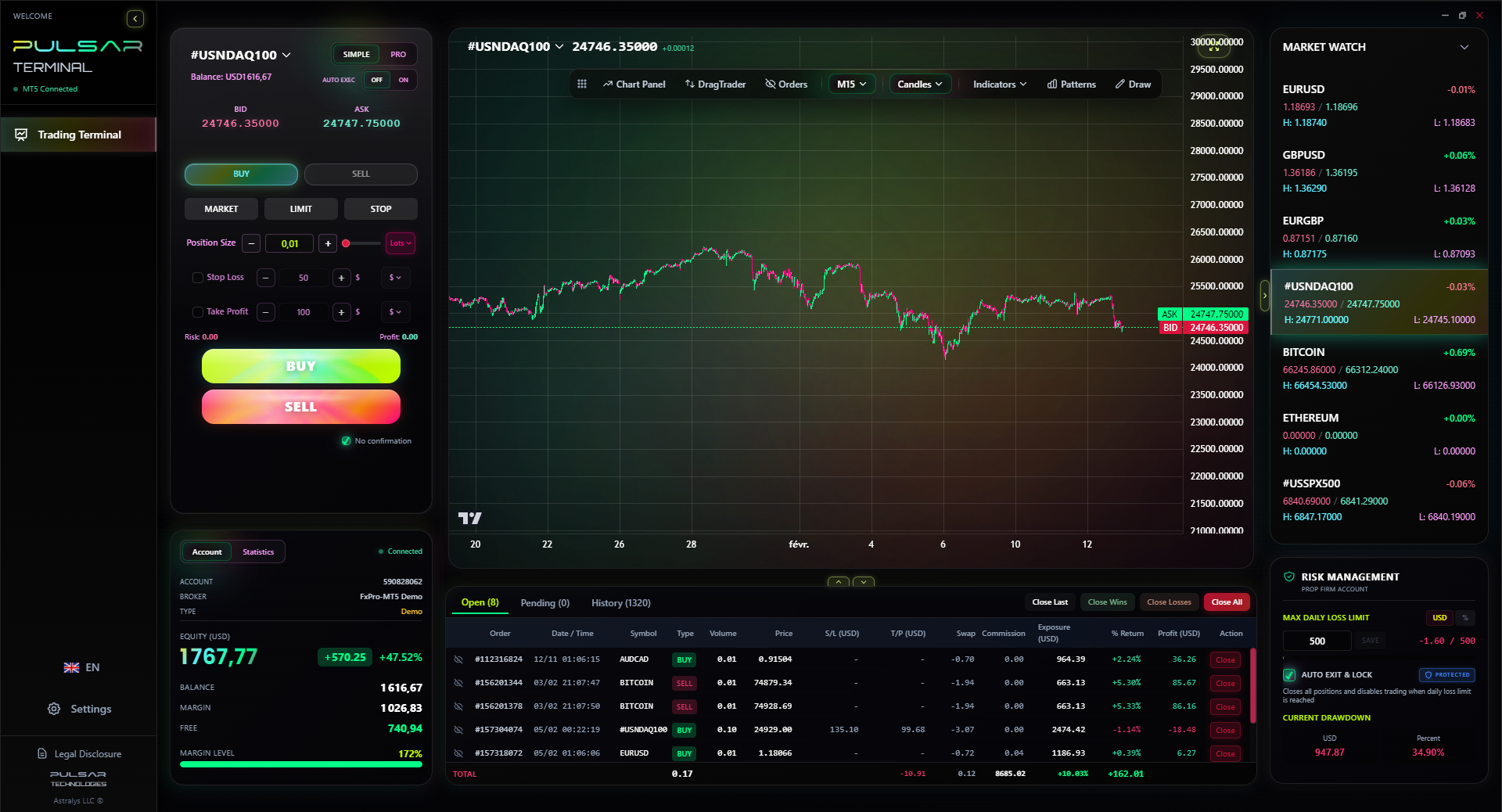
Managing a prop firm challenge or multiple trades requires iron discipline, which is where a tool like Pulsar Terminal automates your risk rules and order management directly on MT5.
Pulsar Terminal
The all-in-one MT5 companion: drag-and-drop orders, multi-TP/SL, trailing stop, grid trading, Volume Profile, and prop firm protection. Used by 1,000+ traders daily.
“The clutter on your chart is inversely proportional to the clarity in your mind.”
Let's make this actionable. Here's exactly what to do.
Week 1-2: Paper Trade the System. Don't touch real money. Open a demo account with a broker like XM or Exness that offers realistic conditions. Practice the 3-Step Filter. Execute 20-30 paper trades. Your goal isn't profit; it's consistency in following the process. Did you set your stop loss every time? Did you wait for the pullback?
Week 3: Fund a Small Live Account. Deposit the minimum amount you're willing to lose completely - maybe R1,000 or R2,000. This is your 'tuition fee.' Trade micro lots (0.01). Your focus is on making the 1% risk rule and your entry/exit process feel automatic. The money is real, so the psychology is real.
Week 4: Review and Refine. Go through your trading journal. What worked? Did you keep losing on trades taken after 10 PM? Did you have a winning streak and then increase your risk, blowing the profits? This review is where the real learning happens.

Example: Your R2,000 account. 1% risk = R20 per trade. You see a setup on EUR/USD with a 25-pip stop loss. Using a calculator, you find a 0.01 lot position risks roughly R4.50 (depending on the ZAR rate). That's well under your R20 limit, so the trade is within your rules. You take it.
The easy way to trade forex is a myth if you're looking for a magic button. But it's a reality if you define 'easy' as a clear, disciplined, and repeatable process that respects the market and protects your capital. It's a marathon, not a sprint. Now go practice.
FAQ
Q1Is forex trading legal and safe in South Africa?
Yes, it's legal and regulated by the FSCA. It's 'safe' only if you use an FSCA-regulated broker that segregates client funds. Trading itself is high-risk, but the regulatory environment protects you from broker fraud.
Q2What is the minimum amount I need to start trading forex?
Technically, you can start with as little as $1 with some brokers. Realistically, I'd recommend at least R2,000-R5,000. This allows you to trade micro lots (0.01) while properly implementing the 1% risk management rule without being wiped out by a single small loss.
Q3Why is the spread on USD/ZAR so much wider than on EUR/USD?
USD/ZAR is an exotic currency pair with lower liquidity and higher volatility. Fewer banks and institutions trade it compared to majors like EUR/USD. The wider spread is the broker's compensation for the increased risk and cost of facilitating the trade in a thinner market.
Q4How are my forex trading profits taxed by SARS?
Net profits from trading are considered income and are added to your other taxable income for the year. You must declare it to SARS. You can deduct legitimate business expenses related to your trading activity, such as platform fees, internet costs, and educational materials.
Q5Can I use international brokers like Pepperstone or IC Markets from South Africa?
Yes, absolutely. Many top international brokers accept South African clients. The key is to check if they have a local entity (FSCA-regulated) or if you'll be signing up with their global entity. Both Pepperstone and IC Markets have strong local support and offer convenient ZAR deposit methods.
Q6What's the biggest mistake new South African traders make?
Two things: ignoring proper position sizing and risk management (the 1% rule), and trading USD/ZAR with the same mindset and lot size as they would EUR/USD. The volatility will eat them alive. They also often chase high use from unregulated brokers, which is a recipe for a quick account blow-up.
Q7Is scalping a good easy way to trade forex for beginners?
No. Scalping strategy requires intense focus, lightning-fast execution, and an iron stomach for transaction costs. It's one of the hardest styles. The 'easy' system I outlined is far more suitable for beginners, as it focuses on higher timeframes and reduces the number of decisions you need to make.
Prof. Winston's Lesson
Key Takeaways:
- ✓Never risk more than 1% of your capital per trade.
- ✓Use the 3-Step Filter: Trend, Pullback, Pre-set Exit.
- ✓FSCA regulation and client fund segregation are non-negotiable.
- ✓USD/ZAR is a volatile exotic; trade it with adjusted size.
- ✓Your trading journal is your most valuable tool.
How useful was this article?
Click a star to rate
Weekly Trading Insights
Free weekly analysis & strategies. No spam.
About the Author
David van der Merwe
Emerging Markets Trader
Johannesburg-based trader with 11 years in emerging market currencies. Specializes in ZAR pairs, FSCA-regulated trading, and South African market analysis.
Comments
Risk Disclaimer
Trading financial instruments carries significant risk and may not be suitable for all investors. Past performance does not guarantee future results. This content is for educational purposes only and should not be considered investment advice. Always conduct your own research before trading.
You Might Also Like

Cara Trading Forex Sukses: 7 Prinsip dari Trader Profesional
Cara trading forex sukses dengan 7 prinsip trader pro: manajemen modal, disiplin, journal trading, backtest. Data nyata, bukan janji profit palsu.
Jam Trading Forex Terbaik untuk Trader Indonesia: Panduan Lengkap dengan Tabel Waktu
Panduan jam trading forex untuk trader Indonesia. Tabel 4 sesi dunia, jam emas 20:00-00:00, sesi mana yang harus dihindari. Data akurat + tips dari trader berpengalaman.
Top 5 Sàn Forex Uy Tín Nhất 2026: Review Jujur dari Trader Indonesia
Top 5 sàn forex uy tín 2026 untuk trader Indonesia. Review jujur: spread, deposit, withdraw, dukungan lokal. Exness, XM, IC Markets & lebih.
Get Pulsar Terminal
All these calculators are built into Pulsar Terminal with real-time data from your MT5 account. One-click position sizing, automatic risk management, and instant calculations.
Get Pulsar Terminal